
At this age, children are shifting from solitary play to noticing others, mimicking grown-ups, and testing their new vocabulary on everything they see. The best picks channel that whirlwind of curiosity into activities that build fine motor control, reasoning, and social confidence without feeling like a chore.
I’m Mohammad Maruf — the founder and writer behind Drink4Good. My deep market research focuses on how toy design, material safety, and open-ended play patterns align with developmental milestones at age three, helping families cut through marketing hype to find what truly works.
This guide covers five carefully vetted options so you can shop with confidence for the best games for three year olds that encourage real skill-building through hands-on, screen-free interaction.
How To Choose The Best Games For Three Year Olds
The right game for a three-year-old hinges on three things: safety, durability, and the ability to teach without a screen. Look for chunky pieces that are too large to swallow, smooth edges, and materials that can handle spills and drool. Prioritize games that encourage active participation — stacking, threading, matching, or tracing — over passive listening.
Prioritize Open-Ended, Reusable Play
Games that offer multiple ways to play (stacking, sorting, lacing, or following pattern cards) grow with your child. A single toy that works for free exploration today and structured matching games tomorrow delivers far more value than a one-trick gadget. Waterproof or tear-resistant pages and wipe-clean surfaces are a practical bonus at this age.
Check the Materials and Choking Risk
Wooden toys should be solid basswood or similar hardwood with non-toxic paint. Plastic components should be BPA-free and free of sharp edges. Any game with pieces smaller than 1.25 inches in diameter or that can fit inside a toilet paper roll needs supervision — even for three-year-olds who still mouth objects when tired or excited.
Quick Comparison
On smaller screens, swipe sideways to see the full table.
| Model | Category | Best For | Key Spec | Amazon |
|---|---|---|---|---|
| LeapFrog 100 Animals Book | Electronic Book | Bilingual vocabulary & animal sounds | Six double-sided pages with touch sensors | Amazon |
| Preschool Learning Activities Workbook | Reusable Workbook | Handwriting & pre-writing practice | 62 write-and-wipe pages, 10 markers | Amazon |
| Montessori Wooden Beads Sequencing Set | Stacking / Lacing | Fine motor & pattern matching | 25 beads, 2 laces, 8 double-sided cards | Amazon |
| Cottify Wooden Matching Game | Memory Card Game | Memory & verbal skills | 36 wooden cards (18 pairs), carry bag | Amazon |
| Grarain Busy Board | Sensory Board | Travel-friendly quiet play | 23 LED lights, wooden frame, 6.7×5.3″ | Amazon |
In‑Depth Reviews
1. LeapFrog 100 Animals Book

The LeapFrog 100 Animals Book stands out because it combines rich audio feedback with a sturdy physical format that survives drops. Six double-sided plastic pages cover twelve animal habitats, and each page responds to a child’s touch with animal names, sounds, and fun facts. Three play modes — animal name, sound, and trivia — keep the interaction fresh far longer than a standard sound book.
What makes this a top pick for three-year-olds is the bilingual toggle. Kids can hear every animal’s name and a related song in English or Spanish, which supports early language exposure without any extra effort from parents. The thick, wipe-clean pages resist tearing, and the included batteries (demo set, so keep spares handy) get the fun started right out of the box.
The audio clarity is crisp even at lower volumes, and the star-shaped button on each spread plays a cheerful song that toddlers quickly learn to find on their own. At roughly 1.5 pounds, it’s light enough for a three-year-old to carry around but robust enough to survive being dropped on a tile floor.
Why it’s great
- Dual-language mode (English/Spanish) for early bilingual learning
- Thick, chew-resistant plastic pages survive toddler handling
- Three play modes prevent boredom and stretch cognitive engagement
Good to know
- Batteries included are demo only; buy fresh AA cells for regular use
- Sound volume cannot be adjusted beyond a fixed low/high toggle
2. Cottify Wooden Matching Game

This memory card game swaps flimsy cardboard for solid basswood circles coated with silk-finish paint. Each 2.2-inch card is 0.12 inches thick — substantial enough for small hands to pick up and flip without bending or tearing. The eighteen pairs feature bright animal illustrations on a colored background that subtly cues children toward matches before they master visual memory.
Because the cards are tear-resistant and water-resistant, they withstand outdoor play, snack-time spills, and the occasional drop in a puddle. The drawstring pouch keeps everything contained, making this an easy grab-and-go activity for restaurants or waiting rooms. Three-year-olds can start by simply naming the animals aloud, then progress to finding pairs as their attention span grows.
The open-ended nature means siblings and parents can play together without complicated rules. A single round takes about ten minutes — short enough to match a three-year-old’s patience but long enough to feel like a real game. The natural wood construction also means zero plastic waste, which matters for eco-conscious families.
Why it’s great
- Solid basswood cards resist bending, tearing, and water damage
- Compact pouch makes travel effortless and keeps pieces organized
- Multiple difficulty levels (naming, matching, speed rounds) grow with child
Good to know
- Storage bag does not fit back in the original box after unpacking
- A few units have reported misprinted pairs; check upon arrival
3. Preschool Learning Activities Educational Workbook
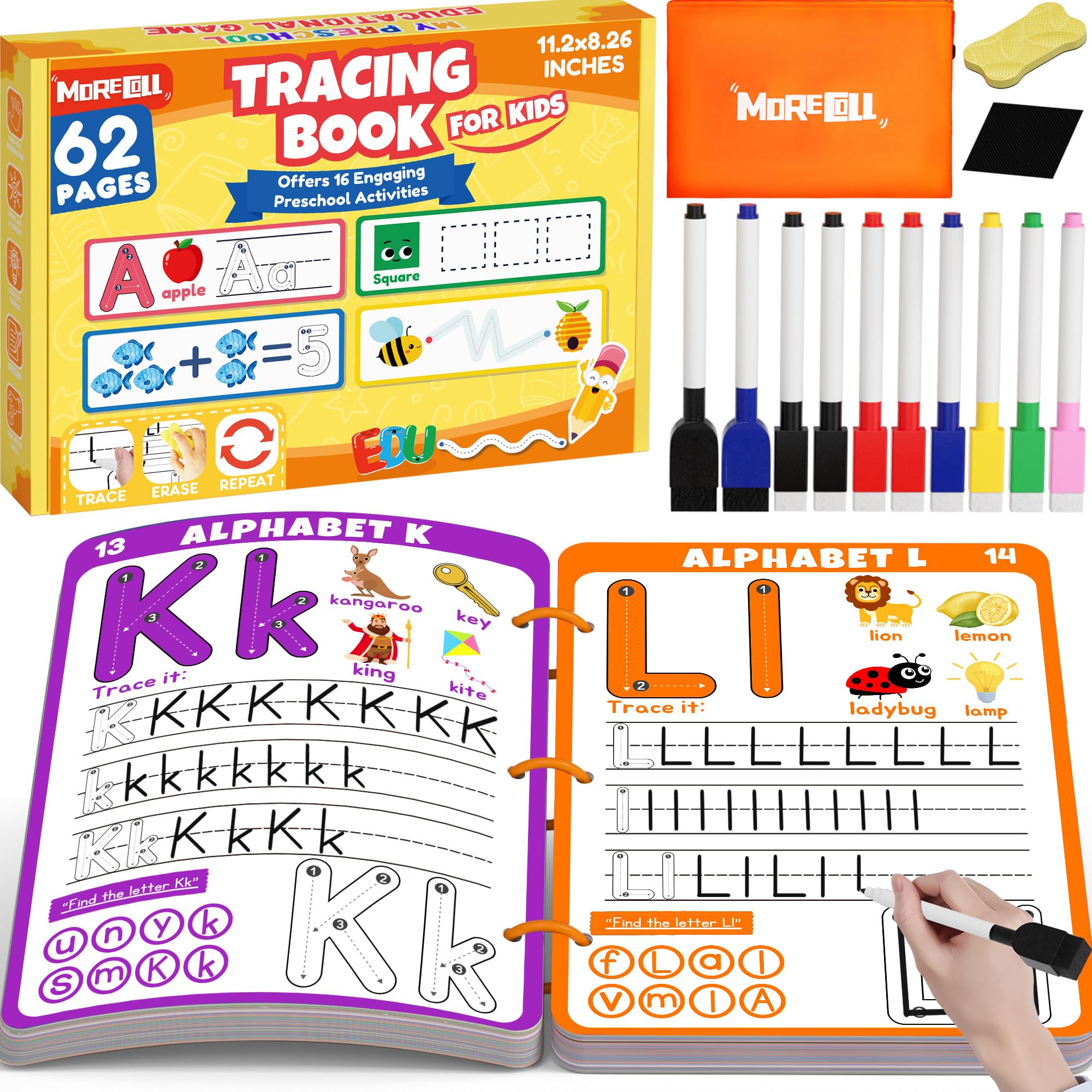
This workbook bundle delivers 62 tear-resistant, waterproof pages that wipe clean with the included cloth and eraser. Sixteen activity types cover letter tracing, number practice, shape drawing, body parts, emotions, simple addition and subtraction, and even a weekly planner. The variety means a single purchase replaces a shelf of individual workbooks.
The removable rings let you pull out a single page for focused play or rearrange them as your child’s skills progress. Dry-erase markers in multiple colors make each session feel new, and the last page includes posture tips for proper pen grip — a small but thoughtful addition for building good handwriting habits early. The storage bag keeps markers and cloth from disappearing under the couch.
Parents consistently report that the write-and-wipe format builds confidence because mistakes erase instantly. The book is particularly effective for children with autism or language delays, as the repetitive practice and immediate feedback support learning without frustration. At 8.26 x 11.22 inches, it fits standard backpacks for preschool or car rides.
Why it’s great
- Reusable waterproof pages eliminate waste and allow endless practice
- 16 distinct activities cover pre-writing, math, and emotional literacy
- Removable rings let you customize the lesson order or share pages
Good to know
- Markers dry out if caps are left off; store them upright in the bag
- Some younger three-year-olds need help gripping the dry-erase markers
4. Montessori Wooden Beads Sequencing Toy Set

This set packs 25 colorful wooden beads in 11 different shapes, a wooden stand, two laces with wooden-tipped ends, and eight double-sided pattern cards into one box. The beads come in 12 distinct colors, so kids can sort by hue, stack by shape, or follow the cards to replicate specific sequences. That flexibility makes it a stealthy math and logic toy disguised as a stacking game.
The threading laces feature a small wooden stick at the tip, which is much easier for small fingers to guide through the bead holes than a floppy plastic needle. Three-year-olds can start with free stacking or simple color sorting, then graduate to matching the pattern cards as their visual discrimination sharpens. The beads stack securely on the wooden stand, so the tower doesn’t topple at the slightest bump.
Weighing very little and measuring 8.7 x 2 x 6.7 inches, the kit stores neatly on a shelf or inside a travel bag. All wood is non-toxic and lightweight, with rounded edges that pass the safety check. Parents note that even children who aren’t ready for pattern matching enjoy simply lacing beads into necklaces or stacking them into towers — proof of the open-ended design.
Why it’s great
- 11 different bead shapes encourage shape recognition and sorting
- Wooden-tipped laces make threading frustration-free for beginners
- Pattern cards offer progressive difficulty from simple to complex sequences
Good to know
- Beads are smaller than expected; supervise children who still mouth objects
- Pattern cards are laminated but can crease if bent repeatedly
5. Grarain Busy Board
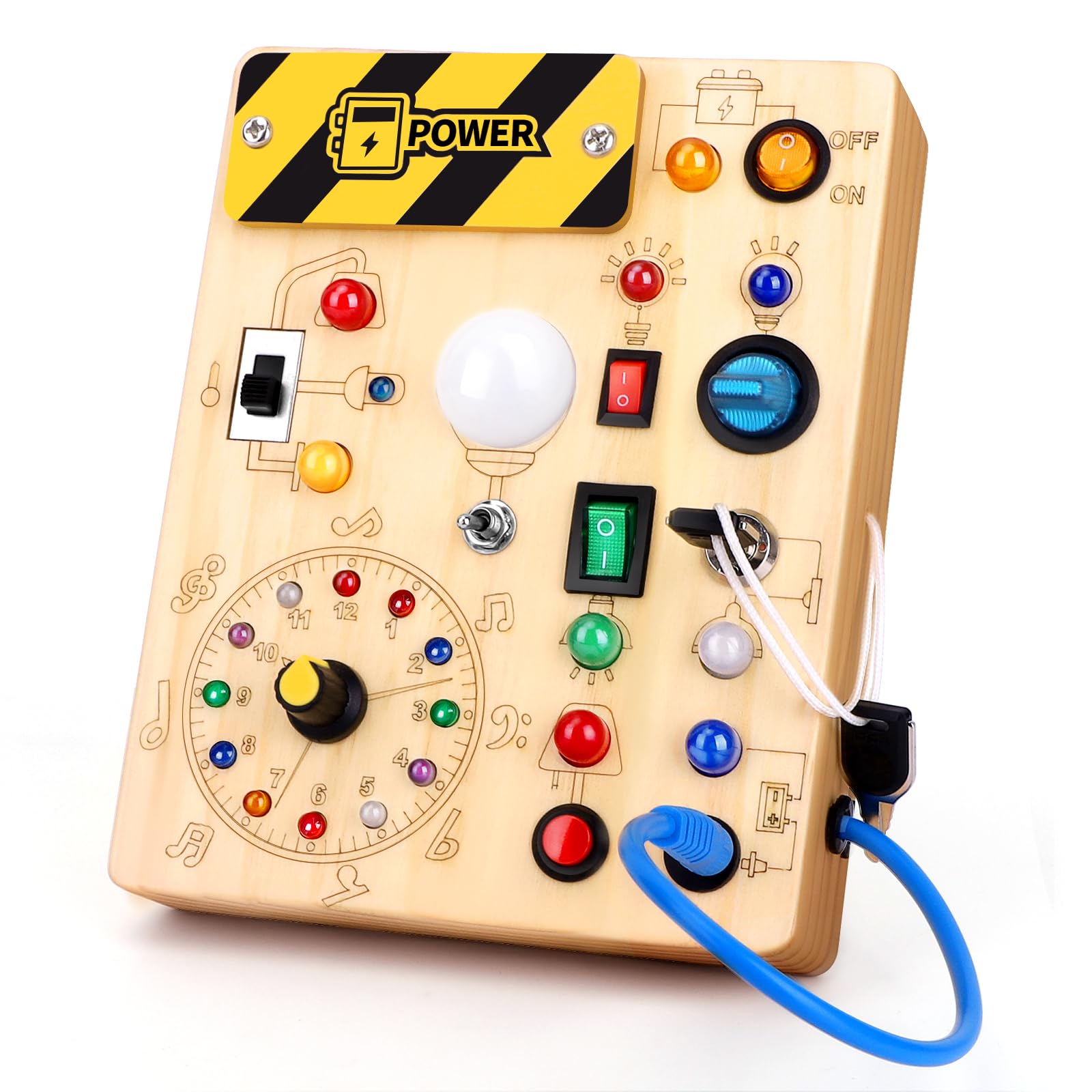
Measuring just 6.7 x 5.3 x 1.1 inches, this compact busy board fits inside a diaper bag or purse without adding noticeable bulk. The front side features a playful clock layout with multiple toggle switches that illuminate 23 low-brightness LED lights, while the back side shows an alphanumeric chart for letter and number recognition. The wood construction feels sturdy in hand and survives drops from toddler height.
The switches include rockers, push-buttons, and slide controls that mimic real electrical interactions — great for developing cause-and-effect understanding and fine motor precision. The LED brightness is deliberately subdued to avoid startling sensitive eyes, and the battery compartment (requires two AAA batteries, not included) is secured with a screw so kids cannot access the cells. The board weighs practically nothing, making it ideal for plane rides, restaurant waits, or quiet church moments.
Parents of one-year-olds through four-year-olds report that this board holds attention longer than most screen-based alternatives. The variety of switch types means a child doesn’t exhaust the novelty after one session. The only caveat is that the plug wire on the front looks somewhat delicate — though no widespread breakage has been reported in reviews.
Why it’s great
- Ultra-compact size fits any bag for on-the-go quiet play
- Low-brightness LEDs are gentle on young eyes and save battery life
- Multiple switch types (rocker, push, slide) teach cause and effect
Good to know
- Requires 2 AAA batteries (not included); no USB recharging option
- Front plug wire appears slightly fragile; supervise rough pulling
FAQ
Are dry-erase markers safe for a three-year-old to hold and mouth?
How do I know if a memory card game is too advanced for my three-year-old?
Final Thoughts: The Verdict
For most families, the best games for three year olds winner is the LeapFrog 100 Animals Book because its bilingual audio, three play modes, and rugged plastic pages support vocabulary development without requiring parental facilitation. If you want a hands-on, screen-free memory experience, grab the Cottify Wooden Matching Game. And for zero-prep pre-writing practice that builds confidence, nothing beats the Preschool Learning Activities Workbook.