
Thin, spindly stems and pale, stretched leaves are the hallmarks of a light that simply doesn’t deliver the energy your greenery craves. The difference between a thriving indoor garden and a disappointing one almost always comes down to the light source, and consumer-grade bulbs simply lack the photosynthetic power to drive dense growth and robust flowering. A purpose-built solution provides the specific wavelengths and intensity that plants demand for every stage of life, from tender seedling to heavy harvest.
I’m Mohammad Maruf — the founder and writer behind Drink4Good. My analysis focuses on membrane-penetrating PPFD values, diode efficiency ratings, and thermal management systems that determine a light’s real-world longevity and performance.
This guide breaks down seven carefully curated models to help you find the very best full spectrum led grow lights for indoor plants that match your space, budget, and horticultural ambitions without wasting money on underpowered fixtures.
How To Choose The Best Full Spectrum LED Grow Lights For Indoor Plants
Selecting a grow light involves more than just picking the brightest panel. You need to understand how light intensity, spectrum composition, and physical coverage interact with your specific growing environment. A mismatch here means wasted electricity and poor plant performance.
PPFD and Coverage Area
PPFD measures the number of photosynthetically active photons that land on a given area each second. A light that claims high wattage but delivers a narrow, intense hotspot is less useful than one with a uniform PPFD map across your canopy. Look for lights that publish their PPFD readings for specific hanging heights and dimensions — a fixture covering a 2×2 foot area well will differ dramatically from one designed for a 4×4 foot tent.
Diode Efficiency and Spectrum Quality
Efficiency, measured in micromoles per joule (μmol/J), tells you how much usable light you get per watt of electricity. Premium diodes like the Samsung LM301H EVO can exceed 3.0 μmol/J, translating to more growth with less heat and lower power bills. The spectrum should include blue wavelengths (around 450nm) for vegetative structure, red (660nm) for flowering, and far-red (730nm) for the Emerson effect, which boosts photosynthetic efficiency.
Thermal Management and Longevity
Heat is the enemy of both your plants and your LED diodes. Overheating reduces the lifespan of the fixture and can stress your plants, causing them to stretch or develop leaf burn. A thick aluminum heatsink or an active fan (though fans introduce noise and a potential point of failure) is critical. Pay attention to the L90 or Q90 rating, which indicates how many hours until the light output drops to 90% of its original value — higher numbers mean longer reliable service.
Quick Comparison
On smaller screens, swipe sideways to see the full table.
| Model | Category | Best For | Key Spec | Amazon |
|---|---|---|---|---|
| Spider Farmer SF1000 | Quantum Board | Small Tents & Seedlings | 2.5 µmol/J PPE | Amazon |
| MARS HYDRO TS1000 | Quantum Board | Balanced Value & Output | 150W Actual Draw | Amazon |
| VIPARSPECTRA XS1500 Pro | Lensed Panel | Even Canopy Coverage | 120° Beam Angle | Amazon |
| AC Infinity IONBEAM S16 | Supplemental Bar | Lower Canopy & Side Lighting | Samsung LM301H EVO | Amazon |
| Barrina BU2000 | Adjustable Panel | Large Tents & High PPFD | 816 LEDs | Amazon |
| VIVOSUN LumaLight 200W | Smart Panel | Smart Control & Automation | IP65 Waterproof | Amazon |
| MARS HYDRO SP3000 | Strip Bar | High-Efficiency 2×4 Coverage | 2.8 μmol/J Efficiency | Amazon |
In‑Depth Reviews
1. Spider Farmer SF1000 100W
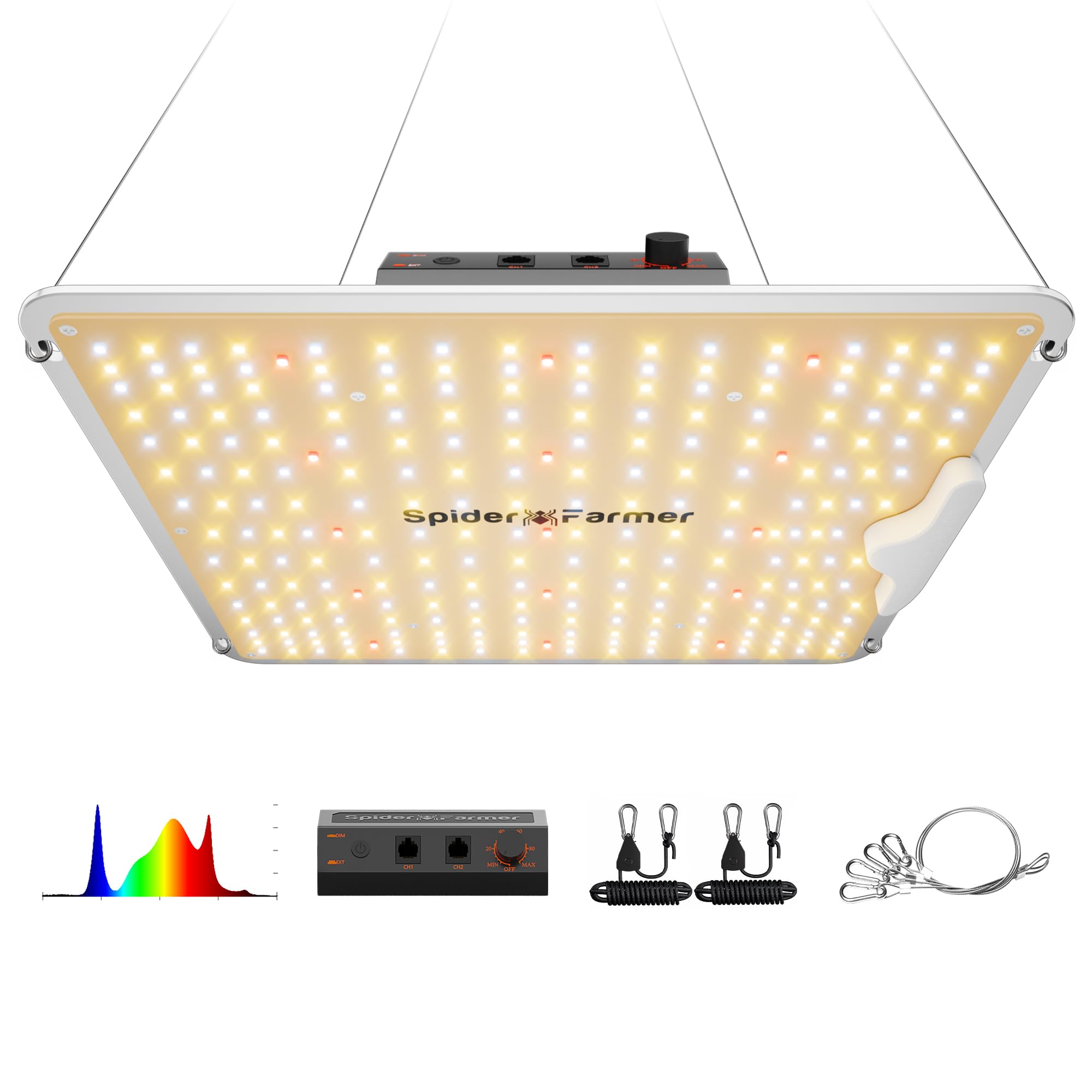
The Spider Farmer SF1000 hits a sweet spot for small-space growers with its 100W actual draw and a system PPE of 2.5 µmol/J. The upgraded diode layout pushes chips toward the edges for a more uniform PPFD map, which is critical for avoiding weak outer growth in a 2×2 or 3×3 tent. The fanless design means absolute silence, with the thick aluminum heatsink handling thermal dissipation effectively.
Its spectrum includes 3000K, 5000K, 660nm red, and 760nm far-red diodes, covering the full cycle from seed-starting to bloom. Users report the IR intensity is lower than the main reds, so don’t expect dramatic far-red effects, but the blue-heavy 5000K chips drive tight node spacing during veg. The dimming knob is smooth and compatible with GGS controllers for automated scheduling.
The real advantage here is the 5-year warranty and local service centers in North America and Europe. That level of after-sales support is rare at this price tier. The light weighs just over 5.8 pounds and measures only 2.3 inches thick, making it easy to mount even in low-ceiling tents.
Why it’s great
- Silent fanless operation with excellent heatsink cooling
- Uniform PPFD from revised edge-gathered diode layout
- 5-year warranty with local service centers
Good to know
- 100W may be underpowered for a full 3×3 bloom cycle alone
- No built-in timer or daisy-chain port
2. MARS HYDRO TS1000 150W

The TS1000 delivers 150W of actual power with a patented white reflector hood that increases light utilization by 25% compared to bare-board designs. The 120° refraction angle ensures side-light hits peripheral plants, which is the primary reason this panel outperforms cheaper boards in coverage uniformity. The new diode arrangement — dense in the center, sparse at the edges — compensates for the natural hotspot fall-off.
Spectrum coverage spans 3200-4200K, 5200-6800K white LEDs alongside 730-740nm red IR, which supports flowering acceleration. The external driver features a single button for 0-100% dimming and supports daisy-chaining up to 50 units, making it scalable for larger commercial setups. Operation is fanless and silent, relying on the aluminum body for passive heat dissipation.
User feedback consistently notes rapid growth responses — seedlings stretching noticeably overnight after installation. Some units have reported driver failures after 6-12 months, but MARS HYDRO’s support generally sends replacements within a month. At 14.2 inches long and weighing about 1.7 kg, it fits neatly into a 2×2 or 2.5×2.5 tent.
Why it’s great
- Patented reflector boosts usable light by 25%
- 0-100% dimming with daisy-chain for up to 50 lights
- Runs cool with fanless aluminum cooling
Good to know
- Reported power supply failures after extended use
- Dimmer box weight can cause light to tilt if not counterbalanced
3. VIPARSPECTRA XS1500 Pro 150W

The XS1500 Pro differentiates itself through its optical lens design, which focuses light with minimal loss to create one of the most even PPFD distributions in its class. Testers have measured 747 μmol/m²/s at 50% power and 13 inches, with consistent readings across the corners — rare for a single-panel fixture. The beam angle is 120 degrees, but the lenses control spill more effectively than open-board designs.
The diode mix includes 3000K, 5000K, 660nm red, and 730nm IR, delivering a wide waveband that mimics natural sunlight. The dimming and daisy-chain functions allow up to 20 units to be controlled from one dimmer, which is ideal for vertical farming and hydroponic racks. The aluminum heatsink is robust, keeping the panel cool even at full draw without any fan noise.
It fits a 3×3 foot veg footprint and a 2×2 foot flowering footprint, so it’s slightly more focused than the TS1000. Users growing hot peppers and other demanding plants report explosive growth and good bud density. The lack of an on-board power switch is a minor annoyance when using external timers, but the build quality is solid.
Why it’s great
- Optical lenses provide superior corner-to-corner PPFD uniformity
- Measured 747 μmol/m²/s at only 50% intensity
- Daisy-chain up to 20 units for large installations
Good to know
- No power on/off switch, requires unplugging or timer
- Exposed LEDs on the board surface lack water resistance
4. AC Infinity IONBEAM S16

The IONBEAM S16 is a specialized tool, not a primary light source. It consists of four 16-inch LED bars using Samsung LM301H EVO diodes rated at 3.14 μmol/J PPE — some of the most efficient chips available. These bars are designed for inter-canopy or supplemental lighting, targeting the lower branches that main overhead lights struggle to reach.
The magnetic mounting system is a standout feature. It attaches directly to the steel frame of most grow tents or to the included steel bars for canvas mounting. Installation takes about 15 minutes. The digital controller (Controller 77 or optional 69 Pro+) offers ten intensity levels, sunrise/sunset simulation, and daily scheduling.
Heat output is minimal, making it safe to place close to foliage without burning. The build quality is heavy-duty, with thick aluminum housings. The included connecting cords are somewhat short for larger tents, so you may need to buy extension cables. This is a premium add-on for those who already have a strong primary light and want to maximize lower canopy yields.
Why it’s great
- Samsung LM301H EVO diodes with 3.14 μmol/J efficiency
- Magnetic mount for quick tool-free installation
- Digital controller with sunrise/sunset timer
Good to know
- Short connecting cords may require extensions in large tents
- Not intended as a standalone primary light source
5. Barrina BU2000 200W

The Barrina BU2000 packs 816 LEDs into an adjustable two-panel design that can switch from a focused spotlight to a wide floodlight. When the panels are angled at 60 degrees, the center-area PPFD jumps by over 25%, making this a flexible option for different canopy shapes. The actual power draw is 200W, generating up to 41,000 lumens.
The spectrum is comprehensive: 5000K blue for tight vegetative nodes, 3000K warm white for structure, 660nm red for flowering, and 730nm IR for the Emerson effect. The PPFD in the central area reaches 1600 μmol/m²/s, which is intense enough for even the most light-hungry plants. The dimming knob is smooth and allows unified control when daisy-chaining multiple units.
User feedback highlights its raw power — several growers accidentally cooked seedlings at full intensity. The fanless design keeps noise at zero, though the wings do get warm at 100% output. At just 2 pounds, it’s surprisingly lightweight for a 200W fixture, though the thin aluminum body relies on passive convection rather than a heavy heatsink. It’s a strong performer for 3×3 and 4×4 tents.
Why it’s great
- Adjustable wings allow spotlight or floodlight configuration
- 816 LEDs deliver 1600 μmol/m²/s PPFD in the center
- Very lightweight at only 2 pounds
Good to know
- Can overwhelm seedlings at full power, requires careful dimming
- Thin aluminum body may run warm under continuous 100% use
6. VIVOSUN LumaLight 200W
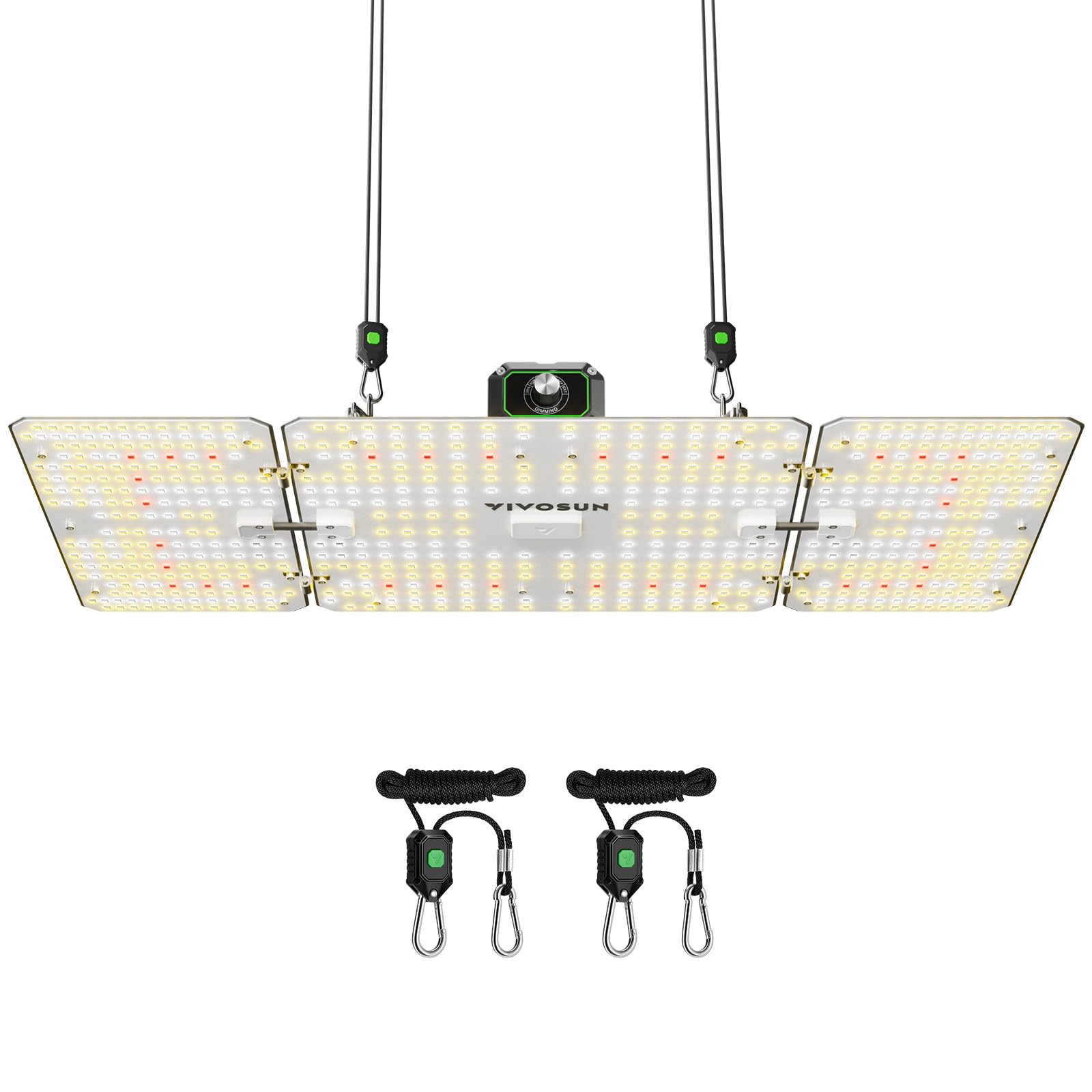
The LumaLight 200W is built for the VIVOSUN ecosystem, with compatibility with the GrowHub controller and mobile app for remote scheduling, dimming, and automation. The 200W fixture uses a strategic diode layout that balances spectrum and intensity from center to edge, with four manual dimming levels (25%, 50%, 75%, 100%). The Q90 rating of 36,000 hours means the light output stays above 90% for over four years of continuous 12-hour cycles.
The IP65 waterproof and dustproof rating is a major differentiator — this is one of the few full-spectrum panels that can withstand direct spraying from nutrients, water, or cleaning agents. This makes it suitable for high-humidity environments and hydroponic systems where moisture is constant. The spectrum includes 3000K, 5000K, 660nm, and 730nm diodes.
It weighs 9 pounds, making it heavier than comparable panels due to the sealed construction and robust iron frame. The 23.5-inch length is designed for 2×4 or 3×3 tents. Reviews note the flimsy power connector to the driver as a weak point — slight movement can interrupt the connection. At 50% power, it’s already very bright, so start seedlings at 25%.
Why it’s great
- IP65 waterproof rating for high-humidity environments
- Q90 rated for 36,000 hours of sustained output
- Compatible with VIVOSUN GrowHub for app-based automation
Good to know
- Power connector to driver is fragile and prone to disconnecting
- Heavy 9-pound weight requires sturdy tent support
7. MARS HYDRO SP3000 300W
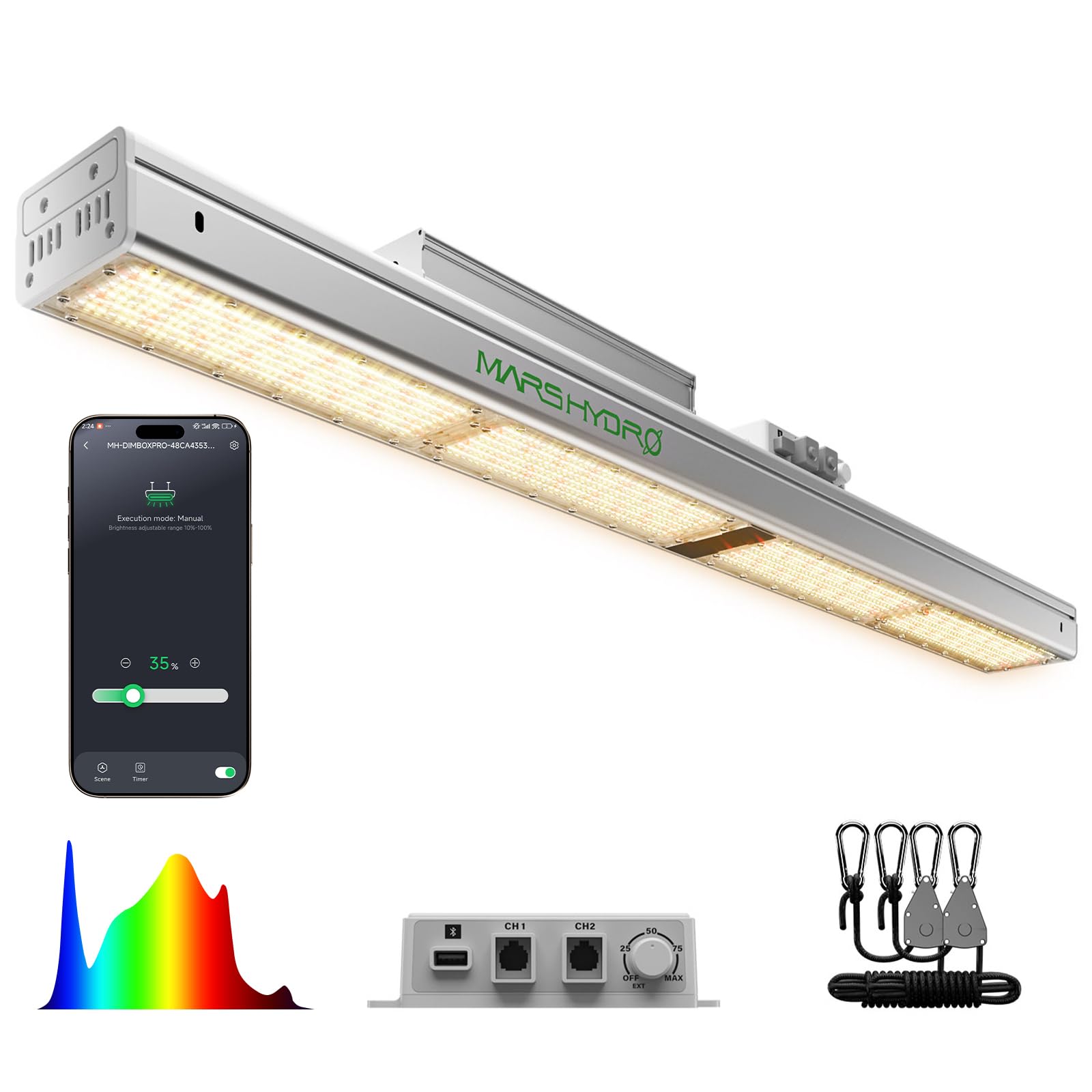
The SP3000 is a high-efficiency strip-bar light designed specifically for 2×4 foot grow tents, delivering 300W with a system efficiency of 2.8 μmol/J. The PPF output is 727.2 μmol/s, meaning every watt produces more usable light than most HPS or older LED designs. The strip-bar layout spreads light evenly across the entire 2×4 footprint without the hot center-spot common to single-board fixtures.
The spectrum covers 3000K, 5000K, and 660nm red, with far-red support. The dimming box allows 0-100% adjustment and daisy-chaining up to 50 lights on a single power cord — critical for commercial vertical farming or large greenhouse installations. WiFi control is available via the optional Iconconnect USB dongle, enabling remote automation, sunrise/sunset modes, and up to 5 timed dimming programs.
The aluminum heatsink is thick and features advanced waterproof sealing technology, giving it a lifespan of up to 50,000 hours. At 9.89 pounds and 42.8 inches long, it requires a longer tent. Users consistently praise the even PAR distribution — one reviewer noted it outperformed a much larger Spider Farmer SF-4000 in uniformity. The 5-year warranty and proven reliability from MARS HYDRO make this a long-term investment.
Why it’s great
- 2.8 μmol/J efficiency with 727.2 μmol/s PPF output
- Strip-bar design provides exceptional evenness across 2×4 footprint
- WiFi remote control with sunrise/sunset automation
Good to know
- Requires separate WiFi dongle for smart control
- Narrow oval hanging openings make installation fiddly
FAQ
How close should I hang a full spectrum LED grow light to my plants?
Do full spectrum LED grow lights save money compared to HPS lights?
Can I use a full spectrum LED light for all plant stages from seed to flower?
Final Thoughts: The Verdict
For most users, the best full spectrum led grow lights for indoor plants winner is the Spider Farmer SF1000 because it combines a fanless silent design, a high 2.5 μmol/J PPE, and an unbeatable 5-year warranty at a mid-range price. If you want smart automation and IP65 waterproofing for humid environments, grab the VIVOSUN LumaLight 200W. And for a high-efficiency commercial-grade setup that evenly covers a 2×4 tent with WiFi control, nothing beats the MARS HYDRO SP3000.