
Choosing a whole-home water heater for a large household means weighing raw BTUs against real-world flow. A 75-gallon storage tank is bulky, prone to standby heat loss, and runs out during back-to-back showers. Tankless gas units flip the script: they deliver a continuous stream at a precise temperature, reclaiming closet or basement space while slashing energy waste. But not all gas-fired tankless heaters handle a 75-gallon-equivalent load the same way—the difference comes down to burner modulation, flow rate ceiling, and heat exchanger materials.
I’m Mohammad Maruf — the founder and writer behind Drink4Good. I’ve analyzed dozens of gas water heater spec sheets, cross-referenced real user reports with manufacturer thermal data, and focused on the BTU-to-GPM ratios that actually matter for homes needing 75+ gallons of hot water per peak hour.
This guide walks through the lineup of units that can match or exceed the output of a traditional tank, with a sharp eye on long-term durability, temperature stability, and installation fit. Read on for a complete breakdown of the 75 gallon gas water heater alternatives that make sense for modern homes.
How To Choose The Best 75 Gallon Gas Water Heater
When the goal is replacing the output of a 75-gallon storage tank, the first filter is always flow rate. A tankless unit must deliver enough hot water per minute to keep multiple fixtures running simultaneously. Beyond raw GPM, factors like temperature rise capability, heat exchanger build, and energy efficiency determine whether a unit will serve a large family for a decade or become a maintenance headache.
Flow Rate and Temperature Rise
Groundwater temperature varies widely by region. A unit rated at 8 GPM might only deliver 5 GPM if the incoming water is 40°F and the target is 120°F. Always check the manufacturer’s temperature rise chart—this single spec tells you whether the heater can actually cover a 75-gallon-equivalent load in your climate.
Heat Exchanger Material
Oxygen-free copper, stainless steel, and alloy steel exchangers each respond differently to hard water scaling and thermal stress. Copper transfers heat fastest, but stainless steel resists corrosion better over time. For long-term reliability in a high-demand home, the exchanger warranty length often signals build quality.
Condensing vs Non-Condensing
Condensing units reclaim exhaust heat for UEF ratings above 0.93, translating to lower gas bills. Non-condensing models are simpler to vent (standard PVC vs. stainless steel) and cost less upfront, but they sacrifice efficiency. For a primary water heater running every day, the condensing premium usually pays back within two to three heating seasons.
Quick Comparison
On smaller screens, swipe sideways to see the full table.
| Model | Category | Best For | Key Spec | Amazon |
|---|---|---|---|---|
| Rinnai CX199iN | Condensing | High-demand commercial-grade use | 11.1 GPM / 199,000 BTU | Amazon |
| Rinnai RX199iN | Condensing | Whole-home smart management | 11.1 GPM / 199,000 BTU | Amazon |
| Rheem RTG-95DVLP-3 | Non-Condensing | Propane installations with high flow | 9.5 GPM / 199,900 BTU | Amazon |
| Rheem Prestige RTGH-84DVLN-2 | Condensing | Efficiency and leak detection | 8.4 GPM / 180,000 BTU | Amazon |
| Rheem Condensing 9 GPM | Condensing | High-efficiency natural gas | 9 GPM / 180,000 BTU | Amazon |
| Takagi T-H3S-DV-N | Condensing | Ultra-low NOx compliance | 8 GPM / 180,000 BTU | Amazon |
| A. O. Smith ATI-310CX3 | Non-Condensing | Low-maintenance scale prevention | 8 GPM / 190,000 BTU | Amazon |
| Rinnai RUCS75iN | Condensing | Reliable contractor-grade build | 7.5 GPM / 150,000 BTU | Amazon |
| Westinghouse HS180A0G-LP | Non-Condensing | Outdoor propane with remote control | 8.1 GPM / 180,000 BTU | Amazon |
| Westinghouse HW180A0G-NG | Non-Condensing | Smart indoor natural gas | 7.9 GPM / 180,000 BTU | Amazon |
| FOGATTI Instagas 180S | Non-Condensing | Outdoor natural gas with high flow | 8.1 GPM / 180,000 BTU | Amazon |
| FOGATTI Instagas 170S | Non-Condensing | Compact indoor natural gas | 7.5 GPM / 170,000 BTU | Amazon |
| EZ Supreme EZSUPREMENG | Non-Condensing | Budget-friendly direct vent | 6.4 GPM / 165,000 BTU | Amazon |
In‑Depth Reviews
1. Rinnai CX199iN

The Rinnai CX199iN is a condensing unit built to commercial-grade standards, pushing 11.1 GPM at 199,000 BTU with a 97% thermal efficiency. That flow ceiling comfortably exceeds what a 75-gallon tank can sustain during peak demand—think two showers, a dishwasher, and laundry running simultaneously without a noticeable temperature dip. The stainless steel heat exchanger is designed for aggressive water conditions, and the Smart Sense gas control system auto-senses fuel type, so the same unit works with natural gas or propane.
Installation flexibility stands out: the Versa Vent system allows indoor or outdoor placement with the optional RX-OVC vent cap, and the unit supports an optional recirculation kit for near-instant hot water at remote fixtures. The Bluetooth-connected Rinnai Central App provides real-time monitoring and maintenance alerts, though the controlr module for full WiFi is sold separately. At 30.1 inches tall and 55 pounds, it’s compact for its capacity.
Owner reports highlight the dramatic efficiency gain over older tank-style heaters—some saw monthly gas consumption drop noticeably after the swap. The 97% efficiency means exhaust temperatures are low enough for PVC venting in most retrofits, reducing installation material cost. A small number of users noted that the taller chassis required minor plumbing reconfiguration, but overall feedback emphasizes reliability and quiet operation.
Why it’s great
- 97% thermal efficiency lowers operating cost
- 11.1 GPM handles heavy simultaneous loads
- Fuel-sensing design works with NG or propane
Good to know
- Recirculation kit purchased separately
- Professional installation strongly recommended
2. Rinnai RX199iN

The Rinnai RX199iN brings smart connectivity to the same high-output platform, delivering 11.1 GPM at 199,000 BTU with a UEF of 0.98. That efficiency rating is among the highest in the residential tankless category, which means less gas burned per gallon of hot water. The condensing design reclaims exhaust heat, and the internal Quick Flush feature simplifies the descaling process—a practical touch for homes with moderate hardness.
The Controlr module (sold separately) enables full WiFi control through the Rinnai Central App, letting you adjust temperature, monitor usage, and receive error notifications remotely. The Versa Vent system again supports indoor or outdoor installation, and the Smart Sense gas valve auto-detects fuel type. At 30.1 inches tall and 55 pounds, the footprint is identical to the CX199iN, making it a direct swap for retrofit projects.
Users consistently report that the unit handles seven fixtures simultaneously without complaint, and the quick-flush valve reduces maintenance downtime. Some buyers noted that the distant-faucet delay is a function of pipe run length rather than heater performance, and the unit’s quiet burner operation earned frequent praise. A single complaint involved hand-washing delay at a far fixture, but this is a recirculation-loop issue, not a heater limitation.
Why it’s great
- 0.98 UEF for maximum fuel savings
- Quick Flush simplifies annual maintenance
- Versa Vent installs indoors or outdoors
Good to know
- Controlr WiFi module not included
- Requires 3/4-inch gas line for full flow
3. Rheem RTG-95DVLP-3
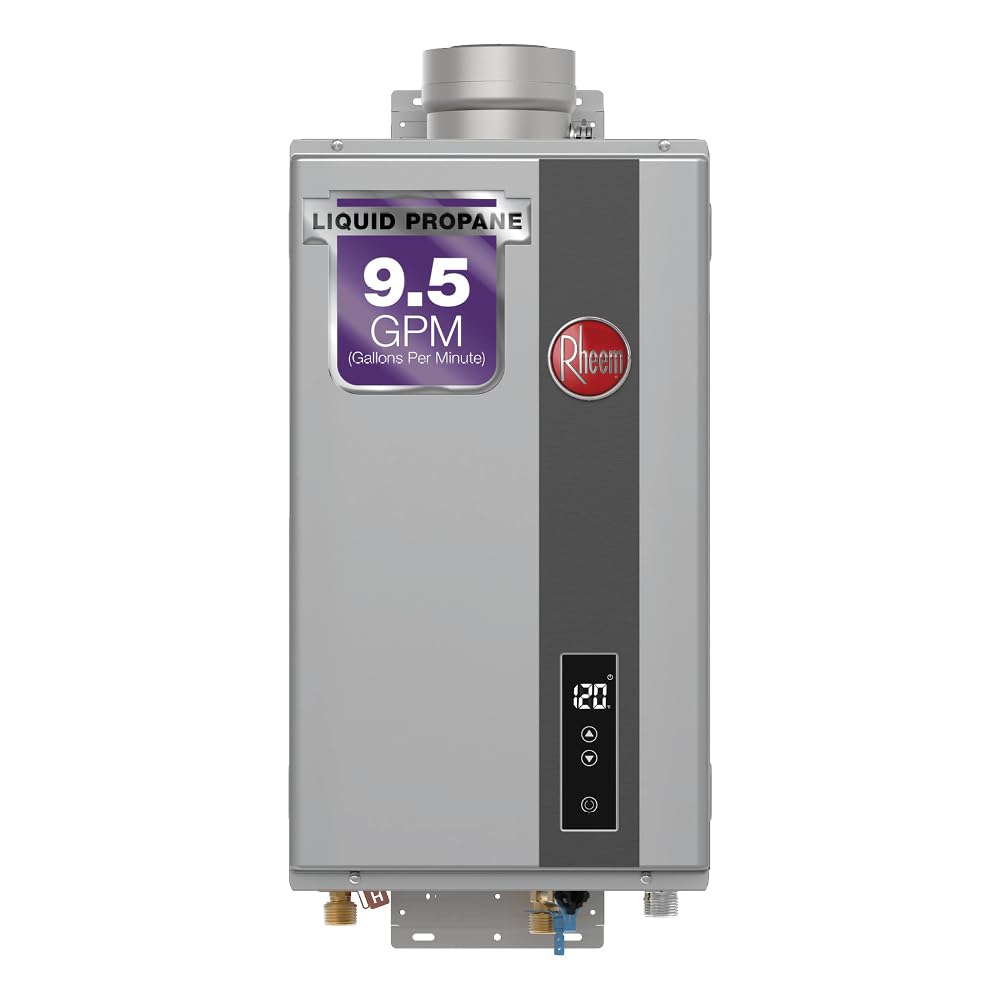
The Rheem RTG-95DVLP-3 is a non-condensing propane unit that punches above its class with 9.5 GPM and 199,900 BTU. For homes that rely on liquid propane rather than natural gas, this model delivers enough thermal capacity to match the peak load of a 75-gallon tank across two to three bathrooms. The hot-start programming prevents the cold-water burst that plagues some tankless units when a second fixture opens mid-shower.
The indoor-rated design uses a standard PVC vent system, which keeps installation straightforward compared to condensing models that may require stainless steel. The compact cabinet—13.5 inches wide and 24.2 inches tall—fits into tighter spaces, and the wall-mount bracket is included. Rheem backs the heat exchanger with a 15-year limited warranty and parts for five years, which signals confidence in the alloy steel burner assembly.
Owners frequently mention that the unit is easy to install with PEX connections and basic gas plumbing skills, though professional hookup is still recommended. The noise level drew mixed reactions—some called it loud relative to their previous tank, while others found it acceptable. A handful of users operating at high altitude (above 8,000 feet) confirmed consistent performance without derating issues.
Why it’s great
- 9.5 GPM from a compact non-condensing chassis
- Hot-start programming avoids cold bursts
- 15-year heat exchanger warranty
Good to know
- Fan noise is noticeable during operation
- Propane only; conversion kit not available
4. Rheem Prestige RTGH-84DVLN-2

The Rheem Prestige RTGH-84DVLN-2 condensing model balances 8.4 GPM output with built-in water and gas leak detection—a rare safety layer that automatically shuts down the unit and displays an error code if a leak is sensed. The condensing design recovers latent heat from exhaust, pushing efficiency above 0.93 UEF while using standard PVC venting. At 77.9 pounds, it’s heavier than competitors, signaling a robust stainless steel heat exchanger.
The leak detection system is particularly valuable for indoor installations where a slow gas or water leak could go unnoticed. The included remote control allows temperature adjustment from inside the living space, and an optional circulation pump kit supports whole-home recirculation loops for instant hot water at distant faucets. The 15-year heat exchanger warranty and five-year parts warranty provide long-term coverage.
Buyers frequently note the quiet operation and quick recovery when multiple fixtures are open. A recurring caution involves the packaging—the unit is heavy and the factory boxing doesn’t always survive shipping, so inspecting upon arrival is prudent. One long-term user reported an error code 12 after five months and cited challenging Rheem support, though others had no issues for years. Overall, the safety sensors and efficiency make it a strong pick for families prioritizing both performance and protection.
Why it’s great
- Integrated gas and water leak detection
- Condensing efficiency with standard PVC vent
- Optional recirculation kit for instant hot water
Good to know
- Heavier chassis; requires sturdy wall mounting
- Packaging may not protect against shipping damage
5. Rheem Condensing Natural Gas 9 GPM
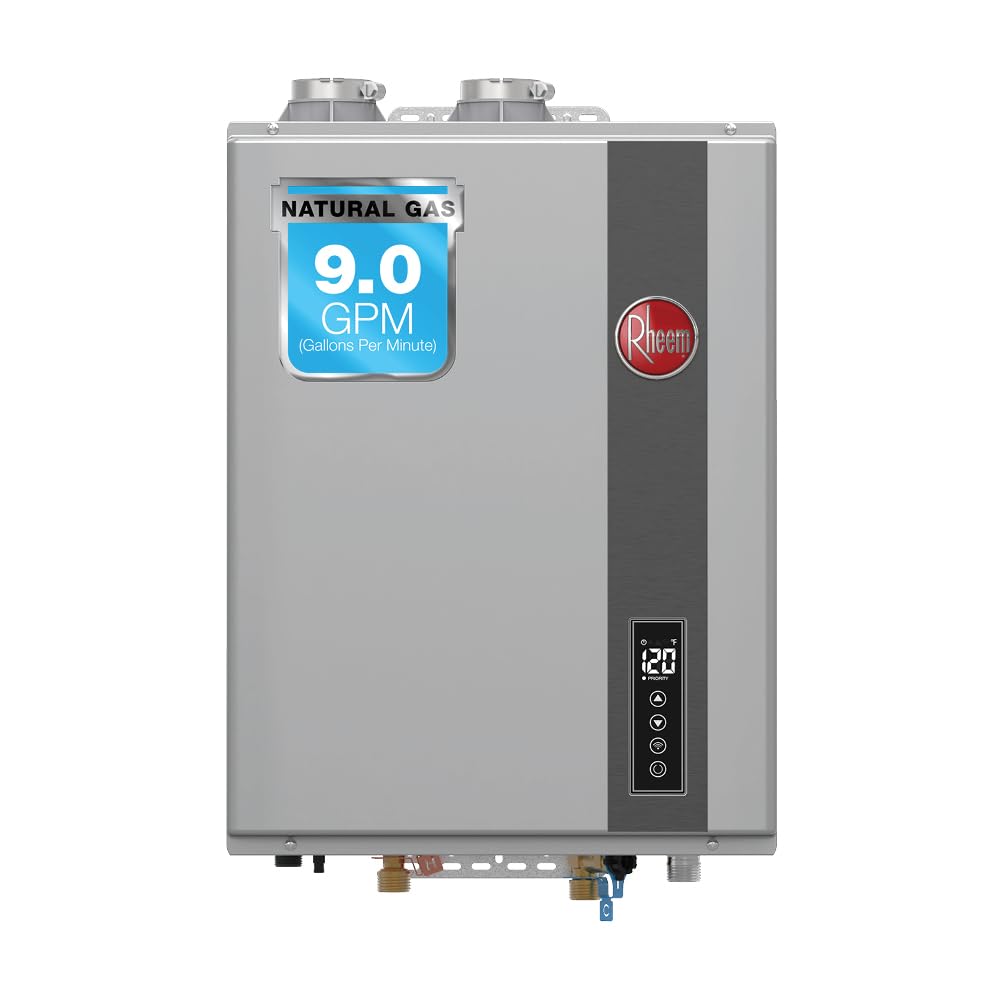
This Rheem condensing natural gas unit delivers up to 9 GPM at 180,000 BTU with a 0.93 efficiency rating. The 9 GPM ceiling is well into the territory of replacing a 75-gallon tank, providing continuous hot water for simultaneous showers, washing machines, and dishwashers. The temperature control range spans 100°F to 140°F, and the default 120°F setting works for most households out of the box.
The condensing heat exchanger extracts additional heat from exhaust gases, which drops the vent temperature enough for standard Schedule 40 PVC. The footprint is moderate at 17.7 inches wide and 23.7 inches tall, with a weight of 59.9 pounds that is manageable for a two-person wall mount. Rheem covers the heat exchanger for 15 years, parts for five years, and labor for one year.
Owner feedback emphasizes the near-silent operation—many describe it as quieter than their dishwasher. Installation is straightforward for experienced plumbers, with the caveat that an expansion tank and pressure regulator may be needed depending on local water conditions. One user noted a strong gas smell in the exhaust, which is normal for high-efficiency burners but requires proper vent termination away from windows and patios. A small subset experienced circuit board failures, though these appear isolated relative to the sales volume.
Why it’s great
- Quiet condensing operation with 0.93 UEF
- 9 GPM capacity for heavy simultaneous demand
- 15-year heat exchanger warranty
Good to know
- Exhaust has a strong gas odor during burn
- Circuit board reliability has mixed reports
6. Takagi T-H3S-DV-N

The Takagi T-H3S-DV-N is a condensing indoor unit that complies with the 2012 SCAQMD Rule 1146.2 for ultra-low NOx emissions, making it a legal choice in California’s South Coast Air Quality Management District. Flow rate is 8 GPM with 180,000 BTU, sufficient for homes that would otherwise rely on a 75-gallon tank but don’t need the absolute highest GPM ceiling. The black cabinet is compact at 17.75 inches wide and 22.5 inches tall.
The condensing design uses a stainless steel heat exchanger to maximize heat transfer and resist corrosion. The direct-vent dual-chamber intake/exhaust system is included in the box, simplifying the venting material purchase. Takagi’s computerized safety features include overheat cut-off, freeze protection, and a no-pilot-light ignition system that eliminates standing pilot energy waste.
Long-term owners report that earlier Takagi units ran for 16 years before needing replacement, and the T-H3S carries forward that reliability reputation. The unit is quiet during operation, though some users note the initial firing-up sequence is audible. Hidden costs include the need for a 3/4-inch gas line (not 1/2-inch) and biannual descaling if the water is hard. A neutralizer kit for the condensate drain is recommended but not included.
Why it’s great
- Ultra-low NOx compliant for strict air districts
- Stainless steel heat exchanger resists corrosion
- Direct-vent kit included with purchase
Good to know
- Requires 3/4-inch gas line for full output
- Biannual descaling recommended in hard water
7. A. O. Smith ATI-310CX3
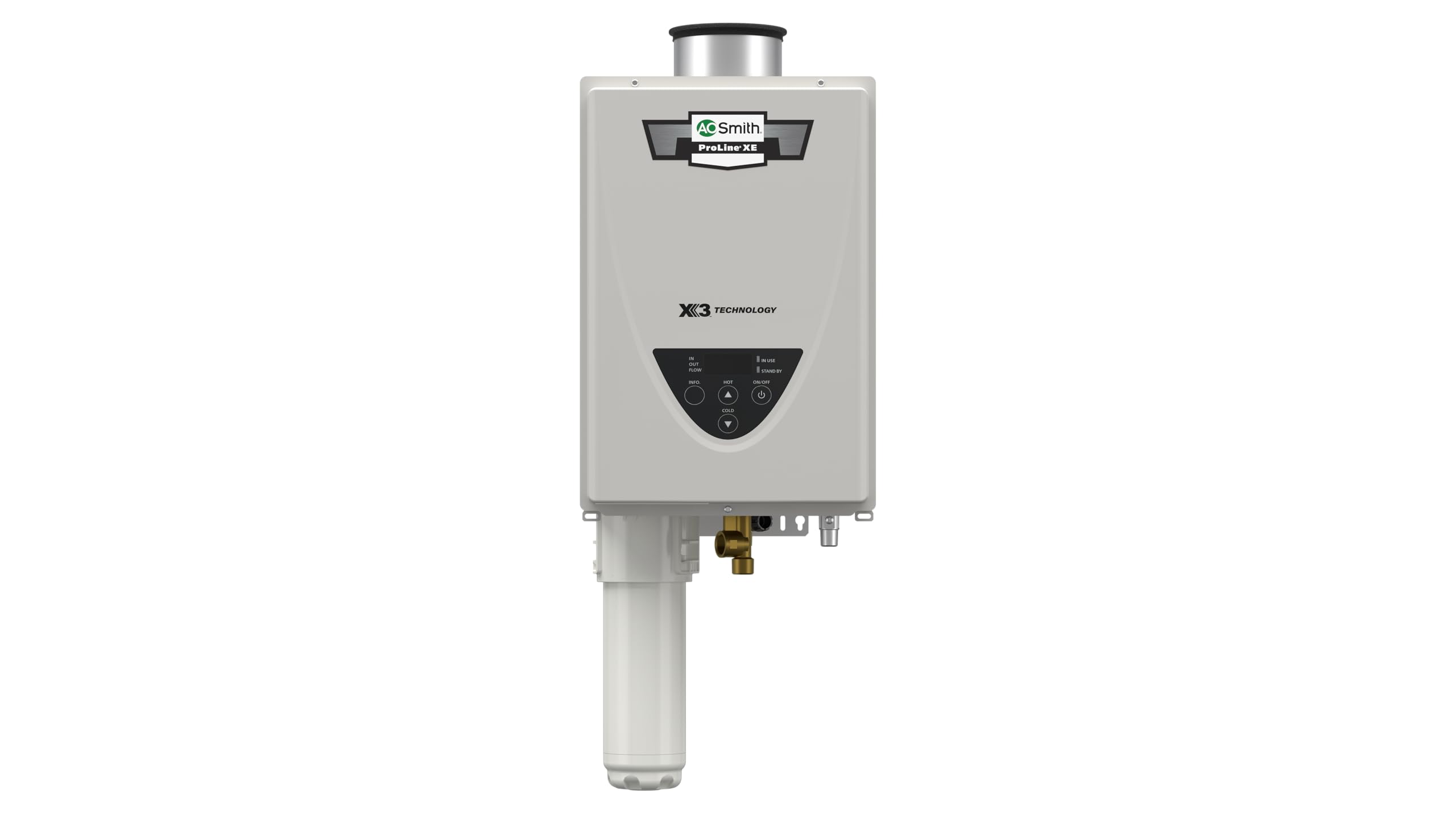
The A. O. Smith ATI-310CX3 uses X3 Scale Prevention Technology, a built-in feature that reduces mineral buildup without requiring external water softeners or annual descaling. This is a meaningful advantage for homes with hard water, where traditional tankless units lose efficiency over time due to scale accumulation on the heat exchanger. Flow rate hits 8 GPM at 190,000 BTU, with a non-condensing design that keeps upfront costs moderate.
The unit’s commercial-grade copper heat exchanger provides 25 times better heat transfer than steel, and the 0.81 UEF is respectable for a non-condensing model. The propane conversion kit is included in the box, and the concentric vent system supports both vertical and horizontal terminations. The compact dimensions—13.75 inches wide and 20.5 inches tall—make it one of the smallest units in this class, freeing up wall space for other mechanicals.
Plumbers who installed the unit frequently describe it as a “nice unit” with straightforward hookup. The built-in scale prevention eliminates the need for isolation valves and descaling kits, cutting long-term maintenance labor. The 15-year heat exchanger warranty offers peace of mind, though some users noted the fan noise is slightly louder than premium condensing units. A buyer warned that the unit requires a dedicated 3/4-inch gas line to reach full flow capacity.
Why it’s great
- X3 scale prevention means no annual descaling
- Compact footprint saves wall space
- Propane conversion kit included
Good to know
- Fan noise is noticeable during operation
- Requires 3/4-inch gas line for 8 GPM output
8. Rinnai RUCS75iN

The Rinnai RUCS75iN is a no-frills contractor-grade condensing unit that prioritizes reliability over smart features. At 7.5 GPM and 150,000 BTU, it sits at the lower end of the flow spectrum for 75-gallon replacements, but for moderate-demand homes—two bathrooms plus kitchen—it provides consistent hot water without the complexity of WiFi or app control. The 12-year heat exchanger, 5-year parts, and 1-year labor warranty reflect a build quality that professional installers trust.
Temperature is set via DIP switches on the control board rather than a digital panel, which keeps the interface simple but requires more effort to adjust. The condensing design accepts standard PVC venting, and the unit supports multiple venting configurations, including the Ubbink Concentric to Twin Pipe adaptor for tight spaces. At 63 pounds and 34 inches tall, it’s the tallest unit in this comparison, so measure your wall space before purchase.
Professional installers appreciate the straightforward hookup and the fact that the unit does not require a separate control panel for basic operation. Owners report that it handles simultaneous showers and dishwasher runs with only a 1.5°F temperature drop, which is excellent for a 7.5 GPM unit. The main drawback is the fixed minimum temperature of 120°F, which can feel too hot in warmer climates and may cause the unit to shut down flow during summer months when incoming water is already warm.
Why it’s great
- Contractor-grade build with 12-year heat exchanger warranty
- Multiple venting options for retrofit flexibility
- Consistent temperature across multiple fixtures
Good to know
- Temperature adjustment requires DIP switch changes
- 120°F minimum temp may be too hot in warm climates
9. Westinghouse HS180A0G-LP
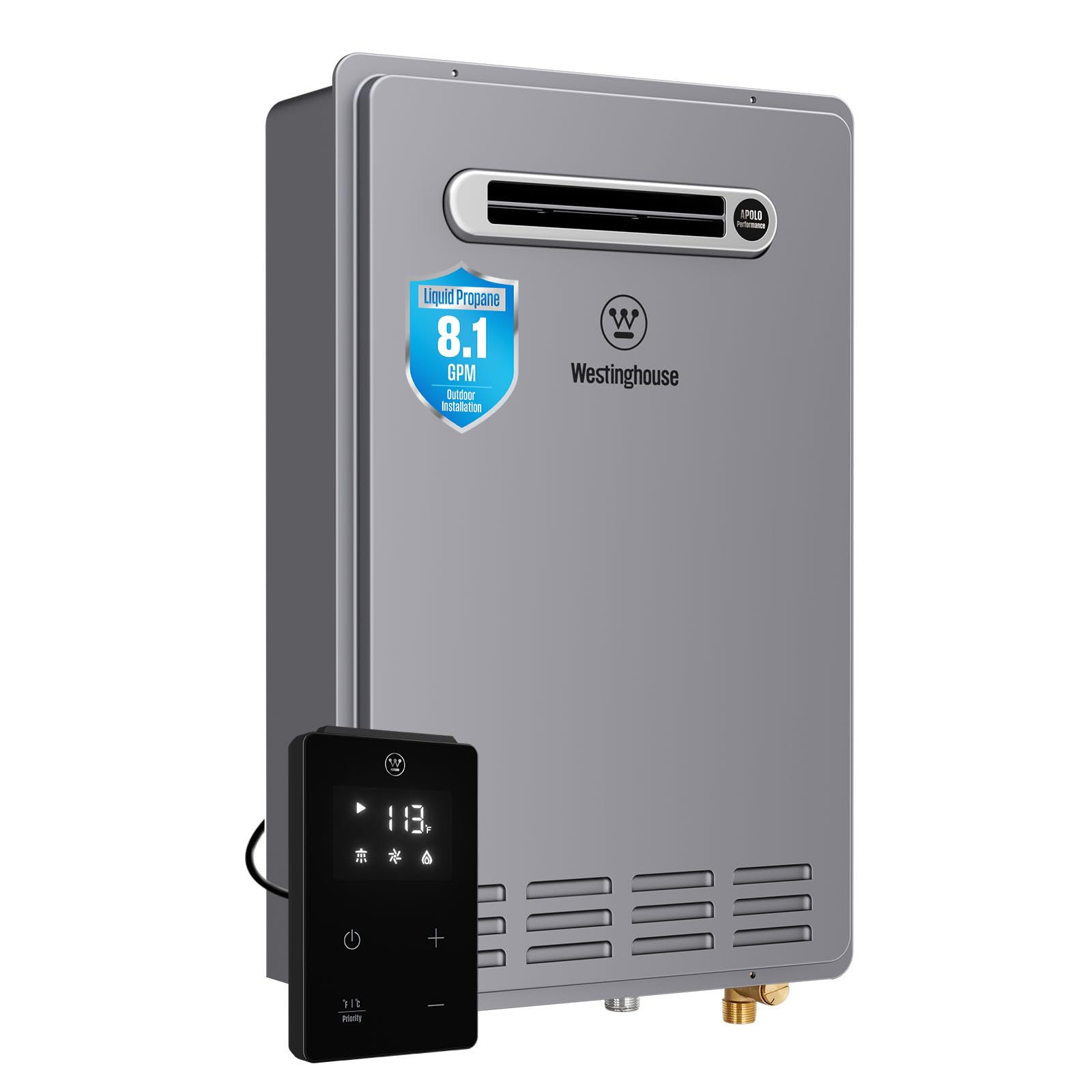
The Westinghouse HS180A0G-LP is an outdoor-rated propane tankless heater delivering 8.1 GPM at 180,000 BTU. The outdoor designation means zero venting cost—no PVC, no concentric kit, no roof penetration—which can save hundreds in installation material. The included indoor remote control panel lets you adjust the temperature from inside the house, solving the common outdoor-unit complaint of having to walk outside to change settings.
The non-condensing design is CSA-certified for safety and includes a variable-speed combustion fan that adjusts airflow based on demand, improving efficiency across the firing range. Freeze protection kicks in automatically when temperatures approach freezing, and the unit is rated for operation down to 5°F. The compact chassis measures 17.1 inches wide and 26.8 inches tall, fitting neatly against an exterior wall.
Owners consistently praise the instant hot water and the ability to set a precise temperature (e.g., 116°F) that eliminates the need to mix cold water in showers. DIY installation is feasible for someone comfortable with gas and water connections, though professional hookup is still recommended. A few users noted that hot water delivery to far fixtures takes longer than expected—this is a pipe-run issue rather than a heater flaw. The remote control range is sufficient for most home layouts.
Why it’s great
- No venting costs with outdoor installation
- Indoor remote control for convenient temp adjustment
- 8.1 GPM handles 3-5 fixtures simultaneously
Good to know
- Requires 120V AC power for operation
- Drain required if temp drops below 5°F
10. Westinghouse HW180A0G-NG
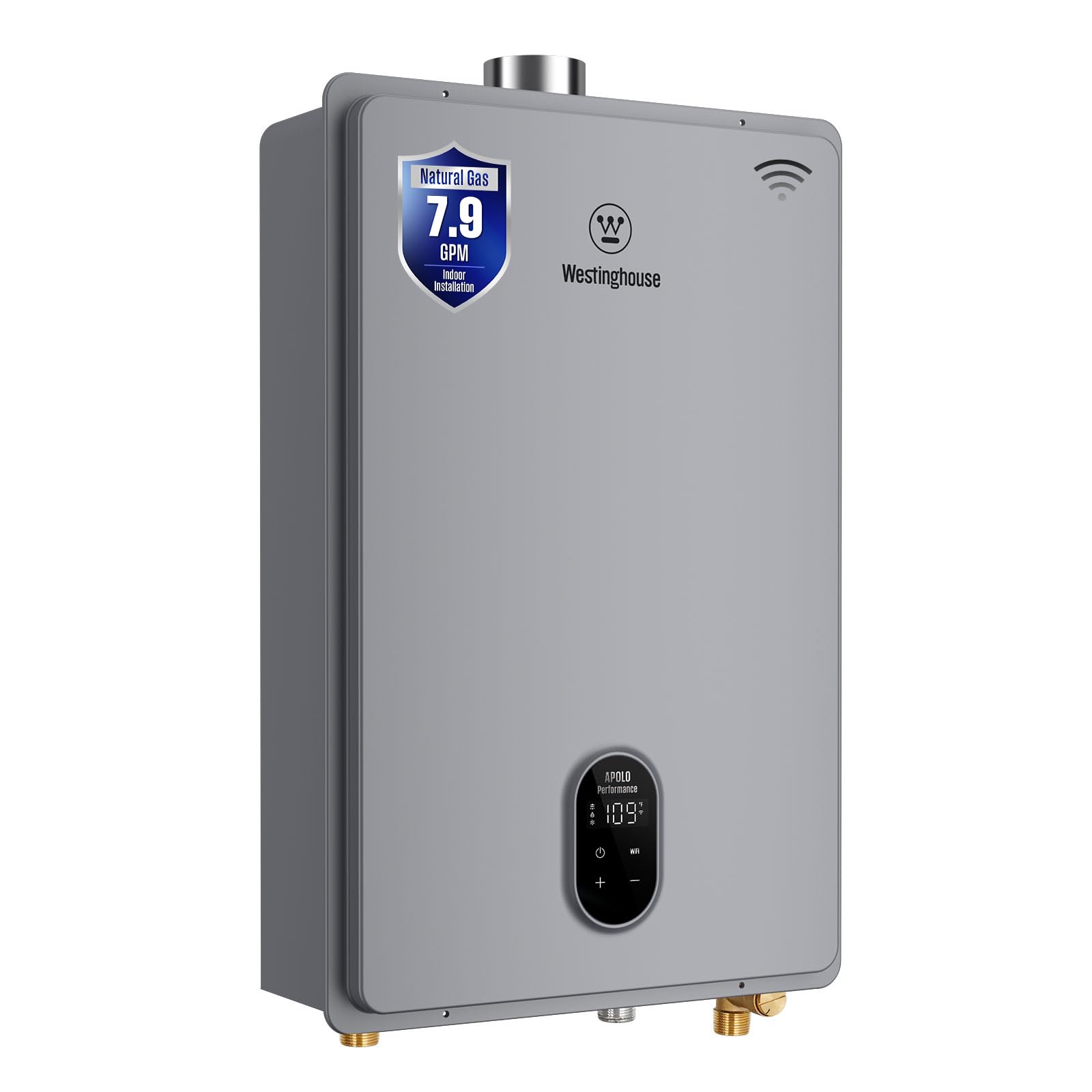
The Westinghouse HW180A0G-NG is an indoor natural gas model that adds WiFi app control to the same 180,000 BTU platform, delivering 7.9 GPM. The smartphone app lets you adjust temperature, monitor operating status, and receive system notifications from anywhere—a feature set usually reserved for pricier condensing units. The ±1°F temperature stability is maintained by self-modulating technology that adjusts gas and water flow in real time.
The non-condensing design uses standard 3/4-inch NPT water connections and is CSA-certified for safety. The freeze protection system and variable-speed combustion fan are built in, and the copper heat exchanger is designed for long-term durability. The wall-mount bracket and installation hardware are included, and the unit is compatible with standard indoor venting materials.
User feedback mirrors the outdoor model: easy installation, instant hot water, and reliable temperature control. The WiFi app functionality received positive comments for its intuitive interface and reliable connection. As with other non-condensing units, the exhaust temperature is higher than condensing alternatives, so standard PVC venting is acceptable but should not be shared with other appliances. Some buyers noted that the unit requires a dedicated electrical outlet nearby for the control board and fan.
Why it’s great
- WiFi app control for remote temperature management
- ±1°F temperature stability prevents cold bursts
- Compact indoor design with standard connections
Good to know
- Requires 120V AC outlet near installation
- Non-condensing; higher exhaust temp than condensing models
11. FOGATTI Instagas 180S
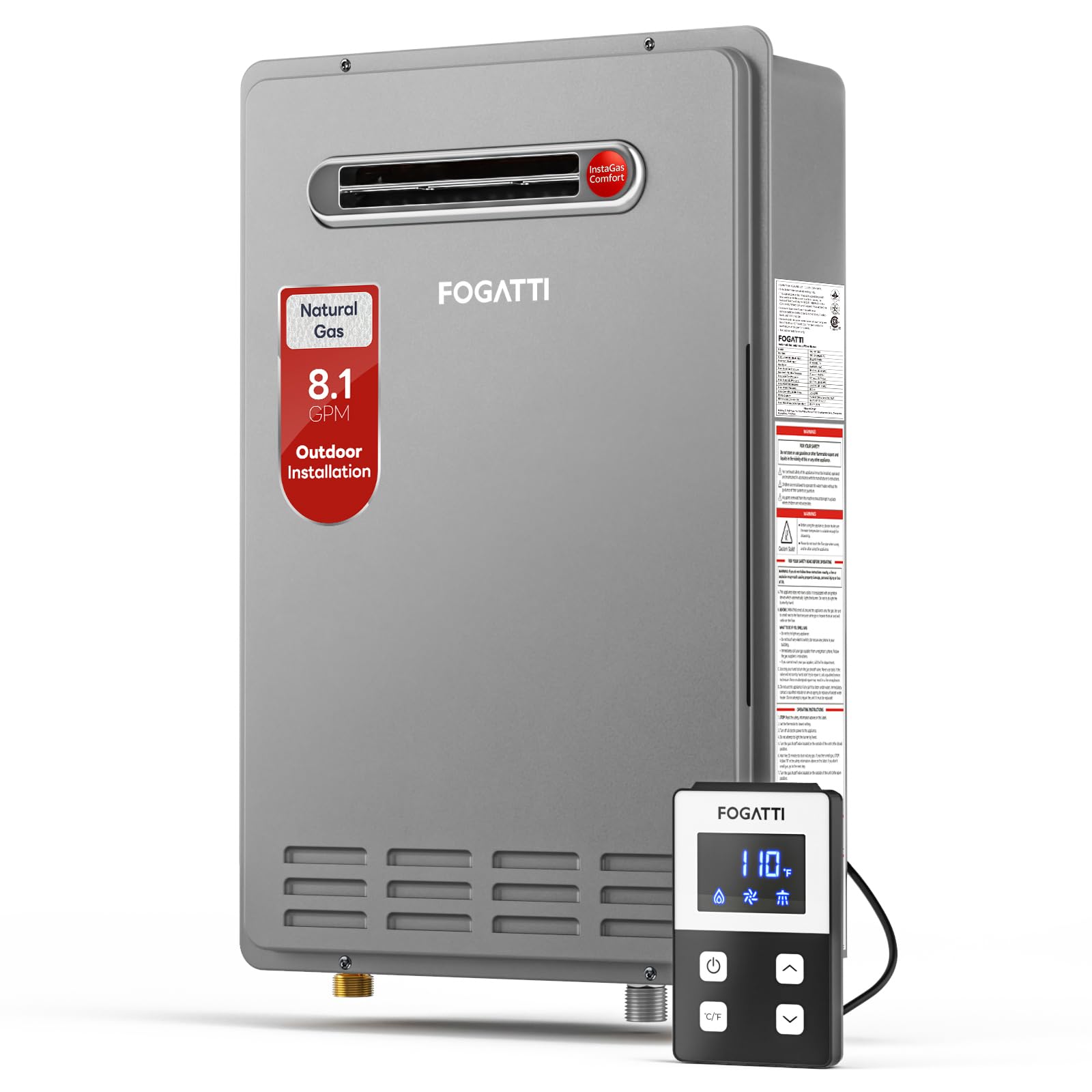
The FOGATTI Instagas 180S is an outdoor natural gas unit delivering 8.1 GPM at 180,000 BTU. Like the Westinghouse outdoor model, the outdoor installation eliminates venting material costs and permits wall mounting on an exterior wall with minimal clearance. The bottom-mounted fan design pushes combustion gases upward and prevents backflow, which adds a layer of safety in windy conditions.
The oxygen-free copper heat exchanger and 304 stainless steel burner are CSA-certified, and the four-stage combustion system works with temperature sensors to maintain ±1°F accuracy. The compact dimensions—26.2 inches tall and 17.1 inches wide—match the indoor version closely, and the unit includes an active heating anti-freeze device that protects internal components down to 5°F. The 2-year full-unit warranty plus 5-year heat exchanger warranty covers the main failure points.
Buyers report easy installation and immediate hot water delivery, with the unit firing up as soon as a faucet opens. The cold-weather performance received specific praise from users in central Florida who experienced a freeze event—the anti-freeze feature kept the unit operational. A recurring caution from the user base is that the FOGATTI brand has some reports of ignition failures (1-2 out of 10 uses in one case), so consistent long-term reliability is less proven than Rheem or Rinnai. The audible error beeping was also noted as hard to hear from upper floors.
Why it’s great
- Active heating anti-freeze protects down to 5°F
- Bottom-mounted fan prevents smoke backflow
- Oxygen-free copper heat exchanger for efficient transfer
Good to know
- Reliability reports are mixed; some ignition failures noted
- Error beeps may be inaudible from upstairs
12. FOGATTI Instagas 170S

The FOGATTI Instagas 170S is the indoor natural gas sibling of the 180S, rated at 7.5 GPM and 170,000 BTU. This unit targets homes where a 75-gallon tank replacement is the goal but where the total fixture count is modest—two or three simultaneous outlets. The compact chassis, at 25 inches tall and 16.3 inches wide, is among the smallest in the lineup, making it a strong candidate for tight mechanical closets or retrofit into existing tank footprints.
The four-stage combustion system with water servo technology holds temperature within ±1°F, and the unit is compatible with low water pressure down to 15 PSI, which is useful for homes with well water or older plumbing. The high-efficiency copper heat exchanger and 304 stainless steel burner are CSA-certified, and the assembly kit includes all necessary hardware for wall mounting. The 2-year full-unit and 5-year heat exchanger warranty mirror the 180S.
Users who installed the 170S report that the instructions are clear and that a competent DIYer can complete the installation in a day. The instant heating response—water gets hot almost immediately after the faucet opens—is consistently praised. As with the larger FOGATTI model, reliability concerns appear in a minority of reviews, with one user reporting frequent ignition failure and recommending established brands instead. The unit is recommended for use below 2,000 feet altitude, so high-altitude buyers should verify performance.
Why it’s great
- Compact size fits small mechanical spaces
- Works with low water pressure down to 15 PSI
- ±1°F temperature stability with servo control
Good to know
- Limited to installations below 2,000 feet altitude
- Long-term reliability less proven than Rheem/Rinnai
13. EZ Supreme EZSUPREMENG

The EZ Supreme EZSUPREMENG is a budget-oriented non-condensing natural gas unit delivering 6.4 GPM at 165,000 BTU. At this flow rate, it cannot match the peak output of a 75-gallon tank during heavy simultaneous demand—it’s better suited for smaller households or as a supplemental unit. The key selling point is the included direct-vent dual-chamber intake/exhaust kit, which saves roughly – in parts cost compared to competitors that sell venting separately.
The LCD control panel offers constant temperature settings, and the wall-mount design keeps the footprint compact. The 30-day money-back satisfaction guarantee and 1-year free product replacement warranty are generous for the price tier, though the 1-year warranty is significantly shorter than the 12-15 year heat exchanger warranties found on premium units. At 49 pounds, it’s one of the lighter units, making installation easier for a single person.
Customers who installed the EZ Supreme report that it provides ample hot water for two-bathroom homes and that the direct-vent system is easy to route through an exterior wall. The fan noise is noted as louder than premium alternatives, and occasional cold-water cutouts were reported when multiple fixtures opened simultaneously. The unit lacks advanced features like temperature modulation or remote control, but for buyers on a strict budget who need a basic tankless replacement, it delivers functional hot water with minimal upfront investment.
Why it’s great
- Included direct-vent kit saves on installation costs
- Lightweight at 49 pounds for easy mounting
- 30-day money-back guarantee reduces purchase risk
Good to know
- 6.4 GPM insufficient for heavy simultaneous demand
- Fan is louder than premium alternatives
FAQ
Can a tankless gas unit really replace a 75-gallon storage tank?
What size gas line does a tankless water heater need?
How often do I need to descale a gas tankless water heater?
Final Thoughts: The Verdict
For most users seeking a 75 gallon gas water heater replacement, the winner is the Rinnai CX199iN because its 11.1 GPM flow, 97% efficiency, and fuel-sensing versatility cover the widest range of household demands with minimal long-term cost. If you want smart connectivity and the highest efficiency rating available, grab the Rinnai RX199iN. And for a propane-powered solution that installs outdoors with zero venting complexity, nothing beats the Westinghouse HS180A0G-LP.