
A freezer door left slightly ajar or a sudden power outage can silently ruin hundreds of dollars worth of food in hours. A reliable monitoring system that pushes real-time alerts straight to your phone eliminates the guesswork, letting you react the moment the temperature climbs into the danger zone — not hours later when the damage is already done.
I’m Mohammad Maruf — the founder and writer behind Drink4Good. I spend my time analyzing hardware specifications, wireless protocols, and real-world performance data for smart home monitoring systems to find the units that actually deliver dependable alerts.
After evaluating critical features like alert delivery speed, temperature accuracy, battery life, and wireless range, I’ve put together this guide to help you find the right freezer alarm that connects to phone for protecting your stored food.
How To Choose The Best Freezer Alarm That Connects To Phone
Not all smart freezer alarms handle the extreme cold or the network disruptions that come with a power outage. Before buying, focus on three areas that separate a reliable guard from a frustrating gadget.
Alert Delivery During an Outage
If the power goes out, your home Wi-Fi typically goes with it. A system that relies solely on Wi-Fi and app push notifications becomes useless when it matters most. Look for models that use a separate hub with an audible alarm (80 dB or higher) and a backup battery that keeps the hub alive long enough to send an SMS or email alert via a router on a backup power supply. The best systems offer a combination of local hub beeps and multiple remote notification channels.
Wireless Protocol and Range
A freezer in a detached garage or basement creates a signal challenge. Standard Wi-Fi sensors often struggle through thick walls or metal enclosures. LoRa-based sensors (like those from YoLink and MOCREO’s long-range models) can communicate over 1,000 feet in open air and punch through concrete. If your freezer sits more than 50 feet or several walls away from your router, choose a system with a dedicated hub that uses a long-range wireless protocol rather than plain Wi-Fi.
Sensor Accuracy and Probe Design
A sensor that drifts by 2°F or more can trigger false alarms or, worse, fail to warn you about a real problem. Industrial-grade chips like the DS18B20 deliver accuracy within ±0.9°F. The probe cable is equally important — a thin flat cable (0.9 mm or less) lets you route the wire through the door seal without breaking the seal or letting cold air escape. Thicker cables force the door open slightly, raising the internal temperature and causing frost buildup.
Quick Comparison
On smaller screens, swipe sideways to see the full table.
| Model | Category | Best For | Key Spec | Amazon |
|---|---|---|---|---|
| MOCREO H5Lite Hub Kit | Mid-Range | Best Overall | ±0.9°F accuracy, 0.9 mm probe cable | Amazon |
| MOCREO H5Pro-LS1D | Premium | Long Range / Outdoor | 1,640 ft open-air range, IP66 | Amazon |
| YoLink X3 2-Pack + Hub | Premium | Data Logging & Extreme Cold | ±0.54°F, -22°F to 158°F range | Amazon |
| YoLink 3-Pack + Hub | Mid-Range | Multi-Zone Monitoring | 1/4 mile LoRa range, 5 yr battery | Amazon |
| SensorPush HTP.xw | Premium | High Accuracy / Heat Index | ±0.1°F accuracy, barometer | Amazon |
| Risinglink Power Outage Detector | Value | Direct SMS Text Alerts | 85 dB alarm, 3 sec detection | Amazon |
| GoveeLife H5107 + Gateway | Value | Outdoor & Greenhouse Use | 1,312 ft LoRa, IP65 waterproof | Amazon |
In‑Depth Reviews
1. MOCREO H5Lite Hub Kit
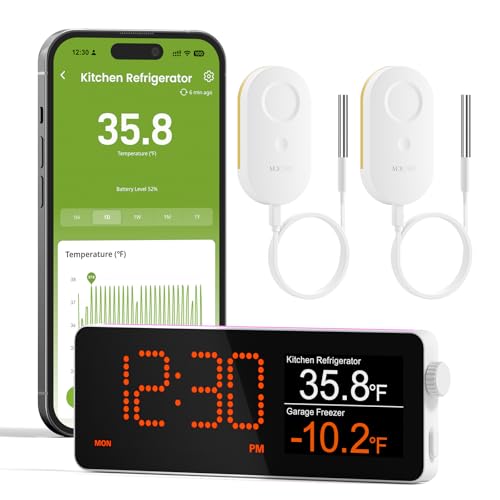
The MOCREO H5Lite Hub Kit hits the sweet spot between price and capability. The kit includes a central hub with an LCD display plus two wireless remote sensors, each using a DS18B20 industrial-grade chip rated at ±0.9°F accuracy across a -40°F to 221°F range. The 0.9 mm ultra-thin flat cable is a standout design choice — it slides through a freezer door seal without breaking the gasket, preventing cold air leakage and frost accumulation that thicker probes cause.
Setup takes about 10 minutes with the companion app. Alerts come through three channels: an 80 dB hub alarm, app push notifications, and email. The iOS Critical Alerts feature bypasses Do Not Disturb mode, which is a meaningful safety net if you sleep with your phone on silent. Battery life reaches 2 years on three AAA cells, and the app sends a warning when the battery drops below 10%. The hub can communicate with up to 30 BLE sensors within 131 feet, making it expandable for whole-home monitoring.
The H5Lite hub doubles as a standalone temperature sensor when paired with a dedicated external probe, giving you flexibility beyond the two included sensors. The data export feature saves 2 years of temperature history to CSV format, which is useful for tracking gradual temperature drift or verifying equipment performance over time.
Why it’s great
- Ultra-thin 0.9 mm probe cable preserves door seal integrity
- Triple alert channels (hub, app, email) with iOS critical alert override
- Expandable to 30 sensors with 2-year data export
Good to know
- Requires 2.4 GHz Wi-Fi — incompatible with 5 GHz-only networks
- Probe wires could be longer for placement deeper inside freezers
2. MOCREO H5Pro-LS1D

The MOCREO H5Pro-LS1D is the long-range beast of the lineup. The H5Pro hub communicates with the LS1 sensors using a proprietary long-range wireless protocol that reaches 1,640 feet (one third of a mile) in open air — enough to cover a detached garage, barn, or workshop that sits far from the house. The LS1 sensor carries an IP66 rating, meaning it resists powerful water jets, making it suitable for humid environments like walk-in coolers or outdoor installations near water pipes.
Temperature accuracy holds at ±0.9°F from -4°F to 131°F, which covers the full operating range of a standard freezer. The hub connects via Ethernet or 2.4 GHz Wi-Fi, giving you a wired fallback when the Wi-Fi signal is weak. The 95 dB hub alarm is noticeably louder than the 80 dB alarm on the H5Lite, and you can silence it remotely from the app — a small but welcome convenience when the freezer is in a hard-to-reach location.
The system supports up to 100 sensors on one hub, which is overkill for a single freezer but ideal for commercial kitchens, restaurant walk-ins, or anyone managing multiple freezer and refrigerator units. Like the H5Lite, it exports 2 years of data to CSV and features early trend detection so you spot a door left ajar or a compressor failure before the temperature spikes too far.
Why it’s great
- Massive 1,640 ft open-air range reaches distant outbuildings
- IP66 splash-proof sensor works in humid and outdoor conditions
- Ethernet backup connection for stable data transmission
Good to know
- Signal struggles inside fully enclosed metal walk-in coolers
- Firmware update required patience during initial setup
3. YoLink X3 2-Pack + Hub

The YoLink X3 steps up from the standard YoLink sensor with commercial-grade accuracy of ±0.54°F and an expanded temperature range of -22°F to 158°F. That lower limit is important — many budget sensors stop working at -4°F, but chest freezers often cycle below -10°F, and this sensor keeps logging data even in deep-freeze conditions. The X3 also logs data offline when it loses connection to the hub, storing it locally so no temperature history is lost during a network disruption.
Battery life is rated at over 5 years on two AA batteries, which is exceptional for a wireless sensor that transmits data regularly. The X3 uses YoLink’s LoRa-based protocol, which reaches about 1/4 mile in open air and punches through concrete walls and metal sheds. The included hub supports SMS text alerts (15 free per month per sensor set), email, and app push notifications. The SMS option is a genuine safety net for power outages when Wi-Fi is down but a cellular-connected router is still working.
The X3 also integrates with Home Assistant via community-supported methods, which matters for users who want to build custom automations. The sensor body is slightly larger than the standard YoLink unit, but that size accommodates the longer battery life and the onboard data-logging memory. For critical freezer monitoring in extreme cold, this is the most capable option.
Why it’s great
- Operates down to -22°F for deep chest freezers
- 5+ year battery life and offline data logging
- SMS text alerts available during Wi-Fi outages
Good to know
- Sensor body is larger than standard YoLink sensors
- SMS alert quota limited to 15 per month per sensor set
4. YoLink 3-Pack + Hub

The YoLink 3-Pack + Hub is the best entry point for monitoring multiple freezers, refrigerators, and additional zones like a greenhouse or basement. With three sensors and one hub, you can cover an upright freezer, a chest freezer, and a refrigerator simultaneously. Each sensor delivers temperature accuracy of ±0.36°F (between 32°F and 129°F) and ±0.72°F in sub-zero conditions, which is strong performance for the price tier.
The battery life matches the X3 at up to 5 years on two AA cells. The LoRa-based protocol keeps the sensors running on minimal power while maintaining a 1/4-mile open-air range. The hub connects to your home network via 2.4 GHz Wi-Fi and sends alerts through the YoLink app, email, and SMS text (15 free per month). Apple users benefit from Critical Alerts that bypass silent mode — a feature that ensures you actually wake up if the freezer temperature spikes overnight.
Integration with Alexa and IFTTT is supported, so you can query the temperature by voice or trigger smart home actions based on temperature thresholds. The sensor has no display, which keeps the size small and battery consumption low, but you’ll rely entirely on the app for readings.
Why it’s great
- Three sensors in one kit for multi-zone coverage
- ±0.36°F accuracy in normal freezer range
- Apple Critical Alerts bypass silent mode on iPhone
Good to know
- No on-device display — all readings via smartphone app
- SMS alert quota limited to 15 per month per device set
5. SensorPush HTP.xw

The SensorPush HTP.xw is the most accurate sensor in this lineup, with a rated temperature accuracy of ±0.1°F and built-in barometric pressure, dew point, and VPD (vapor pressure deficit) monitoring. It records five environmental variables simultaneously and keeps 30 days of onboard data logged even when out of Bluetooth range. Unlike the other sensors here, the HTP.xw uses Bluetooth LE as its primary wireless protocol — you need the separately sold G1 WiFi Gateway to enable remote smartphone alerts.
Battery life runs 1 to 2 years on a CR2477 coin cell in typical conditions, though sub-zero freezer temperatures drain it faster. The sensor body is splash-resistant and compact, making it easy to tuck into tight freezer spaces. The app interface is polished, showing clean graphs for temperature, humidity, heat index, barometric pressure, dew point, and VPD. You can export years of data for analysis, and the gateway unlocks unlimited cloud storage and remote access.
The main limitation is that the gateway is an extra purchase, which pushes the total cost higher than all-in-one systems. Also, Bluetooth range is roughly 100 feet line-of-sight, so without the gateway, you must be close to the sensor to see the latest reading. For users who demand laboratory-grade accuracy and multi-variable monitoring, the SensorPush HTP.xw is the benchmark.
Why it’s great
- Industry-leading ±0.1°F temperature accuracy
- Measures barometric pressure, dew point, and VPD
- 30 days of onboard data logging for offline periods
Good to know
- Remote alerts require separately sold G1 WiFi Gateway
- Bluetooth-only without gateway limits range to ~100 feet
6. Risinglink Power Outage Detector

The Risinglink detector does not measure temperature — it detects power loss. This is a critical distinction: it plugs directly into a wall outlet and monitors the circuit. The moment power drops, the internal battery takes over and fires an 85 dB local alarm, plus it sends direct SMS text messages and emails to up to 2 phone numbers and 4 email addresses. There are no app subscriptions or third-party platforms involved; the device communicates directly over 2.4 GHz Wi-Fi to your internet connection.
Detection happens in as little as 3 seconds, and the device also sends a restoration alert when power returns. This is ideal for spotting tripped breakers, unplugged freezer cords, or short power interruptions that might not be long enough to warm the freezer but signal an underlying electrical issue. The pre-installed backup battery is rated for over 5 years under typical usage, and the unit itself is smaller than a deck of cards at 2.4 x 2.4 x 0.8 inches.
The biggest limitation: if your router loses power too, the device cannot send SMS or email alerts unless the router is on a backup UPS. The local audible alarm still works during a full blackout, but the remote notification fails. For this reason, it works best as a companion to a temperature sensor, not a replacement for one.
Why it’s great
- Direct SMS text alerts with no app or subscription required
- 3-second detection for fast notification of power events
- Compact size and built-in battery rated for 5+ years
Good to know
- Does not measure temperature — only detects power loss
- Router must be on backup power to send alerts during an outage
7. GoveeLife H5107 + Gateway
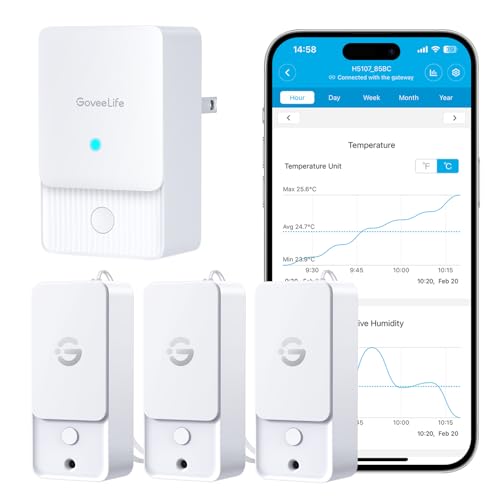
The GoveeLife H5107 system uses LoRa wireless technology to reach up to 1,312 feet between the sensor and the gateway — one of the longest ranges in this comparison. The kit includes three outdoor-rated sensors and one WiFi gateway, all pre-paired for quick setup. Each sensor is IP65 rated, meaning it withstands rain, hose spray, and humid environments like a greenhouse or covered patio as easily as a standard freezer.
Temperature accuracy is rated at ±0.54°F, and humidity accuracy holds within ±3% RH. The gateway supports up to 30 sensors total, so you can expand the system well beyond the three included units. Battery life runs about one year on two AAA cells, which is shorter than the YoLink sensors but still reasonable. The Govee Home app provides clean graphs and customizable alert thresholds for both temperature and humidity.
The H5107 sensor does not include a physical probe cable — it measures ambient air temperature from the sensor body itself. This is fine for freezers with enough air circulation but less ideal for monitors that need to track the temperature of a specific item or surface inside a packed freezer. The system also lacks Alexa voice temperature reporting and does not offer SMS text alerts, limiting its utility during a full Wi-Fi outage.
Why it’s great
- 1,312 ft LoRa range for distant outdoor locations
- IP65 waterproof sensors for greenhouse and patio use
- Three sensors included in the box for broad coverage
Good to know
- No probe cable — measures ambient air only
- No SMS text alerts and no Alexa temperature reporting
FAQ
Will a freezer alarm still send alerts during a power outage?
How thin does the probe cable need to be for a freezer door seal?
Final Thoughts: The Verdict
For most users, the freezer alarm that connects to phone winner is the MOCREO H5Lite Hub Kit because it combines a thin probe cable, industrial-grade accuracy, triple alert channels, and expandability at a reasonable cost. If you need to monitor a freezer in a detached garage or metal building, the MOCREO H5Pro-LS1D offers a massive 1,640-foot range and an Ethernet backup. And for deep-freeze chest freezers that cycle below -10°F, nothing beats the YoLink X3 2-Pack + Hub with its -22°F operating floor and 5-year battery life.