
Every FPV pilot knows the moment: you’re lined up for a split-S through a tight gap, and your sticks feel vague, laggy, or just inexact. That millisecond of uncertainty between your thumb and the drone’s response is the difference between a clean pass and a crash. A great controller eliminates that gap, translating your intent into action without thinking about it.
I’m Mohammad Maruf — the founder and writer behind Drink4Good. I’ve spent years analyzing transmitter hardware, from hall-effect gimbal precision to EdgeTX configuration depth, separating the genuine performance upgrades from the marketing noise.
Whether you are a beginner building your first quad or a seasoned pilot upgrading from a basic radio, choosing the right fpv controller means matching stick feel, channel count, and protocol support to your flying style and budget.
How To Choose The Best FPV Controller
An FPV controller is the single most tactile link between you and your aircraft. A cheap, sloppy gimbal set will fight you on every turn, while a well-designed radio becomes an extension of your thumbs. Focus on three core areas: gimbal technology, protocol compatibility, and form factor.
Gimbal Type: Hall-Effect vs. Potentiometer
Hall-effect gimbals use magnetic sensors to detect stick position without physical contact. This means zero wear over time, smoother centering, and consistent precision across temperature changes. Potentiometer-based gimbals are cheaper but degrade with use, developing dead zones and stick-tension inconsistencies after a few hundred hours of flying.
Firmware & Protocol: EdgeTX vs. DJI Ecosystem
EdgeTX radios like the RadioMaster Pocket give you full control over model setup, mixer curves, and switch assignments, plus support for open protocols such as ExpressLRS (ELRS) for sub-250Hz packet rates and kilometer-range links. DJI controllers lock you into the O4 video transmission system but offer a seamless, polished experience with motion controls and AR cursor integration for their goggles.
Channels and Reserves
A basic 6‑channel radio covers throttle, pitch, roll, yaw, and a mode switch. Add arming, beeper, camera angle, and turtle mode, and you hit 8‑10 real quick. Aim for a 10‑channel minimum for freestyle or long‑range builds, so you keep spares for future add‑ons like GPS rescue or a head‑tracking module.
Quick Comparison
On smaller screens, swipe sideways to see the full table.
| Model | Category | Best For | Key Spec | Amazon |
|---|---|---|---|---|
| RadioMaster Pocket (Charcoal) | EdgeTX ELRS | Compact precision flying | Hall-effect gimbals, 16‑ch | Amazon |
| RadioMaster Pocket (Black) | EdgeTX ELRS | Budget sim & whoop setup | Hall-effect gimbals, ELRS 3.0 | Amazon |
| DJI RC Motion 3 | Motion Controller | Immersive DJI FPV flying | Wrist‑based motion, AR cursor | Amazon |
| FS-i6X + FS-iA10B | Entry‑Level AFHDS | Budget trainer & fixed‑wing | 10 channels, mode 2 throttle | Amazon |
| CADDXFPV Walksnail Avatar Pro Kit | Digital VTX System | Night‑flying digital builds | 22ms latency, 4km range, 1080p | Amazon |
| DJI FPV Remote Controller 3 | DJI Dedicated | Avata 2 & O4 manual flying | 10‑hour battery, M‑gear mode | Amazon |
| DJI Neo 2 Fly More Combo | Combo Bundle | All‑in‑one beginner kit | 151g drone, RC‑N3, 3 batts | Amazon |
In‑Depth Reviews
1. RadioMaster Pocket Portable Remote Controller (Charcoal, ELRS)

The RadioMaster Pocket packs a full EdgeTX operating system into a chassis barely larger than a game controller. Its hall‑effect gimbals deliver smooth, drift‑free centering that pilots normally expect from radios twice the cost. Out of the box, it runs ExpressLRS firmware, giving you sub‑250Hz packet rates and solid range for both simulator practice and real quads.
Fit and finish are impressive for a radio in this tier. The charcoal shell feels dense, the main scroll wheel has a positive detent, and the folding antenna keeps it pocket‑friendly. The built‑in LED lights across the top can be mapped to switch positions, which is a clever visual reminder during complex flights. Battery life easily clears four hours on two 18650s, and a USB‑C port makes charging simple.
The monochrome screen is basic — no color telemetry graphs — but the EdgeTX menu structure is fast enough that you rarely miss it. Some pilots report the included carry pouch is a tight fit with a USB cable attached, but that’s a minor ergonomic nitpick on an otherwise outstanding radio. It’s the best entry point into high‑performance FPV control today.
Why it’s great
- Hall‑effect gimbals for long‑term precision
- EdgeTX offers unlimited model and mixer flexibility
- Compact form factor with foldable antenna
Good to know
- 18650 batteries not included
- Monochrome screen may feel sparse to some
2. RadioMaster Pocket ELRS Hall Gimbal Transmitter (Black)

Nearly identical to the charcoal variant, this black RadioMaster Pocket runs the same hall‑effect gimbals and EdgeTX backbone, but ships pre‑configured with ELRS 3.0 firmware. That matters if you already own ELRS receivers or plan to build a fleet around the protocol — binding is plug‑and‑play, and the 250mW max output covers most park‑flying and backyard whoop sessions with ease.
The form factor is a deliberate step down in size from the Radiomaster Boxer or TX12. For pilots with smaller hands or those who pack a radio into a backpack with goggles, the reduced footprint is a genuine quality‑of‑life upgrade. The detachable joystick and folding antenna reinforce that travel‑first design philosophy. Build quality feels identical to the charcoal — same switch resistance, same scroll‑wheel tactility.
One recurring note from owners is that the stock gimbals, while hall‑effect, can feel slightly notchy right out of the box. A small adjustment of the stick tension screws solves that easily, but it’s worth knowing you’ll want to dial them in before your first serious flight session. For the price, this radio is an absurdly capable entry into the ELRS ecosystem.
Why it’s great
- Pre‑loaded ELRS 3.0 for instant receiver binding
- Ultra‑portable with detachable stick and folding antenna
- Great battery life on two 18650s
Good to know
- Gimbals may need tension adjustment out of the box
- No included SD card means firmware updates require sourcing your own
3. DJI RC Motion 3

The DJI RC Motion 3 is nothing like a traditional transmitter. Instead of thumb sticks, you steer the drone by tilting your wrist — the controller maps pitch and roll to your hand orientation, while a two‑stage throttle trigger controls altitude and yaw. Paired with DJI Goggles 3, an on‑screen AR cursor lets you navigate menus and adjust settings without looking down. This is a radically different flying experience, one that lowers the barrier for newcomers while still feeling engaging for experienced pilots.
Build quality is classic DJI: the gray shell is lightweight at just 110 grams, and the button layout positions takeoff, landing, and emergency brake within easy finger reach. The one‑click brake is genuinely confidence‑inspiring for beginners who worry about losing orientation. Compatibility spans the DJI Neo, Avata 2, Mini 4 Pro, and Air 3, making it a versatile accessory if you are already in the DJI ecosystem.
The catch is exclusivity: the RC Motion 3 requires DJI Goggles 3 to function — there is no standalone or phone‑based mode. The motion control is also gated by DJI’s firmware limits, so you trade full acrobatic freedom for an intuitive, cinematic flying style. For pilots who want the most immersive, hassle‑free FPV experience with DJI gear, this controller defines the category.
Why it’s great
- Intuitive wrist‑tilt motion control for cinematic flight
- AR cursor integration with Goggles 3
- Ultra‑light and ergonomic for long sessions
Good to know
- Requires DJI Goggles 3 — no standalone use
- Speed is capped even in Sport mode
4. FS-i6X 10‑Channel RC Transmitter + FS-iA10B Receiver

The FlySky FS-i6X is the classic first‑radio for a reason: it delivers a full 10‑channel setup at a price that makes it almost disposable, yet it works reliably for trainer quads, fixed‑wing gliders, and even RC cars. The AFHDS 2A protocol is stable within line‑of‑sight ranges, and the bundled FS‑iA10B receiver gives you enough PWM ports for a basic quadcopter build with GPS rescue or a servo‑triggered payload drop.
Ergonomics are straightforward, not luxurious. The grips are rubberized but the plastic shell feels hollow compared to hall‑effect radios. The potentiometer gimbals are functional but lack the buttery smoothness of magnetic sensors. For a beginner who is still learning to hover in a simulator, however, these limitations are invisible. The radio stores up to 20 model memories, which is generous at this tier.
The manual is famously poor — buyers consistently report confusion around binding and sub‑trim settings. Fortunately, the FlySky community is enormous, so YouTube setup guides are plentiful. The back‑mounted module bay is awkward to access, but for a pure entry‑level trainer that leaves budget for goggles and a charger, the FS‑i6X remains a solid starting point.
Why it’s great
- 10 channels at a very accessible price point
- Bundled with a reliable FS‑iA10B receiver
- 20‑model memory for multi‑vehicle households
Good to know
- Potentiometer gimbals will wear over time
- Manual is poorly translated and hard to follow
5. CADDXFPV Walksnail Avatar Pro Kit

While not a controller itself, the Walksnail Avatar Pro Kit is the digital video transmission system that defines how you control your FPV drone. The 1/1.8‑inch Starvis II sensor delivers crisp 1080p/60fps H.265 footage with genuinely usable night vision — a major advantage for pilots who fly at dusk or through shaded tree lines. The 22ms latency at 4km range puts it in direct competition with DJI’s O3 system, and the built‑in 32GB storage means you can record flights without an external camera.
Installation is flexible thanks to dual mounting patterns (20x20mm and 25.5×25.5mm) and dual power inputs. At 33 grams, it adds negligible weight to a 5‑inch build. The dual‑antenna layout with TVS protection helps maintain a solid link even in noisy urban environments. Gyroflow support built into the unit stabilizes footage in post, saving you from having to mount a separate GoPro.
Walksnail’s ecosystem is more open than DJI’s — it works with Goggles X and L without requiring proprietary handshake protocols. The downside is that initial setup can be fiddly, and the kit does not include a remote controller. For pilots building a digital quad from scratch who want top‑tier low‑light performance, the Avatar Pro Kit is the VTX to build around.
Why it’s great
- Excellent low‑light performance with Starvis II sensor
- Built‑in 32GB storage and Gyroflow support
- 4km range with 22ms latency
Good to know
- Setup can be more complex than DJI plug‑and‑play
- No remote controller included
6. DJI FPV Remote Controller 3 (Gray)

The DJI FPV Remote Controller 3 is the dedicated stick‑based radio for pilots fully invested in the DJI ecosystem. It pairs natively with the Avata 2, Neo, and O4 Air Units, and the integrated antenna is tuned for DJI’s O4 video transmission protocol. The standout update here is the 2mm‑extended control sticks, which give both pinch and thumb pilots slightly more leverage for fine maneuvers — a thoughtful tweak that makes a real difference during proximity flying.
Weight drops to roughly 240 grams, noticeably lighter than the previous generation, reducing fatigue during back‑to‑back sorties. The battery life stretches to about 10 hours, which translates to a full weekend of flying without reaching for a charger. The inclusion of Manual (M‑gear) mode alongside Normal and Sport options means advanced pilots can practice full acro without leaving the DJI walled garden.
It is important to note that this controller does not work with Goggles 2 or Integra — you need Goggles 3 or the O4 ecosystem. It also lacks EdgeTX flexibility, so model setup and mixing are confined to what DJI’s firmware allows. For pilots who want reliable, lag‑free control of DJI craft with zero tinkering, this is the premium choice.
Why it’s great
- Integrated O4 antenna for stable DJI video link
- Extended sticks improve precision feel
- 10‑hour battery for extended sessions
Good to know
- Locks you into DJI’s firmware and receiver ecosystem
- Not compatible with Goggles 2 or Integra
7. DJI Neo 2 Fly More Combo (with RC‑N3)
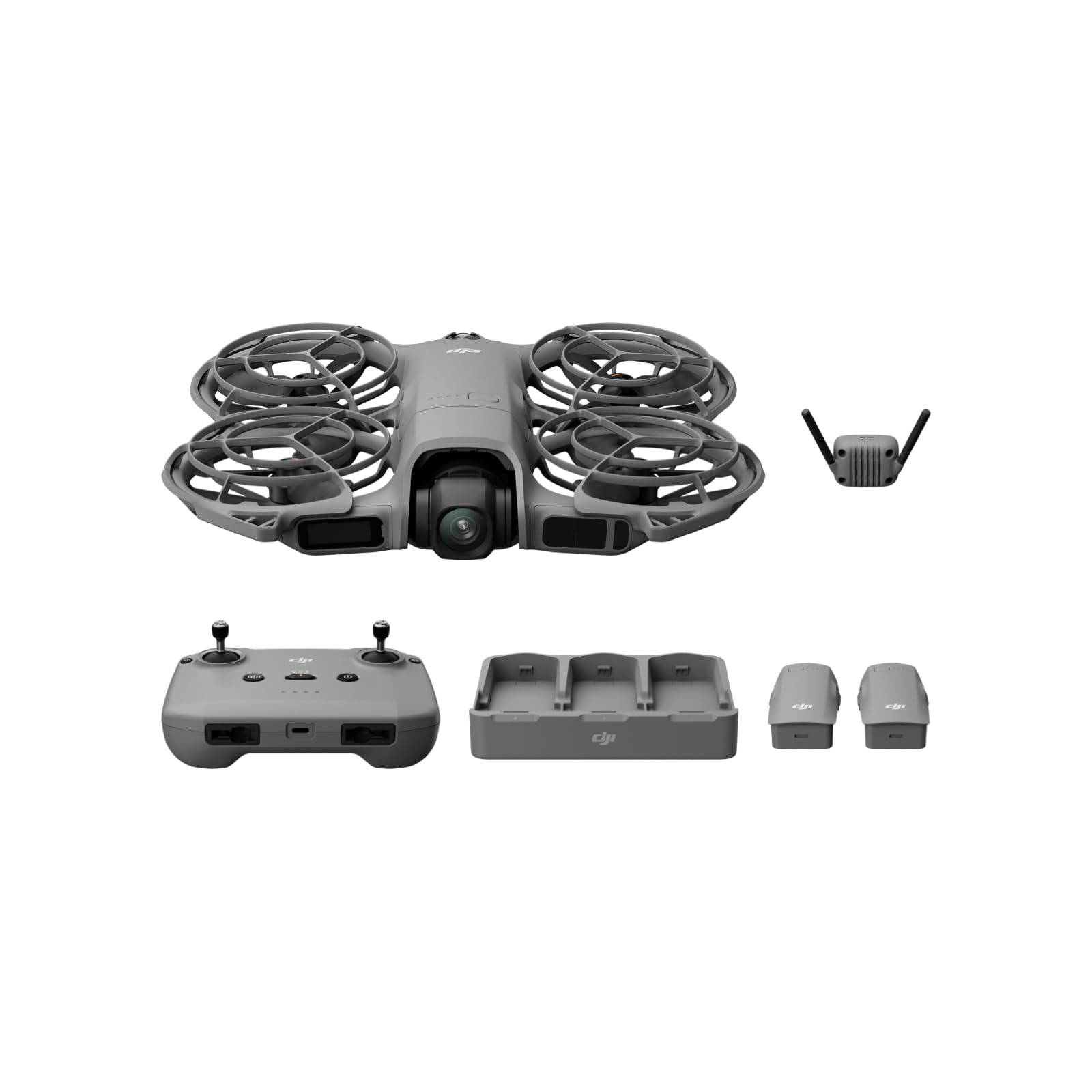
The DJI Neo 2 Fly More Combo bundles the aircraft with the RC‑N3 controller, a digital transceiver, three batteries, and propeller guards into one clean package. The RC‑N3 is a standard two‑stick radio paired with your phone via USB‑C for the live view — a practical approach for beginners who do not yet own goggles. The drone itself weighs only 151 grams (C0 certified), features full‑coverage prop guards, and supports palm takeoff, gesture control, and ActiveTrack.
Flight time per battery is about 10 minutes, which is typical for this weight class, but the Fly More combo’s three‑battery hub keeps you rotating fast. The 360‑degree obstacle sensing works well — the drone stops before contact, which is a huge safety net for new pilots. Video quality at 4K is solid for social media clips, with decent dynamic range for its sensor size.
The RC‑N3 is functional rather than inspiring. It lacks hall‑effect gimbals and feels plasticky compared to DJI’s dedicated FPV Remote Controller 3. You are also locked into the DJI Fly app for all adjustments. As a complete starter kit that includes everything except a phone, the Neo 2 combo is a low‑friction way to get flying immediately, but serious FPV pilots will outgrow both the drone and controller quickly.
Why it’s great
- Everything‑in‑the‑box beginner package
- Obstacle sensing prevents new‑pilot crashes
- Lightweight and C0 certified for relaxed regulation
Good to know
- RC‑N3 feels basic compared to hall‑effect radios
- 10‑minute flight time per battery requires swapping often
FAQ
Do I need hall‑effect gimbals for my first FPV controller?
Can I use a DJI FPV controller with an analog drone?
How many channels do I really need for freestyle flying?
Final Thoughts: The Verdict
For most users, the fpv controller winner is the RadioMaster Pocket (Charcoal) because it combines hall‑effect gimbals, full EdgeTX flexibility, and a compact size that works for both simulator training and real quads. If you want the intuitive motion‑control experience of a DJI ecosystem, grab the DJI RC Motion 3. And for the tightest budget where every dollar matters, nothing beats the FS-i6X as a trainer radio that gets you airborne without breaking the bank.