
The difference between a clean route and a sideline limp boils down to one thing — lateral control. A football knee brace isn’t just a sleeve; it’s a mechanical intervention against valgus collapse, hyperextension, and the grinding pain of a destabilized patella. You need rigid hinges where they count and non-slip traction where the sweat runs.
I’m Mohammad Maruf — the founder and writer behind Drink4Good. I’ve spent years analyzing orthopedic bracing hardware, from hinge articulation angles to neoprene density gradients, to separate true performance gear from rehab-grade sleeves.
Whether you’re recovering from an ACL reconstruction or managing chronic instability, this guide breaks down the seven most field-tested models to help you choose a best football knee brace that actually stays put through a whistle.
How To Choose The Best Football Knee Brace
A football brace must absorb multidirectional load without restricting your stride. The wrong choice leads to bunching, pressure points, or insufficient force redirection — all of which put your joint at risk. Here’s what separates a sideline brace from a game-day brace.
Hinge Configuration & Path of Motion
Single upright hinges (one metal bar on the side) are lighter and better for medial compartment offloading. Bi-lateral hinges (bars on both sides) control varus and valgus forces equally, making them the standard for ACL and MCL protection after sprains or reconstruction. Polycentric hinges that mimic the knee’s natural rolling-gliding motion reduce binding during deep flexion — crucial for a three-point stance.
Strap Architecture & Anti-Migration
A brace that slides down your calf is useless by the second quarter. Look for a four-point leverage strap system (supra-patellar, tibial, and dual calf straps) with silicone or rubber grippers bonded to the inner liner. Velcro-stitched straps that loop back on themselves tend to hold tension longer than single-pass hook-and-loop closures.
Compression Sleeve vs. Frame-Only
A separate compression sleeve worn under the rigid frame adds proprioceptive feedback and wicks sweat, which reduces chafing during high-heat practice. Frame-only designs shed weight but concentrate pressure on the strap contact points. For linemen who need maximum stability, a sleeve-plus-frame combo (like the Shock Doctor Bionic) provides the best balance of grip and breathability.
Quick Comparison
On smaller screens, swipe sideways to see the full table.
| Model | Category | Best For | Key Spec | Amazon |
|---|---|---|---|---|
| DonJoy BIONIC FULLSTOP | Premium | ACL / Hyperextension | Four-point leverage hinge | Amazon |
| Shock Doctor Bionic Knee Brace | Premium | Multi-ligament control | Bi-lateral aluminum hinges | Amazon |
| Ovation Game Changer Unloader | Premium | OA / Bone-on-bone | Single upright unloader | Amazon |
| Comfyorthopedic OA Unloader | Mid-Range | Medial knee offloading | 13-stop ROM dials | Amazon |
| DonJoy Drytex Sport Hinged | Mid-Range | Ligament / Meniscus rehab | Breathable Drytex sleeve | Amazon |
| Mueller Patella Stabilizer | Budget | Patellar tracking / Arthritis | 3 coiled alloy straps | Amazon |
| Shock Doctor Compression Sleeve | Budget | Mild support / Tendonitis | Integrated gel inlays | Amazon |
In‑Depth Reviews
1. DonJoy Performance BIONIC FULLSTOP

The BIONIC FULLSTOP is engineered around a four-point leverage hinge that dampens extension at the critical end-range — it physically trains the quad to avoid hyperextension. That dampening cycle is critical for a cornerback who lands with a straightened leg. The neoprene sleeve uses thermal heat regulation to keep the joint from overheating, and the anti-migration silicone gripper prevents the entire assembly from sliding down into your cleat.
Real users with lateral meniscus repairs report that the bilateral support frame stops the knee from shifting during cutting and rolling motions. The strap system includes four adjustable bands that let you customize tension at the thigh, patellar, and tibial levels — a major upgrade over generic velcro wraps. One wrestler wore this through an entire season without strap degradation, which is rare for a sub-200-dollar brace.
The trade-off is weight. At 2.5 pounds, it’s noticeably heavier than a compression-based model, and the side hinge pads can feel rigid against the IT band during extended wear. But for a player returning from ACL reconstruction or multi-ligament repair, the hyperextension stop alone justifies the heft.
Why it’s great
- Four-point leverage hinge prevents hyperextension at lockout.
- Anti-migration sleeve keeps the brace anchored through sprints.
- Adjustable quad, patellar, and calf straps allow precise fit.
Good to know
- Heavier than sleeve-style braces at 2.5 lbs.
- Side hinge pads can feel stiff against the lateral knee.
2. Shock Doctor Bionic Knee Brace (2090)

This is Shock Doctor’s most advanced knee support, built around bi-lateral aluminum hinges that allow a natural polycentric feel while resisting valgus stress. The hinge design tracks smoothly through flexion without catching — a common failure point in cheaper bilateral braces. A separate compression sleeve worn under the frame provides proprioceptive feedback and wicks sweat, which matters when you’re in shoulder pads for two hours.
Hockey players and linebackers alike report that the dual-pivot hinge restores energy and eliminates referred knee-to-hip pain. The strap system uses hook-and-loop closures that hold tension well; one reviewer noted the brace survived an entire season of heavy squatting without the Velcro fraying. The open-knee design avoids the pressure points that often develop around the patellar tendon in wrap-style braces.
On the downside, the hard plastic hinge cuffs can dig into the shin if you have bony tibial crests. Some users with large calves found the sleeve too tight, requiring a size up from the measurement chart. Measure both your thigh and calf circumference carefully — the interaction between the sleeve and the rigid frame is the make-or-break fit point.
Why it’s great
- Bi-lateral aluminum hinges control varus/valgus forces.
- Included compression sleeve boosts circulation and fit.
- Durable hook-and-loop straps withstand repeated use.
Good to know
- Hinge cuffs can dig into the shin on bony legs.
- Runs small — size up if you have large calves.
3. Ovation Medical Game Changer Unloader

The Game Changer uses a single upright frame to offload the medial or lateral compartment, making it a smart choice for players dealing with osteoarthritis or degenerative meniscal tears. The single-bar design avoids the inner-thigh rubbing common in double-upright braces, and the push-button release buckles are notably easier to operate than traditional ratchet clips — a genuine advantage if you have hand mobility limitations after a game.
Users report immediate pain reduction for medial bone-on-bone conditions, with one reviewer noting they could walk a full vacation itinerary without a limp after dialing in the offloading tension. The adjustment key lets you fine-tune the corrective force in either direction, and the foam-lined frame distributes pressure evenly across the thigh and calf. The neoprene blend fabric breathes reasonably well for a device that encases the entire knee.
Consistency depends on position. The brace requires precise alignment — if it shifts off the medial condyle, the offloading effect disappears. Some users found that the non-slip gel on the inner cuffs caused skin discomfort after four hours, requiring a thin sock or brace liner underneath. It’s not a quick-on, quick-off brace; expect a learning curve of three to four wears before the fit feels locked.
Why it’s great
- Single upright design reduces inner-thigh rubbing.
- Push-button buckles are easier than ratchet clips.
- Adjustable offloading for medial or lateral pain.
Good to know
- Position-dependent — needs precise alignment to work.
- Gel liner may irritate skin during long wear.
4. Comfyorthopedic OA Unloader Knee Brace
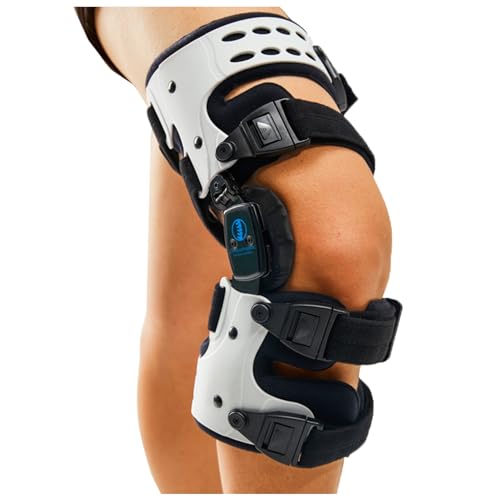
This unloader brace packs 13 range-of-motion dial stops into a frame that accommodates thigh circumferences up to 32 inches — rare for a mid-range brace that doesn’t require a custom fitting. The aluminum and foam construction weighs just over a pound, making it lighter than most dual-hinge models at this price tier. It can be configured for either medial or lateral offloading by reversing the hinge module.
Users with daily medial knee pain report that the brace lets them function through full workdays and light gym sessions without the grinding sensation of bone-on-bone contact. The hex-key hardware and screwdriver included in the box allow you to swap ROM stops on the fly, which is useful for progressive rehab protocols. One review mentions wearing it every day for months without the buckles loosening.
The retention system has a weak point. The buckle clips can pop loose during deep flexion — a known issue during squatting or crouching. A few users with meniscus injuries noted that their physical therapist confirmed this brace only stabilizes lateral ligaments, not meniscal lesions. For pure medial OA offloading it performs well, but it’s not a universal knee support.
Why it’s great
- 13 ROM dial stops for controlled rehab progression.
- Fits large thighs up to 32-inch circumference.
- Reversible hinge for medial or lateral offloading.
Good to know
- Buckle clips can release during deep squatting.
- Not designed for meniscus-specific stabilization.
5. DonJoy Drytex Sport Hinged Knee Brace
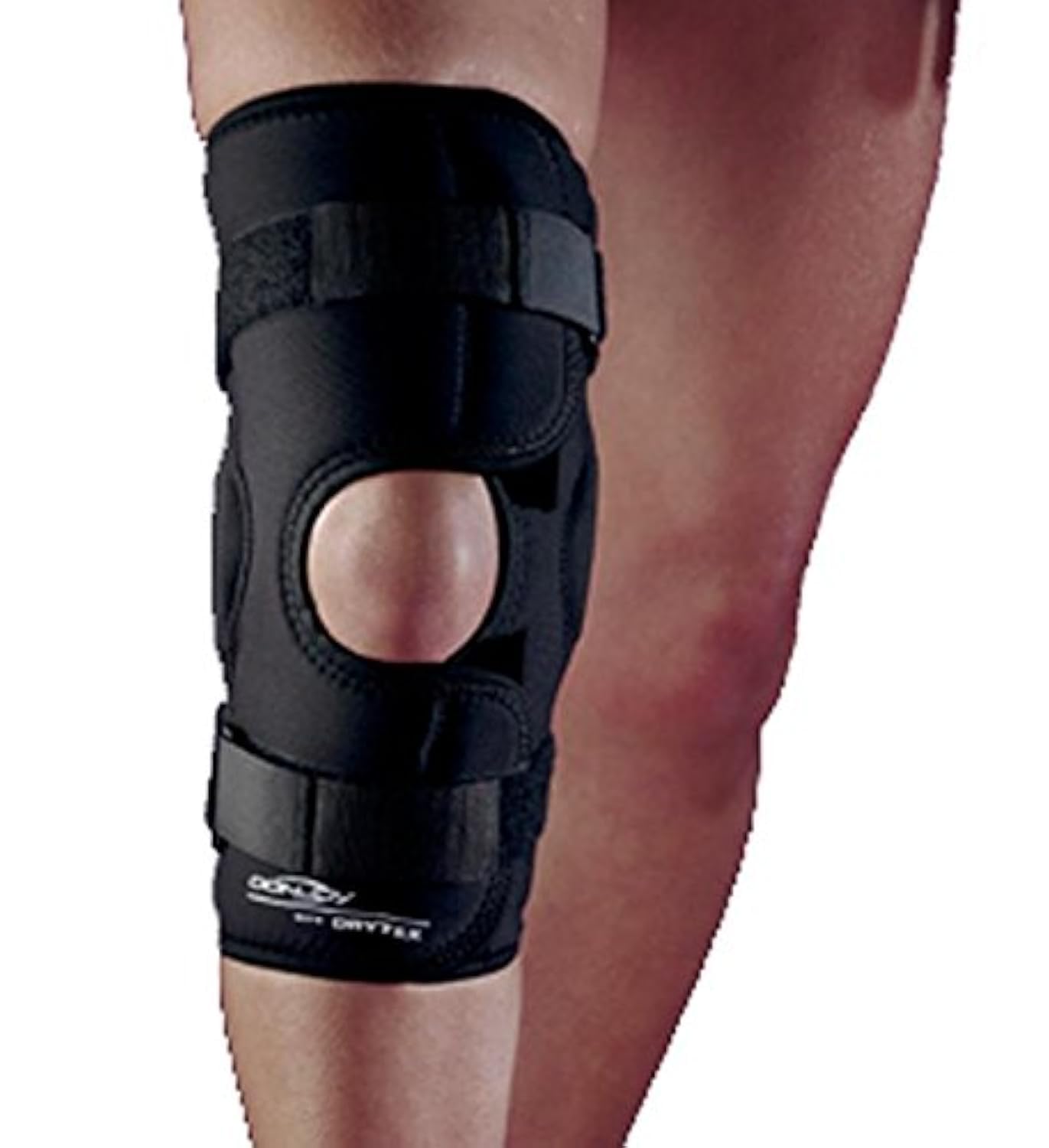
DonJoy’s Drytex Sport is a sleeved hinge brace aimed at players recovering from grade II ligament sprains or meniscus repairs who need more stability than a sleeve but don’t want the weight of a full frame. The Drytex fabric is more breathable than standard neoprene, which reduces sweat pooling in the popliteal fossa. The lateral metal hinge adds varus/valgus resistance without a bulky bilateral frame.
Users report that it provides noticeably more support than an Ace bandage for partial ACL tears, and the compressive sleeve helps with proprioceptive awareness during cutting drills. The hinge geometry is polycentric — it follows the natural roll-back of the femur during deep flexion, so it doesn’t bind when you squat into a three-point stance. One buyer replaced an identical unit that had lasted several years of weekly use before the elastic fatigued.
The Achilles’ heel is the elastic. Multiple reviews note that the sleeve stretches out after two to three weeks of daily wear, causing the brace to slide down the leg even when straps are tightened fully. It also tends to itch against bare skin — wearing a thin compression layer underneath helps but adds bulk. For short rehab windows (four to six weeks) it’s adequate, but not built for a full season.
Why it’s great
- Breathable Drytex fabric reduces sweat buildup.
- Polycentric hinge tracks natural knee motion.
- Good stepping stone from sleeve to rigid frame.
Good to know
- Elastic sleeve can stretch out within weeks.
- Tends to slide down with extended wear.
6. Mueller Sports Medicine Patella Stabilizer

Mueller’s Patella Stabilizer uses three coiled alloy straps that wrap around the thigh and calf, applying targeted pressure to keep the kneecap tracking properly through the femoral groove. It’s a non-hinged design, so you won’t get gross varus/valgus control, but the medio-lateral stabilization is remarkable for a sleeve-style brace. The breathable mesh liner reduces heat retention compared to dense neoprene models.
This is the brace that physician-recommended after patellar dislocations and chondromalacia patellae. One user with bilateral chrondromalacia reported that it eliminated crepitus during stair climbing and stayed in place through an entire work shift. The pull-on fit with adjustable straps is less intimidating than a frame brace — young athletes can apply it independently before practice. Seven sizing options cover thigh circumferences from 10 to 24 inches.
The coiled straps create a pressure band above the kneecap that some users find uncomfortable after extended wear — adhesive moleskin applied to the top edge mitigates the rubbing. It also lacks a rigid hinge, so if you have a complete ACL tear you need a frame brace, not this. As a patellar tracking aid for arthritis or mild instability, it’s a strong budget-tier answer.
Why it’s great
- Three alloy straps lock the patella in the groove.
- Breathable mesh prevents overheating.
- Proven for chondromalacia and post-dislocation rehab.
Good to know
- No rigid hinge — ineffective for complete ACL tears.
- Top strap can rub after hours of wear.
7. Shock Doctor Compression Knee Sleeve

This is a compression sleeve with integrated gel inlays that provide targeted pressure around the joint capsule — not a mechanical brace, but a solid option for tendonitis, minor arthritis, or patellar alignment issues where you don’t need rigid support. The contoured knit fabric allows full range of motion, and the anatomical shape prevents bunching in the back of the knee. It’s also the most discreet option under uniform pants.
Users with torn menisci report wearing this all day at work and through mountain bike rides without irritation. The gel pads stay put after multiple washes, which is unusual for compression sleeves at this level. The pull-on design is effortless: no straps, no buckles, no adjustment. For a skill player who just wants mild compression and warmth without losing mobility, this fills that slot cleanly.
It runs small — if you’re between sizes, the consensus is to go up one. The compression level is moderate, not therapeutic-grade, so it won’t offload or stabilize a ligament injury. It also slides down slightly on narrow legs during extended wear. Consider this a pre-habilitation or everyday comfort tool rather than a post-surgery brace.
Why it’s great
- Gel inlays add targeted compression to the joint.
- Pull-on design is fast and low-profile.
- Good for mild pain relief during active use.
Good to know
- Not rigid enough for ligament instability.
- Runs small — size up for proper fit.
FAQ
Can I wear a football knee brace over my compression tights?
What’s the difference between a hinged brace and an unloader brace?
How tight should a football knee brace feel?
Will a knee brace prevent my ACL from tearing again?
Final Thoughts: The Verdict
For most users, the best football knee brace winner is the DonJoy Performance BIONIC FULLSTOP because its four-point leverage hinge actively prevents hyperextension while the anti-migration sleeve keeps the brace locked through a full practice. If you want precise offloading for arthritis pain, grab the Ovation Medical Game Changer Unloader. And for a cost-conscious rehab frame that still offers 13 ROM stops, nothing beats the Comfyorthopedic OA Unloader.