
A welding glove that fails mid-weld isn’t just an inconvenience — it’s a safety hazard that can send you to the ER. Between managing rod heat, avoiding slag burns, and maintaining enough feel to lay a clean bead, the right pair of leathers makes the difference between a productive day and a painful one. The market is flooded with gloves that look tough but char through on the first real heat cycle, so finding a pair that actually holds up requires looking past the marketing at the real specs.
I’m Mohammad Maruf — the founder and writer behind Drink4Good. I’ve spent years analyzing welding glove construction, from the tensile strength of goat versus cowhide to the real-world breakdown of Kevlar stitching under repeated exposure to extreme heat.
After reviewing the material thickness, heat ratings, seam reinforcement, and liner quality of the top models on the market, I’ve separated the pair that genuinely protect from the ones that just look the part. Here is my curated list of the best welding gloves that actually earn their spot in your shop.
How To Choose The Best Welding Gloves
Not all leather gloves belong in a welding bay. A general-purpose work glove will char and disintegrate within minutes under a MIG arc, while a proper welding glove uses specific hide thickness, heat-resistant thread, and extended cuffs to keep you safe. Focus on these three factors to avoid wasting money on a glove that fails when it matters most.
Leather Type and Thickness
Goatskin grain leather offers the best balance of dexterity and heat resistance for TIG and detailed stick welding, staying soft without sacrificing structural integrity. Split cowhide runs thicker and resists punctures and abrasion better, making it the standard for heavy-duty MIG and forge work. A glove with a thickness of 1.0 mm to 1.2 mm hits the sweet spot for general use — anything thinner risks burn-through, and anything thicker robs you of the grip you need to feed rod consistently.
Cuff Length and Certification
A 14-inch cuff protects your wrist and lower forearm from arc flash and spatter, while a 23-inch gauntlet is essential for overhead welding or forge work where sparks rain directly down. Look for an EN407 heat-resistance certification — this independent standard tests for after-flame and burn-through at a declared temperature, giving you a real metric instead of a vague marketing claim. A glove rated to 932°F with zero after-flame is a fundamentally different product from one that just says “high heat.”
Stitching and Lining Durability
Kevlar thread resists melting and breaking under high heat much better than standard nylon or cotton stitching. A glove with Kevlar stitching through the stress points — fingertips, palm, and thumb crotch — will outlast a conventionally stitched glove by multiple seasons. A breathable cotton lining absorbs sweat and prevents the leather from baking against your skin during long shifts, but the lining should be anchored properly to prevent bunching inside the glove.
Quick Comparison
On smaller screens, swipe sideways to see the full table.
| Model | Category | Best For | Key Spec | Amazon |
|---|---|---|---|---|
| Grill Armor 16-Inch | Premium | MIG/Stick & Forge | EN407 certified 932°F | Amazon |
| Long Welding Gloves 23.6″ | Mid-Range | Overhead & Forge | 23.6-inch cowhide gauntlet | Amazon |
| YESWELDER Goatskin TIG | Mid-Range | TIG & Precision Work | Seamless index finger | Amazon |
| Kim Yuan Split Cowhide | Entry-Level | BBQ & Light Welding | 1.0-1.2mm cowhide | Amazon |
| ARCCAPTAIN Goatskin TIG | Entry-Level | TIG & Small Projects | Goatskin grain leather | Amazon |
In‑Depth Reviews
1. Grill Armor Welding Gloves – 16-Inch

The Grill Armor 16-Inch sets the standard for what a mid-premium welding glove should deliver. It is independently certified to EN407 standards for contact heat up to 932°F with zero after-flame and zero burn-through — a level of testing that most gloves in this price bracket skip entirely. The 16-inch length covers your full forearm, and the double-layer leather padding on the palms, fingers, and back adds meaningful wear resistance for MIG, stick, and forge work.
The leather starts supple out of the box, which means you don’t lose dexterity during the break-in period. Users report that the cuff extends to within two inches of the elbow, offering practical protection for overhead welding and fire pit tending. The cotton lining is soft and breathable, absorbing sweat during extended sessions without making your hands feel clammy. The ambidextrous design keeps things simple for quick changes between tasks.
One minor consideration is that the fingers can feel snug initially, especially for users with wider hands, though the leather does loosen up after a few wears. The brand markets these heavily toward grilling and fireplace use, but the EN407 certification and construction quality make them a legitimate choice for professional welding environments where heat resistance is non-negotiable.
Why it’s great
- EN407 certified for contact heat up to 932°F with zero burn-through
- Soft, supple leather that breaks in quickly without sacrificing grip
Good to know
- Fingers may feel tight on wider hands during initial wears
2. Long Welding Gloves 23.6 Inches 932℉
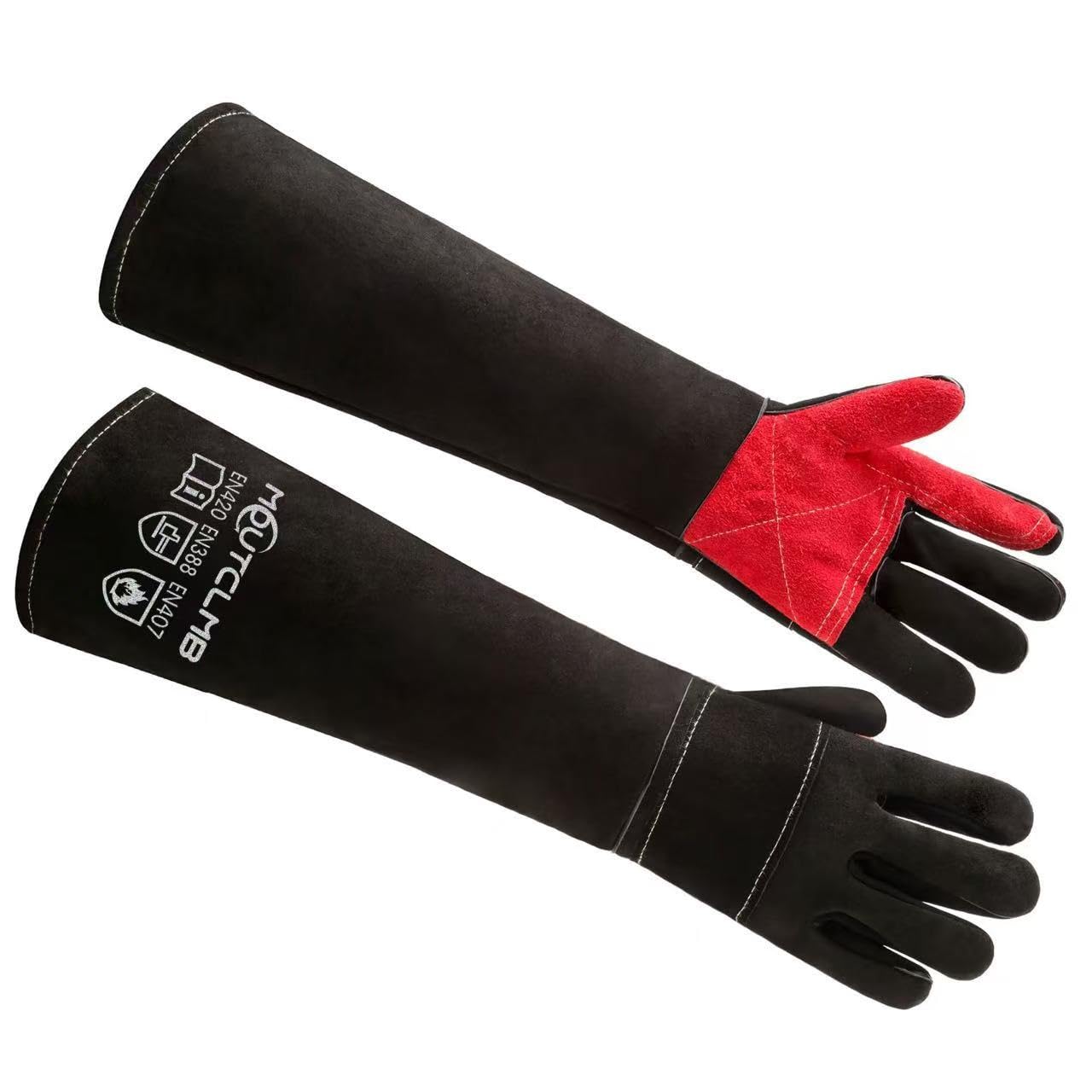
When you need forearm protection that reaches past standard glove lengths, this 23.6-inch cowhide gauntlet delivers the coverage required for overhead welding, forge work, and tasks where sparks and slag fall directly onto your arms. The extra length means you can fit the glove over a thick welding jacket sleeve without leaving a gap, which is a common failure point with shorter cuffs that expose the vulnerable wrist and inner forearm area.
The cowhide construction is thick enough to handle heavy MIG and stick welding sessions, and the 932°F heat rating — while not independently certified in the same manner as the Grill Armor — holds up well in real-world use. Users report surviving two seasons of wood stove and forge work before the stitching shows any degradation. The lining is a basic cotton layer that keeps sweat from soaking the leather from the inside.
The primary trade-off is that the thickness reduces dexterity compared to goatskin options. Picking up small tools or manipulating tongs requires more deliberate hand movement. Some users noted that the original black-and-red version had heat padding limitations, but a later gray replacement model offered lighter weight and better heat retention. These run large, so consider sizing down for a snug fit.
Why it’s great
- Unmatched 23.6-inch length for complete forearm protection above a jacket
- Thick cowhide withstands years of forge and wood stove exposure
Good to know
- Thick leather reduces finger dexterity for precise tool handling
3. YESWELDER Premium Goatskin TIG Welding Gloves

For welders who prioritize feel over brute heat protection — particularly TIG operators — the YESWELDER goatskin gloves offer a level of dexterity that split cowhide simply cannot match. The top-grain goatskin is thin enough to allow you to feel the filler rod feed through your fingers while still providing adequate protection against spatter and contact heat. The seamless index finger and keystone thumb design eliminate internal seams that cause hot spots and discomfort during long welding sessions.
The Kevlar-reinforced stitching at the high-wear zones — fingertips and palm — adds meaningful longevity to a glove that, by nature of being thin, will wear faster than a heavy MIG gauntlet. The unlined palm improves tactile feedback, which is critical when you need to maintain a consistent arc length during TIG welding. The unlined palm also helps with grip, reducing the chance of the rod slipping.
The trade-off is clear: these are not grinding or fitting gloves. The thin goatskin will develop holes relatively quickly if you use them for material handling, grinding, or any task that involves abrasion. They are purpose-built for welding, specifically TIG and light stick work, where heat exposure is concentrated and immediate. If you need a single glove for both welding and grinding, look at the heavier cowhide options instead.
Why it’s great
- Thin goatskin grain provides exceptional dexterity for TIG rod control
- Seamless index finger and keystone thumb reduce pressure points
Good to know
- Not durable for grinding or fitting tasks — holes will develop quickly
4. Kim Yuan Extreme Heat & Fire Resistant Gloves

The Kim Yuan gloves prove that you don’t need to spend a premium to get functional heat protection. Using 1.0 mm to 1.2 mm split cowhide with full Kevlar stitching throughout, these gloves hold up to sustained MIG and stick welding heat without the stitching failing. The 14-inch length provides adequate forearm coverage for table-level work, and the denim jean cuff adds a layer of spark deflection that prevents debris from entering the glove opening.
The practical test results are impressive for the price point. Users report two years of heavy seasonal use on wood stoves and fireplaces with no visible wear to the leather or stitching. The gloves handle direct flame contact long enough to adjust burning logs, and the cotton lining keeps hands comfortable during extended wear. The 662°F heat rating is modest compared to premium options, but for light-to-moderate welding and general heat handling, it is more than sufficient.
The main downsides are the lack of independent heat certification and the thicker cowhide construction that limits fine motor control. These are not ideal for TIG welding where fingertip sensitivity matters. The denim cuff, while practical, is not as durable as a full-leather gauntlet and may fray over extended use. However, for the price, the Kim Yuan gloves deliver outstanding durability and heat protection for general shop work.
Why it’s great
- Kevlar stitching throughout prevents seam failure under high heat
- Proven two-year durability for wood stove and light welding use
Good to know
- Thick cowhide lacks the dexterity needed for precision TIG work
5. ARCCAPTAIN Tig Welding Gloves

ARCCAPTAIN’s goatskin TIG gloves are a solid entry point for new welders who want a comfortable, well-constructed glove without over-investing upfront. The goatskin grain leather is thick enough to handle stick and flux-core welding heat while remaining flexible enough for day-long wear. Users report logging around 150 hours of solid welding before the gloves finally burn through — impressive longevity for a sub-premium pair, especially for small-project welders who don’t run production shifts.
The cotton lining is thick and comfortable, preventing the leather from baking against your skin during extended sessions. The gloves come with a natural fit that doesn’t require a lengthy break-in period, and the stitching holds up well under moderate heat exposure. For a beginner or hobbyist running a handful of beads per session, these gloves offer more than enough protection and comfort.
The limitation is durability at the upper end of the heat spectrum. After 150 hours, users did report burn-through in the high-wear zones, which is expected for a goatskin glove in this price tier. These are not designed for production-level MIG or forge work where sustained contact heat is the norm. For the price, they are a great value for learning the craft, but experienced welders may want to step up to a heavier option for daily professional use.
Why it’s great
- Comfortable right out of the box with minimal break-in required
- Holds up to about 150 hours of solid stick and flux-core welding
Good to know
- Will burn through in high-wear zones after extended heavy use
FAQ
What thickness of leather is ideal for MIG welding gloves?
How long do goatskin TIG gloves typically last before needing replacement?
Can I use welding gloves for blacksmithing and forge work?
Final Thoughts: The Verdict
For most users, the best welding gloves winner is the Grill Armor 16-Inch because it delivers independently certified heat protection, comfortable goatskin-like leather, and a 16-inch gauntlet that covers your forearm without the bulk of a full forge gauntlet. If you need maximum reach for overhead welding, grab the Long Welding Gloves 23.6 Inches. And for TIG welders who refuse to compromise on dexterity, nothing beats the YESWELDER Premium Goatskin for fingertip feel and rod control.