
Lugging a pedalboard the size of a coffee table to every gig and rehearsal is a grind that kills the creative spark before you even plug in. The modern multi-effects processor collapses a studio’s worth of amps, cabinets, and stompboxes into a single unit you can sling over your shoulder — but choosing the wrong one can leave you with thin, digital-sounding tones that lack the dynamic feel of the real thing.
I’m Mohammad Maruf — the founder and writer behind Drink4Good. I’ve spent years analyzing the hardware specs, amp modeling algorithms, and user experiences behind dozens of guitar processors to separate the units that genuinely capture tube-amp feel from those that fall short.
This guide covers the most capable units on the market across a wide range of features and budgets, helping you find the right best guitar processor for your playing style, whether you’re a bedroom producer, a weekend warrior, or a touring professional.
How To Choose The Best Guitar Processor
Choosing the right processor starts with understanding your core use case: silent home recording, full-band live performance, or a hybrid rig. The best unit for you depends on the amp modeling depth, the number of simultaneous effects, the quality of the built-in audio interface, and the physical controls available for real-time tweaking.
Amp Modeling and Cabinet Simulation Quality
The processor’s modeling technology determines how closely the digital output mimics a real tube amp and speaker cabinet. Look for units that use proprietary modeling (like AIRD, MNRS, or HX) or AI-based capture technology. Support for loading third-party Impulse Responses (IRs) is a major advantage, as it lets you swap out the sound of different speaker cabinets and microphones.
Routing, I/O, and Portability
Consider the processor’s connectivity: stereo outputs, an effects loop for integrating your favorite analog pedals, XLR outs for direct connection to a PA system, and a headphone jack for silent practice. MIDI I/O and an expression pedal input open up advanced control options. For live players, the number and layout of footswitches and the clarity of the display are critical for navigating presets mid-song.
Quick Comparison
On smaller screens, swipe sideways to see the full table.
| Model | Category | Best For | Key Spec | Amazon |
|---|---|---|---|---|
| Line 6 HX Stomp | Compact Pro | Pro pedalboard replacement | 300+ HX models, 6 blocks | Amazon |
| HeadRush Prime | Flagship | Full studio/gig command center | 7″ touchscreen, amp cloner | Amazon |
| BOSS ME-90 | Amp/Stomp Hybrid | Physical knob control | 60 GT-1000 effects, 11 AIRD amps | Amazon |
| IK Multimedia TONEX Pedal | AI Capture | Ultra-realistic amp profiles | 150 presets, VIR cabinets | Amazon |
| VALETON GP-200 | Workstation | Deep effects + drum machine | 240+ effects, 4.3″ TFT screen | Amazon |
| IK Multimedia TONEX One | Micro Modeler | Ultra-portable pro tones | 20 presets, micro-pedal size | Amazon |
| HeadRush FRFR108 MKII | FRFR Speaker | Flat-response monitoring | 2000W, 8″ woofer + HF driver | Amazon |
| MOOER GE150 Pro | All-In-One | Budget portable all-rounder | 55 amp models, 40 drum patterns | Amazon |
| Zoom MS-50G+ | Stompbox Multi | Compact pedalboard addition | 100 effects, 6-chain patches | Amazon |
In‑Depth Reviews
1. Line 6 HX Stomp

The HX Stomp packs the full Helix modeling engine into a chassis that’s smaller than a standard pedal, delivering 300+ effects and amp models derived from the flagship Helix floor unit. The key advantage here is the depth of the modeling — every amp model responds to your picking dynamics and guitar volume knob in a way that feels convincingly analog. Users consistently report that it transforms their practice and recording workflow, replacing multi-pedal boards with a unit that fits in a backpack.
With up to six simultaneous amp, cab, and effect blocks, the HX Stomp offers incredible flexibility for such a compact build. The three capacitive-sensing footswitches feature color-coded LED rings that make preset navigation and snapshot switching intuitive once you invest time in learning the menu architecture. The editor software (HX Edit) significantly speeds up patch creation on a computer.
Its 9V power requirement and stereo 1/4-inch I/O make it easy to integrate into existing rigs, and the built-in audio interface handles direct recording at up to 24-bit resolution. The onboard tuner is highly accurate and eliminates the need for a dedicated tuner pedal. Some users find the learning curve steep for deep editing on the unit itself, but the sonic payoff and portability make it the single most versatile option for players who need high-end studio tones from a non-intimidating footprint.
Why it’s great
- Industry-standard HX modeling sounds indistinguishable from real tube amps in blind tests
- Compact size allows it to fit on any pedalboard or sit on a desktop for studio work
- Built-in USB audio interface with re-amping capability for recording flexibility
Good to know
- Learning curve is real — expect a few sessions to master navigating the interface
- Only three footswitches out of the box; additional external footswitches recommended for live use
- Power supply is not included, requiring a 9V DC 300mA adapter or a high-current power brick
2. HeadRush Prime

The HeadRush Prime represents the cutting edge of hardware guitar processing with its 7-inch touchscreen interface and integrated Smart Amp Cloner technology. This is not just a multi-effects pedal — it’s a full guitar and vocal processing workstation that can capture the sound, dynamic, and feel of your favorite amplifiers and pedals with Wi-Fi cloud sharing. The 12 customizable footswitches with display screens give you instant visual feedback of every rig’s status, making it the most stage-friendly unit in this lineup.
Beyond guitar processing, the Prime features a complete vocal FX suite including Antares Auto-Tune, a built-in drum machine with 134 patterns from Alesis Drums/BFD, and a 180-second looper with MIDI sync. The audio interface supports 24-bit 96kHz recording and Bluetooth audio streaming for backing tracks. The steel chassis and built-in Wi-Fi for cloud sharing are significant upgrades over competitors that require extra adapters for wireless connectivity.
The Prime supports over 350 built-in IRs and allows loading of third-party cabinet captures, giving you virtually unlimited control over your final tone. The gapless preset switching with reverb/delay spillover ensures seamless transitions during live performances. Its weight and size are considerable, but for players who need a true one-stop rig that handles guitar, vocals, and backing tracks in a single pedalboard, the Prime delivers an unmatched ecosystem. The learning investment is moderate, but the touchscreen reduces menu diving significantly compared to button-only interfaces.
Why it’s great
- Amp cloning technology allows you to capture and recall your exact analog rig’s sound
- Vocal processing with Auto-Tune eliminates the need for a separate vocal effects unit
- Large touchscreen makes patch creation and editing feel like using a tablet
Good to know
- Considerable physical footprint makes it less suitable for ultra-portable rigs
- Hard cases and travel bags are difficult to source and can be expensive
- Requires a 12V power supply, not compatible with standard 9V pedalboard power
3. BOSS ME-90
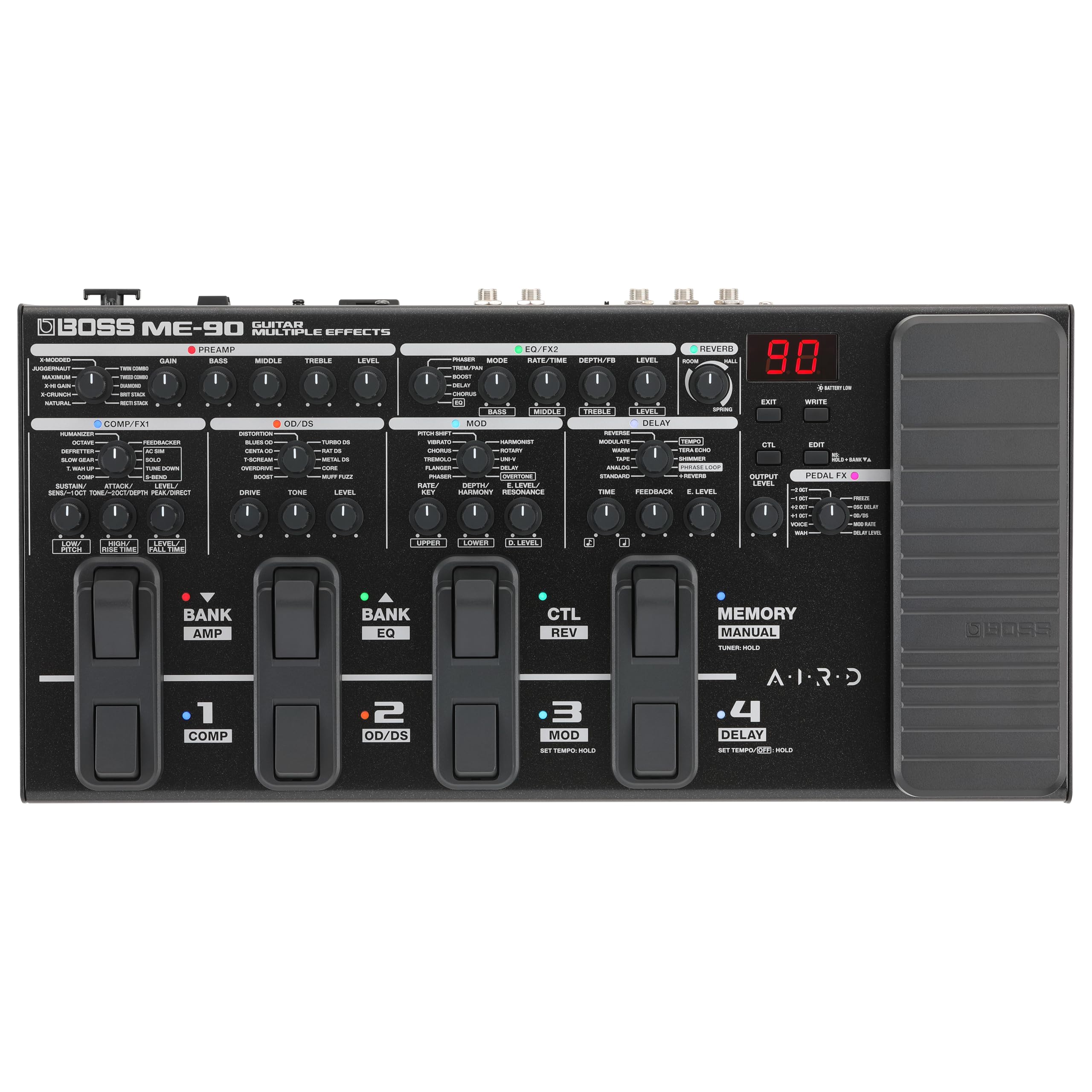
The BOSS ME-90 is a love letter to guitarists who prefer a physical knob-and-footswitch interface over deep digital menus. It packs 60 effects derived from the flagship GT-1000 and 11 AIRD amp models into a layout that feels exactly like a row of individual stompboxes. For players who hate scrolling through parameter pages on a small screen, the ME-90’s dedicated knobs for amp gain, EQ, and effect mix make tone crafting instantaneous and intuitive.
The unit features eight multi-function footswitches and a redesigned expression pedal with a built-in toe switch, giving you robust real-time control over volume, wah, and parameter modulation. It offers 36 factory presets and 36 user presets, with IR loading support for cabinet customization. The optional Bluetooth Audio MIDI Dual Adaptor enables wireless editing via the BOSS Tone Studio app on iOS or Android, which is a significant convenience for stage tweaks.
Processing is handled by 24-bit AD/DA conversion with 32-bit floating-point processing, ensuring high dynamic range and clarity. Users report the presets often need significant EQ adjustment — typical for BOSS units — but the unit can deliver exceptional clean, crunch, and high-gain tones after customization. Its ability to run on six AA batteries for portable use is a rare and practical feature. Some players note that the expression pedal’s volume ramp-up is slightly aggressive, but for anyone seeking stompbox-like ergonomics without a board full of cables, the ME-90 is a top-tier choice.
Why it’s great
- True hands-on knob control with no menu diving for core tone shaping
- Battery-powered operation (6x AA) makes it useful for on-the-go and busking
- Effects loop lets you blend your favorite analog pedals with the digital rig
Good to know
- Factory presets are voiced bright and aggressive, requiring tweaking for warm tones
- Expression pedal has a noticeable volume swell curve that some find intrusive
- Using the USB-C output for direct recording disables headphone monitoring in some configurations
4. IK Multimedia TONEX Pedal

The TONEX Pedal leverages AI Machine Modeling to capture the exact sound and feel of real amps, cabinets, and pedals with a fidelity that rivals using the actual gear. It comes preloaded with 150 gig-ready presets and gives you access to over 25,000 Tone Models via the ToneNET platform. The VIR (Volumetric Impulse Response) technology delivers multi-IR cabinet simulations that make the unit sound more three-dimensional than many competitors at this level.
The pedal includes a stereo multi-effects engine with 15 pre/post-effects including distortion, reverb, delay, modulation, compression, and a noise gate. The routing flexibility allows you to place effects before or after the amp model, giving you deep control over your signal chain. It also supports loading custom IRs and comes with the TONEX SE software for creating your own tone models from your personal amp collection.
Users consistently praise the tone quality, describing it as organic and premium, but the UI/UX receives mixed feedback. On-unit editing is functional but less intuitive than computer-based editors, and the software environment requires some patience to master. The unit lacks a dedicated power switch, and some users report noise issues, particularly with single-coil pickups. For players willing to invest time in the ecosystem, the TONEX Pedal delivers the most authentic amp-capture experience in a portable floor format.
Why it’s great
- AI-captured amp profiles sound and feel remarkably close to the real hardware
- Access to a massive library of 25,000+ tones from the ToneNET community
- VIR cabinet modeling provides superior depth and spatial realism
Good to know
- User interface on the pedal requires a learning curve to navigate efficiently
- Software ecosystem (ToneX Editor) has three separate components, clunky integration
- Some noise floor issues reported when using single-coil guitars at high gain settings
5. VALETON GP-200

The VALETON GP-200 punches well above its weight class with a 4.3-inch TFT color touchscreen and a massive library of 240+ effects, 140 amp/cab simulations, and 100 known stompbox models. What sets it apart is its relative ease of use for a unit with this depth — the menu system is designed to be intuitive, with most edits reachable within two layers. The 8 customizable LED footswitches, XLR outputs, and an effects loop make it genuinely stage-ready.
The GP-200 includes 100 built-in drum rhythms and a 180-second looper, both controllable via the footswitches. It also features a USB Type-C audio interface with OTG support for direct recording to iOS/Android devices. The all-metal chassis and Gorilla Glass screen protection give it a premium, roadworthy feel. Users report its amp models are indistinguishable from the real thing, with particular praise for its Fender-style clean tones and high-gain Marshalls.
One of the GP-200’s strongest features is its signal chain flexibility — you can reorder up to 11 simultaneous effect blocks in the app. The free Mac/Windows software offers comprehensive editing and preset management. Some users note that the unit’s initial cab simulation default is set to ‘off’ for the main outputs, requiring a quick global setting adjustment. Overall, the GP-200 offers one of the most feature-dense and user-friendly experiences in the mid-range segment.
Why it’s great
- Large, bright touchscreen makes patch editing clear and fast, even on a dark stage
- All-metal construction with reinforced screen glass for durability
- Built-in drum machine and USB-C audio interface for practice and recording
Good to know
- Cab simulation is disabled on main outputs out of the box, requires manual enabling
- Power supply requires 9V DC at 100mA center-negative; not a universal power format
- Editing software does not support dragging and dropping across multiple monitors
6. IK Multimedia TONEX One

The TONEX One shrinks the full AI tone modeling power of the larger TONEX Pedal into a micro-pedal format that’s smaller than most overdrive pedals. It can load up to 20 presets in A/B or on/off configurations, making it a powerful ultra-portable option for players who want access to premium amp captures without taking up half a pedalboard. The TRS mono/stereo output lets you connect to real amps, PA systems, or FRFR cabinets seamlessly.
Despite its tiny footprint, the TONEX One includes a tuner, EQ, noise gate, compressor, and reverb as onboard effects. The customizable micro-knob colors help you identify different presets quickly on a dark stage. It connects to the TONEX Librarian software to load and organize over 25,000 Tone Models from the ToneNET library, and the included TONEX SE software lets you capture and model your own amp rig.
Users report the sound quality rivals units costing significantly more, with transients and dynamics that feel immediate and responsive. The free delay and modulation update has expanded its usefulness. However, the lack of MIDI support limits its integration with complex MIDI-controlled rigs. The user interface for auditioning and switching between all 25,000+ models can also feel clunky without a computer connected. For players who want a compact, killer-sounding amp modeler that fits in a pocket of a gig bag, the TONEX One is an outstanding choice.
Why it’s great
- Incredibly small footprint but delivers full-quality AI Tone Modeling
- USB-C powered, simplifying your power setup on a pedalboard
- Access to the massive ToneNET library for endless tone options
Good to know
- No MIDI I/O limits its integration into larger, switchable rigs
- Auditioning tons of Tone Models requires a computer for efficient browsing
- Setup can require troubleshooting, particularly with TS cables versus TRS connections
7. HeadRush FRFR108 MKII
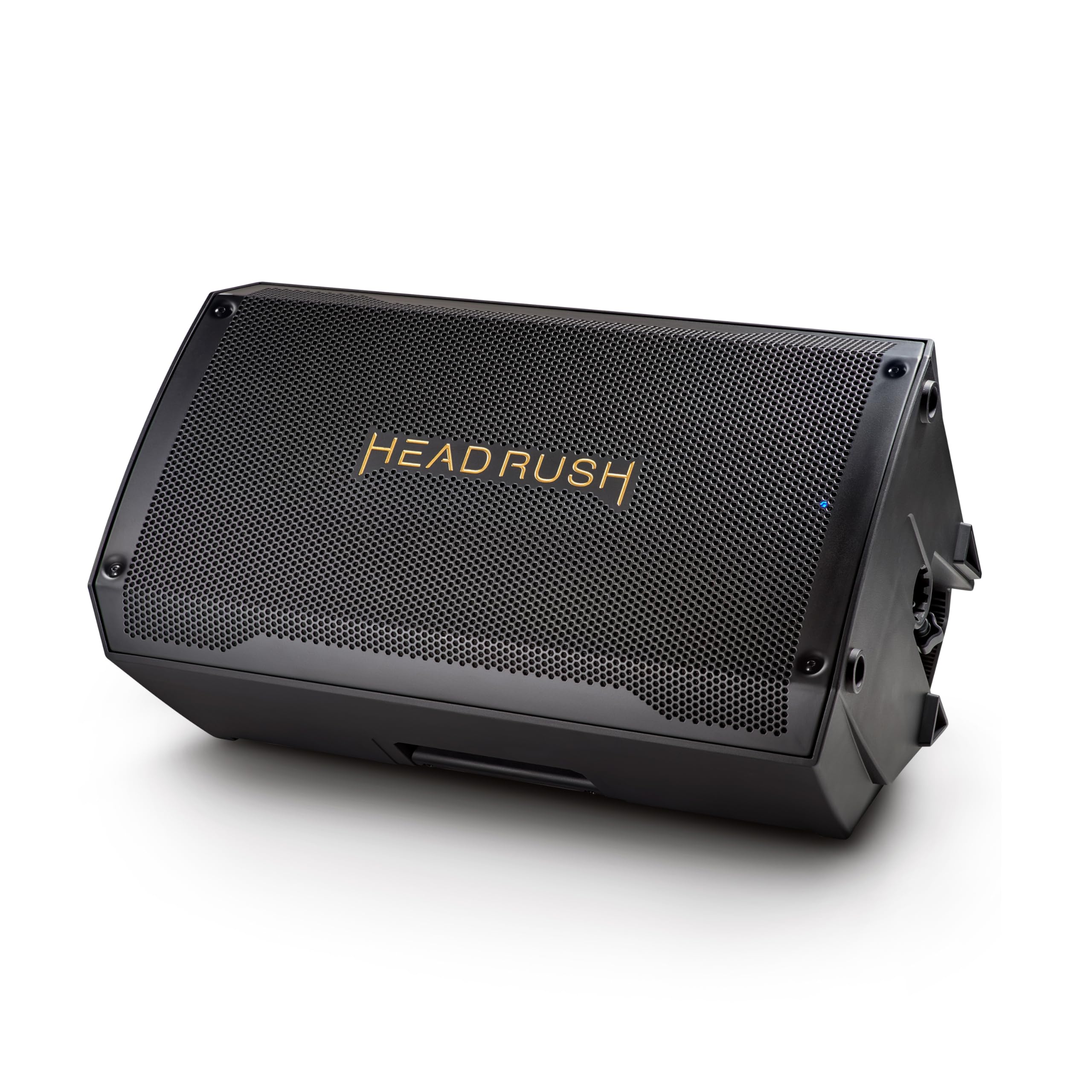
The HeadRush FRFR108 MKII is not a guitar processor itself but a dedicated full-range flat-response cabinet designed specifically for use with multi-effects processors and amp modelers. Its 2000W peak amplifier and 8-inch woofer with a 1-inch HF compression driver provide the accuracy needed to hear exactly what your processor is outputting, without the coloration of a traditional guitar amp. This is the recommended monitoring solution for players who want to hear their modelers as they were designed.
The cabinet features two XLR/TRS combo inputs with independent volume controls, a ground-lift switch to eliminate hum, an HPF EQ switch for cutting through muddy stage mixes, and an XLR link output for daisy-chaining speakers. Bluetooth 5.0 allows you to stream backing tracks wirelessly. The unit can be used upright, as a wedge, or mounted on a pole.
Weighing 21 pounds, the MKII is relatively portable for a powered cabinet in its class. Users find it loud enough for small to medium venues and rehearsals. Some note that the titanium tweeters can produce a bright, piercing high end with distorted tones, which may require some EQ adjustment from your processor. The build quality is solid, and the combination of inputs and connectivity makes it a versatile hub for any modeling rig. For players who own a high-end processor and need a transparent output system, this is an essential companion.
Why it’s great
- True flat response accurately reproduces your modeler’s amp and cabinet simulations
- Bluetooth streaming allows easy integration of backing tracks for practice or gigs
- Lightweight design for a powered FRFR cabinet at just 21 pounds
Good to know
- Titanium tweeters can sound harsh on high-gain settings without EQ adjustments
- Not a traditional guitar amp — requires a processor or modeler to produce sound
- For larger venues, two units or a subwoofer may be needed for full frequency response
8. MOOER GE150 Pro

The MOOER GE150 Pro packs 55 classic amp preamps using MNRS modeling technology, 26 high-quality cabinet simulations, and a full suite of effects into a compact, white-finished chassis. It supports loading MNRS sample files (GNR and GIR) for both amp and cab modules, giving you 20 slots each for custom captures. The inclusion of an effects loop, XLR output, and an expression pedal at this tier is rare and adds significant value for players on a budget.
The built-in 80-second stereo looper and 40 drum rhythms with 10 metronome modes provide excellent practice tools, all controllable via the four multi-purpose footswitches. The USB Type-C interface supports OTG connectivity for direct recording to mobile devices. Users report it replaces most of a pedalboard’s worth of gear and sounds great once you dial in the presets, though the factory presets can be inconsistent.
The lithium battery version (GE150 Pro Li) offers up to 9 hours of operation, making it a truly portable all-in-one solution. Some users have noted initial firmware issues with software connectivity, though MOOER’s customer support has been responsive with updates. The GE150 Pro’s strength is its sheer value proposition — it offers drum machine, looper, amp modeling, effects, and an expression pedal for a very accessible investment. For a practice rig or a backup unit, it is hard to beat.
Why it’s great
- Built-in lithium battery option provides 9 hours of cord-free operation
- XLR output with cab simulation makes it ready for direct PA connection
- Includes an effects loop and expression pedal at the budget-friendly tier
Good to know
- Factory presets often require significant tweaking to sound their best
- Some units may need a firmware update to fix initial software connectivity
- Not intended for demanding professional touring; more suited for practice and jamming
9. Zoom MS-50G+

The Zoom MS-50G+ is a single-stompbox multi-effects unit containing 100 different effects including drives, modulations, delays, reverbs, compressors, and filters. Its defining feature is the ability to chain up to six effects in any order to create custom patches, making it a remarkably powerful tool for a pedal that fits in the same space as a standard overdrive. The metal build, color LCD, and cross-key foot switches make navigation straightforward.
The pedal features true stereo outputs for spatial effects and a built-in chromatic tuner that supports standard, open, and drop tunings. It can be powered via USB-C, two AA batteries, or a standard 9V port, giving you flexibility for any setup. The Handy Guitar Lab app allows you to expand the effects library over time by downloading new algorithms. Users report it is excellent for synths, drum machines, and even kalimba, making it a versatile studio utility tool.
The MS-50G+ uses a single stereo input, so it works best as a mono-in, stereo-out device for guitar. The parameter knobs offer wide adjustability, and the unit’s foot-only operation can be frustrating for some who want to tweak settings while standing. The spring reverb, delay, and tremolo algorithms are good but not on par with dedicated standalone pedals. As a “swiss army knife” of effects for home recording, portability, or experimentation, the MS-50G+ delivers incredible creative potential in a tiny package.
Why it’s great
- 100 high-quality effects in a single standard-pedal footprint
- Six-effect chain with reorderable blocks allows for complex patch creation
- Multi-power option (USB-C, AA batteries, 9V) for maximum flexibility
Good to know
- Parameter knobs are sensitive and can be difficult to adjust precisely by foot
- Initial use can be overwhelming due to the sheer number of effects (option paralysis)
- Not a replacement for high-end dedicated pedals if you already own a premium collection
FAQ
Can a guitar processor replace a tube amp for live performance?
What is the difference between an amp modeler and a multi-effects processor?
Do guitar processors work well with bass guitar?
Final Thoughts: The Verdict
For most users, the best guitar processor winner is the Line 6 HX Stomp because it delivers professional-grade HX modeling in a compact, pedalboard-friendly format that works for both studio and stage. If you want the ultimate all-in-one workstation with vocal processing and amp cloning, grab the HeadRush Prime. And for a tactile, knob-driven experience that feels like a traditional pedalboard, nothing beats the BOSS ME-90.