
That first scratch across a windshield or glass tabletop feels like a permanent scar, but for most light surface damage, a quality repair compound can restore optical clarity without a costly replacement. The trick lies in distinguishing fine scratches you can barely feel from deeper chips that need a different approach entirely.
I’m Mohammad Maruf — the founder and writer behind Drink4Good. After analyzing the particle sizes, purity levels, and application methods across the top-selling glass repair formulas, I’ve separated the kits that genuinely restore clarity from those that just make a mess.
This guide breaks down the core differences between cerium oxide polishes and resin-based fillers, helping you choose the right best glass repair kit for your specific type of damage without overspending or wasting time on the wrong approach.
How To Choose The Best Glass Repair Kit
Glass repair isn’t one-size-fits-all. A kit built for polishing a lightly scratched windshield uses a completely different chemical mechanism than a kit designed to fill a rock chip. Understanding these two paths saves you from buying the wrong product and making damage worse.
Assess the Damage Depth with the Fingernail Test
Run your fingernail across the scratch. If your nail catches, the defect is too deep for any cerium oxide polish — you need a resin-based filler that bonds inside the crack. If your nail glides smoothly, the scratch is surface-level and a polishing compound with 3.5-micron particles will likely remove it completely.
Choose Between Polishing Compound and Resin Filler
Cerium oxide kits (powder or paste) mechanically abrade the glass surface to level out fine scratches, wiper marks, and water spots. They require a drill or rotary tool with a felt pad. Resin kits, like those from Rain-X, inject a liquid polymer into chips and cracks that hardens under UV light, stopping cracks from spreading. The wrong choice means either a polished surface with a still-visible crack or a filled chip surrounded by unpolished haze.
Check the Particle Size and Purity
For cerium oxide powders, purity matters as much as grit size. Look for at least 85% cerium oxide content with a consistent particle size around 3.5 microns. Coarser particles can leave micro-scratches, while inconsistent sizing produces uneven results. Suspension-treated formulas stay mixed in water longer, reducing splatter and improving application control.
Quick Comparison
On smaller screens, swipe sideways to see the full table.
| Model | Category | Best For | Key Spec | Amazon |
|---|---|---|---|---|
| 3D Glass Polish | Cerium Oxide Paste | Light scratches & wiper marks | 16 oz ready-to-use liquid | Amazon |
| Glass Polish Pro | Cerium Oxide Powder | Fine scratch removal & restoration | 85% pure, 3.5 micron | Amazon |
| Teenyyou 1.1 lb | Cerium Oxide Powder | Bulk polishing on multiple surfaces | 3.5 micron avg particle | Amazon |
| Gordon Glass Cerium Oxide Kit | Cerium Oxide Powder | Stubborn stains & scuffs | 8 oz powder + 3″ felt wheel | Amazon |
| Rain-X Windshield Repair Kit (6-Pack) | Resin Filler | Stone chips & crack prevention | Advanced resin formula | Amazon |
In‑Depth Reviews
1. 3D Glass Polish – Cerium-Oxide Based Window Polish (16 oz)
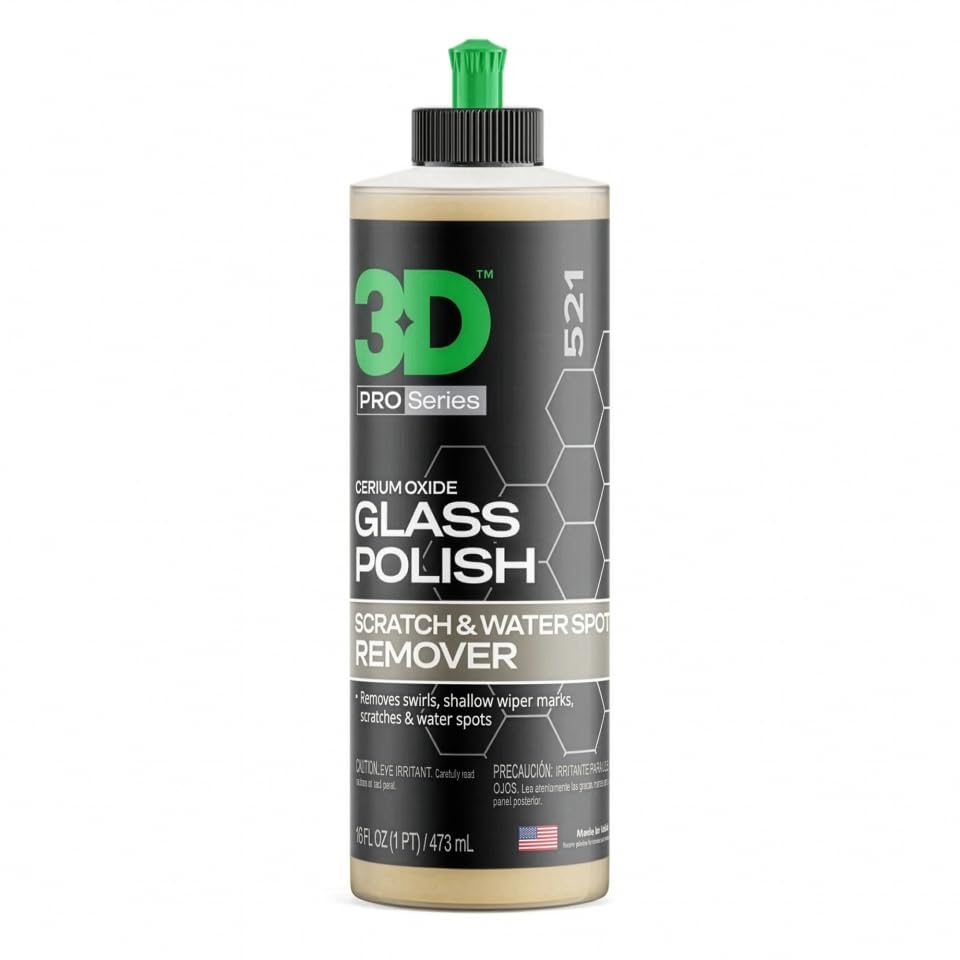
The 3D Glass Polish stands apart because it arrives as a ready-to-use cerium oxide paste, eliminating the guesswork of mixing powder-to-water ratios. This 16-ounce bottle is formulated for extended open time, meaning the compound stays workable long enough to tackle an entire windshield without drying out mid-polish. Automotive detailers favor this for removing wiper marks, etched water spots, and fine swirls that accumulate on daily drivers.
Apply with a rotary polisher and a wool or felt pad at low speed, misting the surface with water to activate the cerium oxide. Users report that superficial scratches from scrapes or aluminum tools buff out completely, restoring glass to like-new clarity. The polish also preps glass surfaces for ceramic coatings by removing embedded contaminants that prevent proper bonding.
Keep in mind that this is a surface-level abrasive — it will not fill deep chips or cracks your fingernail catches. Several users noted that while it cleaned and polished well, it couldn’t erase deeper abrasions. The formula is also drippy, so mask off painted trim and rubber seals to avoid white residue stains.
Why it’s great
- No mixing required — apply straight from the bottle
- Long open time allows thorough panel-by-panel work
- Excellent pre-coating prep for hydrophobic treatments
Good to know
- Requires a rotary or dual-action polisher for best results
- Not effective on scratches deeper than a fingernail catch
- Can leave white residue on adjacent trim if not masked
2. Glass Polish Pro Cerium Oxide Polishing Powder (8.8 oz)
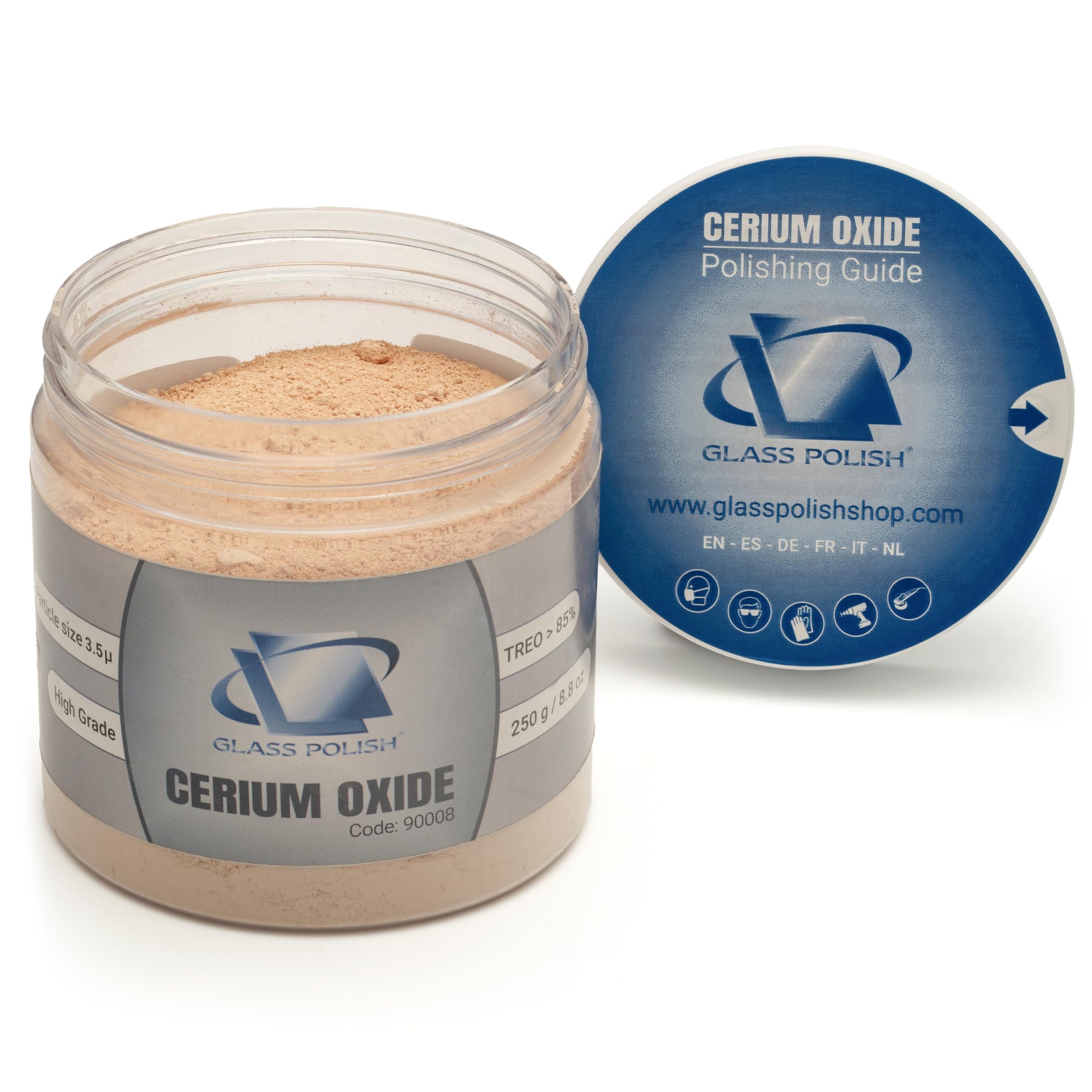
The Glass Polish Pro uses an 85% pure cerium oxide powder with a refined 3.5-micron particle size, a formula backed by over 20 years of professional glass repair experience. The suspension-treated technology keeps the powder evenly distributed in water, reducing splatter and allowing the slurry to be reactivated with a quick mist — critical for longer polishing sessions on large surfaces like windshields or shower screens.
Testers successfully removed heavy mineral deposits and light scratches from a 2007 Mustang coupe using a 5-inch wool pad on a drill, applying eight coating passes that consumed roughly half the jar. The powder works on all glass types — laminated windshields, tempered side windows, mirrors, and even ceramic or marble surfaces. For fine scratches that are barely visible, this compound polishes them out faster than generic auto-store pastes.
Be aware that this is a true polishing abrasive, not a scratch remover. Deep scratches — those you can feel with a fingernail — will only dissipate, not vanish, and may require several hours of buffing. Users also note the fine powder creates a messy slurry that splatters, so covering nearby surfaces and wearing a respirator is recommended.
Why it’s great
- High purity (85%) yields faster polishing than lower-grade compounds
- Suspension-treated formula reduces splatter and stays mixed
- Works on glass, mirrors, marble, and ceramic surfaces
Good to know
- No instructions included — requires research on water-to-powder ratio
- Deep scratches take multiple sessions or remain visible
- Powder is messy and requires masking of painted surfaces
3. Teenyyou Cerium Oxide Polishing Powder (1.1 lb)

The Teenyyou kit delivers the most powder per dollar in this roundup with a full 1.1-pound jar, and independent measurements confirm the jar often exceeds its stated weight, sometimes hitting 1.3 pounds. The cerium oxide is milled to a consistent 3.5-micron average particle size, suitable for glass, stone, marble, and ceramic surfaces. A separate wide-mouth plastic container is included for decanting, which helps manage the fine dust during use.
One reviewer removed stubborn unknown residue from an old windshield in about an hour of buffing on both sides. The powder activates quickly with water and maintains a stable slurry that does not separate as fast as some lower-grade alternatives.
As with any dry cerium oxide, the process is messy — the fine powder becomes airborne easily and the wet slurry splatters across the workspace. Wear a mask and gloves, and tape off adjacent car trim or glass frames before starting. This kit is best suited for buyers who plan multiple restoration projects and want a large supply of consistent abrasive at a reasonable per-ounce cost.
Why it’s great
- Generous 1.1 lb supply exceeds most competitor offerings
- Consistent 3.5 micron particles produce even polishing
- Effective on glass, headlights, and ceramic surfaces
Good to know
- Creates messy slurry that requires workspace protection
- Respirator and gloves recommended during mixing
- Deep, nail-catchable scratches will not be removed
4. Gordon Glass Cerium Oxide Glass Polishing Kit (8 oz)
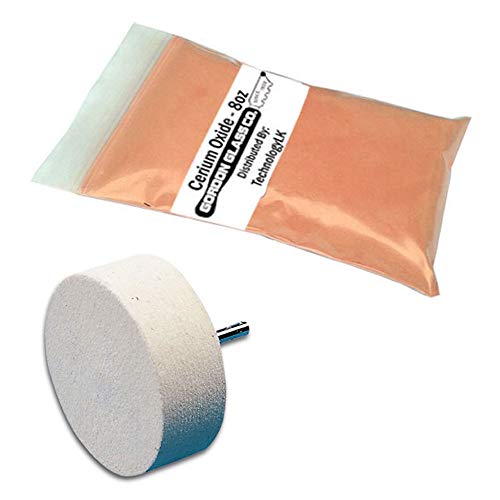
The Gordon Glass kit bundles 8 ounces of cerium oxide powder with a 3-inch diameter felt polishing wheel that mounts to any standard electric drill or grinder. This all-in-one approach removes the separate purchase of a backing pad, making it the most straightforward entry point for someone who already owns a drill but has no polishing gear. The felt wheel is dense enough to hold the slurry against vertical glass surfaces like windows or shower doors.
Testers successfully removed fine scratches from a Tesla windshield caused by a razor blade in about 20 minutes of careful buffing, saving the cost of a full windshield replacement. The powder works best when mixed into a slurry using roughly a 2:1 water-to-oxide ratio — keep a spray bottle handy to rewet the surface as the compound dries. Reports indicate the oxide can be left to dry and then reused by simply adding more water, meaning little material is wasted.
The main drawback is the lack of written instructions. Multiple users expressed frustration about not knowing the ideal mixing ratio or recommended drill speed. The felt pad is also only 3 inches, which works well for spot repairs but makes covering large windshield expanses labor-intensive. Deep scratches and chips are beyond this kit’s capability.
Why it’s great
- Includes a drill-compatible felt polishing wheel
- Dry powder can be mixed and reused multiple times
- Effective on fine scratches from razor blades and scuffs
Good to know
- No mixing instructions or application guide included
- 3-inch pad is slow for large windshield coverage
- Does not address deep chips or cracks
5. Rain-X 600001-6PK Windshield Repair Kit (Pack of 6)

The Rain-X Windshield Repair Kit uses an advanced resin formula that fills stone chips and small cracks from the inside out, stopping the damage from spreading across the windshield. This is a fundamentally different mechanism from the cerium oxide polishes above — instead of abrading glass, the resin bonds to the glass layers and hardens under UV exposure. It works on all types of laminated windshields, making it a critical tool for anyone who drives on highways where flying debris is common.
Each six-pack provides enough material for multiple repairs, with users reporting 95% visual improvement on quarter-sized chips and complete crack arrest on windshields with integrated safety sensor systems. The trick to getting an invisible repair is applying the resin on a cool windshield and then exposing it to direct sunlight for proper curing. One RV owner noted that after using this kit, no chip or crack ever spread further, saving thousands in replacement costs.
The setup process is fiddly — the syringe and bridge applicator require careful alignment over the chip, and the instructions could be clearer about evacuation steps. This kit is also unsuitable for large bullseye chips or cracks longer than a few inches. It is a preventive fix, not a cosmetic restoration, so some residual haze or a faint ring may remain after the resin cures.
Why it’s great
- Six kits in one pack cover multiple repairs or vehicles
- Resin stops cracks from spreading under temperature stress
- Works with modern windshields containing safety sensors
Good to know
- Setup is fiddly and requires patience on first use
- Not for large bullseye chips or cracks over three inches
- Some residual haze may remain after curing
FAQ
Can a glass repair kit remove a deep scratch I can feel with my fingernail?
How long does cerium oxide polishing take to show results?
Is a resin repair kit permanent for windshield chips?
Final Thoughts: The Verdict
For most users, the best glass repair kit winner is the 3D Glass Polish because it combines a ready-to-use cerium oxide paste with long open time and pro-level clarity on light scratches. If you want the best bulk value for multiple restorations, grab the Teenyyou Cerium Oxide Powder. And for preventing rock chips from turning into cracked windshields, nothing beats the Rain-X Repair Kit 6-Pack.