
A thin, poorly shielded speaker cable is the single most common reason a killer amp rig sounds thin, hums loudly, or drops signal mid-solo. The wrong cable doesn’t just degrade your tone — it can dump raw current into places it doesn’t belong, creating a safety hazard inside your cabinet. Choosing the right one is about conductor gauge, connector integrity, and shielding density — not marketing stickers on the package.
I’m Mohammad Maruf — the founder and writer behind Drink4Good. I’ve spent years analyzing the construction specs, real-world durability data, and customer failure reports across dozens of audio cables to isolate the models that actually survive the stage and studio.
Whether you are connecting a head to a 4×12 cabinet or running signal to a passive monitor wedge, the right guitar amp speaker cable protects your gear from power loss and interference that cheaper alternatives invite.
How To Choose The Best Guitar Amp Speaker Cable
The defining factor is conductor gauge — 12 AWG delivers lower resistance over longer runs, while 14 AWG is acceptable for shorter patch cables between head and cabinet. Beyond gauge, look at plug type: molded rubber sleeves offer basic protection, but heat-shrinked metal barrels with internal strain relief survive repeated coiling and stomping far longer. Shielding also matters — a braided copper shield around the conductors blocks the hum from nearby power supplies, which is essential when your amp sits inches from a lighting dimmer pack.
Gauge — The Real Power Handling Spec
American Wire Gauge (AWG) is an inverse scale: lower numbers mean thicker wire. A 12 AWG cable handles high-current amplifiers (over 500 watts RMS) with minimal voltage drop, preserving the full transient punch of your bass or guitar amp. A 14 AWG cable is sufficient for most guitar heads under 100 watts routed to a single cabinet — but if you are daisy-chaining cabinets or running lengths over 10 feet, step up to 12 AWG.
Connector Construction and Strain Relief
The mechanical weak point is always the joint where the wire meets the 1/4-inch TS plug. Look for molded plugs with internal strain clamps or heat-shrink tubing that extends past the solder joint. The best designs use oversized barrels that grip the cable jacket securely, preventing the conductor from twisting or pulling loose during transport. Avoid cables where the plug rotates freely around the wire — that is a guaranteed failure point.
Shielding vs. No Shielding — The Common Misconception
Many players assume speaker cables need heavy shielding like instrument cables, but the truth depends on your environment. A braided or foil shield is important when running the cable near power transformers, dimmer packs, or wireless antenna racks. In a clean studio setup with short cable runs, unshielded twisted-pair construction can work fine. The safest bet is a cable with at least one layer of braided shielding and a foil wrap to cover radio-frequency interference.
Quick Comparison
On smaller screens, swipe sideways to see the full table.
| Model | Category | Best For | Key Spec | Amazon |
|---|---|---|---|---|
| GLS Audio 12 AWG 3 ft | Mid-Range | High-wattage head to cab | 12 AWG conductor | Amazon |
| Pig Hog PHSC3 14 AWG 3 ft | Mid-Range | Durable stage cable | 9.2mm rubber jacket | Amazon |
| D’Addario Classic Series | Mid-Range | Noise rejection | Dual-layer shielding | Amazon |
| UMOKI 12 AWG 15 ft 2-Pack | Mid-Range | Long runs / 2-pack value | 12 AWG OFC conductor | Amazon |
| GEARit 14 AWG CL2 200 ft | Budget | In-wall installation | CL2 rated spool | Amazon |
In‑Depth Reviews
1. GLS Audio Speaker Cable 12 AWG 3 ft

The GLS Audio cable is the first model that serious players and gigging musicians should consider. It uses a true 12 AWG copper conductor wrapped in a flexible 10.5mm rubber jacket — noticeably thicker than standard 16 AWG cables. The oversized 1/4-inch TS plugs have heat-shrink strain relief over the solder joint, preventing the internal connection from fracturing when the cable is yanked or stepped on. Customers running over 1000 watts through bass amps report zero signal loss or overheating, which confirms the gauge rating is honest.
The cable ships with a reusable hook-and-loop strap for wrapping, a small but practical detail for live rigs. Multiple verified reviews from professional musicians and an electronics technician describe it as “better value than DIY” — given the consistent soldering quality and robust connector barrels, that claim holds up. The 3-foot length is perfect for connecting a head to a top-mounted cabinet jack without creating a loop of slack.
Some users wish the connectors were right-angled for tighter spaces, but the straight design is standard for speaker cables and fits most jacks without interference. The AWG rating is printed along the jacket, which is a nice transparency bonus — you can visually confirm you received 12 AWG, not a thinner substitute.
Why it’s great
- True 12 AWG conductor handles high-wattage amps without power loss.
- Heat-shrink reinforced strain relief increases connector lifespan.
- Reusable hook-and-loop strap keeps the cable tidy in a gig bag.
Good to know
- 3-foot length limits use to head-to-cab connections only.
- Straight plugs may not fit recessed jacks without clearance.
2. Pig Hog PHSC3 14 AWG 3 ft

Pig Hog built this cable around a 14 AWG conductor with an unusually thick 9.2mm rubber outer jacket — the jacket is the star here. That extra thickness cushions the wire against stomps, rolling casters, and being coiled tightly into a pedalboard case. The 1/4-inch TS plugs use heat-shrink protectors that extend well past the solder joint, and the connector barrels have a wrapped texture that prevents them from loosening during vibration. Verified buyers using it on Marshall JCM2000 DSL heads report a secure, quiet connection with no hum.
The gauge is 14 AWG rather than 12 AWG, so it is best suited for guitar heads under 100 watts or short patch runs between a head and a single 2×12 cabinet. For bass rigs or high-wattage power amps, stepping up to a 12 AWG cable is safer. Buyers appreciated that the ends protrude slightly more than other cables — this helps them reach front-mounted jacks on some combo amps, though it can bump into furniture in tight setups.
A few customers noted that ordering “used – like new” units carried the risk of damaged jack sleeves, so purchasing new is recommended for maximum reliability. The cable is available in multiple lengths, including longer runs for connecting powered mixers to passive PA speakers, which adds versatility for a single-cable solution.
Why it’s great
- Extra-thick 9.2mm rubber jacket provides superior physical protection.
- Heat-shrink connectors and wrapped barrels resist loosening from vibration.
- Slightly extended plug reach helps with recessed or front-mounted jacks.
Good to know
- 14 AWG gauge is not ideal for high-wattage bass amps or long runs.
- Used-condition listings may arrive with damaged jack sleeves.
3. D’Addario Classic Series Speaker Cable

Planet Waves, the D’Addario accessories division, brings its string-manufacturing precision to the Classic Series speaker cable. The key differentiator is the dual-layer shielding — a foil wrap plus a braided copper layer — that delivers strong noise rejection in electrically noisy environments. This is the cable to choose if your amp sits next to a computer, a dimmer rack, or a wireless receiver that tends to inject buzz. The molded plugs lock the wire securely in place without screws that can loosen over time.
The conductor is 16 AWG, which is adequate for lower-wattage guitar heads under 50 watts running to a single cabinet over a short distance. For higher power or longer runs, the thinner gauge means higher resistance and potential voltage drop. Customers using it with 120-watt guitar heads and 1000-watt bass amps report it works fine at this gauge, but the safety margin is narrower than a 12 AWG alternative. The In=Out Technology branding refers to low-capacitance construction that preserves treble clarity, though for a speaker cable the capacitance matters less than for an instrument cable.
Some buyers noted the molded plug design does not allow field serviceability — if the cable fails, you cannot easily re-solder it. The value proposition is clear: for the entry-level price, you get proven brand reliability and professional-grade shielding in a cable that lasts years under normal use. A great option for studio setups or practice rigs where interference is the primary concern.
Why it’s great
- Dual-layer shielding (foil + braid) rejects hum in noisy environments.
- In=Out Technology preserves signal transparency and longevity.
- Known brand reliability with consistent quality control.
Good to know
- 16 AWG conductor limits max safe wattage compared to 12 or 14 AWG.
- Molded plugs are not serviceable if the cable fails internally.
4. UMOKI 12 AWG 15 ft 2-Pack

UMOKI’s two-pack of 15-foot cables is the best option for musicians who need to run signal from a head to a cabinet positioned across the stage, or for connecting powered mixers to passive PA monitors. The cable uses 12 AWG oxygen-free copper (OFC) conductors, which maintain low resistance even over the full 15-foot run. The PVC-85P rubber jacket is thick enough to resist cuts from stage edges and cable ramps, while remaining flexible enough for coiling after a show. Buyers confirmed the cables performed well at live gigs with no audio dropouts or hum.
The connectors are standard male-to-male 1/4-inch TS plugs with proper soldering and heat-shrink insulation. One verified buyer noted the gauge appears visually closer to 14 AWG than 12 AWG, which suggests the actual conductor diameter may be slightly less than advertised. For most mid-wattage guitar amps under 200 watts, this is still sufficient, but users pushing 500+ watts through long runs should verify the conductor thickness themselves. The 2-pack pricing makes this a solid value compared to buying two premium single cables from major brands.
The cable comes with a 1-year warranty and 30-day return policy, which adds peace of mind for touring musicians. The weatherproof and high-speed claims on the listing are likely marketing — the PVC jacket does offer basic moisture protection, but the cable is not designed for outdoor installation like direct burial. For stage and studio use, it is a reliable, affordable long-run solution.
Why it’s great
- 12 AWG OFC conductor keeps resistance low over 15-foot runs.
- 2-pack provides excellent value for multiple setups or backup.
- Thick PVC-85P jacket protects against stage wear and tear.
Good to know
- Actual conductor gauge may be slightly thinner than 12 AWG.
- Not designed for permanent outdoor or direct burial installation.
5. GEARit 14 AWG CL2 Rated 200 ft
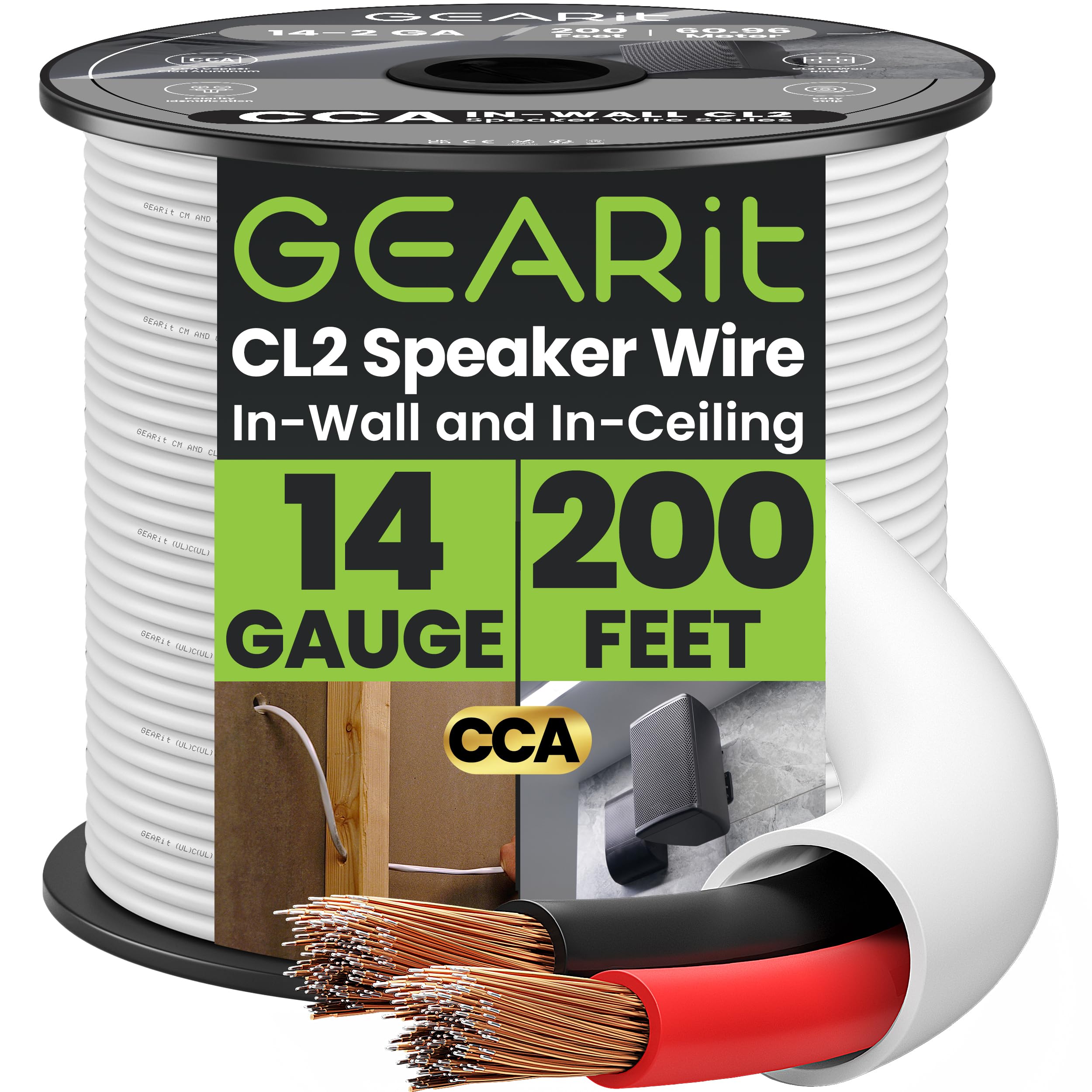
This is a spool of raw speaker wire, not a terminated cable — it is intended for in-wall installation or custom-length runs using banana plugs, spade connectors, or direct screw terminals. The 14 AWG copper-clad aluminum (CCA) conductor strikes a balance between conductivity and cost, though CCA has higher resistance per foot than pure copper. For whole-home audio systems or distributed speaker zones in a church or classroom, this is a practical choice that meets CL2 fire safety rating requirements for in-wall use. The white jacket with sequential foot markers makes precise cuts easy without measuring.
For guitar amp speaker cables specifically, the 14 AWG gauge is safe for short, high-current runs under 1000 watts, but the CCA composition is less forgiving than pure copper if the wire is nicked or bent sharply. The flexibility of the jacket is praised by installers who pulled it through wall studs and conduits — it resists kinking better than budget zip cord. The red and black color coding eliminates polarity confusion when terminating, which is critical for maintaining proper speaker phase in multi-driver setups.
This is not a direct replacement for a factory-terminated 1/4-inch speaker cable — you will need to add your own connectors or solder to a plug. For stage use where convenience and durability matter, a pre-terminated cable is faster and more reliable. The GEARit spool is best suited for permanent installations where you control every termination point and need precise lengths. Home theater and commercial audio projects are its core use case.
Why it’s great
- CL2 rated for safe in-wall installation in residential and commercial settings.
- Sequential foot markers allow precise cuts without measuring tape.
- Red/black color coding prevents speaker polarity errors.
Good to know
- Copper-clad aluminum has higher resistance than pure copper wire.
- Requires user-added connectors — not a plug-and-play speaker cable.
FAQ
Can I use a guitar instrument cable as a speaker cable?
What gauge speaker cable do I need for a 100-watt guitar head?
Final Thoughts: The Verdict
For most users, the guitar amp speaker cable winner is the GLS Audio 12 AWG 3 ft because it delivers professional-grade 12 AWG conductor thickness with heat-shrink strain relief at a surprisingly accessible price point. If you want extra physical protection for stage abuse, grab the Pig Hog PHSC3 with its massive 9.2mm jacket. And for long runs or multi-cabinet setups, nothing beats the value of the UMOKI 12 AWG 15 ft 2-Pack.