
Chasing the perfect HDR experience on a gaming monitor often feels like a war between two extremes: the crushing, inky blacks of OLED versus the raw, retina-searing brightness of a high-end LCD. The reality is that your choice dictates not just how shadows look, but how you actually react to threats in competitive titles like Call of Duty or Elden Ring. This guide cuts through the marketing to focus on the real metrics—contrast ratio, peak luminance, color volume, and motion clarity—that define true HDR performance.
I’m Mohammad Maruf — the founder and writer behind Drink4Good. I’ve spent countless hours analyzing panel technologies and spec sheets to understand how VESA DisplayHDR ratings translate to real-world gameplay across different budgets and use cases.
Whether you are chasing the deepest blacks for horror games or the blistering highlights needed to spot an enemy in a sun-drenched battlefield, this deep-dive into the best hdr gaming monitor options will help you make a purchase that lasts for years, not months.
How To Choose The Best HDR Gaming Monitor
The HDR gaming monitor market has split into two distinct camps: the high-brightness LCD camp that targets sustained luminance (often boasting VESA DisplayHDR 600 or 1000) and the OLED camp that prioritizes infinite contrast ratios with VESA DisplayHDR True Black certification. Understanding which path suits your gaming environment and genre preferences is the first step to a satisfying purchase.
Contrast Ratio: The True Backbone of HDR
An LCD monitor with a 1,000:1 static contrast ratio will always struggle to display true HDR content because its backlight cannot turn off individual pixels. A modern OLED, by contrast, turns off each pixel completely, achieving an infinite contrast ratio. This allows for true blacks that make highlights appear dramatically more vivid. For the best HDR impact, look for monitors certified to VESA DisplayHDR True Black 400 or higher, as this standard specifically tests black level performance and color volume rather than just peak white output.
Refresh Rate and Response Time Synergy
High refresh rate panels (144Hz to 480Hz) are common today, but their benefit to HDR is often overlooked. A fast refresh rate paired with a sub-1ms response time (0.03ms in the case of OLED) ensures that the HDR image remains clear and sharp during rapid camera movements. Ghosting or motion blur will completely ruin the perception of detail in HDR scenes. Ensure your chosen monitor has a fast enough refresh rate for your GPU to utilize, or you will be paying for HDR headroom you cannot use.
Color Volume and HDR Brightness
Peak brightness (measured in nits) tells only half the story. Color volume—how well a panel can maintain its color saturation as it gets brighter—is what makes HDR look rich and three-dimensional. Monitors with 95% DCI-P3 coverage or higher, like QD-OLED panels, maintain vibrant colors even at high brightness levels. A monitor that is bright but has poor color gamut will look washed out, not vibrant.
Quick Comparison
On smaller screens, swipe sideways to see the full table.
| Model | Category | Best For | Key Spec | Amazon |
|---|---|---|---|---|
| ASUS ROG Swift PG32UCDM | Premium OLED | Ultimate HDR & Competitive Edge | 240Hz / 0.03ms / 1000 nits peak | Amazon |
| Sony INZONE M10S | Pro-Esports OLED | Ultra-Fast FPS (480Hz) | 480Hz / 0.03ms / 1440p | Amazon |
| Samsung Odyssey G8 G81SF | Premium 4K OLED | Bright Room HDR Gaming | 240Hz / 0.03ms / Glare Free | Amazon |
| MSI MPG 321URX | Premium OLED | Productivity & Gaming Hybrid | 240Hz / 0.03ms / KVM Switch | Amazon |
| Alienware AW3425DW | Ultrawide OLED | Immersive Ultrawide HDR | 240Hz / 0.03ms / 1800R Curve | Amazon |
| ASUS ROG Strix XG32UCG | High-End LCD | Dual Mode (4K & FHD 320Hz) | 0.3ms / Fast IPS / ELMB Sync | Amazon |
| LG 27GS93QE | Mid-Range OLED | Best Value OLED | 240Hz / 0.03ms / WOLED Panel | Amazon |
| AOC Q27GAZDV | Budget OLED | Entry-Level QD-OLED | 240Hz / 0.03ms / 1440p | Amazon |
| Acer Predator X27U | Budget OLED | Price-Performance OLED | 240Hz / 0.03ms / QD-OLED | Amazon |
| Samsung Odyssey G50D | Mid-Range IPS | All-Purpose QHD HDR | 180Hz / 1ms / DisplayHDR 400 | Amazon |
| CRUA 32″ Curve | Entry-Level LCD | 4K on a Tight Budget | 160Hz / VA / 3000:1 Contrast | Amazon |
In‑Depth Reviews
1. ASUS ROG Swift PG32UCDM

The ASUS ROG Swift PG32UCDM represents the current gold standard for HDR gaming. Its 32-inch 4K QD-OLED panel delivers a peak brightness of 1,000 nits, which is an outlier in the OLED world, coupled with the perfect black levels you expect from a self-emissive display. The 99% DCI-P3 gamut and True 10-bit color depth ensure that every HDR highlight and shadow transition is rendered with incredible fidelity. This monitor is built for those who want the absolute best visual experience and have the GPU budget to drive 240 frames per second at 4K.
Beyond the raw picture quality, ASUS has engineered this monitor for longevity. The custom heatsink and graphene film work together to mitigate burn-in risk, and the company backs it with a 3-year warranty that explicitly covers burn-in. The inclusion of a 90W USB-C port with DP Alt Mode makes it a seamless hub for both a high-end gaming PC and a laptop. Motion clarity is exceptional, with the 0.03ms GtG response time making the ELMB Sync feature almost redundant in practice.
The glossy screen finish is a major selling point for image depth, making colors pop with a three-dimensional quality that matte panels cannot replicate. While this means reflections can be an issue in a bright room, the sheer vibrancy gain is worth the trade-off for most gamers. This monitor is not just a purchase; it is an investment in the most immersive gaming experience currently available at this price point.
Why it’s great
- 1,000-nit peak brightness is outstanding for an OLED, allowing genuine HDR impact without washing out highlights.
- Graphene film and custom heatsink provide industry-leading burn-in prevention, backed by a 3-year warranty.
- Perfect black levels and 99% DCI-P3 color gamut deliver a reference-level HDR image.
Good to know
- Glossy screen is highly reflective; this monitor demands a controlled lighting environment for optimal HDR performance.
- The premium price tag places it at the top of the budget spectrum for this category.
- At 32 inches, 4K resolution requires a very powerful graphics card to hit 240 FPS in modern titles.
2. Sony INZONE M10S

The Sony INZONE M10S is engineered for one specific task: winning. With a 480Hz refresh rate on its 27-inch WOLED panel, this monitor offers motion clarity that is truly a leap beyond 240Hz displays. The 0.03ms response time means there is zero perceptible ghosting, and the image updates so fast that it feels like a direct neural link to the game world. For competitive players of Valorant, Overwatch 2, or Apex Legends, this is the most responsive monitor available.
Sony collaborated with the Fnatic esports team to develop Tournament Mode, which includes FPS Pro and FPS Pro+ settings that adjust the contrast and color saturation to make enemy models stand out against any background. The low-profile stand, which is only 4mm thick, frees up significant desk space for mouse movement. The display also features a 24.5-inch screen size mode for players who prefer the smaller viewing area common in competitive tournaments.
The HDR performance on this monitor is excellent but not its primary strength; peak brightness is limited to around 275 cd/m² to protect the panel, but the infinite contrast ratio of OLED still provides a striking HDR image. The passive cooling system with a large heatsink ensures no fan noise during intense sessions. This is a specialized tool for the high-competitive gamer who needs every millisecond advantage, and it delivers that with no compromises.
Why it’s great
- 480Hz refresh rate with 0.03ms response time is the fastest available, offering unprecedented motion clarity.
- Tournament Mode with FPS Pro+ provides a clear competitive advantage by enhancing target visibility.
- The low-profile stand is a desk-space solution, and the passive cooling system is completely silent.
Good to know
- Peak HDR brightness is lower than premium QD-OLED alternatives, making it less ideal for dark room single-player games.
- The 1440p resolution is a step down from 4K options, which may be a downgrade for users who also do creative work.
- The premium price reflects the esports-targeted features, not a general-purpose HDR experience.
3. Samsung Odyssey G8 G81SF
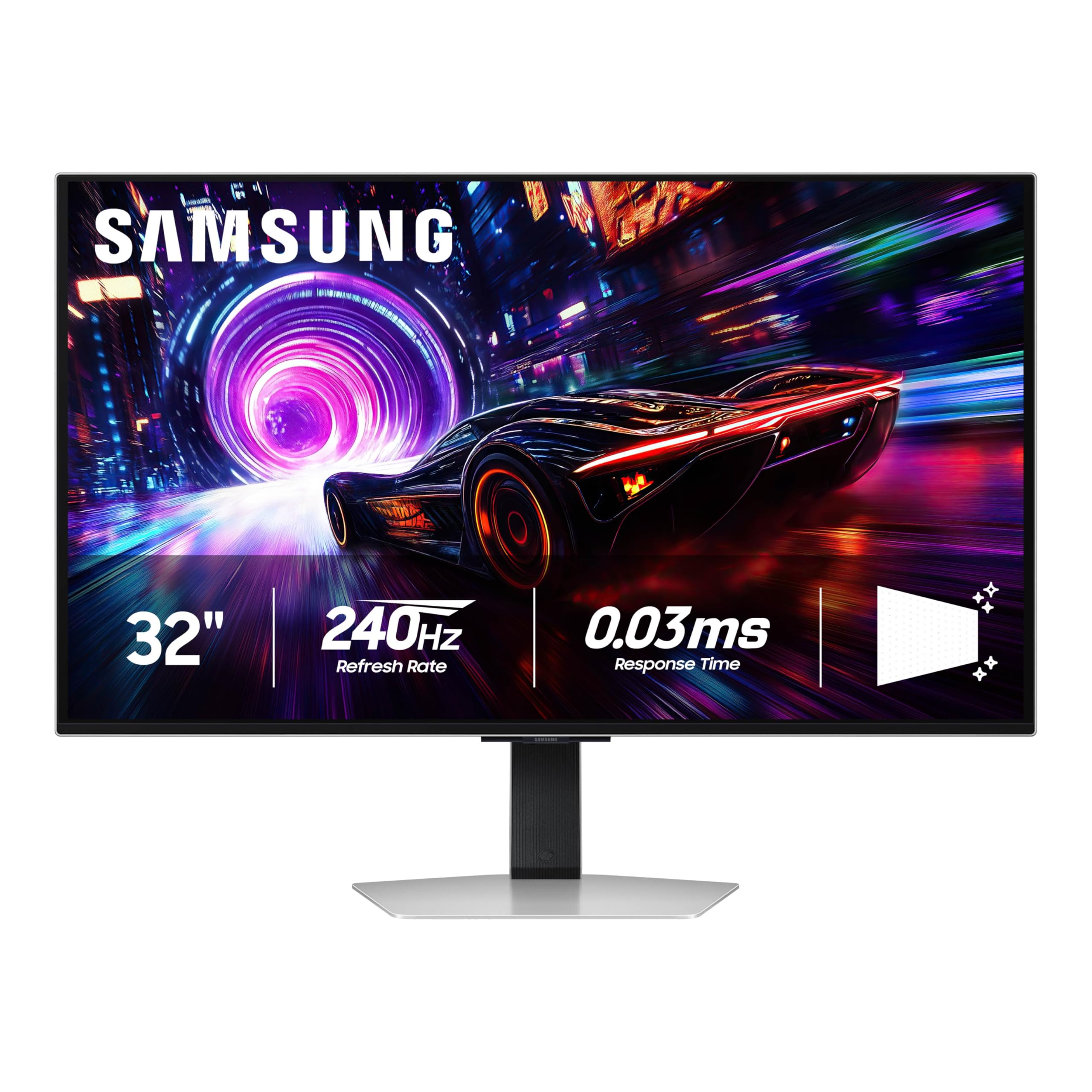
The Samsung Odyssey G8 G81SF solves the single biggest problem with OLED monitors: reflections. Its Glare Free technology makes the screen 54% less glossy than standard anti-reflection film, meaning you can use this monitor in a room with windows without fighting your own reflection. The 32-inch 4K QD-OLED panel delivers the same incredible contrast and color as the best in its class, making it a fantastic choice for gamers who cannot control their ambient lighting.
Beyond the screen finish, this monitor packs genuine innovation in its cooling system. Samsung uses a Pulsating Heat Pipe, a world first for monitors, which diffuses heat five times faster than a graphite sheet to actively prevent image retention and burn-in. The Thermal Modulation System automatically controls brightness to prevent overheating during prolonged HDR gaming sessions. For HDR gaming in a bright living room or home office, this is the most usable OLED monitor available.
The 240Hz refresh rate and 0.03ms response time ensure smooth gameplay, and the monitor supports both AMD FreeSync Premium Pro and G-Sync Compatible VRR. The CoreSync lighting projects on-screen colors onto the back of the monitor, adding immersion. The build quality is excellent, with a heavy metal stand, although the cheap-feeling plastic around the port area is a minor letdown. For bright rooms, this is the definitive 4K HDR OLED.
Why it’s great
- Glare Free technology makes it the best OLED choice for rooms with uncontrolled ambient light.
- Pulsating Heat Pipe cooling system offers active protection against burn-in during heavy use.
- Vibrant QD-OLED color and deep black levels with a premium, adjustable stand.
Good to know
- Some users report the power/menu button can be fragile; handle with care during setup.
- The anti-glare coating may appear slightly softer than a true glossy panel, slightly reducing perceived sharpness.
- Settings menu navigation can be less intuitive than competing brands like ASUS or LG.
4. MSI MPG 321URX

The MSI MPG 321URX is a 32-inch 4K QD-OLED that excels at being a productivity workstation during the day and a gaming powerhouse at night. The built-in KVM switch is the standout feature, allowing you to control two separate computers (e.g., your gaming PC and a work laptop) with a single keyboard, mouse, and monitor setup. For users who need one monitor for both professional work and high-end gaming, this feature alone justifies the premium price tag.
The HDR performance is stellar, with VESA DisplayHDR True Black 400 certification delivering perfect blacks and a 1.5M:1 contrast ratio. The 240Hz refresh rate and 0.03ms response time mean that fast-paced games look incredibly fluid. MSI’s OLED Care 2.0 includes pixel shift, panel refresh, and taskbar detection to mitigate burn-in risk, and the monitor has a reputation for crisp text clarity, which is a common weak point for OLED panels.
The 4-way adjustable stand includes height, tilt, swivel, and pivot adjustments, making it easy to find the perfect ergonomic position. The HDMI 2.1 ports support full 48Gbps bandwidth for 4K 120Hz gaming on PS5 and Xbox Series X. The G-Sync Compatible VRR ensures tear-free gameplay. If you need a single monitor that transitions seamlessly from a spreadsheet to a battlefield, the MPG 321URX is the best tool for the job.
Why it’s great
- Built-in KVM switch is a game-changer for users who share a monitor between a work and gaming PC.
- Excellent text clarity for an OLED, making it viable for long coding or document editing sessions.
- Superb HDR with True Black 400 and 99% DCI-P3 coverage for an immersive gaming experience.
Good to know
- Peak brightness in SDR mode can feel a bit low for very bright rooms; it is best suited for controlled lighting.
- The glossy screen, like other QD-OLEDs, is reflective and requires careful room setup.
- Mac users may need to adjust DisplayPort settings to avoid handshake issues with dual-monitor setups.
5. Alienware AW3425DW

The Alienware AW3425DW offers a different take on HDR gaming with its 34-inch ultrawide 21:9 aspect ratio and 1800R curve. The expansive field of view pulls you into the game world, making it ideal for immersive single-player titles like Cyberpunk 2077, Starfield, or Red Dead Redemption 2. The QD-OLED panel delivers the same infinite contrast, deep blacks, and vibrant colors that make HDR shine in these cinematic experiences.
The 240Hz refresh rate and 0.03ms response time ensure that the ultrawide experience remains fluid and responsive. The monitor supports both AMD FreeSync Premium Pro and NVIDIA G-Sync Compatible, so it works seamlessly with any modern GPU. The 99.3% DCI-P3 color coverage and Delta E < 2 color accuracy make it suitable for creative work as well, and the monitor includes a height-adjustable stand with tilt and swivel.
The HDR brightness is rated at 250 nits typical, with a VESA DisplayHDR TrueBlack 400 certification. While it does not hit the peak luminance of some 4K competitors, the sheer immersion of the ultrawide format combined with the OLED contrast creates a very compelling HDR experience. This is the monitor to get if you value peripheral vision and atmosphere over raw pixel density and sheer brightness.
Why it’s great
- 34-inch ultrawide 21:9 format provides unmatched immersion for single-player HDR games.
- QD-OLED panel delivers perfect blacks and vibrant, accurate colors right out of the box.
- Excellent build quality and ergonomic stand with flexible adjustment options.
Good to know
- Peak brightness is lower than 4K OLED alternatives; it is not the best choice for very bright rooms.
- Text clarity on ultrawide OLED is adequate but may show slight fringing at close viewing distances.
- Ultrawide support is inconsistent across games; some titles may require mods or fixes.
6. ASUS ROG Strix XG32UCG
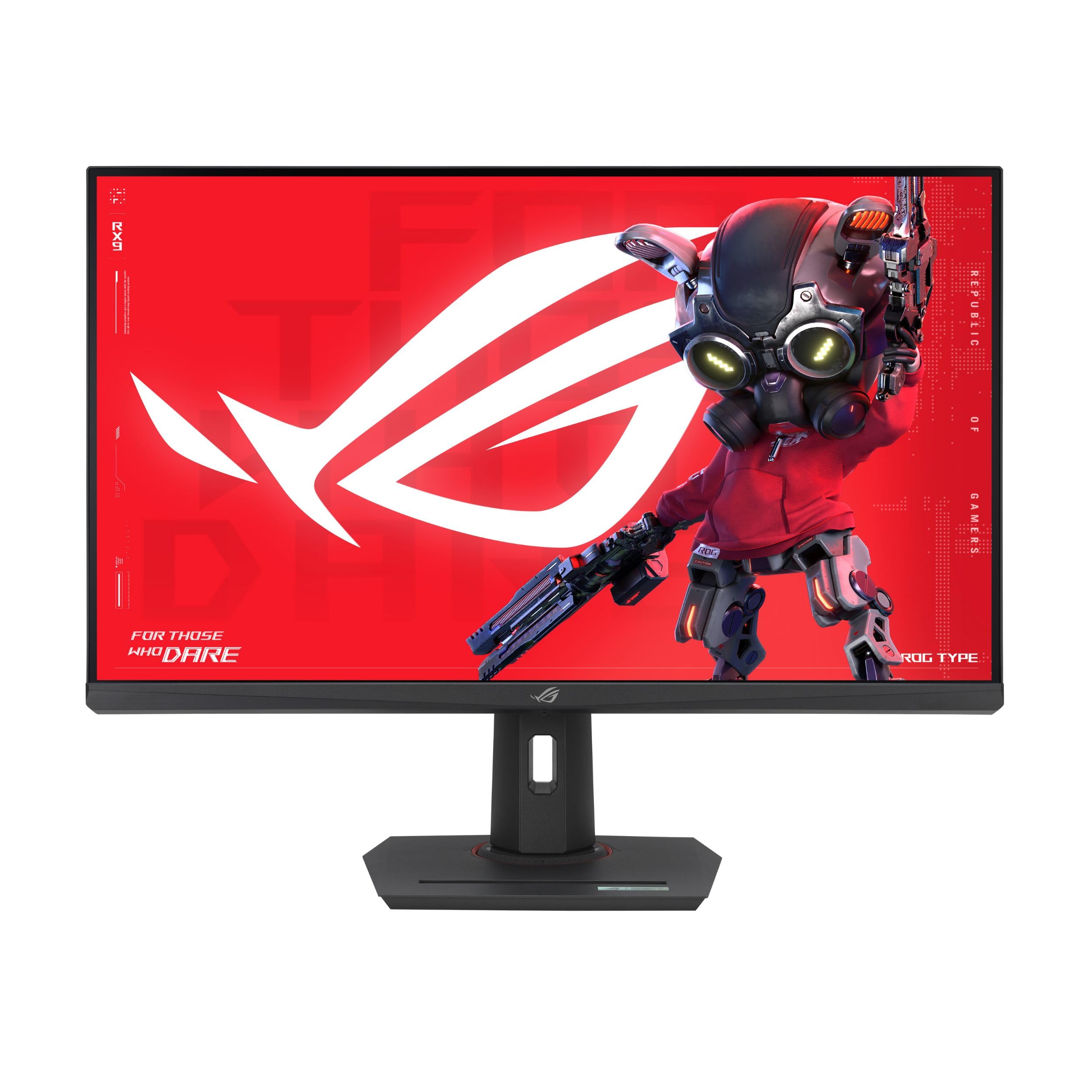
The ASUS ROG Strix XG32UCG is a high-end LCD monitor that competes directly with OLED by offering a dual-mode feature. You can switch between 4K @ 160Hz for visually rich single-player games and FHD @ 320Hz for ultra-smooth competitive play. This flexibility makes it a powerful all-rounder for gamers who play a variety of genres and want to maximize performance in each.
The Fast IPS panel provides a 0.3ms response time (MPRT) and ASUS’s Extreme Low Motion Blur Sync (ELMB SYNC) technology, which allows backlight strobing to work in conjunction with VRR. This eliminates ghosting and tearing simultaneously, which is rare in the LCD world. The 95% DCI-P3 color gamut and 100,000,000:1 dynamic contrast ratio (with a 1,000:1 static ratio) deliver a punchy HDR image that, while not matching OLED’s blacks, is impressively vibrant and bright.
The connectivity suite is excellent, featuring USB Type-C with DP Alt Mode for easy laptop hookup and a tripod socket for mounting a webcam or streaming light. The monitor also includes a 3-month Adobe Creative Cloud subscription. For users who are not ready to commit to OLED’s burn-in concerns or who need the high brightness of an IPS panel for a bright room, the XG32UCG is a very strong alternative.
Why it’s great
- Dual-mode feature offers the best of both worlds: 4K 160Hz for immersion and FHD 320Hz for competition.
- ELMB SYNC eliminates ghosting and tearing simultaneously, offering motion clarity that rivals OLED.
- Bright, vivid IPS panel with excellent HDR brightness suitable for rooms with ambient light.
Good to know
- Static 1,000:1 contrast ratio cannot match the inky blacks of an OLED panel.
- HDR peak brightness is high, but the lack of per-pixel dimming limits the true HDR experience.
- The dual-mode is resolution-specific (4K vs FHD), not refresh-rate adjustable across the entire range.
7. LG 27GS93QE
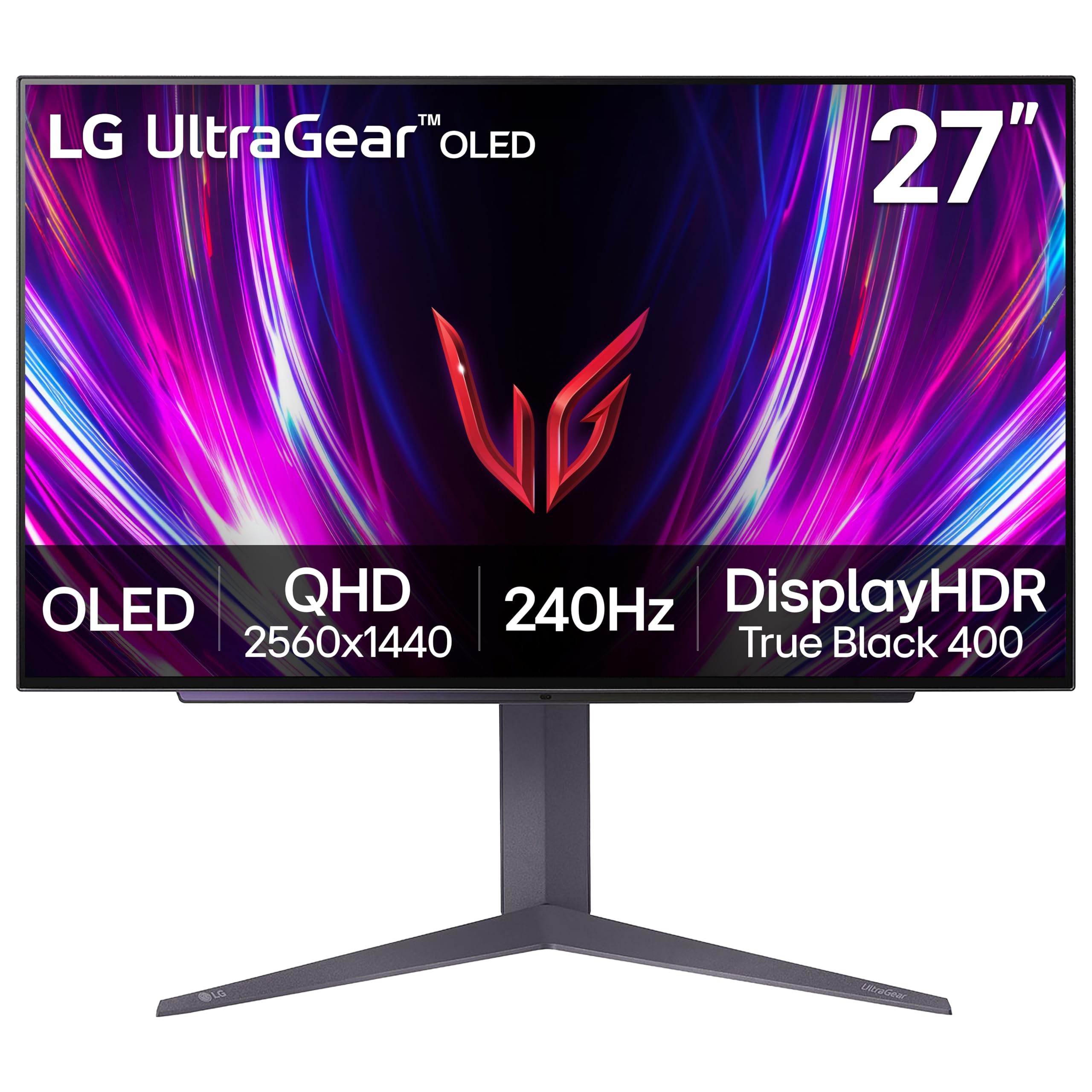
The LG 27GS93QE is a WOLED panel that competes directly with QD-OLED options, often at a lower price. The key difference is that WOLED uses a white subpixel alongside RGB, which some users argue provides more accurate true blacks without the purple-ish tint that can appear on QD-OLED panels in very bright scenes. This monitor delivers an excellent HDR experience with its VESA DisplayHDR True Black 400 certification and 1.5M:1 contrast ratio.
The 240Hz refresh rate and 0.03ms response time are standard for premium gaming, but the LG UltraGear line benefits from excellent software features like Dynamic Action Sync for reducing input lag. The included remote control is a surprisingly useful addition for navigating the on-screen display from a distance. The anti-glare / low reflection OLED coating is effective at managing ambient light without the overly matte texture of some competitors.
The build quality is solid, with a height, tilt, and pivot adjustable stand. The 98.5% DCI-P3 coverage ensures vibrant colors, and the monitor supports both HDMI 2.1 and DisplayPort 1.4 for full-bandwidth 240Hz input. For the budget-conscious gamer who wants OLED’s benefits without paying the ASUS or Samsung premium, the LG 27GS93QE is the smart choice.
Why it’s great
- WOLED panel provides true blacks without the QD-OLED purple tint in bright highlights.
- Excellent value proposition, bringing premium OLED specs to a more accessible price point.
- Includes a remote control for easy settings adjustment, a rare and convenient feature.
Good to know
- Peak HDR brightness is lower than top-tier QD-OLED models, impacting perceived impact in bright scenes.
- Auto input switch feature does not use HDMI-CEC, requiring manual switching for consoles.
- WOLED panel may have slightly lower color volume in very bright HDR highlights compared to QD-OLED.
8. AOC Q27GAZDV
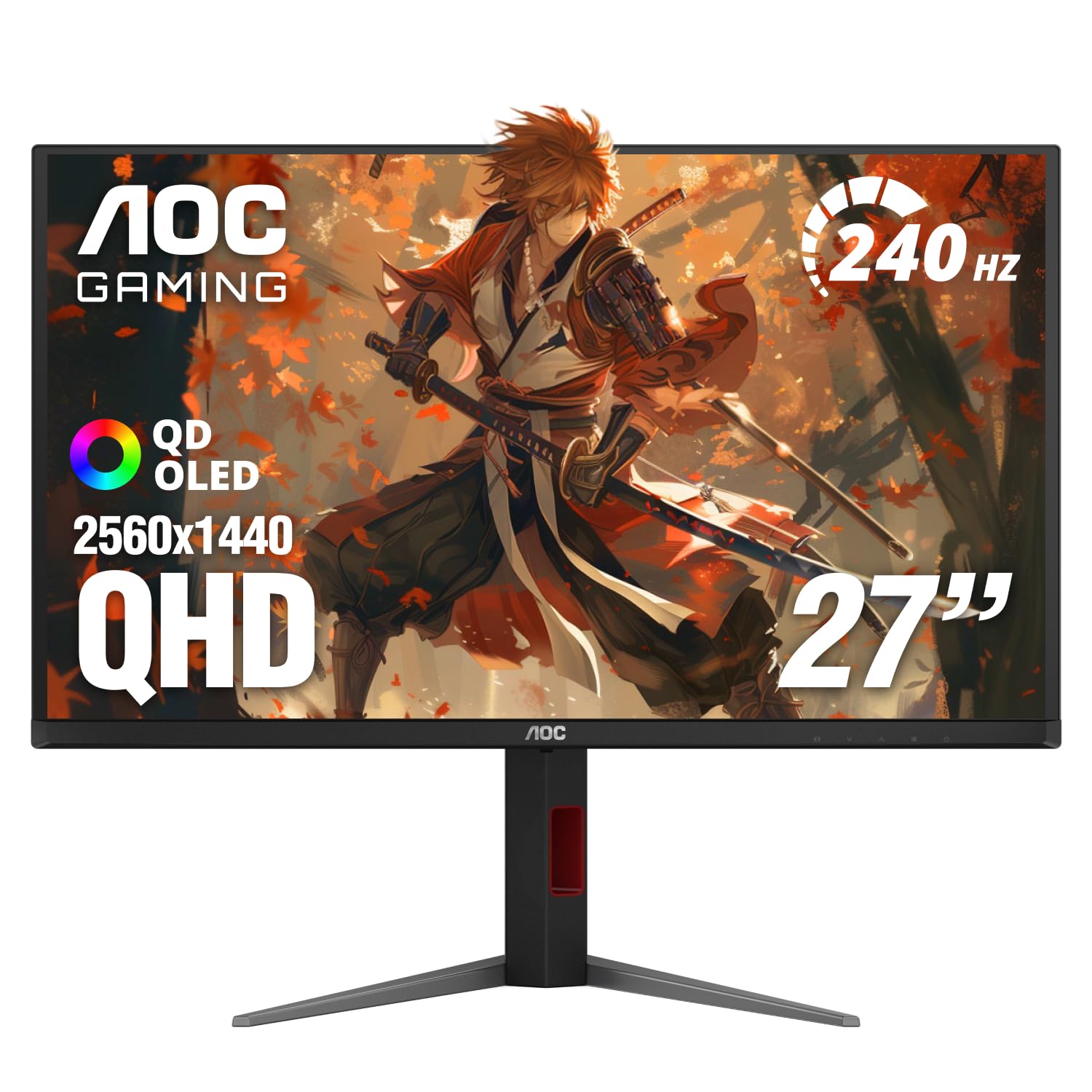
At its introductory price point, the AOC Q27GAZDV brings the QD-OLED experience to a much wider audience. This 27-inch 1440p monitor delivers the same infinite contrast, vibrant 147% sRGB color gamut, and 0.03ms response time as premium monitors, but without the 4K resolution and luxury build. For gamers who prioritize frame rates over pixel density, this is a perfect sweet spot.
The 240Hz refresh rate is highly usable with mid-range graphics cards, and the G-Sync Compatible adaptive sync ensures smooth, tear-free gameplay. The monitor includes a height-adjustable stand with tilt, swivel, and pivot adjustments, as well as a USB 3.2 hub for convenient peripheral connectivity. The HDR performance, with its 1,500,000:1 contrast ratio, is transformative compared to any IPS or VA panel.
The main compromise is the lower peak brightness typical of QD-OLED panels at this price point, but the infinite contrast more than compensates in a dimly lit room. Some users may need to adjust the initial color settings, as the default profile can be a bit muted. For the PC gamer building their first HDR setup and wanting the best visual bang-for-the-buck, the AOC Q27GAZDV is a stunning entry point.
Why it’s great
- Brings genuine QD-OLED performance (infinite contrast, vibrant colors) to a highly accessible price.
- 1440p at 27 inches is a great balance of sharpness and performance for mid-to-high-end GPUs.
- Includes a fully ergonomic stand and a USB hub, features often cut from budget monitors.
Good to know
- Peak HDR brightness is limited, making it less impressive in rooms with direct sunlight.
- Initial color calibration out of the box may require a few minutes of adjustment for optimal viewing.
- The cheaper stand plastic and overall build quality do not feel as premium as competitors.
9. Acer Predator X27U
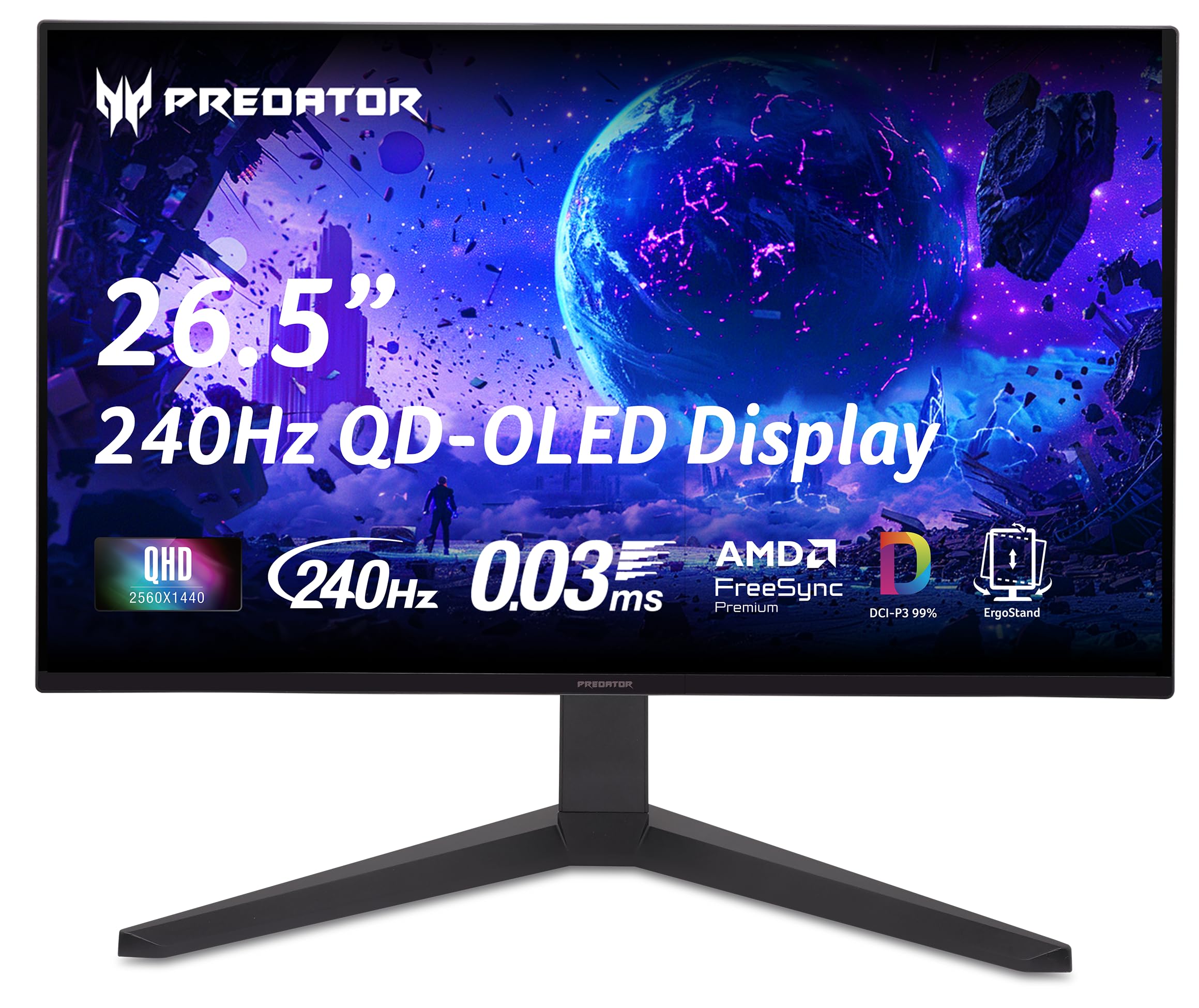
The Acer Predator X27U is another strong contender in the budget QD-OLED space, often priced competitively with the AOC Q27GAZDV. It offers a 27-inch, WQHD (2560×1440) panel with a fast 240Hz refresh rate and a 0.03ms response time. The QD-OLED technology delivers the vibrant colors and deep blacks that make HDR content look spectacular, with a 99% DCI-P3 color gamut and Delta E < 2 color accuracy.
One of the standout features is the inclusion of a built-in 2-watt speaker, which, while not a replacement for a dedicated audio setup, is useful for casual gaming or troubleshooting without headphones. The monitor also offers height, tilt, pivot, and swivel adjustments, allowing for a comfortable viewing position. The ZeroFrame design with ultra-thin bezels maximizes the 26.5-inch screen real estate.
The main trade-off for the price is a predominantly plastic build, which feels less premium than the ASUS or Samsung competition. Some users have also reported receiving units with cracked stands, highlighting a potential quality control issue. However, for the price of a mid-range IPS display, you are getting the core visual experience of OLED, which is an undeniable win for HDR gaming on a budget.
Why it’s great
- Exceptional value, offering QD-OLED’s core HDR benefits at a price close to high-end IPS monitors.
- Excellent color accuracy and gamut deliver a striking, vibrant HDR image out of the box.
- Fully adjustable stand with pivot, swivel, tilt, and height adjustment included.
Good to know
- Build quality is mostly plastic; some users report shipping damage or cracked stands.
- Peak HDR brightness is average for the class; it is best suited for dimmer gaming environments.
- The on-screen display menu is complex and lacks some advanced settings like overdrive adjustment.
10. Samsung Odyssey G50D

The Samsung Odyssey G50D is an excellent example of a high-performance IPS monitor that handles HDR competently without the cost of OLED. The 32-inch QHD (2560×1440) Fast IPS panel delivers crisp images with wide 178-degree viewing angles. Its VESA DisplayHDR 400 certification ensures a noticeable improvement in contrast and brightness over standard displays, making HDR games look punchier and more defined.
The 180Hz refresh rate with a 1ms GtG response time provides a smooth, responsive gaming experience that will satisfy all but the most competitive esports players. It supports both AMD FreeSync and G-Sync Compatible VRR, so screen tearing is a non-issue. The adjustable stand with tilt, swivel, and height adjustment is a boon for ergonomics, and the Eye Saver Mode effectively reduces blue light for long sessions.
The primary limitation is the 1,000:1 static contrast ratio, which is typical for IPS panels. This means blacks will appear gray in a dark room, reducing the impact of HDR in shadow-heavy scenes. However, for a well-lit room or for the gamer who prioritizes fast, responsive gameplay and clear text over the deepest blacks, the G50D is a fantastic, well-rounded monitor that offers excellent value.
Why it’s great
- VESA DisplayHDR 400 provides a tangible brightness and contrast boost over basic HDR monitors.
- Fast IPS panel with 180Hz and 1ms response offers smooth motion without the cost of OLED.
- Excellent build quality with a fully adjustable, sturdy stand and G-Sync/FreeSync support.
Good to know
- IPS glow and 1,000:1 contrast ratio mean blacks are not truly black, limiting HDR depth in dark scenes.
- Some users report poor color calibration out of the box, requiring manual adjustment for accurate colors.
- HDR performance is good for its tier but cannot compete with the infinite contrast of OLED options.
11. CRUA 32″ Curved Gaming Monitor
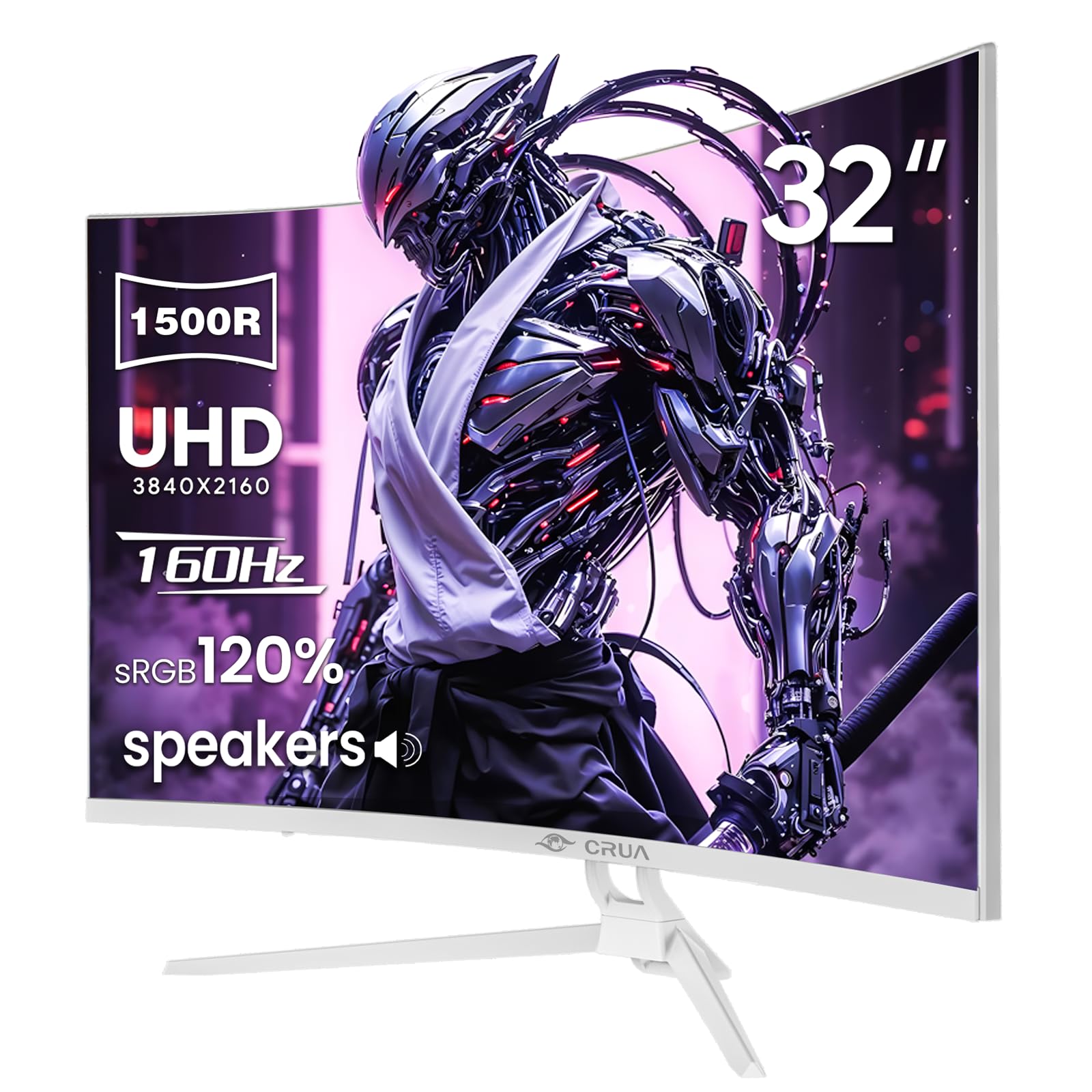
The CRUA 32″ Curved Gaming Monitor is an entry-level 4K display that offers a starting point for HDR gaming on a tight budget. Its VA panel provides a 3,000:1 native contrast ratio, which is much better than IPS for shadow detail and black depth. The 1500R curvature adds a mild sense of immersion that flat panels lack. For users moving from a basic 1080p screen, this is a significant visual upgrade.
The monitor supports a 160Hz refresh rate with AMD FreeSync, which is a good pairing for mid-range GPUs at 1440p. However, driving 4K at 160Hz is very demanding, so you will likely need to play at 1440p to enjoy high frame rates. The included built-in speakers are a convenience, but they lack the power and clarity needed for an immersive HDR experience. The RGB lighting adds a touch of gamer aesthetic to the white chassis.
This monitor is not a true HDR performer. It lacks VESA DisplayHDR certification and its maximum brightness of 320 cd/m² is below the standard for good HDR impact. The 4K resolution provides sharp desktop text, but the color volume and peak luminance are insufficient to make HDR games look dramatically different from SDR. It is a passable 4K screen for general use and light gaming, but serious HDR advocates should aim higher.
Why it’s great
- Affordable 4K resolution with a 160Hz refresh rate and VA-level contrast for its price tier.
- The white chassis and RGB lighting are a unique aesthetic choice for a white-themed setup.
- Included built-in speakers and HDMI 2.1 ports offer convenient connectivity for consoles.
Good to know
- HDR performance is very basic; lacks peak brightness and wide color gamut for true HDR impact.
- VA panel can suffer from slower pixel response times, leading to ghosting in fast-paced games.
- Build quality and included cables are budget-oriented; the DisplayPort cable may limit refresh rate.
FAQ
Is an OLED monitor better than an IPS monitor for HDR gaming?
What is the difference between WOLED and QD-OLED?
Does a higher refresh rate make HDR look better?
What is the risk of burn-in on an OLED gaming monitor?
Final Thoughts: The Verdict
For most users, the best hdr gaming monitor winner is the ASUS ROG Swift PG32UCDM because it combines the perfect black levels of QD-OLED with a peak brightness of 1,000 nits, setting a new standard for HDR immersion. If you want the absolute fastest response for competitive esports, grab the Sony INZONE M10S. And for a bright room where reflections are a problem, nothing beats the Samsung Odyssey G8 G81SF.