
Few things in a garden are as disheartening as watching the first flush of rose blooms turn brown, curl at the edges, or develop that telltale black spot. The challenge with fungal disease on roses isn’t just the cosmetic damage — it’s the speed at which it spreads through the canopy, weakening the plant for the entire season. Without the right prevention and treatment protocol, a single rainy spring week can undo months of careful pruning and feeding.
I’m Mohammad Maruf — the founder and writer behind Drink4Good. I’ve spent years analyzing the chemical and biological formulations in garden fungicides, comparing how different active ingredients interact with rose tissue, soil biology, and local climate patterns to give you a clear, data-backed choice.
Whether you’re tackling powdery mildew, black spot, or rust, this deep-dive guide will help you find the best fungicide for roses that matches your garden’s specific needs and your tolerance for reapplication schedules.
How To Choose The Best Fungicide For Roses
The right product depends on the specific disease cycle in your area, the season of application, and how much maintenance you’re willing to do. A contact fungicide washes off after rain and requires reapplication, while a systemic product moves inside the rose’s vascular system and provides longer protection.
Active Ingredient Matters Most
Chlorothalonil, propiconazole, and myclobutanil each target specific fungal pathways. Chlorothalonil is a broad-spectrum contact protectant—great for preventing infections but it doesn’t cure established disease. Propiconazole is a systemic triazole that stops existing infections and travels to new growth. For organic gardens, Bacillus subtilis stimulates the plant’s own immune defenses, but it’s more effective as a preventative than a cure.
Application Method and Coverage
Concentrates require mixing with water and a sprayer — offering the best value for large rose beds. Ready-to-use hose-end sprays are convenient for quick spot treatments on a few bushes. Pay attention to the recommended spray interval; a product that requires spraying every 7 days can become a chore in a wet season, while some systemics stretch to 14–21 days between applications.
Rain Fastness and Humidity Tolerance
If you live in the Pacific Northwest or the humid Southeast, you need a fungicide that adheres to leaf surfaces after rain. Some formulations include a sticker-spreader adjuvant that helps the product resist wash-off. Powdery mildew thrives in dry heat with cool nights, while black spot needs leaf wetness—knowing your local pattern helps you choose the right chemistry.
Quick Comparison
On smaller screens, swipe sideways to see the full table.
| Model | Category | Best For | Key Spec | Amazon |
|---|---|---|---|---|
| Dow Eagle 20EW | Systemic | Established infections | Myclobutanil 19.7% | Amazon |
| Quali-Pro Propiconazole | Systemic | Large rose beds | Propiconazole 14.3% | Amazon |
| Bonide Fung-onil | Contact | Preventative spray | Chlorothalonil 29.6% | Amazon |
| Fertilome Systemic II | Systemic | Multi‑purpose lawn/rose | Propiconazole 1.55% | Amazon |
| Bonide Revitalize | Organic | Organic rose gardens | Bacillus subtilis | Amazon |
In‑Depth Reviews
1. Dow AgroSciences Eagle 20EW Fungicide

Eagle 20EW is the most potent systemic fungicide on this list, powered by 19.7% myclobutanil — a sterol inhibitor that stops fungal growth from within the plant tissue. It’s labeled for more than 15 fungal diseases including powdery mildew, black spot, rust, and Septoria leaf spot, making it the top choice for rose collectors dealing with multiple pathogens simultaneously. The emulsifiable concentrate formulation penetrates leaf cuticles quickly and provides residual protection for new growth up to 14 days.
User reports confirm its effectiveness on established infections that copper-based and contact fungicides fail to control. One grower saved a mature red oak from blight with a trunk injection mix containing Eagle 20EW, while another eliminated orange rust on blackberry bushes after three applications. The product’s one-pint size is highly concentrated — the mixing rate is typically 0.6–1.2 fluid ounces per 1,000 square feet, so a single bottle can last a small rose garden for several seasons.
This is a professional-grade agricultural fungicide, so personal protective equipment is non-negotiable during mixing and application. The label specifies complex dilution ratios based on target disease and crop type, and the pre-harvest interval for edible crops is long — you should wait at least one year before consuming fruit from treated plants. It is not OMRI-listed and cannot be used in certified organic gardens.
Why it’s great
- Ultra-concentrated formula — small bottle covers large areas for years
- Systemic protection moves into new rose leaves, preventing reinfection
- Effective on resistant powdery mildew and black spot strains
Good to know
- Requires full PPE including respirator and goggles during mixing
- Mixing instructions are complex and use agricultural units (oz/acre)
- Long pre-harvest interval — not ideal for edible-adjacent plantings
2. Quali-Pro Propiconazole 14.3 Fungicide

Quali-Pro delivers 14.3% propiconazole in a microemulsion formulation that produces less odor than older triazole products while offering superior tank stability and leaf coverage. Propiconazole is a locally systemic fungicide — it penetrates leaf tissue and moves within the plant to protect both treated and emerging foliage. It is labeled for brown patch, dollar spot, powdery mildew, rust, and anthracnose across turf, trees, shrubs, and ornamentals, including roses.
Real-world feedback from growers shows this product stops brown patch on St. Augustine grass within two applications and cleared orange rust on wild blackberry with three sprays over the season. One lawn care enthusiast treated a full third-acre lawn using a 2-ounce-per-1000-square-foot rate on infected areas and a 1-ounce rate on surrounding turf, with visible recovery within a week. The 32-ounce bottle provides excellent value for users with large rose beds or mixed ornamental gardens.
Because propiconazole is a triazole, it can be phytotoxic to roses if applied in extreme heat — avoid spraying when temperatures exceed 85°F. The product is not OMRI-certified, and some users report better results against St. Augustine fungus when alternating with a different class of fungicide to prevent resistance. The label warns against runoff into water sources, as propiconazole is toxic to aquatic organisms.
Why it’s great
- Large 32-ounce bottle offers long-term supply for extensive rose gardens
- Low-odor microemulsion formulation is pleasant to work with
- Systemic action protects new rose growth for up to 14 days
Good to know
- Can cause leaf burn on roses if applied in temperatures above 85°F
- Not suitable for certified organic gardening
- Requires alternating with different mode-of-action fungicides to avoid resistance
3. Bonide Fung-onil Multi-Purpose Fungicide

Fung-onil uses chlorothalonil at 29.6% — one of the most trusted broad-spectrum contact fungicides in home gardening. It forms a protective barrier on leaf surfaces that stops fungal spores from germinating, making it ideal for preventing black spot, rust, leaf spot, and blight before they take hold. The 16-ounce concentrate mixes with water and is labeled for a broad range of plants beyond roses, including vegetables, fruits, ornamentals, and trees.
Gardeners report that Fung-onil stopped tomato leaf blight after two applications spaced ten days apart, and controlled powdery mildew on roses and boxwoods with weekly spraying. One user noted that the product leaves a faint white residue on leaves and fruit, but it washes off easily and does not affect flavor. It’s particularly effective as a preventative treatment — apply it before visible symptoms appear, especially during wet spring weather.
Chlorothalonil is a contact fungicide with no systemic activity, so thorough coverage of both upper and lower leaf surfaces is critical. Rain or overhead irrigation will wash off the protective layer, requiring reapplication after heavy rain. The concentrate has a milky, soapy texture that clings well to foliage, but the label warns that it can irritate skin and eyes — wear gloves and long sleeves during mixing and spraying.
Why it’s great
- Powerful broad-spectrum contact protection against black spot, rust, and blight
- A 16-ounce bottle makes up to 16 gallons of spray solution
- The white residue confirms coverage — easy to see which leaves are treated
Good to know
- Must reapply after heavy rain — no systemic protection
- Not OMRI-certified; cannot be used in organic gardens
- Requires thorough coverage of all leaf surfaces and stems
4. Fertilome Liquid Systemic Fungicide II
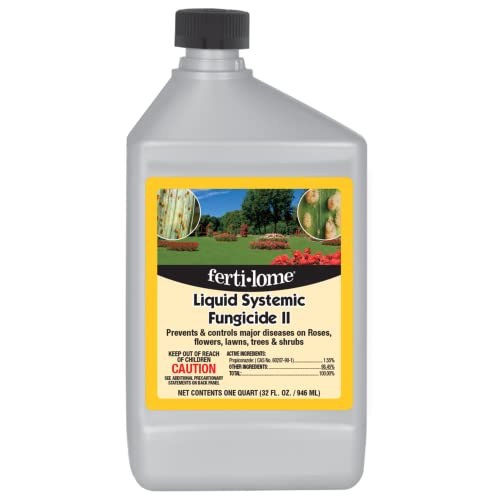
Fertilome Liquid Systemic Fungicide II contains 1.55% propiconazole — a lower concentration than the Quali-Pro product, but still effective for home rose gardens and lawns. It’s labeled for take-all patch, brown patch, dollar spot, leaf spot, and rust, making it a versatile choice for gardeners who want one product for both their roses and their turf. The 32-ounce bottle of liquid concentrate is ready to mix with water in a standard sprayer.
Customer reviews highlight its ability to clear yellow leaves on live oaks after a single treatment, and resolve grass fungus in three days. Some users apply it year after year for consistent lawn health. However, a few gardeners note that it takes two or three applications spaced 7–10 days apart to fully control established infections on roses — it’s more of a maintenance tool than a rescue treatment for severe disease pressure.
The labeling on this product can cause confusion: the product is marketed as a fungicide, but some versions list “Target Species: Insects” on the Amazon listing. Users report it does not kill insects, so you should not rely on it for pest control. The product works best when applied early in the growing season as a preventative, following the label’s recommended rates for roses and ornamentals.
Why it’s great
- Large 32-ounce bottle provides good value for small rose gardens
- Effective on both roses and lawn grass, reducing the number of products you need
- Systemic action provides longer protection than contact-only sprays
Good to know
- Lower propiconazole concentration — may need more applications for severe infections
- Amazon labeling sometimes misidentifies it as an insecticide
- Requires 2–3 applications for established rose diseases
5. Bonide Revitalize Biofungicide

Revitalize takes a fundamentally different approach to fungal control: instead of toxic chemicals, it uses Bacillus subtilis, a beneficial bacterium that triggers the rose’s systemic acquired resistance (SAR) — essentially waking up the plant’s own immune system. It is OMRI-listed for organic gardening and can be sprayed up to the day of harvest without any pre-harvest interval, making it the safest option for edible rose petals or roses near vegetable beds.
Users report it effectively controls powdery mildew, black spot, and blight on houseplants and garden ornamentals, but the results come slower than chemical systemics — you need to start applications before disease sets in and maintain a strict 7–10 day schedule. One grower saw a tomato septoria leaf spot infection clear up after treatment, while another appreciated that it stopped minor fungal issues on mixed plantings even though the product has a distinct, earthy odor.
Revitalize arrives as a 16-ounce concentrate that mixes with water for foliar spray or soil drench. It’s gentle enough for indoor and outdoor use, but the biological mode of action means it’s less effective in heavy disease pressure scenarios. It cannot cure advanced black spot — it’s strictly a preventative and early‑intervention tool. The product’s smell is noticeable during mixing but dissipates once dry.
Why it’s great
- OMRI-listed for certified organic gardening — safe for edible gardens
- Can be used up to the day of harvest with no pre-harvest interval
- Triggers the rose’s natural immune response without toxic residues
Good to know
- Not effective as a curative treatment for advanced black spot or rust
- Needs strict 7–10 day reapplication schedule for reliable prevention
- Has a strong earthy odor during mixing and application
FAQ
Can I use a lawn fungicide on my roses?
What is the difference between contact and systemic fungicides?
How often should I spray fungicide on roses in a wet season?
Final Thoughts: The Verdict
For most users, the fungicide for roses winner is the Dow AgroSciences Eagle 20EW because its 19.7% myclobutanil concentration provides the strongest systemic protection against black spot, powdery mildew, and rust, with ultra-low application rates that make a single pint last for years. If you want a premium systemic suitable for large rose beds, grab the Quali-Pro Propiconazole 14.3. And for certified organic gardens where preventing disease is the priority, nothing beats the Bonide Revitalize Biofungicide with its Bacillus subtilis SAR trigger.