
In a world where nuclear threats, industrial accidents, and even contaminated food supplies are real concerns, having the ability to detect invisible radiation is no longer just for scientists — it’s a core piece of any serious preparedness kit. The right device tells you exactly when it’s safe to stay, when you need to move, and whether your water or food stockpile is contaminated, which is the difference between informed action and blind luck.
I’m Mohammad Maruf — the founder and writer behind Drink4Good. I’ve spent years analyzing the hardware specifications and real-world performance data of radiation detection equipment to help preppers distinguish between gadgets that merely click and tools that genuinely save lives in a crisis.
This guide breaks down the key specs, build quality, and detection capabilities that matter when you need a reliable geiger counter for preppers that won’t let you down when the grid goes dark.
How To Choose The Best Geiger Counter For Preppers
Choosing a radiation detector for preparedness is different from buying one for a hobbyist collection. You need a device that is reliable, easy to read under stress, and has the battery endurance to last through an extended emergency. Focus on these four factors to narrow the field.
Detection Capability & Sensitivity
Not all detectors see the same threats. Most entry-level units use a Geiger-Müller tube that detects beta, gamma, and X-ray radiation, but they have a limited range before they saturate. A prepper’s device should be sensitive enough to spot a small increase above background (around 15-20 CPM) while also being able to handle a high dose rate without going off-scale. Some premium models use a scintillator crystal that is far more sensitive and can identify specific isotopes, which is invaluable for knowing whether a hot spot is short-lived iodine or long-lived cesium.
Battery Life & Power Source
In a grid-down scenario, you cannot rely on USB charging. The best preparedness units use standard AA batteries that you can stockpile, or they have a rechargeable battery that lasts weeks on a single charge. Look for models that offer at least 50 hours of continuous operation. Devices that use proprietary batteries or require frequent recharging become dead weight in a long-term emergency.
Alarm System & Readability
A Geiger counter is only useful if it gets your attention when levels spike. The best units for preppers have an adjustable audio alarm, a flashing LED, and a vibration mode so you can catch a warning even in a noisy environment or when you need to stay quiet. A screen that is readable in direct sunlight and has a backlight for low-light conditions is also critical — fumbling with buttons during a radiation event wastes precious time.
Durability & Portability
Your radiation detector will likely be stuffed into a go-bag, dropped on concrete, or used in rain and dust. A rugged build with a rubber shock protector or a sealed case is a major advantage. The device should also be compact enough to carry in a pocket or on a belt clip without weighing you down. A fragile glass tube inside a cheap plastic shell is a liability when you need it most.
Quick Comparison
On smaller screens, swipe sideways to see the full table.
| Model | Category | Best For | Key Spec | Amazon |
|---|---|---|---|---|
| Radiacode 103 | Scintillator | Isotope ID & Mapping | 20x faster than Geiger tube | Amazon |
| Better Geiger S-2 | Solid-State | High Range Emergencies | 100x higher dose rate handling | Amazon |
| SAF Aranet | Dosimeter | 24/7 Home Monitoring | 4-year battery life | Amazon |
| GQ GMC-320 Plus | Geiger Tube | General Field Use | Swivel display & data logging | Amazon |
| FNIRSI GC-03 | 3-in-1 | EMF & Radiation Scan | Triple detection modes | Amazon |
| GQ 320S | Geiger Tube | Entry-Level Preparedness | Real-time data logging | Amazon |
| MOESAPU FS-5000 | Geiger Tube | Budget Carry Option | 30-day standby runtime | Amazon |
In‑Depth Reviews
1. Radiacode 103

The Radiacode 103 is a gamma spectrometer, not a traditional Geiger counter, and that distinction matters enormously for preppers. It uses a GAGG(Ce) scintillator crystal that detects gamma radiation up to 20 times faster than a standard Geiger-Müller tube, meaning you move through an area 20 times faster before you miss a hot spot. It measures reference count rates at 1 µSv/h = 30 cps on Cs-137, and its spectral resolution (FWHM) of 8.4% allows you to identify specific isotopes like Cs-137, Ra-226, or Th-232 from the energy spectrum.
The free mobile app for iOS, Android, macOS, and Windows is where this device truly shines for preparedness. You can create real-time radiation maps with GPS-logged CPS and µSv/h readings overlaid on Google Maps or Open Street Maps, which is invaluable for plotting a safe evacuation route or marking contamination zones. It also includes a food analyzer mode to check your stockpiles and a spectrogram for identifying decay products of Radon-222, which helps you assess indoor air safety after a fallout event.
With a week-long battery life on a single USB-C charge and a weight of just 2.36 ounces, it’s the most compact and capable unit in this guide. The seven alarm modes — including sound, LED, vibration, and app-based alerts — ensure you never miss a warning. The only real limitation is that it does not detect alpha particles, but for gamma and X-ray threats, which are the primary concern in a nuclear incident, it is the most sophisticated tool a prepper can carry.
Why it’s great
- 20x faster than standard Geiger counters
- Identifies specific isotopes via spectrum analysis
- GPS mapping for evacuation route planning
- Ultra-light at 2.36 ounces
Good to know
- No alpha particle detection
- App QR code may be broken; download manually
- Requires smartphone for full mapping features
2. Better Geiger S-2

The Better Geiger S-2 is engineered for the worst-case scenario. Its solid-state scintillator design can handle radiation levels 100 times higher than a standard Geiger counter without saturating, which is critical if you are near a catastrophic release or entering a contaminated zone. The sensor is also 3 times more sensitive to X-ray and gamma radiation than typical Geiger tubes, and it automatically corrects the measured dose rate based on the incoming energy, giving you a true reading rather than a rough estimate.
For preppers who prioritize grid-down reliability, the S-2 runs on two standard AA batteries and delivers over 50 hours of continuous operation. You can stockpile AA cells by the dozen, unlike proprietary rechargeable packs. The device includes a rubber shock protector and a rugged sealed case, and it is designed and manufactured in the USA, which means replacement parts and customer support are accessible. The display is bright enough to read in direct sunlight and has simple controls for setting dose rate and total dose alarms.
It does not offer graphing, data logging, or Bluetooth connectivity, which keeps the interface simple and reduces points of failure. The audible click on detection is satisfying and informative, and the S-2 comes with a dose chart to help you interpret readings during an emergency. If you need a device that will survive being thrown in a go-bag and still work perfectly after years of storage, this is the one.
Why it’s great
- Handles 100x higher radiation levels
- 3x more sensitive than standard Geiger
- 50+ hours on 2 AA batteries
- Rugged rubber shock protector included
Good to know
- No data logging or graphing
- No Bluetooth or app connectivity
- Larger footprint than pocket models
3. SAF Aranet Radiation Detector
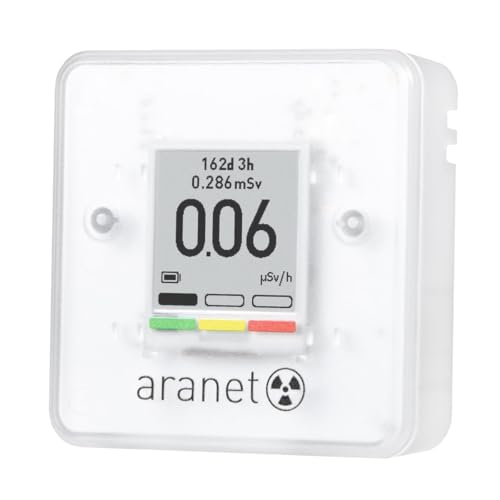
The SAF Aranet is built around a fundamentally different philosophy: set it and forget it. Its E-Ink display consumes negligible power, allowing the device to run for up to 4 years on a single set of batteries, making it the absolute best choice for continuous home monitoring. It measures the ambient equivalent dose rate of gamma, beta, and X-ray radiation and tracks total dose over a 2-year span, giving you a complete dosimeter solution without ever needing to change batteries mid-crisis.
Bluetooth connectivity pairs the Aranet with a free app that provides graphics, alarm settings, and data logs, so you can check radiation trends on your phone without disturbing the unit’s placement. The alarm system is based on scientific recommendations and will alert you if dose rates spike, ensuring you are aware of changes even if you are not actively watching the display. The wireless and portable design makes it easy to mount on a wall or toss into a bag without worrying about battery drain.
One caution: the Aranet is not designed for rapid field scanning or hot-zone entry. Its refresh rate is slower than a handheld Geiger counter because of the E-Ink display, and it lacks the rugged shockproofing of the Better Geiger S-2. But as a stationary sentinel that quietly monitors your home base 24/7 for years at a time, nothing else on this list matches its endurance.
Why it’s great
- 4-year battery life on one set
- Clear E-Ink display readable in sunlight
- Bluetooth app for data logging
- Measures total dose over 2 years
Good to know
- Slow refresh rate for quick scanning
- Not as rugged as field units
- Requires Bluetooth for advanced features
4. GQ GMC-320 Plus
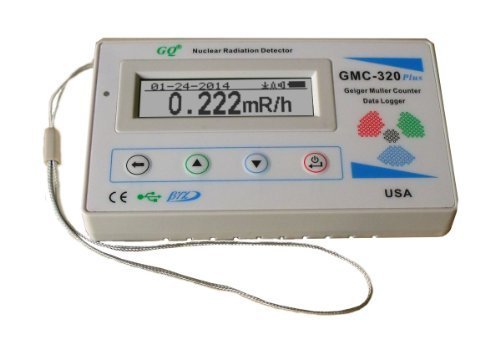
The GQ GMC-320 Plus is one of the most popular and well-reviewed consumer Geiger counters on the market, and for good reason. It uses a real Geiger-Müller tube to detect beta, gamma, and X-ray radiation with good sensitivity — reviewers have reported background readings of 15-20 CPM and spikes to over 5000 CPM near a cat undergoing iodine-131 treatment. The auto-swivel display rotates 180 degrees so you can read it even when the unit is upside down, a small but clever feature for a handheld device.
Data logging is built in, allowing you to record radiation data and play it back later on your computer via the included USB cable and free PC software. This is useful for mapping contamination over time or documenting readings for a group. The rechargeable battery lasts about a day of active use, and the device arrived fully charged for one reviewer, which speaks to GQ’s quality control. The alarm is adjustable — you can set the threshold, choose between audible clicks and alarm tones, or turn it off completely for discreet operation.
One common complaint is that the screen can be hard to read in bright sunlight, which is a concern for outdoor preppers. The plastic enclosure feels light but not incredibly rugged, and the wrist strap has been reported to break easily. The GM tube is glass and fragile if dropped. However, for the versatility of having text, graphic, and large-font display modes plus reliable data logging at this tier, the GMC-320 Plus remains a strong all-rounder for general field use.
Why it’s great
- Auto-swivel display for easy reading
- Built-in data logging with PC software
- Adjustable alarm and click sound
- Rechargeable battery included
Good to know
- Screen reflects glare in sunlight
- Glass GM tube is fragile
- Wrist strap may break quickly
5. FNIRSI GC-03
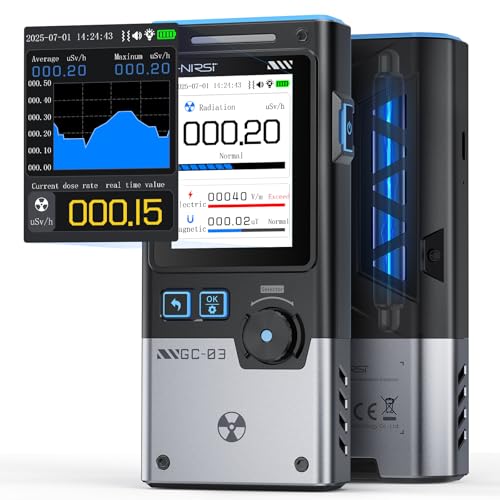
The FNIRSI GC-03 is a 3-in-1 device that combines a nuclear radiation detector (gamma, beta, X-ray) with an electromagnetic field meter for both electric and magnetic fields. For preppers who want to assess not just nuclear fallout but also EMF exposure from damaged infrastructure or hidden wiring, this single unit replaces two separate tools. The Geiger counter side uses a glass tube sensitive to gamma, with a cumulative dose range from 0.00 uSv to 500.0 mSv and an energy range of 48 KeV-1.5 MeV.
The three display modes — curve, professional, and quick view — let you switch between a live graph of radiation changes and a detailed numeric readout depending on your situation. At night, the dark mode theme makes the screen much easier on the eyes. Alarms for nuclear radiation are visual, audible, and haptic (vibration), giving you three layers of warning. The device also tracks up to 50 alarm history records, which is helpful for debriefing after a scan.
The magnetic field sensor measures flux changes rather than absolute magnetic field strength, so it will not give you a baseline Earth-field reading — it detects fluctuations, which is useful for finding live wires but not for geomagnetic sensing. The build is lighter than the GC-01, with a plastic and aluminum body, and it is not as rugged as the Better Geiger S-2. Still, for a prepper who wants to detect both radiation and EMF threats without carrying two devices, the GC-03 offers a compelling multi-function package.
Why it’s great
- Combines Geiger counter and EMF meter
- Three display modes for flexible monitoring
- Visual, audible, and vibration alarms
- Dark mode screen for low-light use
Good to know
- Less rugged than premium options
- Magnetic field meter reads only flux changes
- Language options limited to two
6. GQ 320S
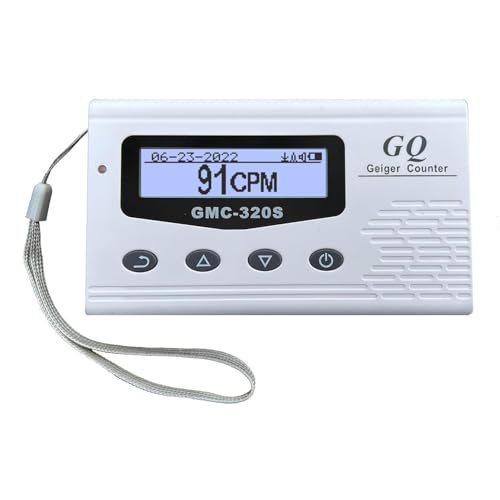
The GQ 320S is the entry-level workhorse from GQ Electronics, offering real-time data logging every second into internal memory — a feature typically reserved for more expensive units. This means you can leave it running in a location and later download the history to your computer via the free PC software to analyze trends. The dosimeter mode, CPM count mode, and graph mode give you three ways to interpret the data, and the swivel display option makes it easy to read from any angle.
One prepper reviewer tested the 320S with a 1.0 µCi Americium-241 source and recorded background readings of 15-20 CPM, which rose to over 200 CPM within 90 seconds of exposure. The alarm triggered at 100 CPM, confirming the unit’s sensitivity. The rechargeable lithium-ion battery lasts long and is included with the device, and the unit itself weighs only 7.8 ounces, making it easy to carry in a pocket or small pouch. A chemistry professor also used it successfully to measure over 4 mR/h from an antique uranium-glazed bowl in a classroom demo.
The main limitation is that the PC software is Windows-only, which is a non-starter for preppers who use Mac or Linux systems. Some users also reported difficulty finding the correct software version, as the 320S variant has its own specific download. The plastic build is adequate for light use but not designed for heavy drops. For the price, however, you get a real GM tube, data logging, and a long-lasting rechargeable battery — a solid starting point for anyone building their first preparedness radiation kit.
Why it’s great
- Real-time data logging every second
- Multiple display modes including graph
- Lightweight at 7.8 ounces
- Alarm triggered at 100 CPM
Good to know
- PC software is Windows-only
- Plastic case not very rugged
- Software version can be confusing to find
7. MOESAPU FS-5000

The MOESAPU FS-5000 is a budget-friendly option that still delivers essential detection capabilities. It is equipped with a J321 GM tube sensitive to beta, gamma, and X-ray radiation within an energy range of 48KeV-1.5MeV, with a response time of 0.5 seconds. The real-time dose rate monitoring spans from 0.01µSv/h to 50mSv/h, and it tracks total dose from 0µSv up to 1000Sv, which is critical for assessing long-term health risks in a fallout zone.
The audio-visual-haptic alarm system is customizable — you can set thresholds for dose rate above 2.5µSv/h and total dose above 1mSv, and choose between sound, light, and vibration alerts. The TFT-LCD screen has six adjustable brightness levels, ensuring glare-free readability under bright sun and comfortable viewing in the dark. The built-in 1800mAh rechargeable battery provides up to 30 days of standby time in low-power mode, which means you can keep it in your go-bag for a month and it will still be ready when you need it.
Reviewers have confirmed it works well for detecting radiation from smoke detectors, uranium glass, and antique collections. One user noted the device survived multiple drops onto concrete without breaking, which speaks to its build quality at this tier. The main trade-offs are that it only detects beta, gamma, and X-ray (no alpha), and the included software is again PC-only. But for a compact unit with a belt clip, a fast 0.5-second response, and a month-long standby, it is a very capable entry-level preparedness tool.
Why it’s great
- Fast 0.5-second response time
- 30-day standby on a single charge
- Customizable sound, light, and vibration alarms
- Durable build survived concrete drops
Good to know
- No alpha particle detection
- Software is PC-only, no Mac support
- Smaller screen may be harder to read at distance
FAQ
How do I know if my Geiger counter is accurate enough for emergency use?
Should I leave my Geiger counter on all the time or only during a crisis?
Final Thoughts: The Verdict
For most users, the geiger counter for preppers winner is the Radiacode 103 because its scintillator speed and isotope identification give you actionable intel during a fallout event. If you want rugged reliability and no dependence on rechargeable batteries, grab the Better Geiger S-2. And for 24/7 home monitoring with a battery that lasts years, nothing beats the SAF Aranet.