
Aluminum’s oxide layer makes it a notoriously difficult surface to bond. Standard household glues slide right off, leaving you with a failed repair and a messy cleanup. The right epoxy must chemically lock into the metal, not just sit on top of it.
I’m Mohammad Maruf — the founder and writer behind Drink4Good. I’ve spent years analyzing industrial-grade adhesives and metal-repair compounds, comparing tensile strengths, cure windows, and thermal limits to find what actually holds on non-porous aluminum surfaces.
For DIY repairs on cracked castings, boat hulls, or automotive parts, selecting the right glue for aluminum means choosing between steel-reinforced epoxies, aluminum-filled compounds, and panel-bonding adhesives that each demand a different approach to surface prep.
How To Choose The Best Glue For Aluminum
Not all epoxies handle aluminum the same way. You need a formula that bonds to non-porous metal, resists vibration, and tolerates the temperature swings your repair will face. Focus on these three factors before you buy.
Surface Preparation Is Everything
Aluminum’s natural oxide layer is slick — no adhesive sticks to it without mechanical abrasion. Always sand the bonding area with 80- to 120-grit paper, then wipe clean with acetone or isopropyl alcohol. Skip this step and even the strongest epoxy will peel off.
Heat and Chemical Resistance
Engine blocks, exhaust components, and radiator repairs see sustained heat. Check the epoxy’s temperature ceiling: entry-level options top out around 250°F, while steel-reinforced formulas can handle over 500°F. If your repair touches oil, coolant, or gasoline, verify the cured bond is waterproof and chemical-resistant.
Working Time and Cure Schedule
Fast-setting adhesives harden in 5 minutes but leave no room to align parts. For structural repairs on brackets or castings, choose a formula with 15–30 minutes of working time so you can clamp, shim, and shape before the epoxy sets. Full cure typically takes 12–24 hours — never stress the bond before that window closes.
Quick Comparison
On smaller screens, swipe sideways to see the full table.
| Model | Category | Best For | Key Spec | Amazon |
|---|---|---|---|---|
| 3M 38315 Panel Bonding Adhesive | Premium | Automotive panel bonding | 50 mL cartridge | Amazon |
| J-B Weld 8281 Original Cold Weld | Mid-Range | Heavy-duty steel-reinforced repairs | 5,020 PSI tensile strength | Amazon |
| AOJEL S300 Metal Epoxy | Mid-Range | Load-bearing rigid repairs | Heat resistant to 392°F | Amazon |
| Mastercool 90935 Alum Bond | Mid-Range | Aluminum casting and radiator repair | Aluminum-filled compound | Amazon |
| WXYCRUEYE Metal Repair Glue | Budget | Quick household fixes | 3-tube pack, 1.76 oz each | Amazon |
In‑Depth Reviews
1. 3M 38315 Panel Bonding Adhesive

3M’s 38315 is the professional standard for bonding aluminum panels in auto body work. The two-part epoxy uses glass bead technology to ensure a consistent gap, preventing the bond line from squeezing out too thin. It bonds to steel, aluminum, SMC, and fiberglass, making it a versatile adhesive for structural and non-structural repairs alike.
The red epoxy is grabby — once the two surfaces meet, sliding them into position is nearly impossible. You need to clamp or screw parts in place during the 24-hour cure. The 50 mL cartridge is small, but a little goes a long way on mounting tabs, door skins, and quarter-panel patches.
Users report it replacing welds on body panels without burning the paint coating on the back side, which prevents rust. It forms a waterproof barrier and machines well after cure. For serious automotive aluminum bonding, this is the gold standard.
Why it’s great
- Glass bead technology ensures consistent bond thickness
- Bonds aluminum, steel, SMC, and fiberglass
- Waterproof and corrosion-resistant after cure
Good to know
- Very tacky — difficult to adjust parts once mated
- Requires separate mixing nozzle and manual applicator
- Small cartridge volume for larger repairs
2. J-B Weld 8281 Original Cold Weld

J-B Weld Original is a household name for metal repair, and the 8281 pro-size tubes deliver the same 5,020 PSI tensile strength that made the brand famous. The steel-reinforced epoxy is dark grey after mixing and cures into a material harder than the aluminum it bonds. It withstands 550°F continuous heat and resists petroleum, chemicals, and water.
Set time is 4–6 hours, with full cure at 15–24 hours. You can tap, drill, sand, and file the cured epoxy just like metal. This makes it ideal for engine blocks, brackets, and housings where the repair must match the surrounding structure.
Reviewers consistently praise its versatility across metal, plastic, wood, concrete, and ceramic. The only trade-off is the long cure window — you cannot rush a structural repair with J-B Weld. But when strength is the priority, nothing in this category beats the Original.
Why it’s great
- 5,020 PSI tensile strength — strongest in class
- Withstands 550°F and resists chemicals
- Drillable, tappable, and machinable after cure
Good to know
- 15–24 hour cure time requires patience
- Not ideal for flexible or thin-gauge repairs
- Dark grey color may stand out on visible surfaces
3. AOJEL S300 Metal Epoxy
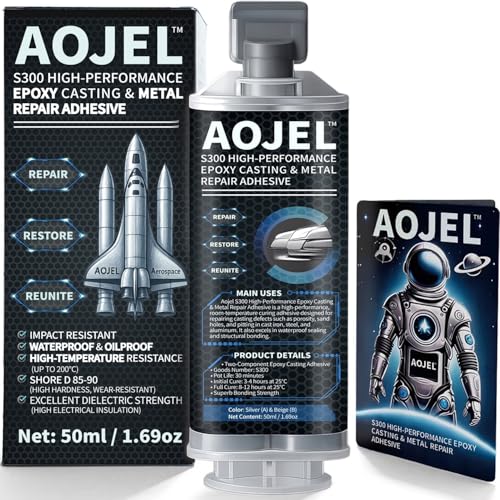
AOJEL S300 is built for load-bearing repairs on rigid aluminum and cast iron parts. Its defining feature is a slow cure that gives you 15–30 minutes of working time — enough to sand, mix, align, clamp, and build thickness before the epoxy starts to stiffen. This makes it a strong choice for complex repairs like cracked crankcases or broken chair frames.
The cured bond is drillable, sandable, and paintable, with heat resistance up to 392°F. It is waterproof and oil-resistant, suitable for garage and automotive environments. The plunger system lets you dispense both parts at once, though some users find it tricky to get an even ratio at the start.
Real-world tests show it reattaching aluminum patio-chair legs and sealing a cracked Honda ATV crankcase. The bond held up to vibration and heat without failure. For rigid, structural aluminum repairs that demand precision placement, the S300 delivers.
Why it’s great
- Long working time for precise alignment and clamping
- Load-bearing formula resists heat and vibration
- Drillable, sandable, and paintable after full cure
Good to know
- Plunger system can be inconsistent at first
- Not for flexible joints or soft plastics
- Full 24-hour cure required for max strength
4. Mastercool 90935 Alum Bond
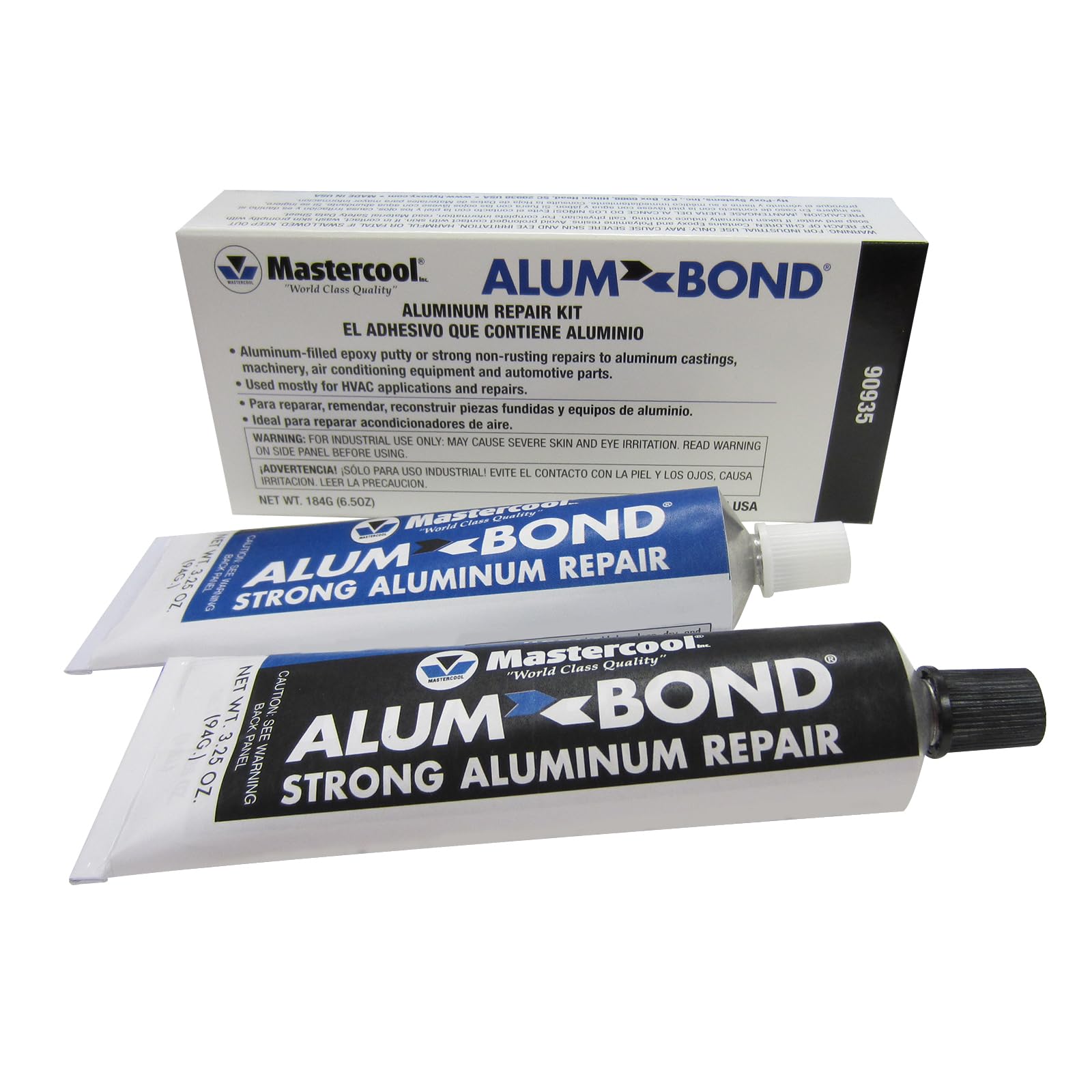
Mastercool 90935 stands apart because it is filled with actual aluminum particles. When cured, it machines like real metal — you can tap threads, drill precisely, and sand flush without the filler breaking away. With 8,600 PSI compressive strength and 3,500 PSI tensile strength, it handles casting defects, blow holes, and radiator leaks.
The non-sag formula stays put on vertical and overhead surfaces, which is critical for engine block repairs and HVAC condenser patches. Temperature resistance tops out at 250°F — fine for radiators and castings, but not for exhaust or high-heat engine components.
Users have sealed leaky boat hulls, repaired condenser coils, and patched exhaust systems. The aluminum content means the repair blends visually with the parent metal, an advantage for visible repairs. If your aluminum repair needs to be machined or tapped afterward, this is the compound to reach for.
Why it’s great
- Aluminum-filled for machinable, tap-able repairs
- Non-sag formula ideal for vertical and overhead use
- 8,600 PSI compressive strength
Good to know
- Heat limit of 250°F — not for exhaust or engine blocks
- Working window is shorter than slow-cure epoxies
- Requires thorough surface roughening for best bond
5. WXYCRUEYE Metal Repair Glue
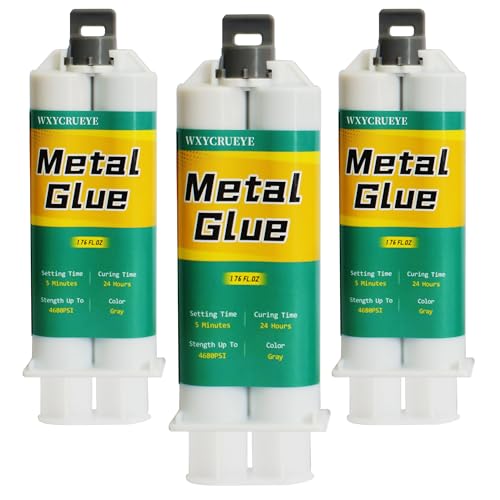
The WXYCRUEYE Metal Repair Glue is a budget-friendly entry-level option that sets in just 5 minutes and cures fully in 24 hours. Each pack contains three 1.76-ounce tubes, giving you multiple repairs per purchase. The epoxy is a clear paste that bonds aluminum, steel, plastic, and ceramic.
Its fast set time is a double-edged sword — you need to work quickly and mix thoroughly. One reviewer reported it peeling off a muffler within a day, likely due to insufficient heat resistance or surface prep. On lower-temperature repairs like refrigerator handles, monitor mounts, and door pulls, it held up well over several months.
For light-duty household fixes on aluminum, this glue works fine. It is not built for structural loads, sustained heat, or outdoor vibration. If your repair demands long-term reliability on aluminum, invest in a mid-range or premium epoxy instead.
Why it’s great
- Affordable three-pack for multiple repairs
- 5-minute set for quick fixes
- Clear finish blends on visible surfaces
Good to know
- Not heat-resistant enough for exhaust or muffler repairs
- Fast set leaves little time for adjustment
- Inconsistent results reported on pressure-bearing joints
FAQ
Do I need to sand aluminum before applying epoxy?
Can I use regular super glue on aluminum?
Final Thoughts: The Verdict
For most users, the best glue for aluminum is the 3M 38315 Panel Bonding Adhesive because it delivers professional-grade strength, a consistent bond line, and versatility across steel, aluminum, and composites. If you need steel-reinforced muscle for heavy-duty repairs, grab the J-B Weld 8281 Original Cold Weld. And for precision machining after repair, nothing beats the Mastercool 90935 Alum Bond.