
A tuner pedal is the silent anchor of any serious pedalboard. Unlike clip-on tuners that struggle with ambient noise or stage vibration, a dedicated foot tuner gives you a mute switch, a true bypass signal path, and a display you can read from a standing position under bright stage lights. The wrong choice introduces tone suck, slow tracking, or an unreadable screen mid-set.
I’m Mohammad Maruf — the founder and writer behind Drink4Good. I’ve spent years analyzing the hardware specs of stage-ready gear, from buffer circuits to display refresh rates, to find what actually holds up under gigging conditions.
The right guitar tuner pedal balances tuning accuracy within half a cent, a display that cuts through direct sunlight, and a bypass system that leaves your tone completely uncolored.
How To Choose The Best Guitar Tuner Pedal
Choosing a tuner pedal involves more than just picking the cheapest option. The circuit design, display type, and bypass architecture directly affect your tone and your ability to tune quickly between songs. Focus on three key areas before buying.
Tuning Accuracy and Display Readability
Look for a tuner with an accuracy of +/- 0.5 cents or better for reliable intonation and in-tune chords. A strobe tuner, like the Peterson, offers 0.1-cent accuracy for precise setup work. The display must be bright enough to read in direct sunlight yet dimmable for dark stages. Multi-color LEDs (red, green, blue) and strobe or half-strobe modes help you see tuning direction at a glance without squinting.
Bypass: True Bypass versus Buffered
A tuner sits at the very front of your signal chain, so its bypass circuit affects every note you play. True bypass completely removes the pedal from your signal path when muted, preserving your guitar’s natural tone. A buffered bypass, on the other hand, drives your signal over long cable runs and prevents high-end loss. The best tuners, like the BOSS TU-3W and Korg Pitchblack X, offer switchable options so you can choose the right mode for your board length.
Size and Power Compatibility
Pedalboard real estate is always at a premium. Mini tuners (roughly half the width of a standard pedal) like the TC PolyTune 3 Mini or Rock Stock Nano save space but may have smaller displays. Standard-sized tuners offer larger screens and easier foot operation. Ensure the pedal accepts a standard 9V DC center-negative power supply (2.1mm barrel jack) to integrate with your existing power brick without an extra adapter.
Quick Comparison
On smaller screens, swipe sideways to see the full table.
| Model | Category | Best For | Key Spec | Amazon |
|---|---|---|---|---|
| BOSS TU-3W Waza Craft | Premium | Pro touring & studio precision | 21-segment blue LED + buffer switch | Amazon |
| Peterson StroboStomp Mini | Premium | Intonation & sweetened tuning | 0.1-cent strobe accuracy | Amazon |
| Korg Pitchblack X | Mid-Range | Versatile stage use | 4 display modes + Ultra Buffer | Amazon |
| TC Electronic PolyTune 3 Mini | Mid-Range | Quick polyphonic tuning | Polyphonic + built-in buffer | Amazon |
| Rock Stock Nano Tuner | Budget-Friendly | Ultra-compact pedalboards | 0.5-cent accuracy, 10 ms response | Amazon |
| OnStage GTP7000 | Budget-Friendly | Entry-level reliable tuning | True bypass, 4-color display | Amazon |
| Ernie Ball VP JR 250K | Specialty | Volume control & swell effects | Taper switch, passive signal | Amazon |
In‑Depth Reviews
1. BOSS TU-3W Waza Craft Chromatic Tuner

The BOSS TU-3W takes the industry-standard TU-3 platform and refines its analog signal path with premium Waza Craft components. The 21-segment blue LED meter is noticeably easier to read under colored stage lights compared to traditional red displays, and it tracks down to a low G on a seven-string bass without any lag or dropout. The onboard buffer is exceptionally clean, and you can switch it off for true bypass operation if your board is short.
Customer feedback consistently praises its ability to lock onto a note instantly and hold the reading steady. The blacked-out chassis and smooth footswitch feel premium underfoot, and the Accu-Pitch Sign function shows a sharp sign when the string is perfectly in tune, removing guesswork. It runs on a standard 9V DC supply and draws only 50 milliamps, making it light on your power brick.
Some users note that the mute function only activates when the tuner is turned on; there is no separate mute-only switch. The Waza Craft price is a step above standard tuners, but the combination of elite build quality, a pristine buffer, and the best display in its class justifies the investment for any player who relies on their gear night after night.
Why it’s great
- Pristine buffered output with switchable true bypass
- Blue LED display is highly readable on dark stages
- Tracks low bass frequencies without hesitation
Good to know
- Premium pricing compared to standard tuners
- No dedicated mute-only footswitch mode
- Standard footprint takes more board space than mini options
2. Peterson StroboStomp Mini
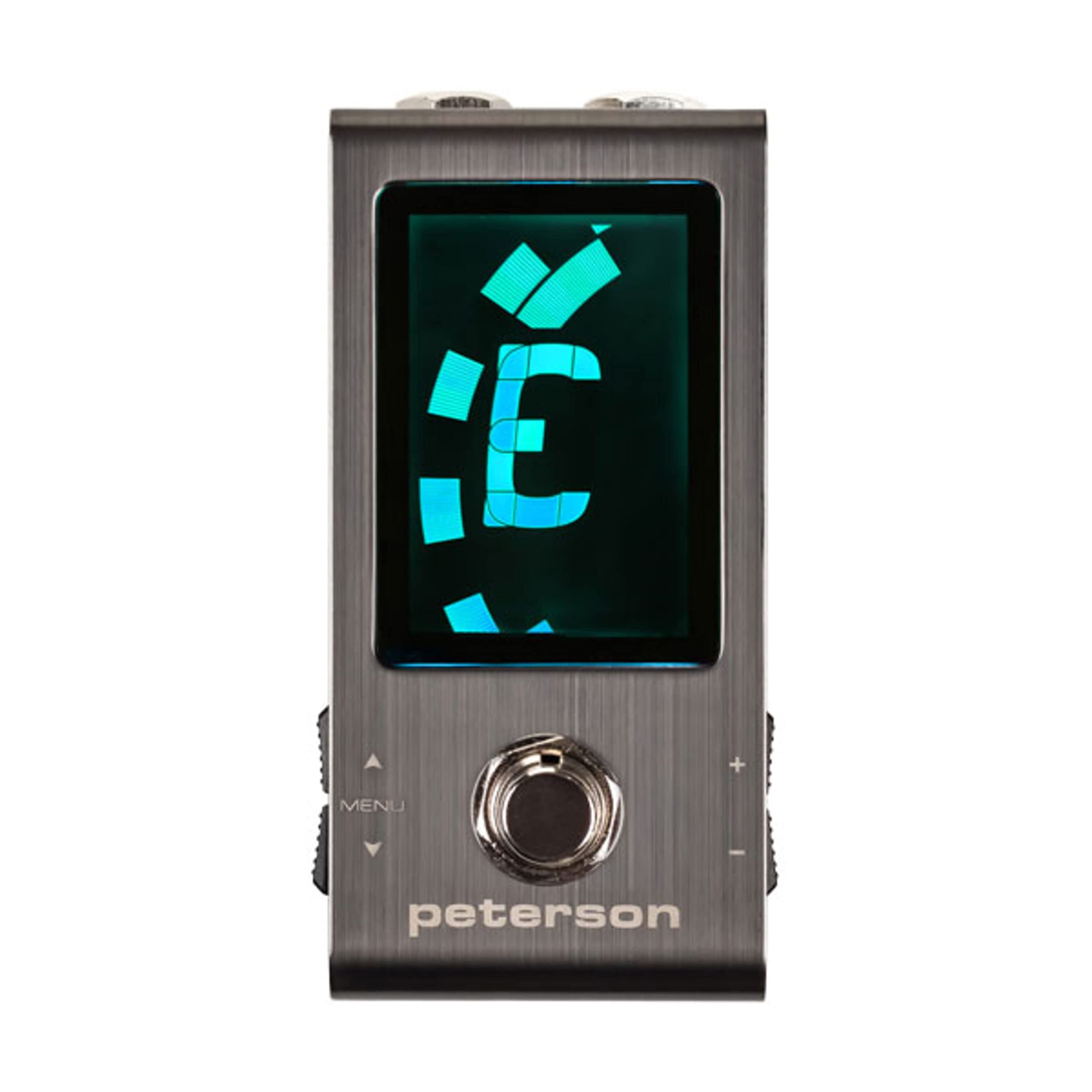
The Peterson StroboStomp Mini delivers true strobe accuracy at 0.1 cents, making it the go-to tool for intonation adjustments and sweetened tunings that account for the quirks of equal temperament. It houses over 80 preset tunings, including Peterson’s famous Sweetened Tunings for guitar, bass, and even open chords. The high-definition LCD with a variable backlight works well in direct sunlight and on a completely dark stage.
Top-mounted jacks help keep your board tidy, and the compact alloy steel enclosure is rugged enough for constant touring. The unit offers three bypass modes: true bypass, pure buffered output, and a monitor mode that keeps the tuner active without muting your signal. Power is flexible — standard 9V DC or USB-C bus power, which is unique among pedal tuners at this level.
Side-mounted push buttons for menu navigation require a bit of finger dexterity and a little space on either side of the pedal, so tight pedalboard packing can be tricky. The deep menu system has a learning curve, though the core strobe tuning function is straightforward once you find your preferred preset. For luthiers and any guitarist who demands laboratory-grade accuracy, this is the ultimate reference tool.
Why it’s great
- 0.1-cent strobe accuracy for flawless intonation
- 80+ presets with sweetened tunings
- USB-C or 9V power flexibility
Good to know
- Menu navigation requires practice
- Side buttons need clearance on board
- Strobe display can take time to read quickly mid-song
3. Korg Pitchblack X Chromatic Tuner

The Korg Pitchblack X offers four distinct tuning display modes — regular, strobe, half-strobe, and mirror — so you can pick the visual style that feels most intuitive to you. The large, high-visibility screen is easy to read from a standing position, and the adjustable brightness means you can dim it for an intimate club or crank it for an outdoor festival. Its Ultra Buffer provides excellent signal integrity over long cable runs, and you can switch between buffered and true bypass.
Aluminum construction keeps it light at 8.7 ounces while feeling solid underfoot. It runs on a standard 9V battery for quick backup or a DC power supply, and the tuning range covers 436 to 445 Hz for non-standard pitch references. Customer reviews from touring musicians consistently note that it is simpler to navigate than the BOSS TU-3 while offering more display flexibility than the TC PolyTune.
There is no polyphonic tuning mode — each string must be tuned individually. The mirror mode, which shows a symmetrical pattern when in tune, is clever but takes some getting used to. For guitarists who want a tuner that handles everything from silent backstage tuning to loud, high-stage sets without breaking the bank, the Pitchblack X is a reliable workhorse.
Why it’s great
- Four display modes for personalized tuning
- Ultra Buffer preserves tone over long cable runs
- Durable aluminum build at a mid-range price
Good to know
- Lacks polyphonic tuning
- Mirror mode has a learning curve
- Standard footprint may crowd mini boards
4. TC Electronic PolyTune 3 Mini

The TC Electronic PolyTune 3 Mini shrinks the full-size PolyTune 3 down to a compact 3.66 x 2.01 x 1.73-inch footprint without sacrificing the polyphonic tuning feature that lets you strum all six strings at once and see which ones are sharp or flat. The built-in BonaFide Buffer ensures your guitar signal stays strong over long cable runs, and the pedal provides multiple tuning modes including chromatic and drop-D support.
The bright white display is crisp and easy to read, and the push-button control is simple enough to operate mid-song. In polyphonic mode, the display shows a graphic string-by-string readout that immediately highlights problem strings — a huge time-saver during quick stage changes. The unit runs on a standard 9V power supply and draws only 0.1 amps, making it power-brick friendly.
Some users find the polyphonic mode less accurate than a dedicated strobe tuner for fine intonation work, though it is more than sufficient for standard tuning between songs. The mini size means the footswitch is small and may require a precise tap compared to a full-size pedal. For any guitarist who values speed over ultra-fine precision, the PolyTune 3 Mini is a smart, space-saving choice.
Why it’s great
- Polyphonic tuning for instant chord checks
- BonaFide Buffer maintains high-frequency clarity
- Compact size fits tight pedalboards
Good to know
- Polyphonic mode less precise for intonation
- Small footswitch can be tricky to engage
- Display dimmer than some competitors in direct sun
5. Rock Stock Nano Electric Guitar Tuner Pedal

The Rock Stock Nano Tuner reimagines the pedal tuner by integrating the display into the footswitch itself, creating a palm-sized enclosure that is roughly a quarter the size of a standard tuner. Despite the small footprint, it offers a lightning-fast 10-millisecond tuning response and maintains an impressive accuracy of 0.5 cents. The vivid LED strobe display is bright enough for any stage environment and shows the note name clearly.
The mute function is clean — activating the tuner mutes your signal without introducing pops or clicks, and deactivating it returns your signal instantly with no tone loss. The compact 2 x 2.75 x 3-inch body fits easily in the corner of any board or even in a gig bag pocket as a backup. It accepts a standard 9V center-negative power supply for easy integration.
Build quality reviews are mixed: while the initial impression is solid, several customers report failure after six to eight months of heavy gigging, and some experienced a loud pop when toggling the mute after sustained use. The plastic screen surface is vulnerable to scratches, though the display itself remains readable. For weekend warriors or as a backup, the Nano is a clever space-saver, but touring players may want a more robust option.
Why it’s great
- Ultra-compact design saves major board space
- Fast 10 ms response with 0.5-cent accuracy
- Clean mute with no pop on first use
Good to know
- Long-term durability concerns for heavy use
- Plastic screen prone to scratching
- Some units develop pop after months of use
6. OnStage GTP7000 Mini Guitar Tuner Pedal

The OnStage GTP7000 is a compact, no-frills tuner that delivers true bypass switching and a 4-color display (regular, strobe, and half-strobe modes) at an entry-level price. It covers a pitch range of 430 to 450 Hz with a tuning tolerance of +/- 0.5 cents, which is solid for general use and basic intonation checks. The 5 x 2 x 2-inch housing fits on any board without crowding, and it comes with a 9V DC adapter.
Users consistently note that the display is bright, the switch feel is positive, and the true bypass keeps the signal path clean. It works well for both electric and acoustic guitar and handles bass tuning adequately. Several customers appreciate that it replaces a clip-on tuner with a hands-free, foot-switchable solution at a minimal cost.
Some users report that the tuning accuracy is slightly less consistent than premium brands like D’Addario or BOSS, and a small number experienced a popping noise when muting the signal, which is undesirable for live performance. The rubber foot on the bottom does not hold adhesive Velcro well, so mounting may require additional hardware. For beginners or as a backup, the GTP7000 offers excellent value if you accept its minor quirks.
Why it’s great
- True bypass for uncolored signal path
- Bright 4-color display with multiple modes
- Included 9V adapter reduces hidden costs
Good to know
- Accuracy less consistent than premium tuners
- Possible pop noise when muting mid-set
- Velcro doesn’t stick well to rubber base
7. Ernie Ball VP JR 250K Volume Pedal

The Ernie Ball VP JR 250K is not a tuner — it is a dedicated volume pedal designed for passive signals, making it a niche companion for players who want to shape their dynamics and create swells. It uses a mono volume control with a taper switch that offers two distinct swell rates: a gradual, violin-like swell or a more immediate volume cut. The brushed aluminum chassis weighs only 2.51 pounds and sits low on the board thanks to its compact 10 x 3 x 4.5-inch dimensions.
The pedal uses a string mechanism for the sweep, which is smooth and repeatable straight out of the box. When the string eventually wears out, replacement strings are inexpensive and easy to install. Customers who have used volume pedals for decades, including steel guitar players, praise its smooth feel and reliable construction. No battery is needed — it is fully passive.
Because this is a volume pedal rather than a tuner, it does not provide any tuning or muting functions. If you need a tuner, you will still need a dedicated tuning pedal in your chain. The taper switch is located underneath the footplate, making it inconvenient to adjust mid-performance. For players specifically looking to add volume swells and dynamic control to their board, the VP JR remains a classic choice.
Why it’s great
- Smooth, reliable string-driven sweep
- Low profile fits well on pedalboards
- Two swell rates via taper switch
Good to know
- Volume pedal only — no tuning function
- Taper switch is hard to reach mid-set
- String replacement required after extended use
FAQ
Should I put my tuner pedal before or after overdrive pedals?
Can a tuner pedal work with a bass guitar?
What does Accu-Pitch or a strobe mode actually do?
Is a polyphonic tuner accurate enough for recording?
How do I power a tuner pedal without a dedicated power supply?
Final Thoughts: The Verdict
For most users, the guitar tuner pedal winner is the BOSS TU-3W Waza Craft because it combines bulletproof reliability, a pristine switchable buffer, and the most readable display for stage use. If you want laboratory-level strobe accuracy for intonation and setup work, grab the Peterson StroboStomp Mini. And for fast between-song tuning on a cramped board, nothing beats the compact polyphonic convenience of the TC Electronic PolyTune 3 Mini.