
That orange or yellow powder on your plant leaves isn’t just unsightly — it’s a fungal infection that weakens tissue, reduces yields, and spreads to neighboring plants within days. A targeted fungicide for rust fungus stops the infection cycle by either coating leaf surfaces or moving systemically through the plant’s vascular system.
I’m Mohammad Maruf — the founder and writer behind Drink4Good. I analyze fungicide chemistry, active ingredient concentrations, and application protocols to find formulations that actually suppress rust spore germination rather than just masking symptoms.
After reviewing concentrate ratios, target species lists, and real-world recovery reports across five leading products, this guide delivers the top-tier fungicide for rust fungus whether you’re protecting vegetable beds, ornamental shrubs, or a full turf lawn.
How To Choose The Best Fungicide For Rust Fungus
Rust fungi are obligate parasites — they need living plant tissue to survive and produce those characteristic orange pustules. General-purpose garden sprays often fail because they lack the active ingredient necessary to penetrate rust’s thick spore wall. Choosing correctly starts with understanding three factors: chemistry mode, application timing, and plant safety.
Systemic vs. Contact Fungicides
Contact fungicides like neem oil coat leaf surfaces and prevent spore germination but cannot cure an established infection inside the leaf. Systemic fungicides — particularly those containing propiconazole or myclobutanil — move through the plant’s xylem and stop rust from spreading internally. For active rust outbreaks, systemic chemistry is almost always the faster solution.
Concentration and Coverage
Concentrates typically treat 6–12 gallons of finished spray per pint, making them far more economical than ready-to-use bottles. A 16-ounce concentrate may cover 200–400 square feet of dense foliage, while a quart of concentrate can handle an entire suburban lawn. Check the dilution ratio on the label — products requiring 2–3 ounces per gallon offer stronger per-dose power.
Plant Sensitivity and Residue
Edible crops, delicate ornamentals, and turf each tolerate different adjuvants. Oil-based sprays can burn leaf margins in direct sun, while microemulsion formulations leave minimal visible residue. If you’re treating vegetables, look for organic-approved options or those with a short pre-harvest interval. For ornamental rust on roses or shrubs, stronger synthetics are usually safe.
Quick Comparison
On smaller screens, swipe sideways to see the full table.
| Model | Category | Best For | Key Spec | Amazon |
|---|---|---|---|---|
| Quali-Pro Propiconazole 14.4 | Systemic Triazole | Lawn & turf rust | 14.3% propiconazole concentrate | Amazon |
| Bonide Captain Jack’s Orchard Spray | Multi-Purpose | Fruit tree rust | Sulfur + pyrethrin blend, 32 oz | Amazon |
| Fertilome Triple Action | 3-in-1 Spray | Roses & ornamentals | Neem oil + pyrethrin, 16 oz | Amazon |
| Bonide Revitalize Biofungicide | Organic Biofungicide | Edible crops & houseplants | Bacillus amyloliquefaciens, 16 oz | Amazon |
| Garden Safe Fungicide3 | RTU Neem Oil | Quick spot treatment | Clarified neem oil, 1 gal RTU | Amazon |
In‑Depth Reviews
1. Quali-Pro Propiconazole 14.4 Fungicide

This is the strongest weapon in the list for active rust outbreaks. With 14.3% propiconazole — a triazole-class systemic fungicide — it moves into leaf tissue and stops rust from the inside out. The microemulsion formulation means less odor, better tank stability, and more even coverage compared to wettable powders. It’s labeled for turf, ornamentals, trees, and even golf-course-grade applications, making it versatile beyond just home garden use.
Real-world reports confirm it eliminated orange rust on blackberries after three applications and halted brown patch on Bermuda grass within a single treatment. The 32-ounce bottle makes roughly 16 gallons of finished spray at the standard 2-ounce-per-gallon rate — enough to cover a full-season lawn or repeated orchard sprays. Users note you cannot eat fruit for at least a year post-application, so this one stays away from vegetable beds.
For lawn rust that turns your grass orange after mowing, this is the fastest fix. The systemic residual lasts 14–21 days depending on rainfall, which is longer than contact sprays. Just rotate with a different mode of action every season to prevent resistance buildup.
Why it’s great
- Systemic triazole chemistry stops internal rust infections
- High 14.3% concentration delivers long residual control
- Microemulsion reduces odor and improves leaf coverage
Good to know
- Not for use on edible crops near harvest
- Requires full PPE and a quality sprayer
2. Bonide Captain Jack’s Citrus, Fruit & Nut Orchard Spray

This concentrate is purpose-built for fruiting trees and nut crops. The sulfur component acts as a contact fungicide against rust, powdery mildew, and brown rot, while pyrethrin provides simultaneous insect control. One pint makes up to 6.4 gallons of finished spray at the recommended dilution, which is cost-efficient when treating multiple mature trees.
Customer reviews highlight visible improvement on apple and cherry trees: leaf spots disappeared and overall canopy greened up after two applications. The spray also kills Japanese beetles within an hour and handles tent caterpillars, whiteflies, and cucumber beetles — making it a true all-in-one for orchard management. A slight sulfur residue remains on leaves, but it’s non-persistent and washes off with rain.
On the downside, sulfur is strictly a preventive and early-stage treatment. Once rust pustules are established, you’ll need to pair this with a systemic product. And because sulfur can irritate sensitive plants in hot weather, avoid spraying above 85°F.
Why it’s great
- Combines rust control with insecticide and miticide
- High dilution ratio makes a 32-oz bottle last all season
- Safe for use up to one day before harvest
Good to know
- Contact-only — won’t cure deep rust infections
- Sulfur residue may burn leaves above 85°F
3. Bonide Revitalize Biofungicide

This is a biological fungicide that uses a beneficial bacterium — Bacillus amyloliquefaciens strain D747 — to trigger the plant’s own immune response. It’s approved for organic production and can be sprayed right up to harvest day, making it the safest option for vegetable gardens and edible crops. The 16-ounce concentrate treats roughly 8–16 gallons depending on the target disease.
Customers report it turned around a septoria leaf spot issue on tomatoes and cleared minor fungal problems on houseplants. The mode of action is preventive rather than curative: the bacteria colonize leaf surfaces and outcompete rust spores before they germinate. For mild rust pressure on edibles, this works reliably without synthetic residues.
Expect a noticeable smell — reviews consistently mention the odor is strong but tolerable. And because it’s biological, you’ll need to reapply every 7–10 days and after heavy rain. For an active rust outbreak with pustules already visible, pair with a stronger systemic first, then switch to Revitalize for maintenance.
Why it’s great
- Organic-approved for edible crops up to harvest day
- Triggers systemic acquired resistance in plants
- Safe for indoor and outdoor use on houseplants
Good to know
- Preventive only — not curative for existing rust
- Frequent reapplication required after rain
4. Fertilome Triple Action
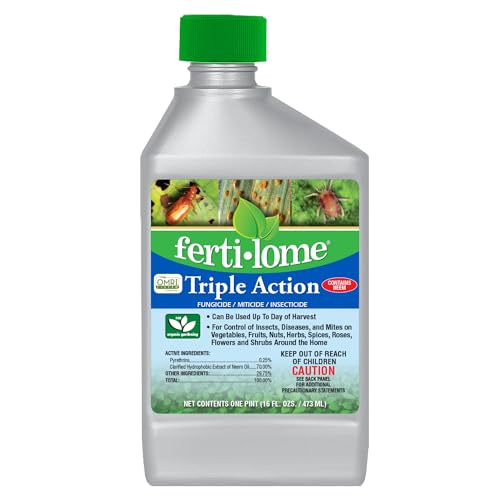
Fertilome Triple Action combines neem oil extract, pyrethrin, and sulfur into a single concentrate that works as fungicide, insecticide, and miticide. It’s specifically labeled for rust, powdery mildew, and leaf spot on fruits, herbs, vegetables, roses, and shrubs. The neem oil component smothers rust spores on contact while pyrethrin handles any insects that might be spreading the infection.
Long-time users report dependable results on apple trees and azaleas, with visible recovery after two applications. One review noted it restored azaleas suffering from both drainage issues and fungal disease, eliminating pods and returning leaves to healthy shape. The 7–14 day reapplication schedule is standard for contact-based products.
The biggest limitation is that neem oil can burn leaf edges if applied during hot, sunny conditions — spray in the evening or early morning. And because it’s a contact spray, coverage must be thorough; missing the underside of leaves leaves rust spores untouched. For light rust pressure on ornamentals, it’s a solid mid-range choice.
Why it’s great
- Three modes of action in one concentrate
- Proven on fruit trees, roses, and azaleas
- Organic-derived ingredients for edible gardens
Good to know
- Neem oil can burn foliage if applied in direct sun
- Requires full leaf coverage — underside included
5. Garden Safe Fungicide3
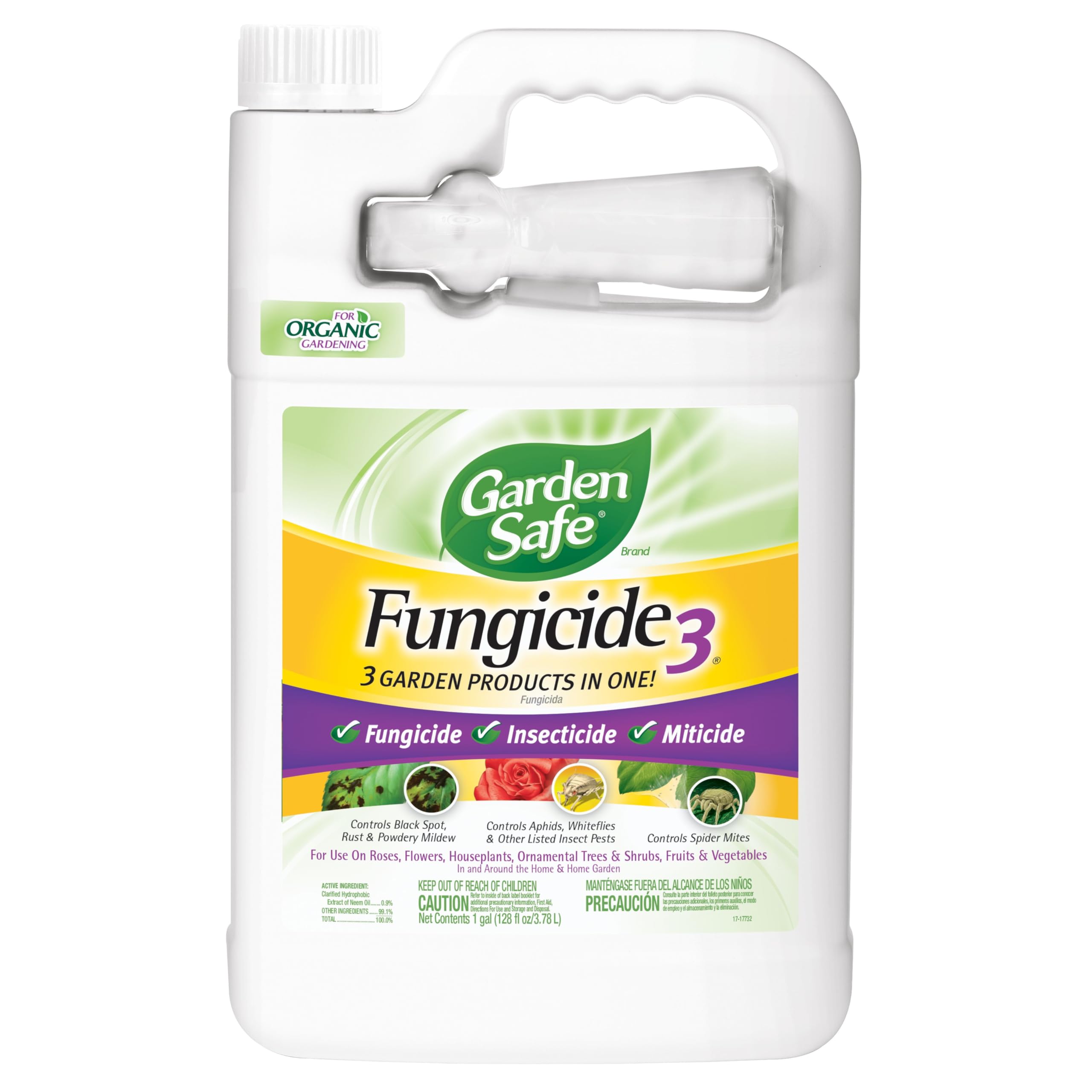
Garden Safe Fungicide3 is a ready-to-use one-gallon spray containing clarified hydrophobic neem oil extract. It’s the most convenient option in this guide — no mixing, no measuring, just attach the sprayer and go. The neem oil kills rust spores, aphids, spider mites, and whiteflies in a single pass, making it a fast solution for small gardens or spot treatments.
Reviews praise its performance on orchids, hibiscus, roses, and tomatoes. One gardener with a large vegetable plot reported weekly applications eliminated mildew, improved foliage color, and increased blueberry yield. The organic certification means you can use it on edibles without worrying about synthetic residue.
The attached sprayer has limited reach — about 4 inches of tubing — which makes covering tall plants or undersides awkward. Some users advise replacing the sprayer entirely or decanting into a better pump. Also, several reviews noted leaf burn when applied during midday heat; use at dawn or dusk for best results.
Why it’s great
- Ready-to-use — zero mixing required
- Organic neem oil safe for vegetables and fruit
- Triple-function: fungicide, insecticide, miticide
Good to know
- Integrated sprayer has very short hose reach
- Can burn sensitive leaves if applied in full sun
FAQ
Can I use a rust fungicide on vegetables I plan to eat?
How often should I reapply fungicide for rust fungus?
What makes rust fungus different from powdery mildew?
Can I mix fungicide with insecticide in one sprayer?
Final Thoughts: The Verdict
For most users, the fungicide for rust fungus winner is the Quali-Pro Propiconazole 14.4 because its systemic triazole chemistry stops rust infections that contact sprays miss, and the 32-ounce concentrate provides season-long coverage at a reasonable cost per application. If you need a harvest-safe option for edible crops, grab the Bonide Revitalize Biofungicide. And for quick spot-treatment on houseplants or small garden beds, nothing beats the convenience of Garden Safe Fungicide3.