
Hooking a power amp into your rig is a specific move — you’ve already decided the preamp or modeler does the tone shaping and you just need clean, transparent wattage to push a cab. The wrong choice adds noise, colors your sound, or simply lacks the headroom for live stage work. This guide isolates the units that deliver exactly what the signal chain sends them, without injecting their own character or failing under load.
I’m Mohammad Maruf — the founder and writer behind Drink4Good. My research focuses on power amp output topologies, damping factor specs, and how different load ratings interact with real cabinet impedances across both solid-state and tube platforms.
The right best guitar power amp depends entirely on whether you need a lightweight pedalboard-mounted solution for fly dates or a full 100-watt tube head built for metal-grade headroom and a built-in attenuator for home volume control.
How To Choose The Best Guitar Power Amp
The decision comes down to the rest of your chain. Modeler users need a flat, neutral power source that amplifies without tone coloration. Traditionalists running a full pedalboard or preamp pedal want a power section that either stays transparent or adds a specific sonic imprint, like the compression and breakup of tubes. Your cab impedance, the venues you play, and your tolerance for weight and heat all steer the choice.
Wattage vs Real Volume
Wattage ratings are linear in theory but logarithmic in practice. Doubling power only increases perceived volume by about 3 dB. A 20-watt tube amp played through an efficient 4×12 cab can keep up with a drummer. A 100-watt solid-state head run into a low-sensitivity 1×12 may struggle. Look past the number and consider the cabinet pairing and whether the amp has an attenuator or built-in speaker for bedroom-level use.
Impedance Matching and Load Protection
Every power amp expects a specific load range, typically 4, 8, or 16 ohms. Running a 4-ohm cab on an 8-ohm output forces the amp to work harder and can overheat the output transformer in a tube unit or shut down a solid-state protection circuit. Some models include a speaker defeat or dummy load for silent recording via XLR out, a feature that saves you from buying a separate load box.
Connectivity and Portability
Check for an effects loop, balanced XLR out with cab simulation, and a headphone jack. If you fly to gigs, weight and footprint matter — a 2.8-pound pedalboard-sized unit beats lugging a 30-pound head. For studio use, USB output and direct recording features reduce the need for external interfaces.
Quick Comparison
On smaller screens, swipe sideways to see the full table.
| Model | Category | Best For | Key Spec | Amazon |
|---|---|---|---|---|
| Seymour Duncan PowerStage 170 | Solid State | Modeler users needing ultra-portable clean power | 170W into 4 ohms, 2.8 lbs | Amazon |
| BOSS Katana Artist Head Gen 3 | Hybrid | Versatile players wanting deep effects and power amp input | 100W Class AB, 4-band EQ, Power Amp In | Amazon |
| BOSS Katana Head Gen 3 | Hybrid | All-in-one head with built-in 5-inch speaker for home | 100W, 5-inch internal speaker, 12 amp characters | Amazon |
| Orange Super Crush 100 | Solid State | Clean, pedal-friendly platform with XLR cab sim | 100W Class A/B, analogue preamp, FX loop | Amazon |
| Orange Pedal Baby 100 | Solid State | Pure power stage for pedal users who want zero color | 100W into 8 ohms, Class A/B, 8.7 lbs | Amazon |
| Peavey 6505 Mini MH | Tube | Metal players needing two channels and built-in attenuator | 20W/5W/1W, 2x EL84 tubes, MSDI XLR out | Amazon |
| Quilter Labs SuperBlock UK | Solid State | Backup amp on pedalboard with British voiced cab sims | 25W, 3 voicings, XLR + headphone outs | Amazon |
| OriPure 5W OA-H05 | Tube | Budget entry into all-tube power with handcrafted transformer | 5W, 1x EL84, handcrafted output transformer | Amazon |
| Randall RD100H Diavlo | Tube | High-gain three-channel head for extreme metal | 100W, 3 channels, tube boost mode | Amazon |
In-Depth Reviews
1. Seymour Duncan PowerStage 170

The PowerStage 170 sits at the sweet spot of the entire category because it solves the central problem modeler users face: getting a lightweight, low-noise, high-headroom power stage that fits on a pedalboard. At 2.8 pounds, it slides into a gig bag unlike any full-size head, and its 170-watt rating into 4 ohms ensures you have significant reserve for clean, undistorted output even through an inefficient cab.
Its three-band analog EQ is intuitive for on-the-fly tuning without touching your modeler preset. The Master Volume knob gives you solo-level boost control, and when you bypass your dirt pedals, the PowerStage reverts to a clean platform that avoids the sterile sound some budget solid-state units introduce. Multiple users confirm it remains quiet with a low noise floor, and the fan, while audible at desk volume, is inaudible in a band mix.
Reliability does surface as a concern — multiple reports of a clicking sound developing after months of use, with the unit failing during live shows. While Seymour Duncan support has been responsive, the failure pattern across several units suggests this may be a design vulnerability for players who push it hard daily. For careful home and occasional gig use, the risk is low, and for its weight-to-power ratio, no other pedalboard power amp matches it.
Why it’s great
- Extremely portable at 2.8 pounds; fits on most pedalboards.
- Clean, transparent power with useful 3-band analog EQ for room tuning.
Good to know
- Multiple reports of unit failure (clicking sound) after 4-6 months of regular use.
- Requires a preamp pedal or modeler; not a standalone preamp.
2. BOSS Katana Artist Head Gen 3

The Katana Artist Head Gen 3 is BOSS’s flagship hybrid power amp that bridges the gap between a modeler-friendly platform and a traditional tube-like feel. Its Class AB power section delivers 100 watts, and the dedicated Power Amp Input allows you to bypass the head’s preamp and effects entirely, turning it into a clean, high-headroom power stage for units like the Quad Cortex or Axe-Fx. This dual identity makes it the most versatile unit in the mid-range tier.
Inside, you get six selectable amp characters, each with a variation, plus five independent effects sections covering booster, modulation, FX, delay, and reverb. The four-band EQ provides deeper tone shaping than the standard three-band found on most heads. While the standard Katana Head has a built-in 5-inch speaker for silent practice, the Artist does not, so it is strictly aimed at those pairing with an external cab.
The learning curve is real — unlocking all 60-plus BOSS effects requires the Tone Studio software or a third-party editor. Without it, you are limited to the onboard knobs, which still offer excellent range. Users praise its ability to take the Quad Cortex via the Power Amp Input, delivering authentic tone without loading the modeler’s own power amp sims. It is heavier and larger than pure pedalboard units but still lighter than an equivalent tube head.
Why it’s great
- Power Amp Input bypasses preamp for use with modelers as a clean power stage.
- Six amp characters and five effects sections give enormous versatility.
Good to know
- No built-in speaker for silent practice unlike the standard Katana Head Gen 3.
- Bluetooth adapter for wireless editing is sold separately.
3. BOSS Katana Head Gen 3

The standard Katana Head Gen 3 takes the same Tube Logic platform as the Artist but adds a built-in 5-inch practice speaker that runs at 30 watts. This single feature changes the value proposition completely — you get a stage-ready 100-watt head that also functions as a discreet practice amp without connecting an external cab. For apartment players who also gig, this removes the need for a separate low-wattage bedroom amp.
The amp characters include the new Pushed type, which delivers edge-of-breakup tones that respond dynamically to pick attack, a feature that tube purists often miss in modeling platforms. The five effects sections cover the essentials, and the USB-C port doubles as a speaker output and audio interface for direct DAW recording. The 0.5-watt power setting lets you crank the master for power tube saturation at low volume through the internal speaker.
While the internal speaker is convenient, it is small and cannot replicate the low-end thump of a 12-inch cab. The clean tones can be tricky to dial in — the sheer number of parameters in Tone Studio means it takes time to find your sound. Build quality is robust, and the 19.4-pound weight is reasonable for a 100-watt hybrid head. For the price, no other unit offers this combination of built-in speaker, effects, and power amp flexibility.
Why it’s great
- Built-in 5-inch speaker enables silent practice without a cab.
- USB-C acts as audio interface for direct recording to DAW.
Good to know
- Clean tones are more difficult to dial in compared to the drive channels.
- Driver and software installation for Tone Studio can be slow.
4. Orange Super Crush 100

The Orange Super Crush 100 is a serious contender for players who want a solid-state power amp that feels like a tube amp. Its all-analogue, single-ended preamp feeds into a Class A/B 100-watt power section, delivering the same punch and dynamic response that Orange’s tube heads are known for, but without the weight, heat, or tube replacement costs. At 30.4 pounds, it is heavier than the Pedal Baby but lighter than a full tube stack.
The two channels are footswitchable and cover clean from pristine to edge of breakup, and dirty from blues grit to high-gain metal when boosted with a Tube Screamer. The built-in digital reverb is footswitchable and road-worthy. The balanced XLR out with CabSim is a practical addition for direct-to-FOH use, saving you from carrying a separate cab or microphone. Users consistently note that it responds to picking dynamics and volume knob rolls, something many solid-state amps fail to replicate.
The gain channel tends to cut mids, which can make it sound slightly loose compared to a tube Marshall or Fender Hot Rod. It is not a pure power amp — it has its own preamp character that may color your pedal tone. For those wanting a transparent power stage for a modeler, the Pedal Baby is a better fit. But for a standalone head that works both as a pedal platform and a grab-and-go amp, the Super Crush 100 is hard to beat in this price range.
Why it’s great
- Responds to pick attack and volume knob dynamics like a tube amp.
- Footswitchable reverb and CabSim XLR out for direct recording and FOH.
Good to know
- Gain channel cuts mids and can sound slightly loose.
- Not a transparent power amp; has its own analogue preamp character.
5. Orange Pedal Baby 100

The Orange Pedal Baby 100 is a pure power amplifier designed to do one thing: amplify your pedalboard or modeller with absolute fidelity. Its Class A/B topology delivers 100 watts into an 8-ohm load and 70 watts into 16 ohms. Weighing only 8.7 pounds, it is a lightweight alternative to the Super Crush for players who already have a separate preamp or pedal-based rig and just need clean muscle.
The front end uses a Class A single-ended topology that Orange claims adds a subtle warmth reminiscent of their tube circuits. In practice, it stays neutral enough to let your pedals define the tone, which is exactly the brief. Users confirm it is extremely loud, punchy, and clean, even driving two 16-ohm cabs simultaneously. The simple two-band EQ (treble and bass) is enough to adjust for room acoustics without mucking up your carefully dialed pedal settings.
Its simplicity can also be a limitation — no reverb, no effects loop, no XLR output. If you need any of those, the Super Crush 100 or a modeler-based solution may serve you better. The impedance options are also limited: it works optimally with an 8-ohm load or two 16-ohm cabs in parallel. A single 16-ohm cab cuts power to 70 watts, which is still plenty, but worth noting for those with a single 16-ohm cabinet. For the pure power amp role, it remains one of the best options.
Why it’s great
- Extremely clean and transparent; no tone coloration.
- Lightweight at 8.7 pounds; easy to transport for fly dates.
Good to know
- No reverb, effects loop, or XLR out; pure power stage only.
- Impedance limited to 8 or 16 ohms; no 4-ohm support.
6. Peavey 6505 Mini MH

The 6505 Mini MH delivers the classic 5150/6505 high-gain sound in a small all-tube package, using 2x EL84 power tubes and 3x 12AX7 preamp tubes. Its 20-watt output is surprisingly loud — users consistently confirm it keeps up with drummers in a three-piece band. The built-in attenuator lets you drop to 5 or 1 watt for apartment-friendly volume while keeping the power tubes cooking, which is a game-changer for the genre.
Two footswitchable channels cover everything from pristine clean (with a crunch mode for tweedy breakup) to the legendary high-gain lead channel that defined modern metal. The three-band EQ is simple but effective, and the footswitchable buffered effects loop keeps your delay and reverb clean even at high gain. The MSDI XLR output with ground lift provides a balanced direct signal, and the USB output is a nice bonus for recording.
Early production units had overheating and TSI threshold issues, but those appear resolved. The stock tubes are serviceable; upgrading can improve headroom and clarity. The footswitch uses a single cable, meaning you cannot independently control channel switching and reverb on/off at the same time. It is also heavy for a mini head at 15 pounds. For metal players who want authentic tube saturation at home volumes, there is no better compact option.
Why it’s great
- All-tube 6505 sound with built-in attenuator for 1W/5W/20W operation.
- Two channels cover clean to extreme high-gain; takes pedals well.
Good to know
- Early units had overheating issues; confirm current stock is revised.
- Footswitch cannot independently control channel and reverb simultaneously.
7. Quilter Labs SuperBlock UK

The SuperBlock UK is a 25-watt solid-state power amp in a pedal enclosure, voiced specifically for British amp tones — Vox AC-style chime and Marshall Plexi crunch. It functions as both a DI box and a power stage, making it an ideal backup rig that lives on your pedalboard. The three voicings cover clean jangle, edge-of-breakup, and high-gain British roar, giving you a surprising amount of variety for a unit this size.
The dry, cab-emulated monitor output via XLR and 1/4-inch TRS is a standout feature for direct recording of silent stage use. The effects loop is a welcome addition at this price, and the reverb, while not deep, is musical and usable. Many users pair it with a 2×10 or 1×12 Celestion-loaded cab for small gigs, confirming it is loud enough for practice and intimate venues.
It lacks the physical low-end punch of a full-size head, especially when compared to tube amps through a 4×12 cab. The clean headroom is limited — push it too hard and it compresses earlier than a 100-watt unit. As a pure backup for a larger rig or a primary practice amp, it excels. As a main stage power amp for loud bands, the 25-watt limitation will show. The stainless steel enclosure is road-ready, and Quilter’s build quality is well-regarded.
Why it’s great
- Three British voicings cover Vox and Marshall territory.
- Cab-emulated XLR and 1/4-inch outputs for silent recording or FOH.
Good to know
- Limited clean headroom and physical low-end compared to full-size heads.
- 25W rating may not be enough for loud stage use with inefficient cabs.
8. OriPure 5W OA-H05

The OriPure OA-H05 is a genuine all-tube power amp head that uses a single 12AX7 preamp tube, an EL84 power tube, and a 6Z4 rectifier tube in a single-ended Class A configuration. At 5 watts, it is strictly a practice and recording amp — it gets loud enough for home use but will not keep up with a drummer. What it lacks in volume, it makes up for in tonal character, with handcrafted output transformer using grain-oriented silicon steel for improved low-end response.
The Gain and Volume knobs control two preamp stages, letting you dial in everything from clean sparkle to warm overdrive. The Bright/Warm switch and separate High, Mid, and Low EQ controls offer more tone shaping than most 5-watt heads. The cast-aluminum casing feels premium and protects the tubes well during transport. Users note that replacing the stock 12AX7 with a 12AU7 (ECC82) significantly increases clean headroom and clarity.
The stock tubes are mediocre — expect to spend a little more on tube upgrades for the full potential. There is no effects loop, headphone output, or speaker defeat, so you must connect it to a cab at all times. The single-ended output means it distorts earlier and sounds warmer than push-pull designs, which is exactly what many tube purists want. For a budget entry into all-tube power, it punches above its weight with careful tube selection.
Why it’s great
- Genuine all-tube, single-ended Class A design with handcrafted transformer.
- Extensive EQ section for a mini head: Bright/Warm switch plus 3-band EQ.
Good to know
- Stock tubes lack headroom; upgrading to 12AU7 improves performance.
- No effects loop, headphone out, or speaker defeat; must always run into a cab.
9. Randall RD100H Diavlo
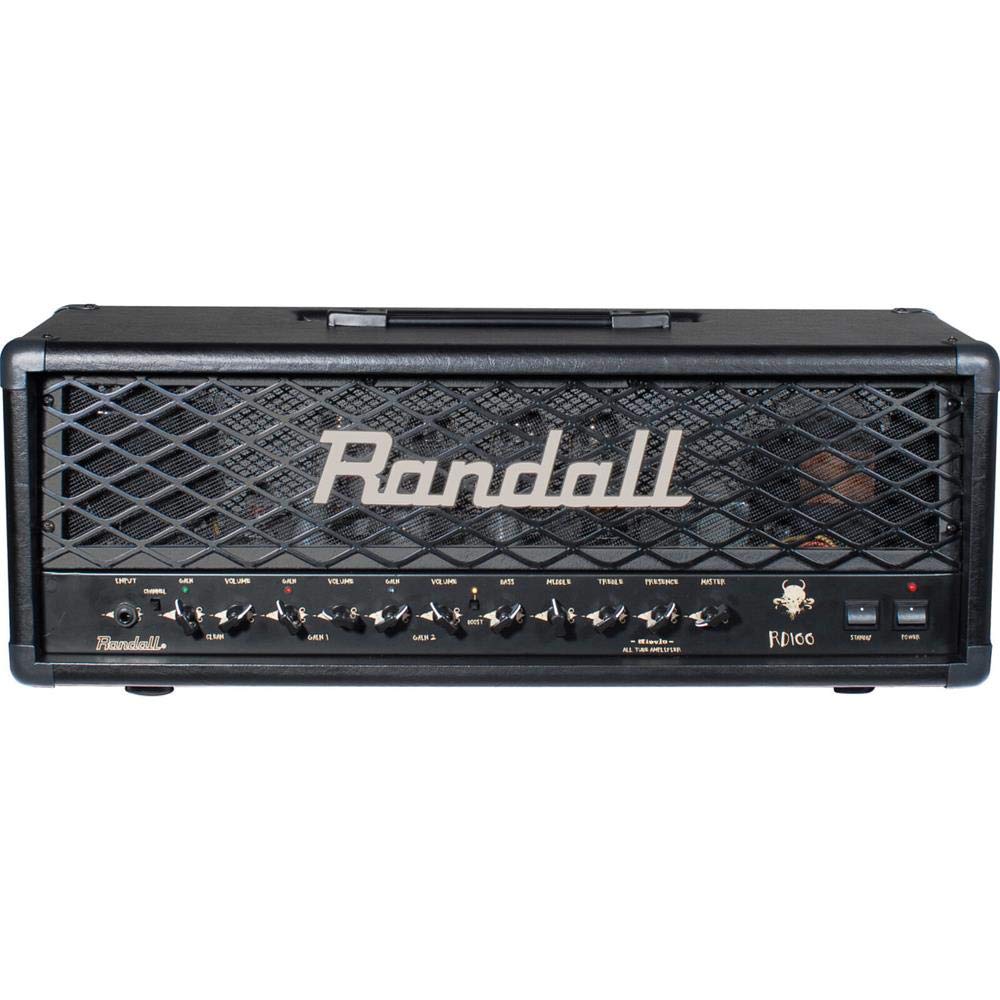
The Randall RD100H Diavlo is a three-channel all-tube 100-watt head built for high-gain metal, drawing from Randall’s legacy with Dimebag Darrell. Clean Channel 1 is surprisingly articulate and works for indie jangle or pristine cleans at bedroom levels. Channels 2 and 3 deliver progressively greater saturation, with Channel 3 offering extreme gain for modern metal leads. The Tube Boost mode adds harmonics and volume for solos without needing an external pedal.
The speaker-emulated XLR direct output with ground lift allows direct connection to a mixing board or audio interface, and the four-function footswitch covers channel selection and boost. Users note it is extremely loud — far louder than its 100-watt rating suggests — and works beautifully with a 25-watt Celestion Greenback for controlled volume or a full 4×12 for stage-filling sound. Build quality is listed as flawless, and the red LED interior lighting is a subtle cosmetic touch.
Despite its strengths, the high-gain channels can become muddy past certain gain settings, requiring careful EQ to keep palm mutes tight. Some users report that at full band volume, the sound becomes somewhat dry and the boosted gain can feel mushy and harsh compared to a Mesa Boogie. The clean channel, while beautiful, lacks sparkle at higher stage volumes. It also weighs a heavy 25 kilograms, making it a less portable option for players who fly to gigs.
Why it’s great
- Three channels plus Tube Boost mode cover everything from pristine clean to extreme metal.
- Speaker-emulated XLR direct out with ground lift for recording and FOH.
Good to know
- High-gain channels can become muddy past 4:00 on the gain control.
- Extremely heavy at 55 pounds; not suitable for flying musicians.
FAQ
Can I use a guitar power amp with a modeler like the Axe-Fx or Quad Cortex?
What is the difference between a tube and solid-state power amp for guitar?
Final Thoughts: The Verdict
For most users, the best guitar power amp winner is the Seymour Duncan PowerStage 170 because it balances everyday portability with enough clean headroom to drive a 4×12 cab and the reliability concerns only arise under the most rigorous touring schedules. If you want a versatile all-in-one head with a built-in practice speaker, grab the BOSS Katana Head Gen 3. And for pure, uncolored power for your pedalboard or modeller, nothing beats the lightweight transparency of the Orange Pedal Baby 100.