
Hunting for the best graphics card under means navigating a minefield of last-gen leftovers and tempting-but-trap “deals” that promise big performance but deliver driver headaches and VRAM bottlenecks. The – sweet spot is uniquely competitive right now, with new-generation chips from both NVIDIA and AMD offering legitimate 1440p gaming, ray tracing, and AI upscaling features that were reserved for premium cards just two years ago. Whether you’re building a fresh SFF rig or upgrading a decade-old system, the choice comes down to balancing raw rasterization, memory bandwidth, and feature support within a strict budget.
I’m Mohammad Maruf — the founder and writer behind Drink4Good. I’ve spent years analyzing GPU specs, studying real-world benchmarks, and tracking pricing trends to separate marketing hype from genuine value in the entry-to-mid-range segment.
This guide is built to help you sort through the noise and identify the best gpu under 400 that matches your exact resolution target, case size, and performance expectations.
How To Choose The Best GPU Under 400
With the price cap, you’re looking at the upper tier of entry-level, the sweetest part of the mid-range, and the very bottom of the premium stack. Knowing which spec matters most for your setup prevents you from overpaying for features you will never use.
VRAM Capacity – More Is Not Always Better, But 8GB Is the Floor
8GB of VRAM is the practical minimum for 1440p gaming in 2025. Cards with 6GB, like the low-profile RTX 3050, will struggle with texture-heavy titles and higher resolutions. Meanwhile, 10GB and 12GB options provide breathing room for mods and future titles, but you will pay a premium for that extra headroom that may go unused if you stick to 1080p.
Architecture Generation – Don’t Buy Last-Gen at New-Gen Prices
The jump from Ampere (RTX 30 series) or RDNA 2 to Blackwell (RTX 50 series) or RDNA 3 brings tangible improvements in ray tracing, AI upscaling (DLSS 4 vs. DLSS 3), and power efficiency. A new-gen card with 8GB of GDDR7 often outperforms a last-gen card with 12GB of GDDR6 in real-world gaming scenarios. Always prioritize the architecture generation over raw specs when comparing cards at the same price point.
Resizable BAR and Motherboard Compatibility
Modern GPUs, especially Intel Arc and Radeon RX 7000-series cards, require Resizable BAR (also called Smart Access Memory on AMD systems) enabled in your BIOS to reach full performance. If you are upgrading an older system — for example, a prebuilt Dell Optiplex or a motherboard from 2017 or earlier — check that your BIOS supports this feature. Without it, some cards may run significantly slower or experience unusual stuttering in CPU-bound scenes.
Form Factor and Power Connectors
Case size matters. Low-profile SFF cards (like the Maxsun RTX 3050) fit into the smallest Optiplex cases but trade cooling and performance. Full-height dual-fan and triple-fan designs run cooler and quieter but need at least two PCIe slots of space. Also check your power supply: most cards in this range use a single 8-pin connector, but some RTX 5060 models may require a 750W PSU to handle transient power spikes under load.
Quick Comparison
On smaller screens, swipe sideways to see the full table.
| Model | Category | Best For | Key Spec | Amazon |
|---|---|---|---|---|
| PNY RTX 5060 Epic-X ARGB OC | Premium | Silent 1440p gaming | 8GB GDDR7, 2280 MHz | Amazon |
| ZOTAC RTX 5060 AMP | Premium | Competitive esports | 8GB GDDR7, 28 Gbps | Amazon |
| MSI RTX 5060 Ti 8G Ventus 3X | Premium | VR and ray tracing | 8GB GDDR7, 2602 MHz | Amazon |
| ASUS Dual RTX 5060 OC | Mid-Range | Creative work & 1440p | 8GB GDDR7, 2565 MHz | Amazon |
| GIGABYTE RTX 5060 WINDFORCE OC | Mid-Range | Budget 1080p/1440p | 8GB GDDR7, 2512 MHz | Amazon |
| XFX Speedster SWFT210 RX 7600 | Mid-Range | Stable Linux gaming | 8GB GDDR6, 2655 MHz | Amazon |
| ASRock Intel Arc B570 | Mid-Range | 1440p & content creation | 10GB GDDR6, 2600 MHz | Amazon |
| Maxsun GeForce RTX 3050 | Budget | SFF Optiplex builds | 6GB GDDR6, 1470 MHz | Amazon |
| abytespark Prebuilt (i7 + RX 590) | Budget | All-in-one starter PC | 8GB GDDR5, 3.9 GHz CPU | Amazon |
In-Depth Reviews
1. PNY NVIDIA GeForce RTX 5060 Epic-X ARGB OC Triple Fan
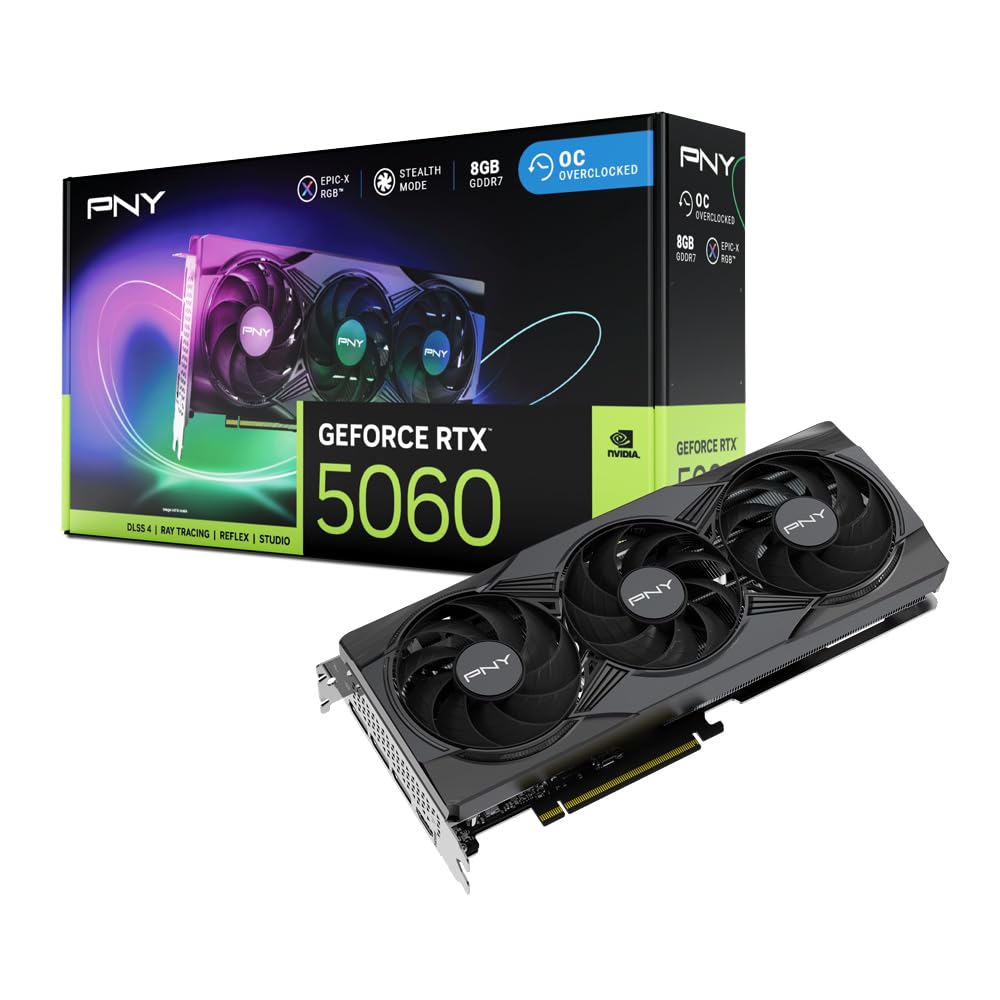
The PNY RTX 5060 Epic-X ARGB OC represents the pinnacle of what you can fit under the ceiling without sacrificing the Blackwell architecture’s key features. Its triple-fan cooler pushes the card toward the upper end of the budget, but the payoff is whisper-quiet operation even under sustained 1440p loads, with the fans remaining nearly inaudible at medium speeds. The 8GB of GDDR7 memory on a 128-bit bus handles modern texture streaming with fewer hitches than GDDR6 equivalents, and the included ARGB lighting adds a premium aesthetic without feeling gaudy. Real-world testing shows consistent 100+ FPS at high settings in most shooters and open-world titles, which is impressive given the sub- pricing.
Where this card truly shines is in its feature set: fifth-gen Tensor cores enable DLSS 4 frame generation for a significant FPS boost, while fourth-gen ray tracing cores deliver more realistic lighting without tanking performance. The SFF-ready design means it drops into compact mid-tower cases without airflow concerns, and the dual-slot profile leaves room for other expansion cards. The included NVIDIA Studio drivers also make this a credible option for creative workloads like Premiere Pro and DaVinci Resolve, where RTX acceleration cuts render times drastically.
The main compromise is the 8GB VRAM — future titles may require texture quality reductions at 4K, but at 1440p this is a non-issue for the next few years. The PCIe 5.0 interface is also redundant on older x16 slots, though it runs fine at x8 speeds without bottlenecking. Pair it with a well-ventilated case and a 650W+ PSU for the best experience.
Why it’s great
- Triple-fan cooler runs nearly silent under load
- DLSS 4 and ray tracing on a budget-friendly card
- SFF-ready dual-slot design fits most mid-tower cases
Good to know
- 8GB VRAM may limit 4K texture quality in future titles
- Premium pricing at the top of the budget
2. ZOTAC Gaming GeForce RTX 5060 AMP DLSS 4

The ZOTAC RTX 5060 AMP focuses on raw memory bandwidth — its 28 Gbps GDDR7 chips are the fastest in this comparison, translating to snappier response times in competitive titles like Fortnite, Overwatch, and Call of Duty. Users report frame rates exceeding 390 FPS in Fortnite with appropriate settings and CPU pairing, which makes this card a top choice for esports-focused builders. The IceStorm 2.0 cooling system, featuring dual 90mm BladeLink fans, composite heatpipes, and pass-through airflow, keeps the card well under 75°C during extended sessions without ramping up to audible levels.
The 2550 MHz boost clock sits near the top of the 5060 stack, and the SFF-ready 2-slot design means it fits comfortably in smaller cases like the Cooler Master NR200 or Fractal Terra. The FREEZE fan stop technology cuts the fans entirely during low load, making this an excellent pick for quiet desktop or HTPC builds. Three DisplayPort 2.1b and one HDMI 2.1b port support up to 8K output, so the card is also future-proof for high-resolution multi-monitor setups.
The main catch is price — at it sits at the very edge of the budget, and some users note that the 5060 Ti variants offer slightly better rasterization for a minor premium if you can stretch the budget. Also, the card relies on an 8-pin PCIe power connector, meaning older PSUs without that rail may need an adapter or upgrade. Pair it with a Ryzen 5600 or higher to avoid CPU bottlenecks at high frame rates.
Why it’s great
- Fastest 28 Gbps GDDR7 memory in the under- segment
- IceStorm 2.0 cooling stays quiet under sustained gaming
- Compact 2-slot design fits SFF builds without compromise
Good to know
- Premium budget pricing, close to 5060 Ti territory
- 8-pin power connector may require PSU upgrade for older systems
3. msi Gaming RTX 5060 Ti 8G Ventus 3X OC

The MSI Ventus 3X OC pushes the RTX 5060 Ti architecture into the territory — just slightly over the mark, but worth it if VR gaming or high-fidelity ray tracing is a priority. The 2602 MHz boost clock is the highest in this roundup, and the triple-fan TORX Fan 5.0 design moves substantial airflow while staying quiet enough that the GPU is rarely the loudest component in your case. User reports confirm it runs VR titles like Into The Radius 2 at 120 FPS with full detail, which is remarkable for a card in this price band.
The build quality is classic MSI: a solid metal backplate with an airflow vent, a thick baseplate that transfers heat efficiently, and composite heatpipes that pull thermal energy away from the memory modules. This robust thermal solution means the card rarely enters boost throttle territory, even during prolonged heavy loads. The 128-bit GDDR7 memory interface handles 1440p gaming without stuttering, and the NVIDIA Blackwell architecture provides improved ray tracing performance over the previous generation by roughly 30% in supported titles.
The biggest drawback is the price premium — you are paying for the Ti suffix and the triple-fan cooler, but the 8GB VRAM limit remains the same as the cheaper 5060 models. If you are strictly a 1080p or light 1440p gamer, the extra cost is hard to justify. The card is also physically large — 3-slot width — so measure your case clearance before purchasing.
Why it’s great
- Highest boost clock in the comparison for demanding titles
- Triple-fan cooler handles VR loads without throttle
- Sturdy metal backplate and heatpipe design for long-term durability
Good to know
- Slightly over the budget cutoff
- Large 3-slot design requires generous case clearance
4. ASUS Dual NVIDIA GeForce RTX 5060 OC Edition

The ASUS Dual RTX 5060 OC Edition hits the sweet spot of the – range by offering the full Blackwell architecture (DLSS 4, PCIe 5.0, GDDR7) at a price that undercuts most triple-fan solutions. The OC mode boost clock of 2565 MHz provides genuine performance uplift compared to reference cards, and the axial-tech fans — featuring a barrier ring that increases downward air pressure — keep the card running in the low 70°C range even during extended gaming sessions. Users report 140 FPS in Fortnite and smooth 1440p gameplay in most modern titles without any tweaking.
The 150W TDP is one of the lowest in its class, translating to excellent power efficiency — the card typically draws around 100W in realistic gaming scenarios, which means even a 500W PSU can comfortably run it. The 0dB technology stops the fans entirely under light workloads, making this an ideal choice for a quiet home office or media center PC that occasionally needs gaming muscle. The 2.5-slot design fits most mid-tower cases without obstructing adjacent PCIe slots.
Some users note that fresh driver installs sometimes require a clean uninstall (DDU) from previous GPUs to avoid instability — this is a general NVIDIA recommendation, not specific to ASUS. The card also lacks RGB, which is a pro for minimalists but a con for builders seeking a lit build. At , it represents the best performance-per-dollar in the 5060 family.
Why it’s great
- Best performance-per-dollar among RTX 5060 options
- Low 150W TDP runs cool and quiet on a 500W PSU
- 0dB fan stop for completely silent operation at idle
Good to know
- No RGB lighting for those who prefer illuminated builds
- May require DDU cleanout when swapping from a competing GPU
5. GIGABYTE GeForce RTX 5060 WINDFORCE OC 8G

The GIGABYTE RTX 5060 WINDFORCE OC 8G is a straightforward no-frills option that relies on GIGABYTE’s proven WINDFORCE cooling system to keep the 5060 chipset running at its 2512 MHz boost clock. This card is ideal for 1080p gamers who want headroom to hit high refresh rates without paying for features they will not use. The dual-fan design is relatively compact at 7.83 inches long, meaning it will fit in most budget cases without issue, and the single 8-pin power connector works with the vast majority of power supplies on the market.
GDDR7 memory running at 128-bit delivers excellent bandwidth for texture streaming in modern titles, and the PCIe 5.0 interface ensures forward compatibility with newer motherboards. The included thermal design runs quietly — users report the fans averaging around 50-60% speed under gaming loads, which is inaudible inside a closed case. For those upgrading from a GTX 1660 or similar, reviewers describe the performance jump as “roughly double,” which transforms the experience across most popular game libraries.
The main trade-off is that the WINDFORCE cooler, while effective, does not include the 0dB fan stop feature found on ASUS and MSI cards, meaning the fans always spin when the card is powered on. This is not an issue for most users, but those chasing absolute silence at idle should consider a different model. The 8GB VRAM is adequate for 1080p, but 1440p users may need to dial texture settings down in the most demanding titles.
Why it’s great
- Affordable entry point into RTX 5060 and GDDR7
- Compact size (7.83 inches) fits most budget cases
- Single 8-pin power connector simplifies installation
Good to know
- Fans always spin — no 0dB idle mode
- 8GB VRAM may require settings reduction at 1440p in future titles
6. XFX Speedster SWFT210 Radeon RX 7600

The XFX Speedster SWFT210 RX 7600 is the best option in this roundup for Linux gamers and anyone who prioritizes out-of-the-box driver stability over the latest NVIDIA features. Based on AMD’s RDNA 3 architecture, this card delivers strong 1080p and solid 1440p performance with an impressive 2655 MHz boost clock — the highest in this comparison by clock speed alone. The dual-fan SWFT cooler is notably quiet even under sustained load, as users confirm the card staying in the upper 70°C range after a driver update, with fan speeds hovering around 60%.
The 8GB GDDR6 memory runs on a 128-bit bus, which is standard for this class and enough for smooth 1440p gaming at medium-to-high settings. The card’s compact 9.49-inch length and dual-slot design make it versatile across case sizes, and the lack of RGB will appeal to those building a stealth-themed PC. For VR enthusiasts, users confirm it runs Assetto Corsa and Half-Life Alyx without issues, which is impressive given the sub- price point.
The main shortcoming is that the RX 7600 lacks hardware-level ray tracing acceleration comparable to NVIDIA’s RTX 40 or 50 series, and DLSS is not available — you are limited to FSR (FidelityFX Super Resolution), which is less effective at 4K upscaling. The 8GB VRAM also feels slightly tighter than the RTX 5060’s GDDR7, though in practice both handle 1440p similarly. Driver maturity on Windows is excellent after the latest Adrenalin updates, resolving earlier thermal issues.
Why it’s great
- Excellent Linux driver support — swap from Nvidia is seamless
- Very quiet dual-fan cooler with low power draw
- High 2655 MHz boost clock for smooth 1080p/1440p gaming
Good to know
- No DLSS — limited to AMD FSR for upscaling
- Ray tracing performance is weaker than comparably priced RTX cards
7. ASRock Intel Arc B570 Challenger 10GB OC

The ASRock Intel Arc B570 Challenger is the dark horse of this list — a card that requires a bit of technical effort but rewards creators and gamers with excellent value. The Intel Xe2-HPG architecture includes Xe Matrix Extensions for AI acceleration, and XeSS 2 upscaling competes closely with DLSS in supported titles. The dual-fan 0dB cooling technology keeps the card silent at idle, and the metal backplate prevents sag on the compact PCB.
Content creators will appreciate the hardware AV1 encoding support, which significantly reduces file sizes and export times in Premiere Pro and DaVinci Resolve compared to older codecs. The 2600 MHz GPU clock is competitive with the RTX 5060, and the 10GB VRAM buffer allows for larger project files and higher-resolution textures. Gamers benefit from DirectX 12 Ultimate support and high framerates in titles optimized for Intel’s architecture — users report crushing VRChat and Palworld at high settings after enabling Resizable BAR in the BIOS.
The major caveat is that Intel Arc cards require Resizable BAR (4G decoding and Above 4G encoding in BIOS) to function correctly. If your motherboard does not support these features — or if you are using an older CPU like a Ryzen 5 2600 or Intel 9th-gen — you may encounter driver timeouts and instability. Users also report occasional blue screens related to driver conflicts, usually solvable by clearing CMOS and re-enabling BAR. Not a card for plug-and-play beginners, but a fantastic value for skilled builders.
Why it’s great
- 10GB VRAM on 160-bit bus outperforms 8GB cards in texture-heavy games
- Hardware AV1 encoding speeds up video exports
- Very budget-friendly price with excellent 1440p performance
Good to know
- Requires Resizable BAR enabled in BIOS — not compatible with all motherboards
- Driver stability can be temperamental; best for experienced users
8. maxsun GeForce RTX 3050 6GB Low Profile

The Maxsun GeForce RTX 3050 6GB Low Profile is a niche product designed specifically for small form factor (SFF) systems like the Dell Optiplex, HP EliteDesk, or Lenovo ThinkCentre where only a half-height PCIe slot is available. Its slim 6.65 x 2.71-inch profile fits into cases that cannot accommodate any other modern GPU, and it draws power solely from the PCIe slot — no external power connector needed — which is crucial for prebuilt office PCs with low-wattage PSUs. The Ampere architecture includes NVENC encoding for streaming and DLSS support, which is remarkable at this form factor.
Performance is adequate for 1080p gaming at medium settings in esports titles like Fortnite, Warzone, and Rocket League, with users reporting 80+ FPS on balanced settings. The card also excels in 3D design work like Solidworks, where users have found workarounds to enable hardware acceleration. The included low-profile bracket makes installation straightforward, and the single-slot width ensures it does not block adjacent components. Fan noise is noticeable under load — a common trade-off for the tiny cooler.
The biggest limitation is the 6GB VRAM over a 96-bit bus, which is a severe bottleneck for modern games and 1440p resolutions. The core clock of 1470 MHz is also modest, and without external power the card cannot overclock meaningfully. The Maxsun RTX 3050 is exactly what it looks like: a last-gen entry card for ultra-constrained SFF builds. If you have room for a full-height GPU, skip this and go for an RTX 5060 option instead.
Why it’s great
- Only modern GPU that fits low-profile SFF optiplex cases
- No external power needed — runs off PCIe slot alone
- DLSS and NVENC support at the smallest possible form factor
Good to know
- 6GB VRAM and 96-bit bus are severe bottlenecks for modern gaming
- Fan gets loud under load due to compact cooler
9. abytespark Prebuilt Gaming PC (i7-4770 + RX 590)
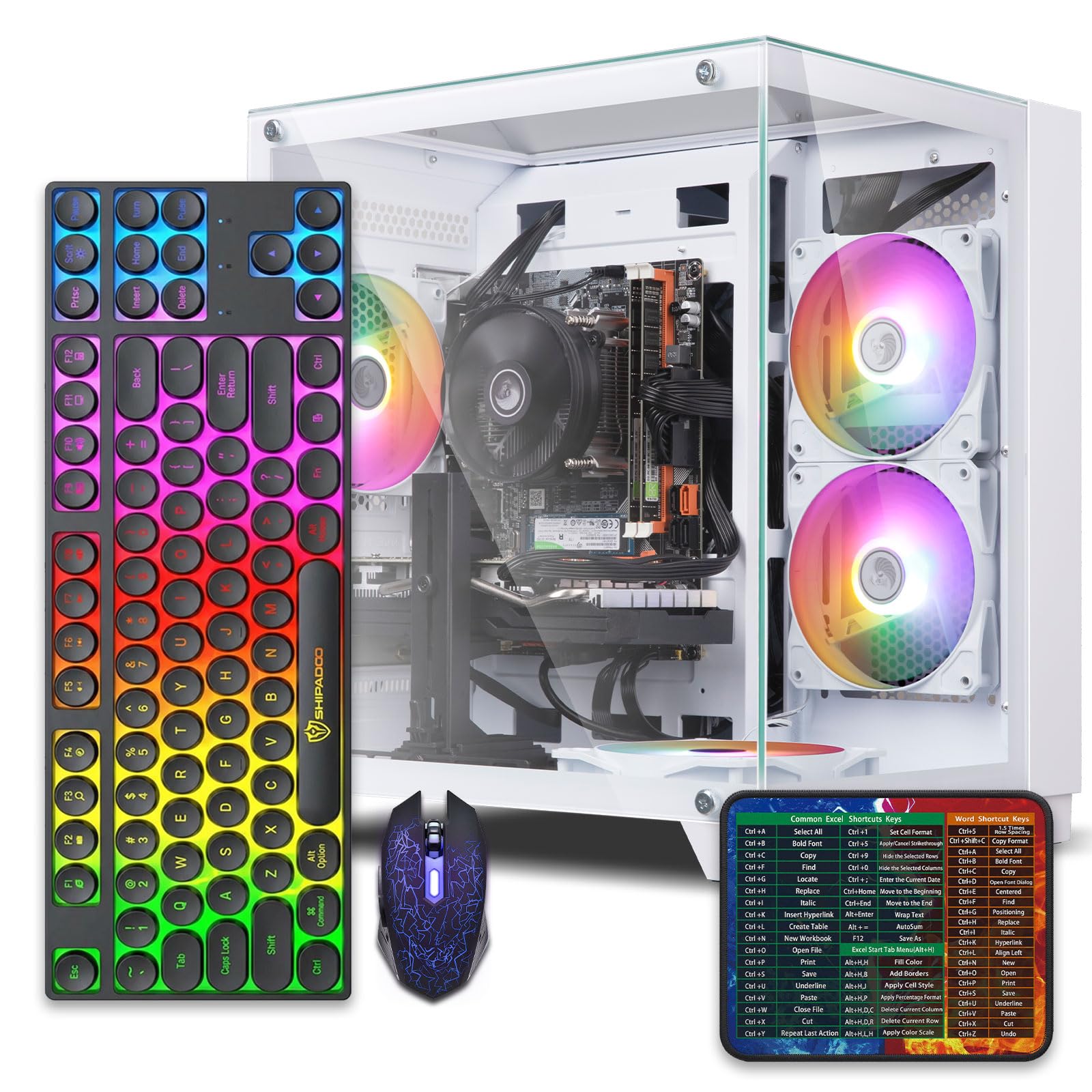
The abytespark Prebuilt Gaming PC is not a standalone GPU, but a complete desktop system built around a decade-old Intel Core i7-4770 processor and an AMD Radeon RX 590 with 8GB GDDR5. As a package, it offers a budget-friendly entry into PC gaming for those who do not own any components — keyboard, mouse, and mousepad are included. The RX 590 can still handle games like Fortnite, GTA V, and Minecraft at 1080p medium settings with 60+ FPS, and the included 16GB DDR3 RAM and 512GB SSD provide enough storage for a modest game library.
The blue-lit RGB fans and white case give it a gamer aesthetic that appeals to younger builders on a tight budget. Users report that setup takes about an hour out of the box, and the system runs BONEWORKS in VR, which is surprising given the hardware’s age. The included Windows 11 Home license is convenient, though the bypass installation method used for unsupported CPUs is a concern for long-term stability and security updates.
The hard truth is that this system uses hardware from 2013–2014 (i7-4770, B85 chipset, no NVMe boot support, no TPM 2.0 module). The RX 590 is ancient by GPU standards and lacks modern features like ray tracing, DLSS, or efficient encoding. This PC will struggle with any AAA title released after 2020 at acceptable settings. It is a temporary gateway into PC gaming — expect to replace the entire platform within 12–18 months if you want to play current releases smoothly.
Why it’s great
- Complete plug-and-play package with peripherals included
- Runs 1080p esports titles and older games smoothly out of the box
- Budget-friendly price for someone starting from zero hardware
Good to know
- Hardware is 10+ years old with no upgrade path
- Windows 11 installed via unsupported bypass; no TPM or Secure Boot
- RX 590 lacks modern features like ray tracing or DLSS
FAQ
Is 8GB of VRAM enough for 1440p gaming in 2025?
Should I buy an RTX 5060 or a used RTX 3070 for under ?
Can I use the Intel Arc B570 on a motherboard without Resizable BAR?
What power supply wattage do I need for a GPU under ?
Are low-profile or single-slot GPUs worth buying for gaming?
Final Thoughts: The Verdict
For most users, the best gpu under 400 winner is the ASUS Dual RTX 5060 OC Edition because it packs the full Blackwell architecture, GDDR7 memory, and DLSS 4 into a compact dual-fan design at a price that leaves room for other components. If you need the quietest possible operation in a small case, grab the PNY RTX 5060 Epic-X ARGB. And for content creators or Linux users on a tight budget, nothing beats the value of the XFX RX 7600 or the ASRock Intel Arc B570.