
The difference between a pair of graduated compression socks that actually work and a pair that just squeezes is obvious within the first hour of wear. The right pair applies precise pressure at the ankle, then gradually releases it up the calf, creating a gentle milking action that pushes blood back toward the heart. The wrong pair cuts off circulation at the knee band or bunches behind the heel, turning a medical tool into an all-day irritation. For nurses, flight attendants, pregnant women, and anyone battling varicose veins or leg fatigue, the choice determines whether your legs feel light and energized by evening or heavy and throbbing.
I’m Mohammad Maruf — the founder and writer behind Drink4Good. I spend my days analyzing the mechanics of wellness products, mapping compression gradients to real-world venous return data, and separating the socks that deliver measurable therapeutic benefit from those that only look the part.
This guide cuts through the confusion surrounding best graduated compression socks for women by examining the five top contenders based on gradient accuracy, fabric durability, fit consistency across sizes, and real feedback from long-haul wearers who tested them through 12-hour shifts, international flights, and daily recovery routines.
How To Choose The Best Graduated Compression Socks For Women
Not all compression socks are built the same, and the wrong choice can mean hours of discomfort or, worse, ineffective therapy. Focus on three variables: compression level, graduated design integrity, and construction quality. The compression level, measured in millimeters of mercury (mmHg), dictates the pressure at your ankle. The graduation ensures that pressure decreases as the sock moves up your leg. The construction quality — fiber blend, knit density, and seam finishing — determines whether the sock holds its shape after repeated washing or loses its therapeutic edge within weeks.
Compression Level: Matching mmHg to Your Condition
Mild compression (8-15 mmHg) offers light support for tired legs during long flights or extended standing. Moderate compression (15-20 mmHg) is the most common therapeutic range — it addresses varicose veins, minor edema, pregnancy discomfort, and general leg fatigue without being overly difficult to put on. Firm compression (20-30 mmHg) requires a doctor’s recommendation and is typically used for moderate edema, post-surgical recovery, or chronic venous insufficiency. Going too high without medical advice risks cutting off circulation rather than improving it.
Graduated Design: The Gradient Matters More Than the Number
True graduated compression socks apply maximum pressure at the ankle (100 percent of the stated mmHg) and reduce it at the calf (roughly 50 to 70 percent of the ankle pressure). Some brands advertise a compression level but then deliver uniform squeeze from ankle to knee, which defeats the therapeutic purpose. Look for socks that clearly state the pressure at both the ankle and upper calf, or at minimum include an explicit claim of graduation in the product description. User complaints about socks that “cut in” behind the knee usually point to poor graduation rather than a too-high mmHg rating.
Fit and Sizing: Ankle, Calf, and Foot Length Specificity
Compression socks rely on precise circumferential fit. A sock that is too loose at the ankle won’t generate enough pressure, while one that is too tight at the calf creates a tourniquet effect. Measure your ankle circumference at the narrowest point, calf circumference at the widest point, and the length from the floor to the bend of your knee. Cross-reference those measurements against the brand’s sizing chart rather than defaulting to your shoe size. Brands like Sockwell include extended sizing (S, M, L, XL) with calf-specific ranges, while others use a one-size-fits-many approach that tends to fail for women with wide calves or very slender ankles.
Quick Comparison
On smaller screens, swipe sideways to see the full table.
| Model | Category | Best For | Key Spec | Amazon |
|---|---|---|---|---|
| Sockwell Women’s Micro Grade | Knee High | All-day standing & travel | 15-20 mmHg graduated, bamboo rayon blend | Amazon |
| Doc Miller Thigh High Open Toe | Thigh High | Varicose veins & pregnancy | 15-20 mmHg, open toe, unisex sizing | Amazon |
| Sockwell Women’s Full Flattery | Knee High | Seamless everyday wear | 15-20 mmHg, seamless toe, USA made | Amazon |
| Dr. Motion 4 Pairs Knee-hi | Knee High | Budget-friendly multi-pack | 15-20 mmHg, 4 pairs, professional style | Amazon |
| Soxland 6 Pair Pack | Knee High | Maximum variety & rotation | 15-20 mmHg, cotton blend, 6 pairs | Amazon |
In‑Depth Reviews
1. Sockwell Women’s Micro Grade
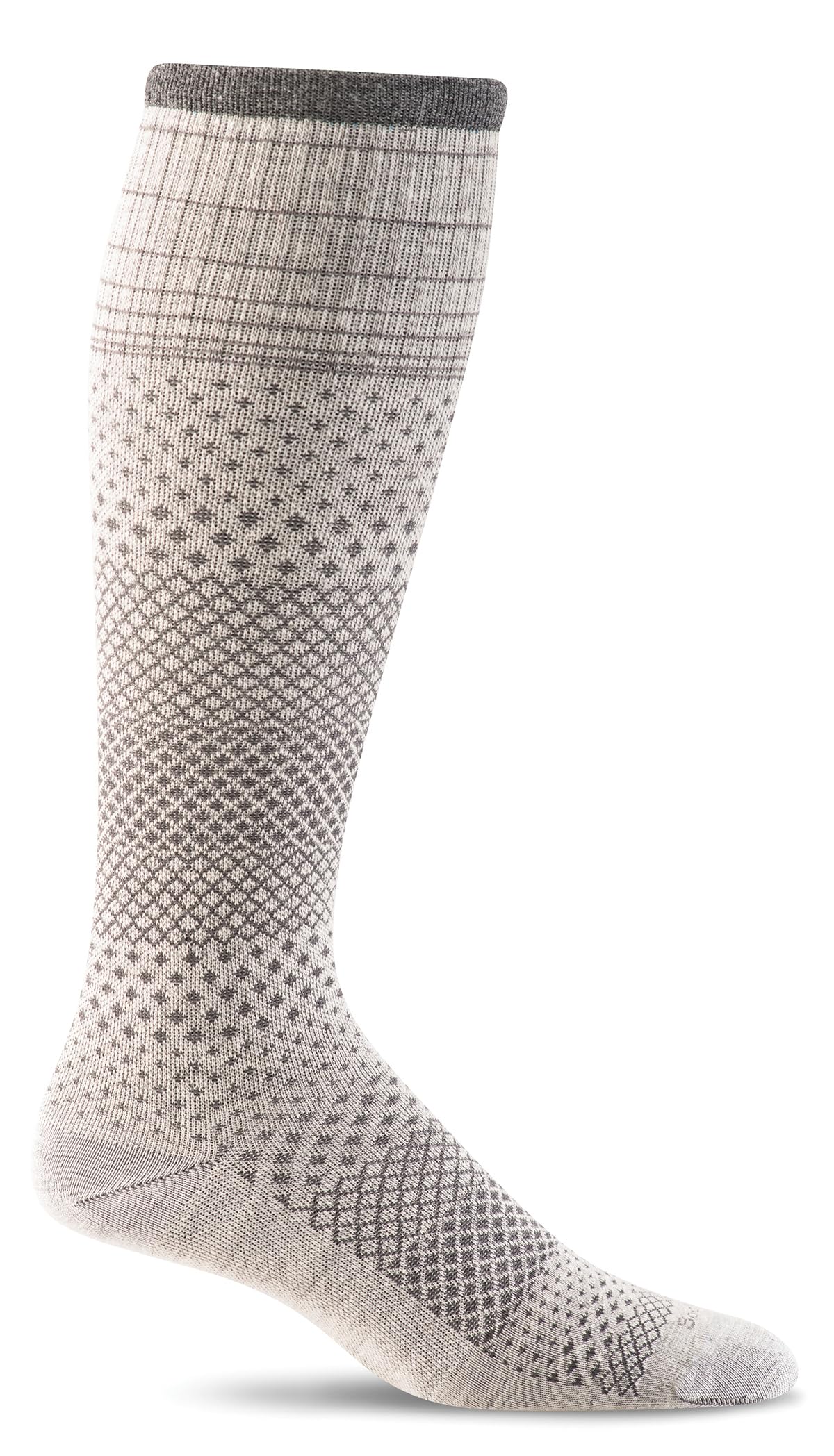
The Sockwell Micro Grade hits the exact balance of compression power and all-day wearability that most women in this category need. The 15-20 mmHg gradient is noticeable from the moment you pull them on — your ankles feel supported without being squeezed into numbness — and the bamboo rayon blend makes them significantly more breathable than cotton-heavy alternatives. Nurses who wear these for 12-hour shifts report zero swelling and no moisture buildup, even in closed-toe work shoes.
What sets the Micro Grade apart is the moisture-wicking construction combined with a wide selection of colors and patterns. Women who typically hate the clinical look of compression socks genuinely enjoy wearing these. The fabric stays flexible through the calf, so women with average to moderately athletic calves don’t experience the dreaded banding effect behind the knee. Multiple reviewers wore them for 10-plus-hour plane rides and arrived with ankles that looked and felt normal — no swelling, no red indent lines.
The Sockwell brand also offers both light (8-15 mmHg) and firm (20-30 mmHg) versions in the same Micro Grade line, making it easy to adjust pressure without changing your trusted fit. The only limitation is the lack of a thigh-high option, but as a knee-high daily driver for standing, travel, and general circulation support, this is the most complete package available.
Why it’s great
- Breathable bamboo rayon blend prevents overheating during long shifts
- True 15-20 mmHg graduation with no calf banding
- Wide variety of colors and patterns that look like normal socks
Good to know
- Only available in knee-high length; no thigh-high option
- May feel tight on very large calves despite extended sizing
2. Doc Miller Thigh High Open Toe Compression Stockings

For women dealing with varicose veins that extend above the knee or who need pregnancy support, the Doc Miller thigh-high offers a graduated compression solution that covers the full leg without the restrictive feeling of a closed-toe stocking. The 15-20 mmHg rating applies graduated pressure from ankle to upper thigh, and the open-toe design keeps your feet cool and allows for easy wear with sandals or open-toe shoes during warmer months. The material is thick enough to provide genuine support without feeling like medical-grade rubber.
Several reviewers noted that the fit varies noticeably by color — the blue version runs significantly smaller and tighter than the black, so if you buy multiple pairs in different colors, expect inconsistencies. The top band includes a silicone grip that keeps the stockings from sliding during moderate activity, though a few users with slender thighs reported that the band created mild itching after extended wear. The material also settles slightly after a few hours, which reduces the visual bulk under fitted clothing.
Putting on thigh-highs is its own challenge, and the Doc Miller design doesn’t simplify that process. You need to use the inside-out method or a donning aid to get them up smoothly. Once on, the support is genuine and the open-toe comfort is a legitimate advantage for anyone who hates feeling fabric cramped inside the toe box. For medical or recovery use where full-leg coverage is required, these deliver dependable graduated compression.
Why it’s great
- Open-toe design keeps feet cool and works with open-toe shoes
- Genuine graduated compression for full-leg coverage
- Silicone top band does a good job staying in place during walking
Good to know
- Fit varies noticeably by color — black fits truer than blue
- Difficult to put on without donning aid or inside-out technique
3. Sockwell Women’s Full Flattery Graduated Compression Socks
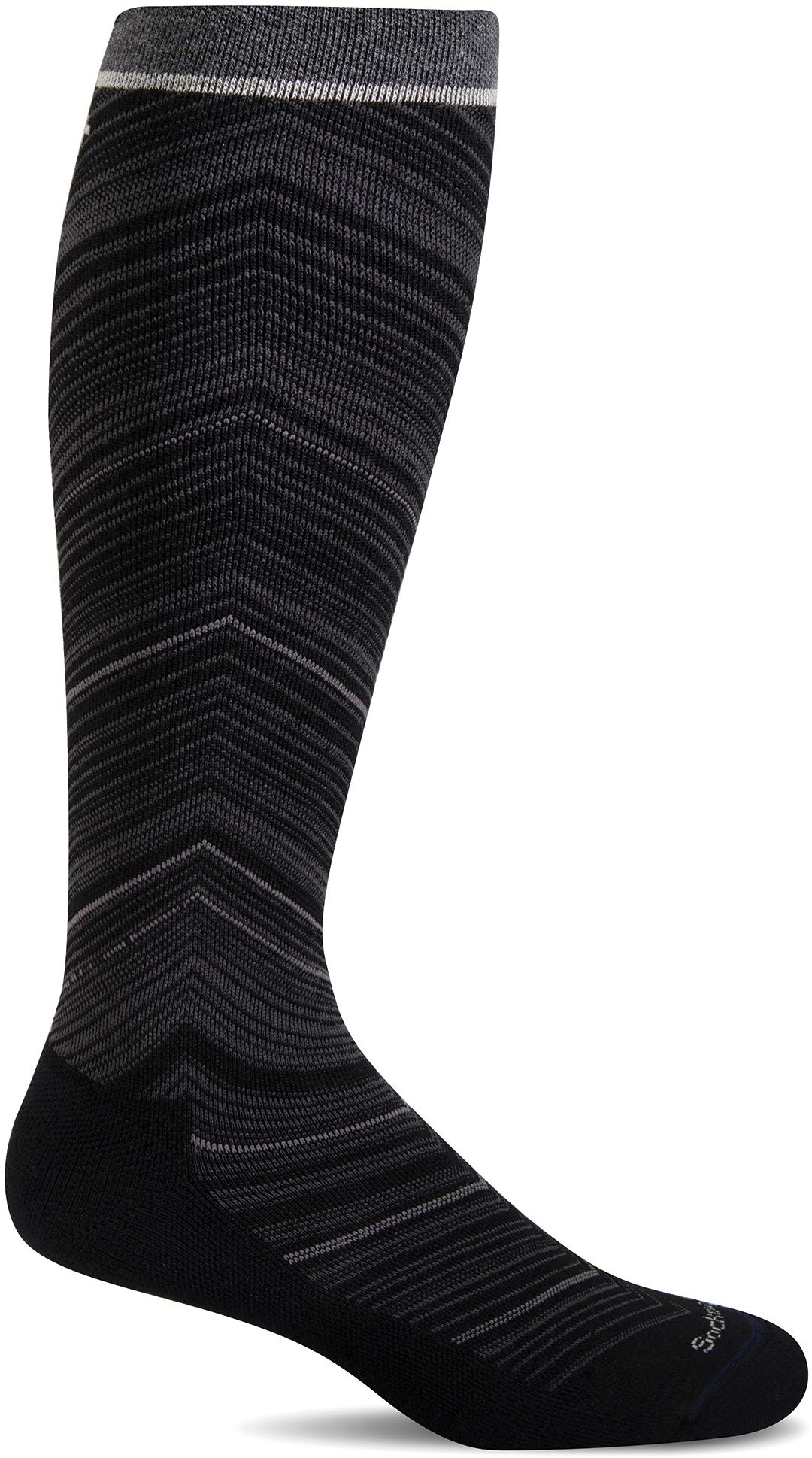
The Full Flattery by Sockwell is designed for women who want compression that feels invisible. The seamless toe construction eliminates the bunching and ridge irritation that plagues many mid-range compression socks, making them comfortable enough to wear with Mary Janes or low-profile sneakers. The 15-20 mmHg graduation is smooth and consistent, and the fabric is noticeably finer and more breathable than most competitors in this price tier.
Multiple reviewers with long-term wear experience — particularly nurses and women with lymphedema — praised the Full Flattery for leaving zero red indentations after 12 hours of continuous use. The sock stays in place without rolling down, and the moderate compression level is sufficient to manage swelling during long shifts without feeling restrictive. The color palette leans toward natural and professional tones, making these suitable for office attire where clinical-looking socks would stand out.
The durability trade-off is real: several users reported that after roughly three months of consistent wear and washing, the compression gradually weakens and the socks lose their therapeutic edge. That’s not unusual for this category — few knee-highs maintain full gradient beyond 90 to 120 wash cycles — but it’s worth noting if you plan to wear them daily. The comfort during the first three months, however, is among the best available for women who prioritize feel over maximum compression life.
Why it’s great
- Seamless toe design prevents irritation in shoe toe boxes
- Leaves no red indentations even after 12-hour wear
- Natural colors and smooth fabric suitable for professional attire
Good to know
- Compression weakens after roughly three months of daily use
- May be too light for those requiring firm 20-30 mmHg support
4. Dr. Motion 4 Pairs Graduated Compression Knee-hi

Dr. Motion delivers a solid entry-level graduated compression experience at a per-pair cost that makes it easy to build a full rotation without breaking your budget. The 15-20 mmHg compression is noticeable but not punishing, and the overall construction — smooth knit, reinforced heel and toe — holds up well through repeated washing. Reviewers with medical jobs and retail standing shifts consistently reported less leg fatigue and noticeable swelling reduction.
The key limitation is sizing specificity. Women with shoe sizes above 9.5 or with wide feet reported that the foot portion feels tight and can cause rubbing at the heel and ankle. The calf circumference range is also somewhat narrow — women with very athletic or fuller calves found the socks hard to pull up and experienced some binding behind the knee. If your measurements fall within the standard range, these work well, but if you’re on the edges of the sizing chart, the fit becomes inconsistent.
On the positive side, the style is professional and understated, making them acceptable for office environments, and the four-pair format means you always have a clean pair ready. For someone new to graduated compression or looking for a budget-friendly way to test whether daily compression helps their leg fatigue, this multi-pack is the lowest-risk entry point in this guide.
Why it’s great
- Four pairs in one purchase for easy daily rotation
- Mild-to-moderate compression reduces swelling for most standard sizes
- Professional look suitable for office and clinical settings
Good to know
- Runs small for women’s shoe size 9.5 and above
- Narrow calf range; may bind on athletic or full calves
5. Soxland Women’s Compression Socks Therapeutic Graduated (Pack of 6 Pairs)
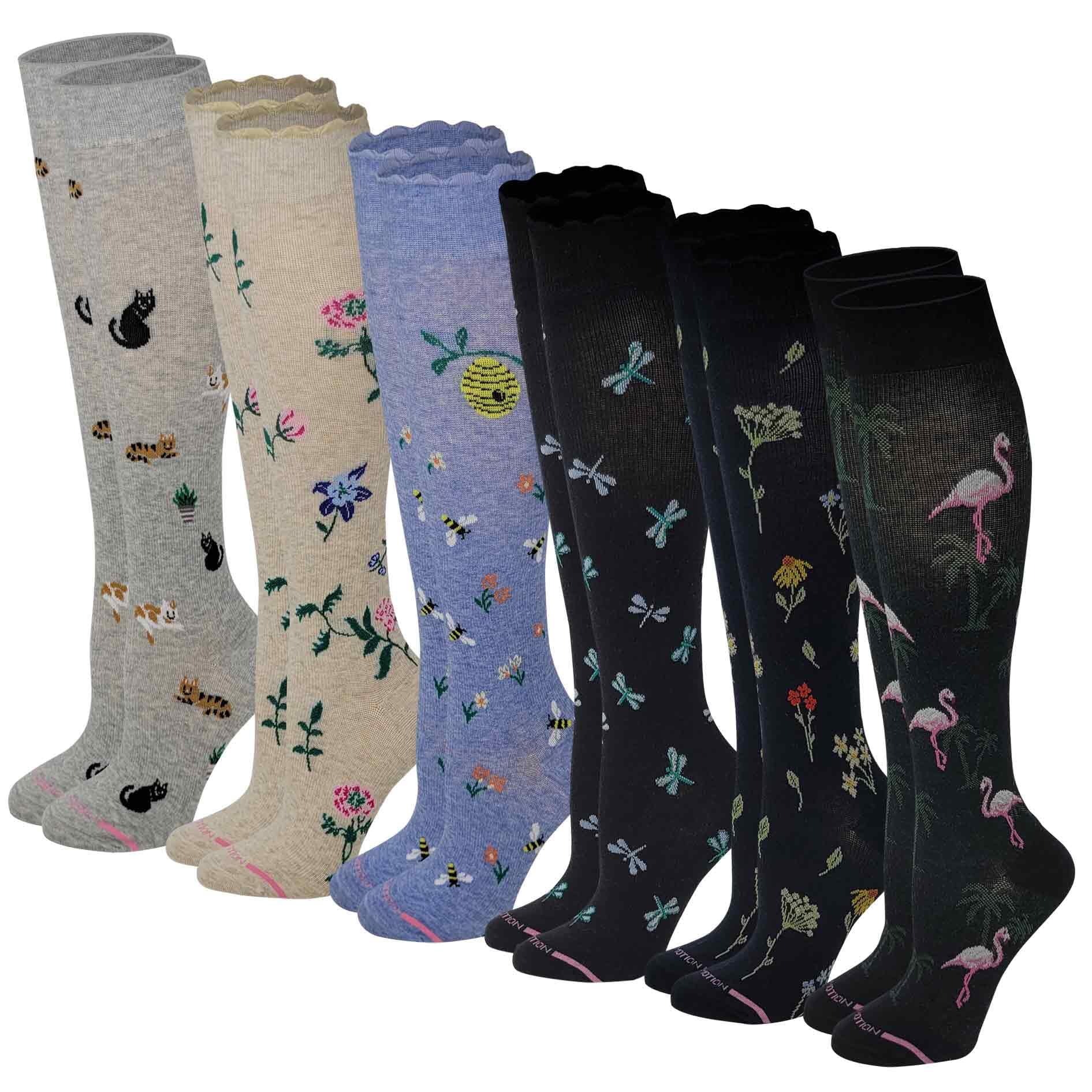
The Soxland six-pair pack is the most versatile option here for women who want variety — both in style and in wash-day logistics. The cotton blend fabric feels softer against the skin than synthetic-heavy alternatives, though it also means the socks are slightly harder to pull on compared to slicker nylon blends. The 15-20 mmHg compression is consistent, and wearers who stand for 12-hour shifts reported meaningful reductions in leg discomfort and swelling.
Reviewers with smaller feet (sizes 5 to 5.5) appreciated that the foot section doesn’t bunch or leave excess fabric at the toe — a common problem when brands design for a wide foot range. The patterns are cute without being loud, and the Christmas-themed options got special mentions for holiday gifting. The product description is notably vague on exact sizing specifications and compression testing standards, so you rely more on user feedback than on technical documentation.
The primary trade-off with the six-pair pack is the learning curve for getting them on. Multiple reviews note that the cotton construction makes for a tighter initial pull than 20-30 mmHg socks from other brands, despite the stated 15-20 mmHg rating. Once on, the comfort is high, and you get enough pairs to never scramble for clean ones. For women who want maximum rotation with a softer footbed feel, the Soxland pack is the smart bulk buy.
Why it’s great
- Six pairs provide a full week’s rotation without constant washing
- Cotton blend feels softer and more breathable than all-synthetic socks
- Fits smaller feet (size 5-5.5) without toe bunching
Good to know
- Harder to pull on than nylon blends due to cotton friction
- Product description lacks detailed sizing and compression spec documentation
FAQ
Can I wear graduated compression socks to sleep?
How do I know if my graduated compression socks are the right size?
How long do graduated compression socks typically last?
Final Thoughts: The Verdict
For most women, the best graduated compression socks for women is the Sockwell Women’s Micro Grade because it combines true 15-20 mmHg graduation with a breathable, stylish construction that holds up through 12-hour shifts and long-haul flights without irritation. If you need full-leg coverage for varicose veins or pregnancy support, grab the Doc Miller Thigh High. And for building a low-cost rotation without sacrificing effectiveness, nothing beats the Dr. Motion 4 Pairs pack.