
Planting a garden row-by-row by hand is a slow, back-aching ritual that often ends with uneven spacing and wasted seeds. A purpose-built seeder changes that equation entirely, turning a morning of stooping into a straight, efficient walk down the bed.
I’m Mohammad Maruf — the founder and writer behind Drink4Good. I’ve spent years analyzing the mechanical design, seed-plate systems, and real-world durability of planting tools to help gardeners make a confident, lasting decision.
Whether you are starting a large vegetable patch or refining a few raised rows, choosing the right tool comes down to seed-plate accuracy, frame build, and row-marking consistency. The following guide cuts through the specs and reviews to find the best garden seeder for your specific soil and crop plan.
How To Choose The Best Garden Seeder
Not all seeders handle the transition from beet to bean smoothly. The wrong design can skip seeds, clog on damp soil, or flex under pressure, turning a time-saving tool into a frustration. Focus on three mechanical details to get it right the first time.
Seed Plate Versatility and Change Mechanism
The seed plate is the heart of any seeder. A good system uses metal or thick plastic plates that snap in or rotate without tools. The number of plates means less than the range of seed sizes the set actually covers — a set that handles radish, pea, and corn is far more useful than one optimized only for large seeds. Look for guides or test settings printed on the hopper that help you match seed variety to the correct plate without guesswork.
Quick Comparison
On smaller screens, swipe sideways to see the full table.
| Model | Category | Best For | Key Spec | Amazon |
|---|---|---|---|---|
| EarthWay 10001 | Precision Seeder | Large vegetable gardens | 7 seed plates, 38 seed types | Amazon |
| Chapin 8701G | Push Seeder | Versatile home gardens | Powder-coated steel frame | Amazon |
| Charles Walters CWSRS | Single Row Seeder | Customizable planting depths | 10 seed plates included | Amazon |
| Agri-Fab 45-0640 | Push Planter | Reducing back strain | Aluminum frame, 3 lb hopper | Amazon |
| Varomorus 4-Row | Multi-Row Seeder | Greens and small seed beds | Adjustable row distance | Amazon |
| Scotts EdgeGuard DLX | Broadcast Spreader | Lawn fertilizer and grass seed | 15,000 sq. ft. capacity | Amazon |
| Scotts Elite | Broadcast Spreader | Large lawns, dual rotor accuracy | 6 ft spread pattern | Amazon |
In‑Depth Reviews
01. EarthWay 10001 Precision Garden Seeder

The EarthWay 10001 has been a standard in the single-row seeder category for decades, and for good reason. Its aluminum frame keeps the unit lightweight at about 11 pounds, while the rustproof poly hopper stands up to moisture without corroding. The seven included seed plates cover 38 different seed types, making it one of the most versatile options on the list for medium to large vegetable gardens.
Real-world performance depends heavily on soil preparation — this seeder works best in well-tilled, debris-free beds. Users consistently report fast planting speeds, with a 500-foot beet row taking under ten minutes once the correct plate is dialed in. The 30-inch adjustable row marker keeps lines straight, though taller users note the handle could be longer for comfortable ergonomics above six feet.
The main trade-off is that small seeds like carrot or cabbage can be hit-or-miss with the stock plates, sometimes requiring a wax spray on the hopper bottom to prevent binding. The seeding depth adjustment is straightforward, and the furrow opener and press wheel provide reliable seed-to-soil contact. For gardeners planting bulk quantities of peas, beans, corn, and similar staples, this is a proven workhorse.
Why it’s great
- Lightweight aluminum frame is easy to push even in firm soil
- Wide plate selection covers nearly every common garden vegetable
- Consistent depth and spacing at walking speed
Good to know
- Small seeds may require aftermarket adjustments for reliable pickup
- Handle height is short for users over 6 feet
- Requires well-tilled, fluffy soil for best results
02. Chapin 8701G Garden Push Seeder Planter
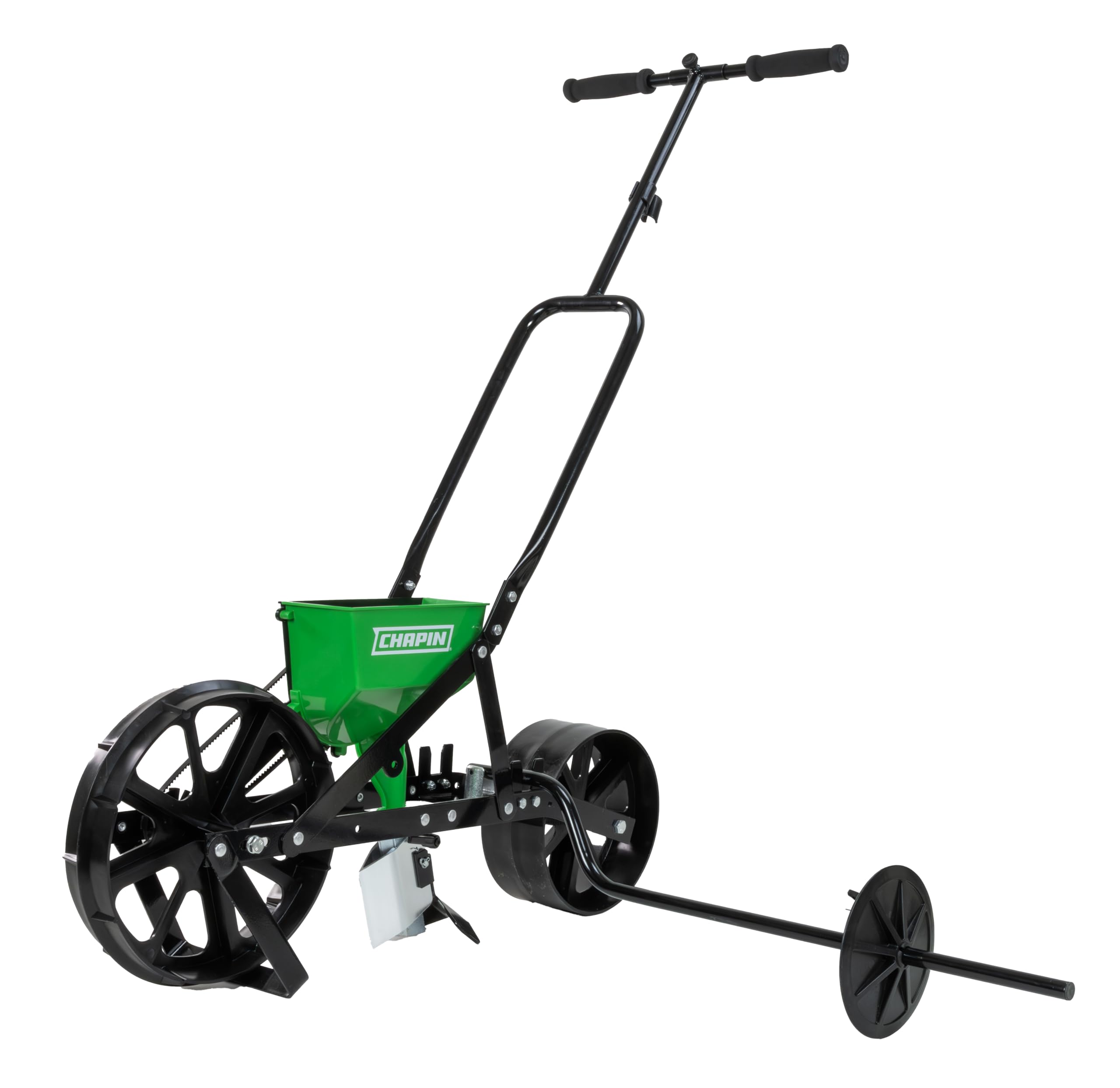
The Chapin 8701G brings a powder-coated steel frame to the mid-range segment, offering more rigidity than an all-aluminum design at the cost of a slightly heavier push at 14.87 pounds. The 1.5-liter poly hopper is rust-resistant and sized well for a single pass down a 50-foot row without needing a refill. Six interchangeable seed plates cover up to 20 vegetable varieties, which is a narrower range than the EarthWay but still sufficient for most home gardens.
Assembly is straightforward, though the row marker instructions can be unclear. Once set up, the cushioned handle grips reduce hand fatigue during extended sessions. The rotating wheel marks consistent row widths, and the zinc plow blade opens a clean furrow in prepared soil. The chain-drag covering system is effective for most seed sizes, tucking soil back over the seed row as you walk.
The main reported issue is seed plate accuracy with certain shapes — cucumber seeds in particular can lodge behind the plate, dropping two or three at once instead of one. This is a common mechanical challenge with gravity-fed plates and non-round seeds. Chapin backs the unit with a one-year limited warranty and US-based support, which adds peace of mind for a moderately priced planter.
Why it’s great
- Sturdy powder-coated steel frame resists flex under load
- Cushioned grips reduce hand fatigue on long rows
- Easy to push with stable tracking in prepared soil
Good to know
- Some non-round seeds may drop multiples instead of singles
- Row marker instructions could be clearer
- Heavier than all-aluminum competitors
03. Charles Walters Equipment CWSRS Single Row Seeder

The Charles Walters CWSRS stands out by including ten seed plates in a storage bag — the largest count in this lineup. That extensive plate set makes it a strong choice for gardeners who rotate through many crop types across the season. The adjustable depth settings are easy to change without tools, and the reinforced row marker mountings keep the marker arm steady even in slightly uneven soil.
The chain drag covering system is a design highlight. A strong chain pulls soil over the planted seed, while the wider rear wheel compresses the soil for good seed-to-soil contact. The hopper lid keeps seeds dry and prevents spillage when moving between rows, and the built-in kickstand is a practical touch that keeps the seeder upright during refills.
Real-world feedback is split between excellent results and a steep learning curve. The plate selection reference guide is imperfect, so expect some trial and error to match the right disk to your seed variety. The most consistent complaint is that the pickup mechanism struggles when the hopper runs low — tilting the seeder slightly to the right helps maintain flow. For the price, the plate variety and chain cover system make this a feature-rich option if you are willing to dial in the settings.
Why it’s great
- Ten seed plates offer the widest seed type coverage in this review
- Chain drag and rear wheel provide excellent seed coverage and compaction
- Hopper lid and kickstand add practical convenience
Good to know
- Plate selection guide requires some guesswork for best results
- Seed pickup becomes unreliable when hopper is nearly empty
- Mixed reviews on overall build consistency
04. Agri-Fab Push Garden Seeder Planter (45-0640)

The Agri-Fab 45-0640 is built around reducing physical strain, and its lightweight aluminum frame delivers exactly that. At a lower weight than steel-framed alternatives, this seeder is easy to push and maneuver, even for gardeners with limited upper-body strength. The 3-pound poly hopper is sized for small to medium gardens, and the rust-resistant plow blade opens a clean furrow in cultivated soil.
The seven interchangeable seed plates cover up to 20 different seed types, with a bias toward larger seeds like peas, beans, and corn. The adjustable row marker helps maintain straight rows, and the overall design follows the classic push-planter layout that has been in use for generations. Assembly is simple, and most users have the unit working within minutes of unboxing.
The weak point is small seed handling. Multiple reviews report that the seed plates jam or skip on tiny seeds like sweet peas, and the rubber seed-catching mechanism can pinch seeds against the hopper wall. The plastic plates also flex slightly under pressure, which can change the seed opening size. For gardeners focused on large-seeded staples, this is a time-efficient back-saver; for fine-seed planters, expect to do some manual troubleshooting or stick to hand sowing for small varieties.
Why it’s great
- Very lightweight frame makes pushing effortless
- Large seeds like beans and corn plant consistently
- Simple setup and intuitive operation
Good to know
- Small seeds jam or skip frequently in the stock plates
- Plastic seed plates can flex and alter seed opening size
- 3-pound hopper requires more frequent refills
05. Varomorus Metal Precision Manual Seeder (4-Row)

The Varomorus 4-Row seeder breaks away from the single-row design to plant four rows simultaneously, which is a substantial time-saver for dedicated bed planters. The adjustable row distance lets you match the spacing to your garden layout. The all-metal construction is noticeably heavier and more rigid than mixed-material competitors, offering long-term durability if properly maintained.
The compact design is well-suited for small to medium beds where you want to maximize planting density. The seeder works best with uniform, dry seeds like radish, beet, and onion that flow freely through the metal seed cylinders. The adjustable row distance is a practical feature that sets this unit apart from fixed-width multi-row planters.
The main mechanical challenges are wheel resistance and seed cylinder changes. The wheels tend to stick in soil with even small clumps or moderate moisture, which can cause the seed cylinders to skip. Changing between seed cylinders requires disassembly, and the bolts can be difficult to secure. Several users found the seed tubes clogged frequently during operation. For gardeners willing to modify the wheels or switch to a smoother-turning setup, this can be a productive multi-row tool, but it demands more patience than single-row alternatives.
Why it’s great
- Plants four rows in one pass for major time savings
- All-metal build is durable and corrosion-resistant with care
- Adjustable row spacing adds flexibility for different bed sizes
Good to know
- Wheels stick in clumpy or moist soil, affecting seed drop
- Seed cylinder changes require tool disassembly
- Tubes can clog, especially with irregular seed shapes
06. Scotts Turf Builder EdgeGuard DLX Broadcast Spreader

The Scotts EdgeGuard DLX is a broadcast spreader, not a drill seeder, so it is a different tool for a different job — but one that many gardeners also need. It is designed to spread grass seed, fertilizer, and ice melt across open lawn areas rather than planting individual seeds in rows. The pre-calibrated design requires no assembly, and the 10.9-pound weight makes it easy to handle.
The EdgeGuard side shield is the stand-out feature, keeping product off driveways, sidewalks, and landscaping beds. The hopper holds enough material to cover 15,000 square feet of Scotts lawn products, which is generous for a residential spreader. The agitator and hopper design provide consistent product flow, and the unit rolls smoothly even on slightly uneven ground.
Some ergonomic and design quirks appear in longer use. The handle is short for taller users, and the hollow wheels can collect product granules, especially in dew. The axle can slide slightly, causing the cap to pop off if the unit is pushed aggressively. For its intended purpose — applying granular products to an open lawn — the EdgeGuard DLX delivers reliable, consistent coverage at a reasonable entry point.
Why it’s great
- EdgeGuard side shield protects non-lawn surfaces effectively
- Comes fully assembled and pre-calibrated for immediate use
- Light enough for one-handed operation on flat terrain
Good to know
- Handle height is short for users over 6 feet tall
- Hollow wheels can pick up product in wet conditions
- Axle has a tendency to slide, requiring secure placement
07. Scotts Elite Spreader

The Scotts Elite is the most accurate broadcast spreader Scotts offers, employing dual rotor technology that creates a 6-foot spread pattern. This makes it ideal for larger lawns where even, consistent coverage reduces striping and waste. The hopper capacity covers up to 20,000 square feet, cutting down on refill trips for one-acre properties. The never-flat tires handle uneven terrain without going flat mid-job, a genuine advantage over air-filled wheels.
Ergonomic details include an ergonomic handle and a built-in smartphone holder, which is useful for following a lawn care app or listening to instructions while working. Assembly is minor, taking about five minutes out of the box. Users consistently report that the spread pattern is noticeably more even than standard single-rotor spreaders, particularly left-to-right and at the spread edges.
The main observation from long-term users is that the edge guard can leak slightly if the hopper is more than two-thirds full, and the outlet gate may not close completely unless the handle is released with a quick motion. Lubricating the gate mechanism with spray Teflon helps maintain smooth operation. For lawn-focused gardeners who also need broadcast seed and fertilizer application, this is a premium upgrade that saves time and product.
Why it’s great
- Dual rotor technology delivers the most even spread pattern in its class
- Never-flat tires eliminate downtime from punctures
- Large hopper capacity reduces refill frequency significantly
Good to know
- Edge guard can leak when hopper is more than two-thirds full
- Gate mechanism may require lubrication for consistent closing
- Requires minor assembly out of the box
FAQ
Why do some garden seeders skip seeds even with the correct plate installed?
Can a garden seeder handle tiny seeds like carrot or lettuce?
Final Thoughts: The Verdict
The standout performer for the best garden seeder is the EarthWay 10001 Precision Garden Seeder because of its proven plate system, lightweight aluminum frame, and reliable depth control for most common vegetable seeds. If you want the widest seed plate variety straight out of the box, grab the Charles Walters CWSRS Single Row Seeder. And for gardeners who need to plant multiple rows quickly in prepared beds, the Varomorus 4-Row Seeder offers a unique multi-row approach, though it requires more patience with setup and soil conditions.