
Nothing kills home gym momentum like seeing dents in your floor or feeling every joint ache after a session. The wrong flooring turns burpees into punishment and sends shockwaves through the room. Protecting both your subfloor and your body begins with choosing the right gym flooring — a decision that impacts every rep you take.
I’m Mohammad Maruf — the founder and writer behind Drink4Good. I’ve spent years analyzing home gym setups, comparing material densities, foam compression rates, and real-world durability so you don’t have to guess which mat handles deadlifts and which folds under pressure.
Whether you plan to park a squat rack over it or just want cushion for floor work, the right gym flooring for home gym is the difference between a space you use daily and one you ignore.
How To Choose The Best Gym Flooring For Home Gym
Home gym flooring isn’t one-size-fits-all. The right choice depends on the type of workout you do, the surface underneath, and how much noise you can tolerate. Here are the three factors that separate a smart buy from a wasted investment.
Thickness vs. Density — Which Wins Under Weight?
Many buyers assume thicker is always better, but a thick low-density foam can compress permanently under heavy equipment. Look for high-density EVA foam rated at 2.0 pounds per cubic foot or denser. For rubber or PVC mats, density translates to weight — heavier mats generally mean more durable material that won’t cup or crack under repeated impact.
Material Type — Rubber, Foam, or TPE
Rubber mats offer the best protection for dropping iron, but they carry a strong chemical odor that can linger for weeks. EVA foam is lighter and more comfortable for bodyweight work, but can dent under heavy racks. TPE is the eco-friendly middle ground — it’s non-toxic and easily recyclable, though it tends to be less durable under daily weightlifting. Match the material to your primary activity, not your secondary one.
Installation and Layout — Tiles vs. Rolled Mats
Interlocking tiles make room layout flexible and allow partial replacement if one section wears out. The downside is separation at the seams over time during dynamic movements. Rolled mats provide a seamless surface with zero shifting, but they are heavy to move and require accurate cutting for irregular spaces. Choose tiles for multi-purpose rooms and rolled mats for permanent gym-only spaces.
Quick Comparison
On smaller screens, swipe sideways to see the full table.
| Model | Category | Best For | Key Spec | Amazon |
|---|---|---|---|---|
| BalanceFrom Puzzle Exercise Mat | EVA Interlocking Tile | Full room coverage & bodyweight work | 3/4″ thick, 96 sq ft per 24 tiles | Amazon |
| Torin Mat Block APM36001BK-1 | EVA Interlocking Tile | Large area coverage with easy layout | 0.5″ thick, 144 sq ft per 36 tiles | Amazon |
| American Floor Mats Ultimate Stand-Alone Mat | Solid Rubber Mat | Heavy deadlifts & equipment pads | 3/8″ thick for slam-proof toughness | Amazon |
| HAPBEAR Large Exercise Mat | PVC Single Sheet | Full-body HIIT & cardio sessions | 8mm (1/3″) thick, 7’x5′ surface | Amazon |
| GXMMAT Large Exercise Mat | PVC Single Sheet | High-impact cardio with footwear | 7mm memory foam layer, double non-slip | Amazon |
| Hatha Yoga Large TPE Mat | TPE Single Sheet | Yoga/Pilates on a budget | 1/2″ thick, 6’x4′ size | Amazon |
| Our Modern Space Interlocking Foam Tiles | EVA Interlocking Tile | Budget-friendly room padding | 24-pack, 0.4″ thick, 96 sq ft | Amazon |
In‑Depth Reviews
1. BalanceFrom Puzzle Exercise Mat

The BalanceFrom Puzzle Exercise Mat delivers a rare combination: true 3/4-inch thickness without the feather-light feel of budget foam. Each tile is made from high-density EVA rated at a density that resists permanent compression from a 200-pound squat rack while still offering enough give to protect elbows during push-ups. The 96-square-foot coverage from 24 tiles means a single order can floor a 10×10 room corner to corner.
Double-sided non-slip surfaces keep the mat in place on concrete and hardwood alike, and the moisture-resistant surface wipes clean after sweaty sessions. Customers report using these for Brazilian Jiu-Jitsu takedowns and cardiac rehab workouts — a broad compatibility range that matches the density profile. The blue color option adds visual separation between workout zones.
Some users note that the puzzle connections can separate slightly over time during intense lateral movements like burpees. A thin layer of double-sided tape under the seams solves this without compromising portability. For the thickness-to-price ratio, this is the smartest single purchase for a fully padded home gym floor.
Why it’s great
- 3/4-inch thick EVA foam cushions joints on concrete subfloors
- 96 sq ft coverage covers most average home gym spaces
- Lightweight enough to reconfigure layout without tools
Good to know
- Puzzle seams can pull apart during high-intensity lateral drills
- Not dense enough to protect subfloor from repeated barbell drops
2. Torin Mat Block APM36001BK-1
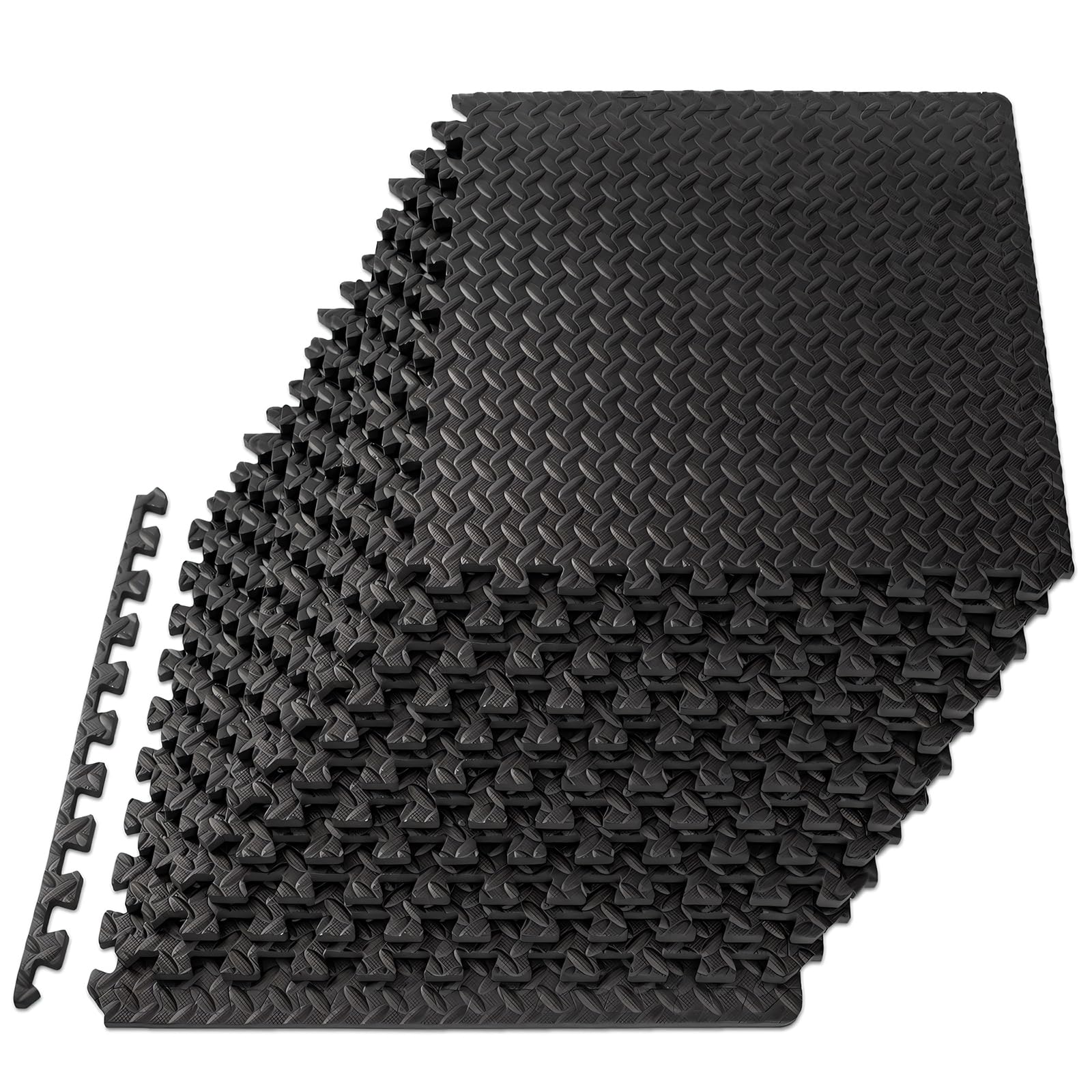
The Torin Mat Block APM36001BK-1 is the solution for anyone who looks at standard 24-tile packs and still sees exposed floor. At 144 square feet from 36 tiles, this is the largest interlocking setup in this lineup at a half-inch thickness. The high-density EVA material is phthalate-free, making it a safer option for spaces where kids or pets will be on the floor.
Installation is genuinely tool-free — the puzzle edges click into place and stay locked even under a stepper during high-impact aerobics. Buyers consistently mention that their knees and hips thank them after switching to these tiles from thinner gym mats. The plain black finish works in garages, basements, or living-room corner gyms without clashing with decor.
The half-inch thickness is adequate for bodyweight work and light dumbbells, but heavy drops will leave dents over time. This is a coverage-first product for compound movements and steady-state cardio. If your routine includes Olympic lifts from overhead, layer a rubber deadlift platform on top.
Why it’s great
- Massive 144 sq ft set covers any room without gaps
- Phthalate-free EVA foam is safe for children and pets
- Non-slip surface keeps stability during plyometric drills
Good to know
- Half-inch foam compresses under heavy dropped barbells
- Individual tile weight is light enough to shift during vacuuming
3. American Floor Mats Ultimate Stand-Alone Mat

American Floor Mats takes a different approach — instead of foam, they use a dense rubber compound that lays flat with zero curling and withstands extreme environments like uninsulated garages. The 3/8-inch variant provides enough heft to absorb the impact of deadlifts without transferring shock to the concrete below. The proprietary manufacturing process reduces the sharp chemical smell that plagues many rubber mats.
This mat is designed as a stand-alone unit, not a locking tile, so it works best as a dropping zone for barbells or as an outfeed table base in a woodworking shop. The texture is grippy to the touch but firm enough that cleats or shoes don’t sink in. Customers report using multiple thicknesses within the same gym — 1/4 inch for foot traffic areas, 3/8 inch for lifting platforms.
The downsides are real: at this weight, moving the mat around is a two-person job, and the lack of interlocking edges means gaps can form if you push mats together without taping. The odor, while reduced, still requires outdoor airing for a few days. This is a specialty mat for serious iron work, not a general-purpose floor covering.
Why it’s great
- Dense rubber absorbs deadlift drops without permanent indentations
- Proprietary process significantly reduces rubber odor
- Completely flat profile — no curling at corners over time
Good to know
- Does not interlock with adjacent mats — gaps can develop
- Heavy and difficult to reposition once placed
4. HAPBEAR Large Exercise Mat

HAPBEAR cuts through the clutter with a single sheet design that eliminates seam separation entirely. At 7×5 feet, this is the largest one-piece option in the roundup, offering 35 square feet of high-density PVC foam in a continuous surface. The 8mm thickness (just over 1/3 inch) balances shock absorption with a firm enough feel for exercises performed in footwear.
The double-layer anti-slip system uses a corrugated top texture and a suction cup bottom grip that refuses to budge on hardwood or tile. Users report using this mat for Insanity, T25, and kettlebell workouts without any sliding migration. The included storage bag and resistance bands add value, though the bag stitching has been flagged as the weakest point on an otherwise rugged product.
At 15.6 pounds, the HAPBEAR is light enough to roll up and store between sessions, but heavy enough to stay anchored during burpees. The 8mm thickness is a trade-off — it won’t protect against dropped dumbbells, but for bodyweight and cardio work, it provides the right balance between cushion and stability. The lack of interlocking edges means the mat won’t drift apart, but it also won’t cover an irregularly shaped room.
Why it’s great
- Continuous sheet design prevents seam gaps during high-impact movements
- Double non-slip surface grips even on slick concrete
- Light enough to roll and store but heavy enough to stay planted
Good to know
- 8mm density is not sufficient to absorb heavy barbell drops
- Included storage bag stitching may not hold up to frequent travel
5. GXMMAT Large Exercise Mat

The GXMMAT Large Exercise Mat uses a 7mm high-density memory foam layer that bridges the gap between surface comfort and firm support. This is the mat that actually works with shoes on — the dense microfiber structure doesn’t compress into a rut under sneaker treads, making it a top pick for jump rope, plyometrics, and MMA drills. The double-sided non-slip surfaces use a grooved underside that locks onto garage concrete and a subtly textured top that keeps hands steady during plank variations.
At 6×5 feet, the surface is generous enough for a single user to spread out across the diagonal. The PVC material is free of latex, phthalates, and silicone, which matters for users with chemical sensitivities who plan to breathe hard on this mat daily. The included pair of gloves, three Velcro storage straps, and a carry bag turn this into a mobile gym floor that can travel with you to outdoor or basement setups.
The memory foam layer does have a catch: repeated impact from very heavy weights (over 100 lbs dropped) will leave temporary indentations that may not fully spring back. Also, a small subset of users report sliding on the mat surface when hands or feet become very sweaty during plank jacks. A thin towel layer underneath handles most of this complaint. For the money, this is the strongest option for mixed cardio and strength in footwear.
Why it’s great
- Memory foam structure holds up to shoe tread wear without damage
- Double non-slip surface works reliably on garage cement
- Bonus storage bag and straps make transport simple
Good to know
- Heavy drops can cause temporary memory foam indentations
- Moisture from sweat can reduce top-surface grip over time
6. Hatha Yoga Large TPE Mat

The Hatha Yoga Large TPE Mat delivers 6×4 feet of phthalate-free, recyclable thermoplastic elastomer at a half-inch thickness. TPE is the middle path between PVC and standard foam — it offers enough joint relief for floor work without the heavy chemical footprint of petroleum-based mats. The 1/2-inch thickness is generous enough to eliminate knee pain during lunges while still being thin enough that your balance isn’t compromised during standing poses.
The non-slip texture on both sides creates a stable platform for Vinyasa flows and Pilates routines. Users specifically highlight the lack of strong odor compared to rubber mats — a minor initial off-gassing is reported but clears within a day or two. The inclusion of two bundling ribbons makes storage simple, and the 8.8-pound weight means you can carry it from room to room without strain.
The TPE material does have a lower tear strength than PVC or rubber, so dragging equipment across it will accelerate wear. This mat is optimized for low-impact activities where you move on top of it, not across it. If your home gym includes slide boards or heavy sled pulls, choose a different material. For stretching, yoga, and light bodyweight circuits, the Hatha Yoga TPE mat is the most environmentally responsible option here.
Why it’s great
- Recyclable TPE material with no phthalates or toxins
- 1/2-inch thickness provides genuine joint relief
- Very minimal odor compared to natural rubber alternatives
Good to know
- Lower tear resistance — dragging weights can rip the surface
- Tiles can slide on hardwood without a rug pad underneath
7. Our Modern Space Interlocking Foam Tiles

The Our Modern Space Interlocking Foam Tiles offer the lowest entry point in this roundup, but the savings come with a specific set of trade-offs. At 0.4 inches thick, these tiles sit below the half-inch threshold that most trainers recommend for consistent joint protection. The high-density EVA material works adequately for stretching, light yoga, and as a noise-dampening layer under a kid’s play area or drum set.
The tiles snap together easily and stay put during gentle movement. Users report satisfaction when using them as a cold-floor barrier in basements or for soundproofing a room. The black color hides dirt well, and the plastic surface wipes down with soap and water. For a secondary gym space where you don’t drop weights, this pack covers 96 square feet at a cost that leaves room in the budget for other equipment.
The thin profile means these tiles won’t protect subfloor from heavy equipment legs or dumbbell drops. The interlocking edges are adequate for static setups but tend to separate during dynamic exercises like burpees. If your budget absolutely demands entry-level pricing, these tiles work for stretching zones. Everyone else should save for a thicker option.
Why it’s great
- Lowest cost per square foot of any option in this guide
- Easy to cut and shape around irregular room layouts
- Effective noise dampening for sound-sensitive neighbors below
Good to know
- 0.4-inch thickness offers limited joint protection on hard floors
- Seams separate during high-impact moves like jumping lunges
FAQ
Can I use yoga mats as gym flooring for a home gym?
How do I clean interlocking foam gym tiles?
Do I need underlayment beneath gym flooring in a garage?
Final Thoughts: The Verdict
For most users, the gym flooring for home gym winner is the BalanceFrom Puzzle Exercise Mat because the 3/4-inch thickness and high-density EVA build handle bodyweight workouts, light dumbbells, and kids’ play without breaking the bank. If you want seamless coverage for high-impact cardio, grab the HAPBEAR Large Exercise Mat. And for dropping barbells without denting your subfloor, nothing beats the American Floor Mats Ultimate Stand-Alone Mat.