
You spent serious time dialing in a perfect amp-and-cab model on your floorboard. Then you plug into a standard guitar cabinet, and the sound turns into a muddy, colored mess. That is the exact problem a full-range flat-response system solves. An FRFR speaker delivers the uncolored audio your modeler or multi-fx unit actually outputs, letting you hear the studio-quality emulation you programmed rather than a cabinet’s natural EQ curve.
I’m Mohammad Maruf — the founder and writer behind Drink4Good. My analysis of FRFR gear focuses on frequency response curves, power-handling specs, driver materials, and real-world stage performance data to help guitarists match a speaker to their modeling rig.
Whether you run a Fractal, Helix, Quad Cortex, or a compact pedalboard amp sim, picking the right frfr speaker for guitar determines whether your presets translate to a live room or rehearsal space with clarity and punch.
How To Choose The Best FRFR Speaker For Guitar
An FRFR speaker is a PA-style loudspeaker designed to have a flat frequency response, meaning it does not add its own tonal coloration to your guitar signal. Your amp modeler or profiler handles all the cabinet and microphone emulation; the speaker’s job is to reproduce that signal as accurately as possible. Choosing the wrong one — like a standard guitar cab — will stack an additional EQ curve on top of your carefully crafted presets.
Woofer Size and Cabinet Format
The most common sizes are 8-inch and 12-inch woofers. An 8-inch FRFR like the HeadRush FRFR108 MKII is lighter, easier to transport, and ideal for bedroom practice, rehearsals, and small stages. A 12-inch woofer moves more air, delivers fuller low-end response, and handles larger venues without a subwoofer. If your presets rely on deep bass from extended-range guitars or detuned riff work, a 12-inch model is the safer bet.
Power Handling and SPL
Power ratings from 200W to 2500W are common in this category. Continuous RMS power tells you how much clean output the speaker can maintain. Peak power indicates short-term headroom for transient hits. For home practice, 200-400W RMS is sufficient. For band rehearsals and live gigs, look for at least 500W RMS. Maximum SPL figures around 125-131 dB give you enough volume to hear yourself on stage against a drummer.
Inputs, Connectivity, and Portability
Most FRFR speakers offer XLR/TRS combo inputs for connecting your modeler. Bluetooth streaming is convenient for backing tracks or set-break music but not critical for pure guitar use. Weight matters: a 21-pound unit is much easier to carry to a weekly rehearsal than a 48-pound cabinet. Features like ground-lift switches and HPF EQ controls help solve stage noise issues and cut through muddy mixes.
Quick Comparison
On smaller screens, swipe sideways to see the full table.
| Model | Category | Best For | Key Spec | Amazon |
|---|---|---|---|---|
| HeadRush FRFR108 MKII | Active FRFR | Compact stage monitor | 8″ woofer, 2000W peak | Amazon |
| HeadRush FRFR112 MKII | Active FRFR | Full-range live performance | 12″ woofer, 2500W peak | Amazon |
| Fender Tone Master FR-12 | Active FRFR | Authentic amp-in-the-room feel | 12″ custom speaker, 1000W | Amazon |
| Laney LFR-112 | Active FRFR | High-output modeling rigs | 12″ woofer + horn, 400W | Amazon |
| QSC K12.2 | Active PA | Professional stage/sound | 12″ woofer, 2000W peak | Amazon |
| Yamaha DHR12M | Active Coaxial | Precise stage monitor | 12″ coaxial, 1000W, 129dB | Amazon |
| Yamaha DBR12 | Active PA | Reliable all-purpose monitor | 12″ woofer, 1000W, 131dB | Amazon |
| RCF EVOXJ8 | Active Line Array | Wide coverage live sound | 12″ sub + 2″ drivers | Amazon |
| Bose L1 Pro8 | Active Line Array | Portable singer-songwriter PA | 8 articulated 2″ drivers | Amazon |
| Samson RS112A | Active PA | Budget multi-purpose PA | 12″ woofer, 400W peak | Amazon |
In‑Depth Reviews
1. HeadRush FRFR108 MKII
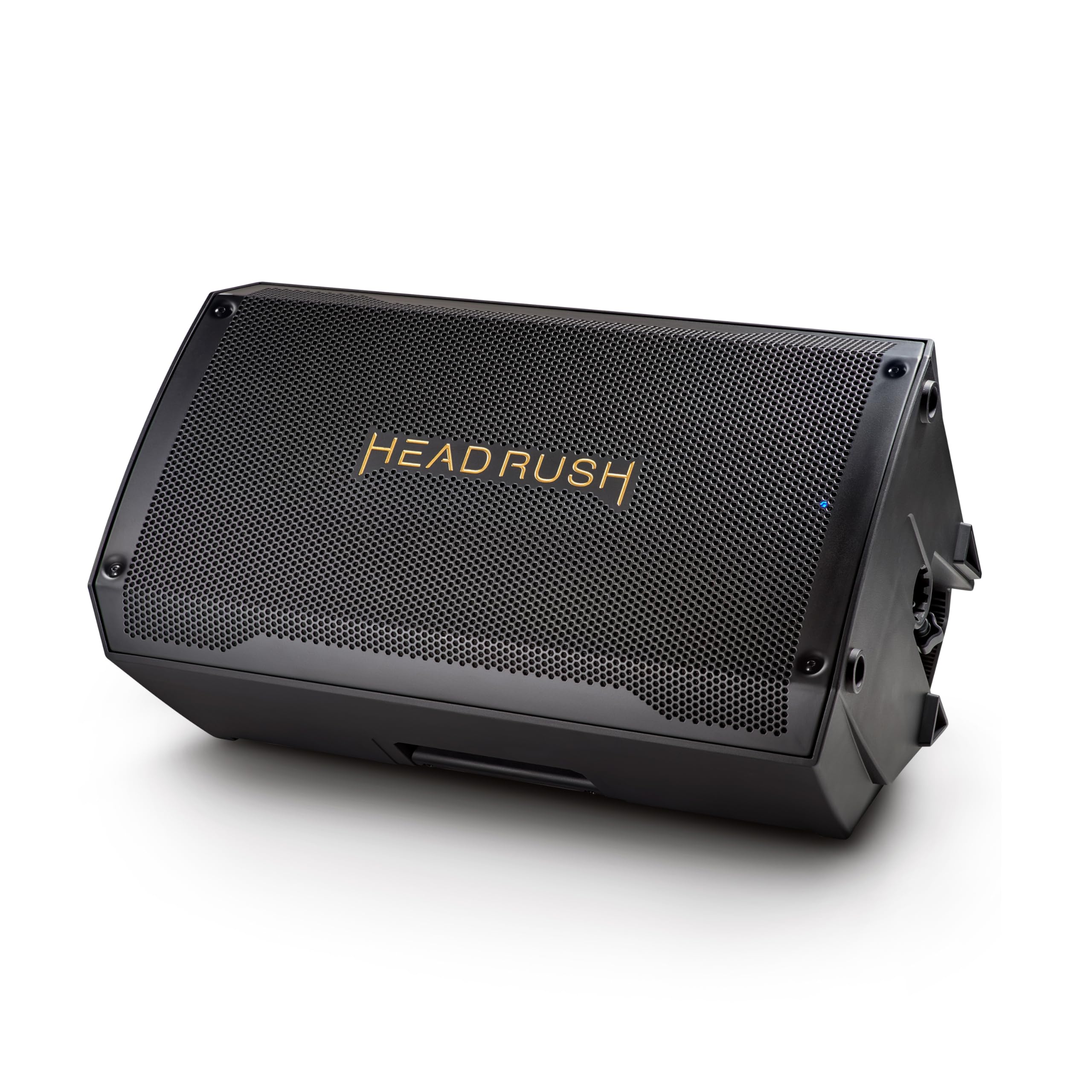
HeadRush designed the FRFR108 MKII as a purpose-built FRFR speaker, not a repurposed PA cab. The 8-inch woofer and 1-inch HF compression driver deliver a genuinely flat response that accurately translates amp and cab emulations from modelers like the Fractal FM3 or Helix. At just 21 pounds, it is the most portable serious option in this roundup, and the 2000W peak rating provides more than enough headroom for rehearsals and small to medium gigs.
The HPF EQ switch is a practical feature that helps cut through muddy stage mixes, and the ground-lift switch eliminates hum from ground loops without needing an external DI. Bluetooth 5.0 streaming is built in, making it easy to play backing tracks from a phone during practice. The cabinet supports wedge, upright, or pole-mounted positioning, offering flexibility for monitoring or front-of-house use.
User feedback confirms that the FRFR108 MKII works exceptionally well with multi-fx units. One reviewer noted that pairing it with a Valeton GP200 produced surprisingly loud and clear home practice tones. Another mentioned that the titanium tweeters can sound harsh on high-gain presets, but swapping to polyimide drivers is a viable mod. Overall, this is the lightest, most travel-friendly dedicated FRFR option that still delivers professional-grade accuracy.
Why it’s great
- Extremely lightweight at 21 lbs for easy transport
- Bluetooth 5.0 allows wireless backing track playback
- HPF and ground-lift switches solve common stage noise issues
Good to know
- Titanium tweeter can be harsh on high-gain sounds for some ears
- 8-inch woofer lacks deep low-end compared to 12-inch models
2. HeadRush FRFR112 MKII

The FRFR112 MKII is the big brother of the 108, upgrading to a 12-inch woofer and pushing peak power to 2500W. This results in considerably more low-end authority and overall stage volume. At 34.7 pounds, it is heavier but still manageable for a single trip, and the wedge/upright/pole-mount versatility remains intact. The 1-inch HF compression driver is voiced to handle high SPL without harsh breakup.
The same HPF EQ and ground-lift switches carry over, so you get the same practical stage tools. Bluetooth connectivity is included, and the two XLR/TRS combo inputs with independent volume controls let you mix a modeler and a backing track source simultaneously. The XLR direct output makes daisy-chaining or sending a signal to front-of-house straightforward.
Users report that the FRFR112 MKII works well with Fractal units, though some recommend applying a PEQ block to flatten the curve for critical listening. One reviewer noted that it is loud enough for a crowd of around 100 people indoors. The titanium tweeter receives the same mixed feedback as the 108 model — some find it piercing on distorted tones. If you need a 12-inch dedicated FRFR for live use, this is a strong mid-range contender.
Why it’s great
- Powerful 2500W peak rating provides ample stage volume
- 12-inch woofer delivers full low-end response for detuned guitars
- Versatile positioning options for monitor or main use
Good to know
- Weighs 34.7 lbs, heavier than the 8-inch version
- Titanium tweeter may require EQ or driver swap for some users
3. Fender Tone Master FR-12

Fender entered the FRFR market with the Tone Master FR-12, and it immediately became a favorite among players who want the familiar feel of a traditional guitar cab without the coloration. The closed-back 1×12 enclosure houses a custom Fender speaker designed specifically for flat response. At 35.3 pounds and 1000W of power, it sits in a sweet spot of portability and output.
The FR-12 is refreshingly simple — no Bluetooth, no menu diving, no digital display. It is a plug-and-play powered speaker that accepts your modeler’s output and reproduces it accurately. Users report that it sounds considerably more “amp-like” than other FRFR options, with reviewers noting it replaced their Line 6 PowerCab 112+ due to simpler operation and more natural tone. The tilt-back legs improve stage monitoring angles, and the XLR output allows direct connection to a house system.
Some users noted a slight hiss on early units, though later production runs seem to have resolved this. The cabinet can resonate on hard surfaces, so adding grippy feet helps. If you value a traditional backline aesthetic and want an FRFR that feels familiar to a guitar player, the FR-12 is the closest you can get to a standard amp cabinet without sacrificing flat response.
Why it’s great
- Closed-back cab design feels like a traditional guitar amp
- Plug-and-play simplicity with no DSP menu required
- Tilt-back legs improve stage monitoring angles
Good to know
- Early units had a slight hiss issue at idle
- Cabinet can resonate on hard surfaces without isolation feet
4. Laney LFR-112

The Laney LFR-112 is a purpose-built active guitar cabinet built around a 12-inch woofer and a separate horn driver, totaling 400W of clean RMS power. It is designed from the ground up to work with modelers and profilers, and user feedback from Fractal FM3 and Quad Cortex owners is overwhelmingly positive. The cabinet emulated XLR DI out is a standout feature for sending a processed signal directly to front-of-house.
Build quality is excellent — the 48-pound cabinet feels solid, and the switchable front illumination adds a visual touch for dark stages. The integrated XLR and jack combo sockets accept balanced and unbalanced inputs, and the MP3/aux input is useful for practice. One limitation is that the DI output lacks its own level control, meaning you cannot mute the main speaker while maintaining a separate DI feed.
Users consistently describe the LFR-112 as making their modelers sound “huge,” with one reviewer calling it the best FRFR they have heard with a Quad Cortex. The high output handles Mesa, Marshall, and Bogner models without breaking up. If you run a premium modeling rig and need a dedicated high-SPL FRFR cabinet, the LFR-112 delivers some of the most amp-like dynamics in this price bracket.
Why it’s great
- Cabinet-emulated XLR DI out for direct FOH connection
- Reviewers praise huge tone with Quad Cortex and Fractal units
- Switchable front illumination for stage visibility
Good to know
- DI output lacks independent level control from main speaker
- 48-pound weight is on the heavier side for transport
5. QSC K12.2

The QSC K12.2 is a professional-grade powered PA speaker that doubles as an excellent FRFR monitor for guitar modelers. Its 2000W Class-D amplifier drives a 12-inch woofer and a 1.75-inch HF compression driver, producing best-in-class audio performance with a maximum SPL that easily cuts through a live band. The multi-function digital display gives you access to factory presets and user-savable scenes for different applications.
Low-noise variable speed fans keep the amplifier cool without adding background hiss, a common complaint with cheaper PA speakers. The K12.2 supports dual pole-mount holes for straight or tilted positioning, plus a monitor angle for wedge use. The locking blue AC power cord is a small but welcome reliability feature for gigging musicians. Bluetooth is not built in, but XLR connectivity is robust.
Users across corporate events, clubs, and mobile DJ applications rate the K12.2 as the industry standard for sound quality and durability. One reviewer reported running the speaker outdoors at 50% volume for six hours with flawless results. For guitarists, the neutral frequency response makes it a dependable FRFR platform, though the premium price reflects its professional PA pedigree rather than a dedicated guitar-market design.
Why it’s great
- Industry-standard build quality and reliability for professional use
- Digital display with presets and user-savable scenes
- Low-noise fan design prevents background hiss
Good to know
- No built-in Bluetooth for wireless streaming
- Premium price reflects PA-grade components, not dedicated guitar FRFR
6. Yamaha DHR12M
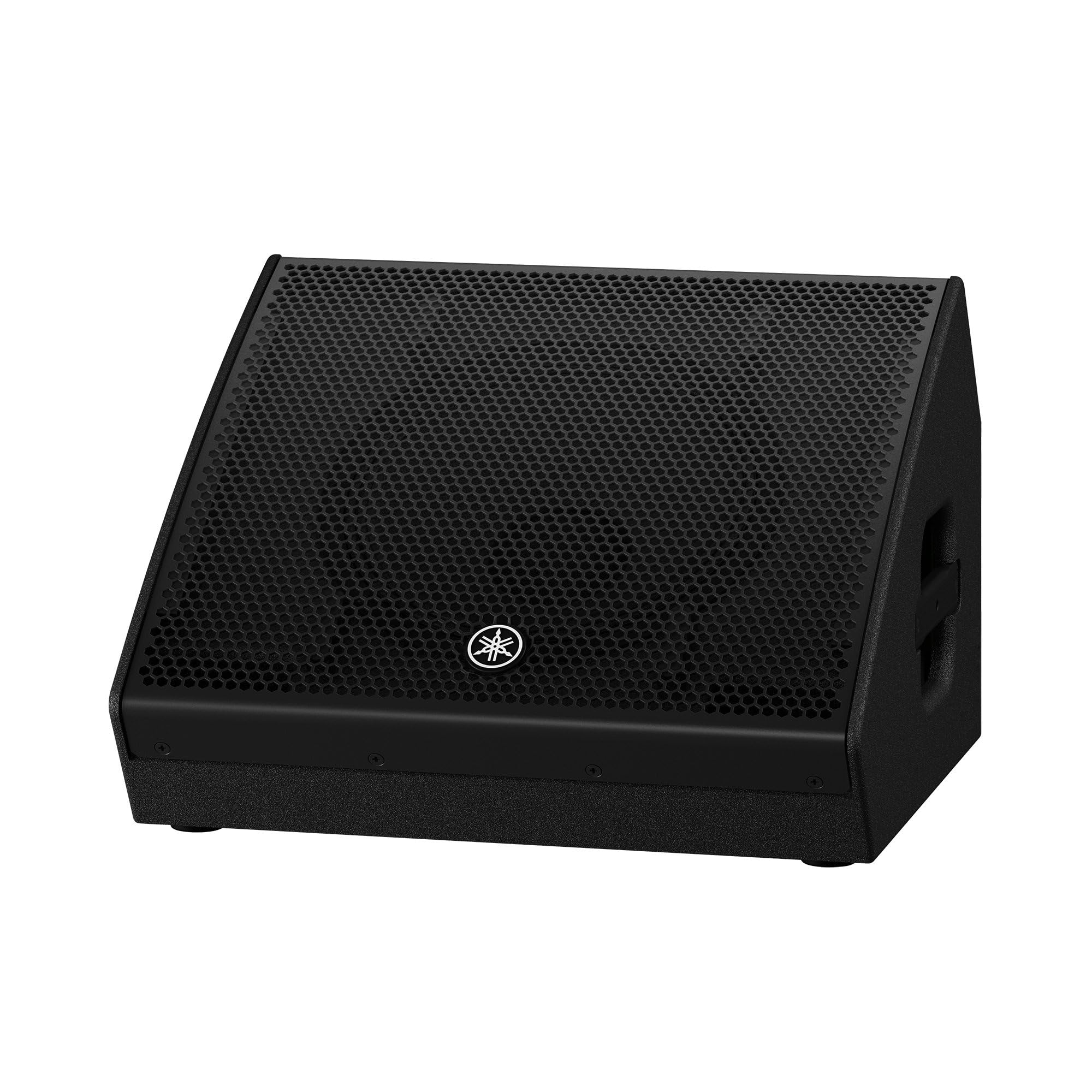
The Yamaha DHR12M uses a coaxial driver design, placing the 1.75-inch HF compression driver at the center of the 12-inch LF cone. This coaxial arrangement ensures that high and low frequencies originate from the same point, eliminating phase cancellation and providing a more accurate sound image — critical for a modeling guitarist who needs to hear exactly what their presets sound like. The plywood enclosure adds acoustic rigidity.
1000W of Class-D power drives the DHR12M to a maximum SPL of 129dB with a frequency response extending from 52Hz to 20kHz. The 48-bit DSP processing includes Yamaha’s D-Contour intelligent dynamic control, which adjusts EQ based on output level to maintain tonal balance at any volume. The low-profile wedge shape is designed for optimal monitoring positioning on stage.
Users praise the DHR12M for clear, loud sound with good bass response. One reviewer noted that while the coax design provides accurate sound placement for musicians and singers, the cabinet is on the heavier side, making solo setup on a pole stand challenging. Another reviewer found the sound quality disappointing with very little low end, though this may reflect individual preference rather than a design flaw. For demanding stage monitoring, the coaxial accuracy is a real advantage.
Why it’s great
- Coaxial driver eliminates phase issues for accurate sound reproduction
- Plywood enclosure provides superior acoustic performance
- 48-bit DSP with D-Contour maintains tonal balance at all volumes
Good to know
- Heavier cabinet makes single-person pole setup difficult
- Some users find low-end response underwhelming
7. Yamaha DBR12

The Yamaha DBR12 is a high-performance powered PA speaker that serves dual duty as a capable FRFR monitor for guitar. With 1000W of digital power and a maximum SPL of 131dB, it is one of the loudest speakers in this roundup. FIR-X tuning optimizes the crossover and phase response for clean, clear output across the frequency range. It is lightweight for its output class — a key factor for mobile guitarists.
The DBR12 includes a low-frequency cutoff switch and a monitor position switch, allowing you to tailor the response for floor wedge use. Yamaha backs the speaker with a 7-year warranty, reflecting confidence in the long-term reliability. The lack of built-in Bluetooth means you will need a separate receiver for wireless audio from a phone or laptop.
Users consistently note the clear sound and lightweight construction. One reviewer uses it as a drum amp for electronic kits and praises the monitor switch’s convenience. Another noted that while the speaker is loud and clear, it lacks bass depth and mid fullness compared to higher-end options like the DXR series. For a reliable mid-range PA speaker that can double as a modeling rig monitor, the DBR12 is a proven workhorse.
Why it’s great
- 131dB max SPL provides serious stage volume
- Lightweight for a 12-inch powered speaker
- 7-year warranty adds long-term value assurance
Good to know
- No Bluetooth connectivity for wireless streaming
- Bass and mid response not as full as premium tier models
8. RCF EVOXJ8

The RCF EVOXJ8 is a compact line array system that pushes well beyond traditional FRFR speaker territory. It pairs a high-powered 12-inch subwoofer with a top section containing four 2-inch full-range drivers. This configuration delivers a wider horizontal dispersion than any single-driver cab, making it ideal for guitarists who need consistent coverage across a wide stage or for front-of-house duties in singer-songwriter setups.
FIR filtering corrects phase and amplitude across the frequency range, taking into account the weak points of the transducers and cabinet resonances. The result is stunning sound performance with high SPL handling. The system is quick to set up and durable — the metal grille and robust enclosure handle gigging abuse. Connectivity includes XLR and 1/4-inch inputs.
Users report that the EVOXJ8 delivers clear sound at distances over 100 yards, with one karaoke reviewer noting superior tweeter reliability compared to cheaper PA speakers. The 12-inch sub provides strong bass, but it is not a replacement for an 18-inch sub in heavy EDM applications. For a guitarist who also runs vocals and backing tracks, the EVOXJ8 offers FRFR accuracy with the coverage benefits of a line array.
Why it’s great
- Wide 180-degree horizontal coverage from line array design
- Compact and quick to set up for mobile gigging
- FIR filter tuning delivers accurate phase and amplitude response
Good to know
- Line array format is overkill for simple guitar monitoring
- Bass response strong but not subwoofer-level for heavy EDM
9. Bose L1 Pro8

The Bose L1 Pro8 is a highly portable PA system built around a C-shaped line array with eight articulated 2-inch neodymium drivers and a 7×13-inch high-excursion Race Track subwoofer. It is designed for singer-songwriters and small venue performers who need premium sound from a single trip setup. For the modeling guitarist, the L1 Pro8 provides the flattest response of any Bose system, accurately reproducing amp sims and cab emulations.
The system breaks down into three lightweight components — the array, the extension, and the power stand with the built-in subwoofer. Bluetooth streaming and a three-channel mixer are integrated, with wireless control via a smartphone app. The 180-degree horizontal coverage means audience members across a wide coffee shop or small bar hear the same balanced mix.
Users praise the sound fidelity, with one reviewer calling it a “no-brainer” purchase for its clarity across highs, mids, and lows. Some users report that the column connection feels less secure than previous Bose models, and the lack of a travel cover for the base is a minor complaint. At this price point, the L1 Pro8 is a premium all-in-one solution for guitarists who need FRFR monitoring plus full PA capability for vocals.
Why it’s great
- Extremely portable with one-trip setup from vehicle to venue
- Wide 180-degree coverage ensures consistent audience listening
- Built-in mixer with Bluetooth and app control
Good to know
- Column-to-base connection feels less secure than previous generations
- No travel cover included for the subwoofer base unit
10. Samson RS112A
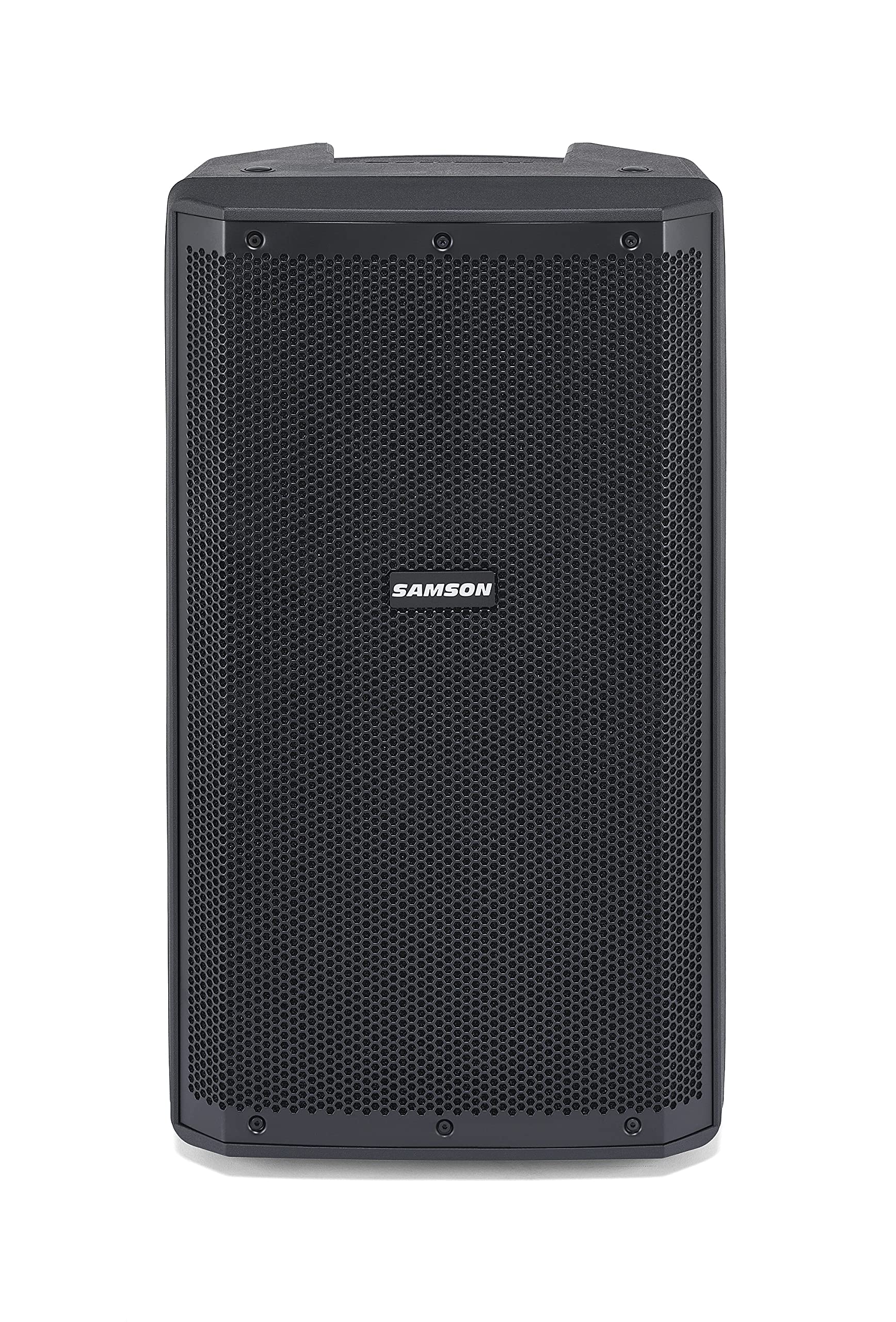
The Samson RS112A is a budget-friendly active PA speaker that can function as an FRFR monitor for guitar modelers. Its 12-inch extended-range woofer and 1-inch HF driver produce 400W peak power, enough for rehearsals and smaller gigs. Bluetooth 4.0 connectivity is built in, allowing wireless backing track playback from a phone or tablet. Two selectable Mic/Line XLR-1/4-inch combo inputs with independent volume controls and variable compressor give you flexible routing.
The polypropylene enclosure with a full perforated metal grille is impact-resistant and road-ready. Three ergonomic carry handles make transport manageable, and the integrated 1.375-inch pole mount supports standard speaker stands or floor monitor wedge positioning. The XLR mix output lets you daisy-chain additional speakers for wider coverage.
Users report that the RS112A works well as a powerful PA monitor, with one reviewer using multiple units for a band PA system. The Bluetooth volume is lower than expected per some feedback, and the USB port only functions with Samson’s proprietary wireless mic system. It is not a dedicated FRFR — you are buying a general-purpose PA speaker — but for the budget-conscious guitarist who needs FRFR-capable monitoring, it delivers surprising value.
Why it’s great
- Very budget-friendly entry point for FRFR-capable monitoring
- Bluetooth streaming for backing tracks and set-break music
- Impact-resistant polypropylene enclosure with metal grille
Good to know
- Bluetooth volume noticeably lower than wired inputs
- USB port only works with Samson wireless mic system
FAQ
Can I use a regular PA speaker as an FRFR for my modeler?
Do I need an 8-inch or 12-inch FRFR speaker for guitar?
Why does my FRFR speaker sound harsh with high-gain presets?
Can I use an FRFR speaker as a standard guitar cab with a tube amp?
What is the minimum wattage I need for live gigging with an FRFR?
Final Thoughts: The Verdict
For most users, the frfr speaker for guitar winner is the HeadRush FRFR108 MKII because it delivers dedicated FRFR accuracy, Bluetooth connectivity, and excellent portability at a reasonable price point, making it the best all-around choice for bedroom players and gigging musicians alike. If you want that familiar Fender amp feel and simpler operation, grab the Fender Tone Master FR-12. And for high-output modeling rigs like Fractal or Quad Cortex demanding maximum stage presence, nothing beats the Laney LFR-112.