
Weak winter light, dark corners, and leggy seedlings are the real reasons indoor gardeners search for better lighting. Standard household bulbs lack the red and blue wavelengths plants need for photosynthesis, leaving your herbs, succulents, and greens struggling to survive. A purpose-built bulb changes everything by delivering the exact spectrum that drives growth, flowering, and fruiting.
I’m Mohammad Maruf — the founder and writer behind Drink4Good. I’ve spent years analyzing full-spectrum LED chips, PPF ratings, and beam angles to separate marketing fluff from hardware that actually fuels healthy root systems and dense foliage.
These recommendations focus on real-world PPF output, color rendering, and thermal management so you can choose with confidence. Whether you’re nursing a single succulent or running a shelf of seedlings, this guide to the best grow bulbs will help you match the right light to your specific plants and setup.
How To Choose The Best Grow Bulbs
Picking the right grow bulb isn’t about wattage — it’s about matching the light’s energy output to the specific type of plant you’re growing. Leafy greens need different intensity than flowering tomatoes, and the distance between bulb and foliage changes everything.
PPF: The Number That Actually Matters
Photosynthetic Photon Flux (PPF), measured in micromoles per second, tells you how much usable light the bulb emits. Budget bulbs typically output 10-16 µmol/s — fine for low-light houseplants. Premium options push 23 µmol/s or higher, which supports fruiting plants and dense growth. Ignore incandescent wattage equivalents; PPF is the metric that correlates directly to plant health.
Spectrum: White Light vs. Red-Blue
Full-spectrum white bulbs (around 4000K-5000K) look natural in a living space and support all growth stages without the harsh purple glow. Red-blue-dominant bulbs maximize chlorophyll absorption for flowering phases but can be visually unpleasant in a room you occupy daily. Choose white light for general use and red-blue for targeted bloom boosts in a dedicated grow area.
Beam Angle and Heat Management
A wide 230-degree beam spreads light across a large area, ideal for shelves of seedlings. A narrow 60-degree beam concentrates energy onto a single plant for deeper canopy penetration. Heat output is equally critical — ceramic heat sinks (like SANSI’s Chip-on-Ceramic tech) dissipate heat faster than aluminum, allowing higher PPF without burning leaves placed six inches away.
Quick Comparison
On smaller screens, swipe sideways to see the full table.
| Model | Category | Best For | Key Spec | Amazon |
|---|---|---|---|---|
| SANSI 32W A21 | Premium | High PPFD single-plant focus | 423 µmol/s/m² @ 1FT | Amazon |
| GE BR30 Seeds & Greens | Mid-Range | Natural white light in living spaces | 16 PPF micromoles / second | Amazon |
| ALIDE A19 6-Pack | Mid-Range | Multi-pack for seedling shelves | 23 PPF micromoles / second | Amazon |
| ALIDE A19 3-Pack | Budget | Economy entry for small setups | 23 PPF micromoles / second | Amazon |
| SANSI Dual Gooseneck Clip | Premium | Flexible desktop or shelf positioning | 2000LM total output / dual head | Amazon |
In‑Depth Reviews
1. SANSI 32W Full Spectrum A21 Grow Light Bulb

This bulb delivers the highest PPFD concentration in the lineup — 423 µmol/s/m² at one foot — making it the closest thing to a direct sunlight substitute in a standard E26 socket. The 60-degree beam angle focuses that energy into a tight cone, which means it punches through dense foliage better than any wide-beam competitor. It’s ideal for a single large potted plant or a small cluster of high-light succulents that need deep canopy penetration.
SANSI’s patented Chip-on-Ceramic (COC) technology replaces the typical aluminum substrate with a non-conductive ceramic heat sink that pulls heat away from the LED junction drastically faster. The result is lower thermal resistance, longer lifespan (25,000 hours), and the ability to run at 32 actual watts without the bulb cooking itself. Users report it runs warm to the touch but never dangerously hot, even after an eight-hour cycle. The 4000K daylight color temp and 95 CRI produce white light that blends naturally into a living room without the purple tint that bothers many home growers.
ETL listing and the 5-year protection plan add a layer of confidence that most grow bulbs under simply don’t offer. The bulb is noticeably heavier than a standard A19, so verify your lamp fixture can support the weight. It also produces negligible audible hum — a welcome detail for bedroom or office use.
Why it’s great
- Highest PPFD concentration in its price tier — penetrates dense foliage
- Ceramic heat sink enables 32W sustained output without thermal throttling
- 95 CRI delivers natural daylight color that looks clean in any room
Good to know
- 60° narrow beam limits coverage area — not ideal for wide shelf setups
- Bulb weight is higher than typical A19; check lamp socket stability
2. GE Grow Light BR30 Seeds & Greens

GE’s BR30 floodlight form factor sets this bulb apart from the standard A19 crowd. The wider 110-degree beam angle distributes light over a broader area, making it the best choice for a desk with multiple small pots or a shelf stacked with seed trays. The 16 PPF output is on the lower end of the lineup, but that is perfectly adequate for leafy greens, herbs, and low-to-medium light houseplants like pothos or snake plants.
The critical advantage here is visual comfort. GE tuned this bulb to emit a neutral white light that doesn’t look purple or pink — it integrates into a decorative lampshade or ceiling fixture without announcing itself as a grow light. The 90 CRI also helps colors look natural to the human eye, so your space doesn’t feel like a lab. Users often comment that the bulb revived struggling plants in low-light corners after just a few weeks of six-hour daily cycles.
At 9 watts per bulb and a 25,000-hour lifespan, the GE BR30 runs cool enough to touch after hours of operation. The 2-pack packaging makes it easy to outfit a pair of gooseneck desk lamps. A minority of users report a faint high-pitched whine from some units, but replacement pairs tend to eliminate the issue. The reflector shape also means the bulb protrudes further than an A19 — double-check clearance inside any enclosed fixture.
Why it’s great
- BR30 reflector distributes light evenly across a wide tabletop or shelf
- Natural white appearance — no purple glow, blends into home decor
- 90 CRI and low heat output make it safe for close plant placement
Good to know
- 16 PPF is too low for high-light vegetables or flowering plants
- Occasional reports of audible coil whine from certain units
3. ALIDE A19 Full Spectrum 6-Pack
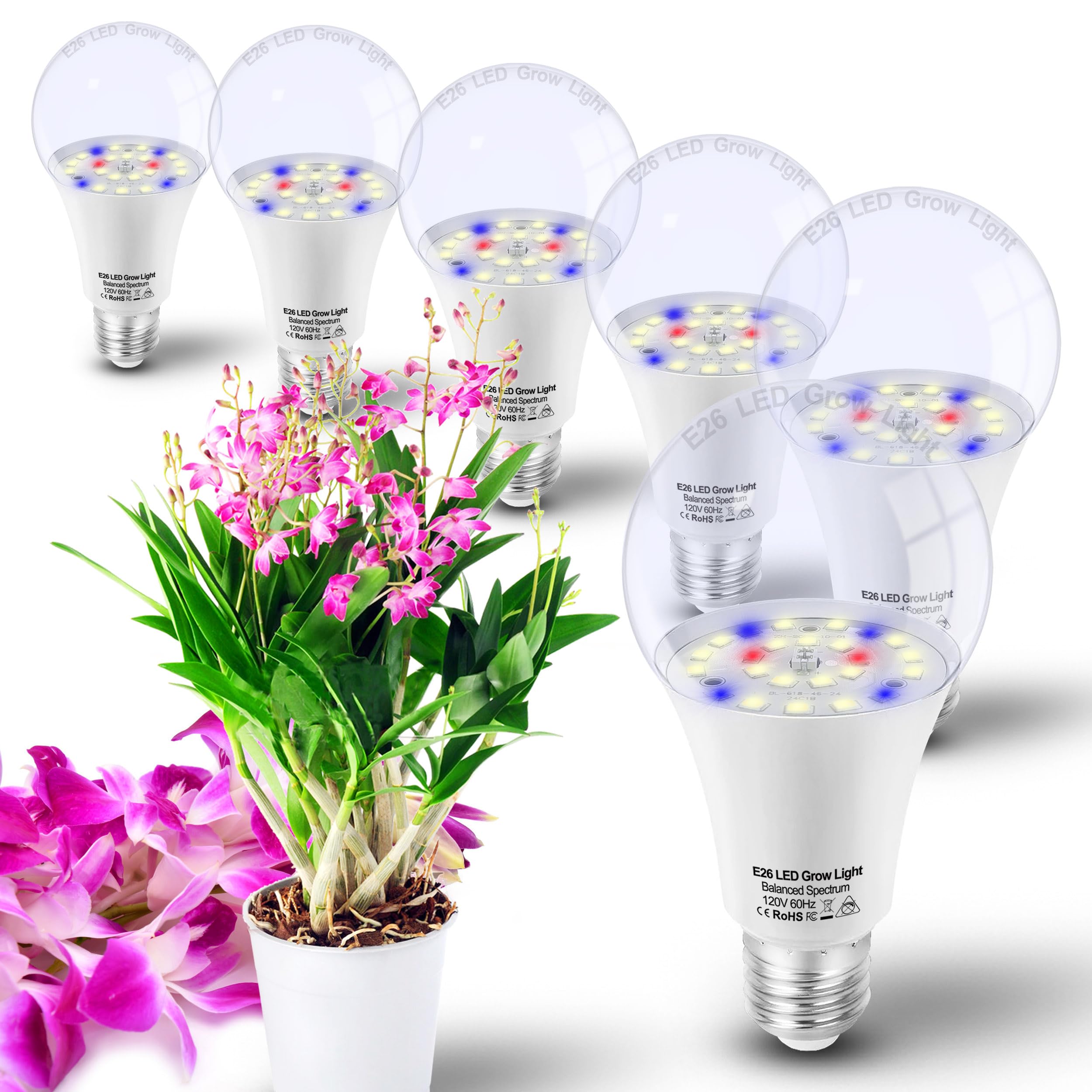
This ALIDE 6-pack delivers the highest per-bulb PPF of any multi-pack in the roundup — 23 micromoles per second — and does it with a 230-degree beam angle that saturates a wide growing area. If you’re outfitting a three-tier shelf with trays of lettuce, basil, or tomato seedlings, six of these bulbs at 10 watts each will cover the setup without leaving dim spots. The bulb uses three discrete LED chip colors (5000K white, red, and blue) rather than a single phosphor blend, giving you targeted wavelength spikes at 450nm for vegetative growth and 660nm for flowering.
Installation is straightforward: standard E26 base screws into any household lamp, clamp light, or ceiling fixture. The bulbs produce 1000 lumens each — roughly equivalent to a 100W incandescent — while pulling only 10 watts. That means a six-bulb setup running 12 hours a day will add roughly to your monthly electric bill. Users consistently mention that the bulbs feel lightweight, run cool, and have kept succulents and houseplants healthy through winter months without supplemental light.
The trade-off is a modest 85 CRI, which means the light has a slight cool-purple cast that won’t match the room’s ambiance as well as the GE or SANSI white bulbs. The bulbs are also not waterproof, so any outdoor use requires a rainproof fixture. The 6-pack pricing works out to a significant per-bulb discount versus buying individual units, making this the obvious pick for anyone scaling up a home propagation station.
Why it’s great
- 23 PPF at 10W is an excellent efficiency ratio for the price
- 230° ultra-wide beam spreads light evenly across shelf setups
- Six-bulb pack provides complete coverage for a multi-tier plant stand
Good to know
- 85 CRI and red-blue mix produce a cool-purple tint
- Not rated for wet or outdoor use without a sealed fixture
4. SANSI Dual Gooseneck Clip Grow Light with Timer

This is the only non-bulb-only product in the lineup — a full fixture with two independently positionable gooseneck heads, each housing a 10W PAR20 bulb. The total output hits 2000 lumens across the two heads, and the adjustable necks let you aim one head at a tall monstera and the other at a low tray of succulents simultaneously. The 380nm-800nm full spectrum mimics natural sunlight, and the bulbs are user-replaceable, which extends the fixture’s life well beyond the typical integrated-LED grow light.
The integrated timer is the standout convenience feature. You can set the light to run for 4, 8, or 12 hours on a 24-hour cycle — it turns on and off automatically without a separate smart plug. The clip mount attaches to shelves, desks, or plant stands up to about 1.5 inches thick. SANSI backs the bulbs with a whole-life free replacement policy, meaning if a bulb fails years from now, you get a new one at no cost. Users report that the clip holds securely under normal use, though the goosenecks can sag slightly under the weight of the metal-bodied bulb heads if angled too far outward.
The heads run warm — not hot enough to pose a fire risk, but enough that touching the aluminum heatsink after hours of operation can be uncomfortable, and leaves placed within an inch or two may show heat stress. The 20W total power draw and 90% energy savings versus an equivalent incandescent make it economical for daily use. The lack of app control means the timer resets after a power outage, which is a minor hassle for those relying on precise photoperiods.
Why it’s great
- Dual adjustable goosenecks cover two separate plant zones from one outlet
- Auto timer with 4/8/12-hour options simplifies daily light cycles
- Lifetime free bulb replacement adds long-term value
Good to know
- Bulb heads run warm — keep at least 3-4 inches from foliage
- Timer resets after power loss; requires reprogramming if unplugged
5. ALIDE A19 Full Spectrum 3-Pack

This 3-pack shares the same core LED chip design and spectral output as the 6-pack above — 23 PPF per bulb, 1000 lumens, 10W draw, and a 230-degree beam angle. The difference is simply quantity. If you only need to light a single shelf or a few desk plants, the 3-pack avoids paying for bulbs you won’t use. The 5000K base with added red and blue emitters provides the same wavelength targeting for germination, vegetative growth, and flowering phases.
Standard E26 base screws into any ordinary lamp or pendant fixture. The bulb weighs next to nothing, and users frequently mention that the low heat output means they can place it inches above tender seedlings without risk of scorching. The 85 CRI and mixed-color emitters produce the same cool-purple cast as the 6-pack, so this isn’t the set to use in a decorative floor lamp in your main living area — it’s best kept in a utility space, greenhouse cabinet, or dedicated plant corner.
The per-bulb cost on the 3-pack is higher than the 6-pack, but the upfront investment is lower, making this the lowest barrier to entry for anyone new to indoor grow lighting. Customer feedback over a year of use shows consistent reliability with no premature failures, though one review noted a single dead bulb replaced quickly by the seller. A19 shape fits standard fixtures without any overhang concerns.
Why it’s great
- 23 PPF and 230° beam match the higher-count 6-pack in performance
- Three bulbs are the exact right number for a single shelf unit
- Minimal heat emission safe for close seedling placement
Good to know
- Higher per-bulb cost than the 6-pack version
- Cool-purple light tint isn’t living-room friendly
FAQ
Can I use a standard LED bulb instead of a dedicated grow bulb?
What distance should I place a grow bulb from my plants?
Final Thoughts: The Verdict
For most users, the best grow bulbs winner is the SANSI 32W A21 because it delivers the highest PPFD concentration of any bulb here, uses advanced ceramic thermal management, and provides natural-looking 4000K daylight. If you want a discreet bulb that blends into a standard living room lamp without purple tint, grab the GE BR30 Seeds & Greens. And for outfitting a multi-shelf seedling operation on a budget, nothing beats the per-bulb PPF value of the ALIDE A19 6-Pack.