
The jump from integrated graphics or an older card to a modern dedicated GPU transforms everything — the stutter vanishes, textures snap into focus, and frame rates finally match your monitor’s refresh rate. But choosing the wrong card for your resolution and power supply can mean wasted money or a system that won’t even boot.
I’m Mohammad Maruf — the founder and writer behind Drink4Good. I’ve spent years analyzing GPU architectures, VRAM requirements, and real-world benchmarks to help buyers find the card that actually delivers in their specific build.
Whether you are targeting 1080p esports titles or exploring 4K ray-traced worlds, finding the right gpu for pc requires matching the chip, memory, and cooling to your monitor and case constraints.
How To Choose The Best GPU For PC
Selecting a graphics card involves more than just picking the newest launch. Your monitor resolution, power supply rating, and case clearance all determine whether a card performs as expected or becomes a thermal bottleneck.
Match VRAM to Your Resolution
For 1080p gaming, 8GB of VRAM is the current baseline. Stepping up to 1440p or 4K without a 12GB or 16GB buffer leads to texture pop-in and frame drops in modern titles. Cards with 16GB or more provide headroom for modded textures and future game engines.
Cooling and Physical Fit
A dual-fan card with a 2-slot shroud fits most mid-tower cases. Triple-fan designs run quieter at high load but often exceed ten inches in length — always measure your clearances. Small-form-factor builds must verify PCIe slot positioning and fan clearance against the glass panel.
Quick Comparison
On smaller screens, swipe sideways to see the full table.
| Model | Category | Best For | Key Spec | Amazon |
|---|---|---|---|---|
| ASUS Prime RTX 5070 | Premium | SFF 1440p gaming | 12GB GDDR7 | Amazon |
| GIGABYTE RX 9070 XT | Premium | 4K high refresh | 16GB GDDR6, 3060 MHz | Amazon |
| PNY RTX 5070 Ti | Premium | Ultrawide 3440×1440 | 16GB GDDR7, 2640 MHz | Amazon |
| MSI RTX 5080 Ventus White | Premium | High-end 4K gaming | 16GB GDDR7, 2640 MHz | Amazon |
| XFX Swift RX 9060 XT | Mid-Range | 1080p max settings | 16GB GDDR6, 3320 MHz boost | Amazon |
| GIGABYTE RTX 5060 | Mid-Range | 1080p esports | 8GB GDDR7, 2512 MHz | Amazon |
| ASRock RX 6600 | Budget | Budget 1080p gaming | 8GB GDDR6, RDNA 2 | Amazon |
| MSI RTX 3050 Ventus | Budget | Entry-level & media | 6GB GDDR6, 96-bit | Amazon |
| EVGA RTX 3090 FTW3 | Enthusiast | Workstation & 8K | 24GB GDDR6X, 1800 MHz | Amazon |
In-Depth Reviews
1. ASUS Prime RTX 5070

The ASUS Prime RTX 5070 delivers the sweet spot of Blackwell performance in a SFF-friendly 2.5-slot design. The 12GB GDDR7 frame buffer handles 1440p ray-traced titles with ease, and the axial-tech fans keep noise low even during extended sessions. Users report 60 to 65 degrees Celsius under load with the Performance BIOS engaged.
For competitive gamers pairing this with a strong CPU, the 2542 MHz boost clock and DLSS 4 provide smooth 1440p high-refresh gameplay in titles like Rainbow Six Siege and Overwatch. The phase-change thermal pad helps maintain consistent boost clocks during long gaming marathons.
Installation is straightforward but the card requires a 16-pin power adapter — be sure your power supply has the necessary connections. At 12 inches long, check your case clearance before purchase.
Why it’s great
- Excellent 1440p ray tracing performance
- Compact 2.5-slot form factor fits many ITX cases
- Quiet and efficient cooling design
Good to know
- 12-inch length may not fit smaller cases
- Requires special 16-pin power adapter
2. GIGABYTE RX 9070 XT Gaming OC

GIGABYTE’s RX 9070 XT brings RDNA 4 muscle to the 1440p and 4K arena with 16GB of GDDR6 memory and a 3060 MHz boost clock. The WINDFORCE cooling system, featuring Hawk fans and server-grade thermal gel, keeps temperatures under 65 degrees Celsius even during extended gaming. Users report over 300 FPS in Call of Duty when paired with FSR 4.1.
The card achieves excellent price-to-performance against the competition, nearly matching more expensive counterparts in real-world gaming. Cyberpunk 2077 at 1440p high settings hovers around 150 FPS, and 4K60 is easily achievable in most titles. The subtle RGB lighting allows for a clean build aesthetic.
This card requires three 2×6 PCIe power connectors, so a 750W or higher power supply is recommended. It runs slightly warmer than some other RX 9070 XT models, but undervolting quickly resolves any thermal concerns.
Why it’s great
- Outstanding 1440p and 4K performance
- Quiet WINDFORCE cooling with low temps
- Excellent value for the performance tier
Good to know
- Requires 3x PCIe power cables
- Runs slightly hotter than competing models
3. PNY RTX 5070 Ti Epic-X ARGB
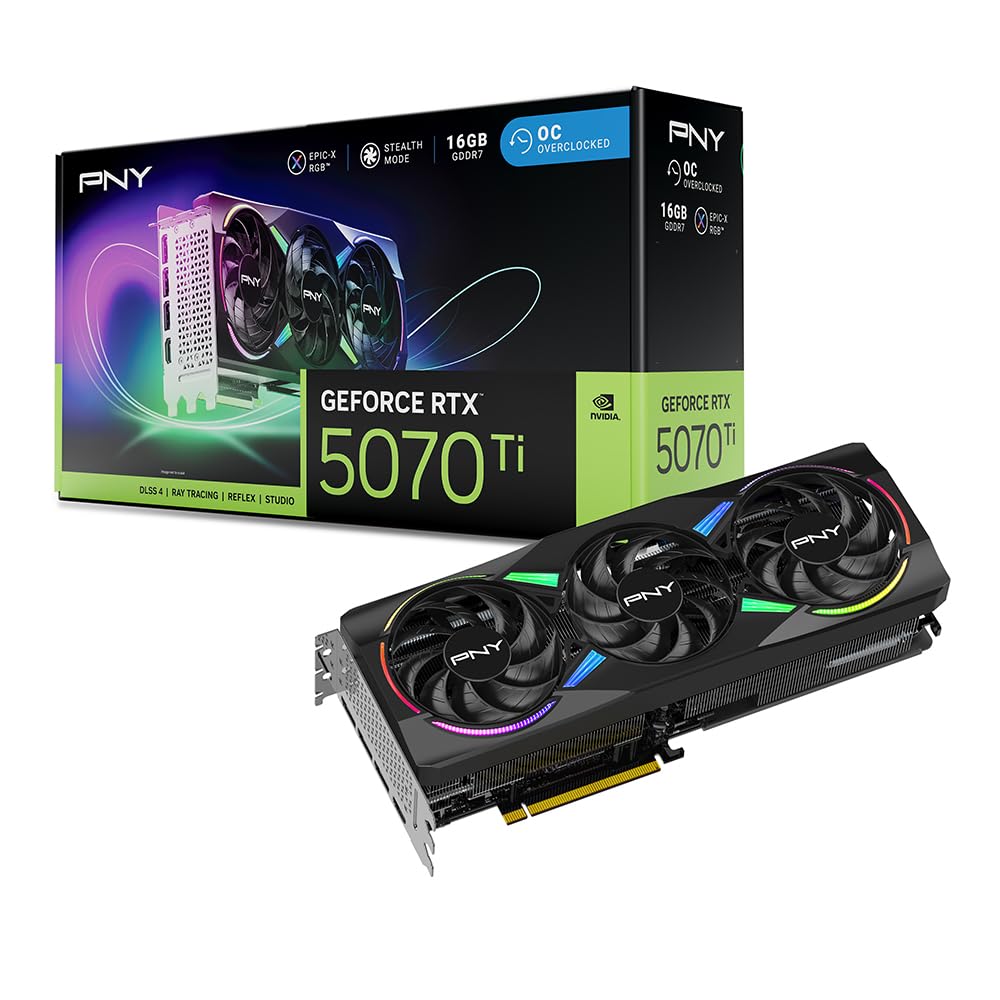
The PNY RTX 5070 Ti Epic-X brings 16GB of GDDR7 memory and a 256-bit interface to the ultrawide gaming market. The triple-fan cooler keeps the 300W board quiet under load, with minimal coil whine and excellent thermal performance. Users highlight that the card stays cool enough to barely warm the exhaust air.
For 3440×1440 resolution gaming, this card is a standout — DLSS 4 and fourth-gen ray tracing cores deliver over 100 FPS in the latest titles with ray tracing enabled. It pulls significantly less power than previous-generation high-end cards while offering meaningful raster and RT uplifts over the RTX 6950 XT.
The card is 12 inches long and thick, so measure your case width before ordering. Bright RGB lighting may not suit every build aesthetic. It also requires a dedicated 16-pin to three 8-pin power cable, so a new PSU is recommended for older systems.
Why it’s great
- Silent operation even under heavy gaming load
- Excellent DLSS 4 ray tracing performance
- 16GB GDDR7 provides future-proofing
Good to know
- Very large — check case compatibility
- Bright RGB cannot be easily disabled
4. MSI RTX 5080 Ventus 3X White

MSI’s RTX 5080 Ventus 3X in white offers flagship-level performance with a clean aesthetic perfect for all-white builds. The 16GB GDDR7 memory on a 256-bit bus paired with a 2640 MHz boost clock pushes high frame rates at 4K with ray tracing enabled. Users upgrading from a GTX 1080 report a massive generational leap in both visuals and smoothness.
The triple-fan Ventus cooling keeps temperatures between 60 and 70 degrees Celsius under load, with power draw under 300W in demanding titles like Rainbow Six Siege. The card runs quietly even without additional case fans, making it a strong choice for silent-focused builds.
At just over three pounds and 12 inches long, it requires a sturdy case with proper support. The white color scheme is unique but limits compatibility with non-white builds. Some users note that the price-to-performance ratio is not as strong as mid-range alternatives for most gamers.
Why it’s great
- Stunning white design for themed builds
- Quiet operation with great thermals
- Strong 4K ray tracing performance
Good to know
- Large and heavy — requires proper support
- White-only color scheme limits flexibility
5. XFX Swift RX 9060 XT 16GB
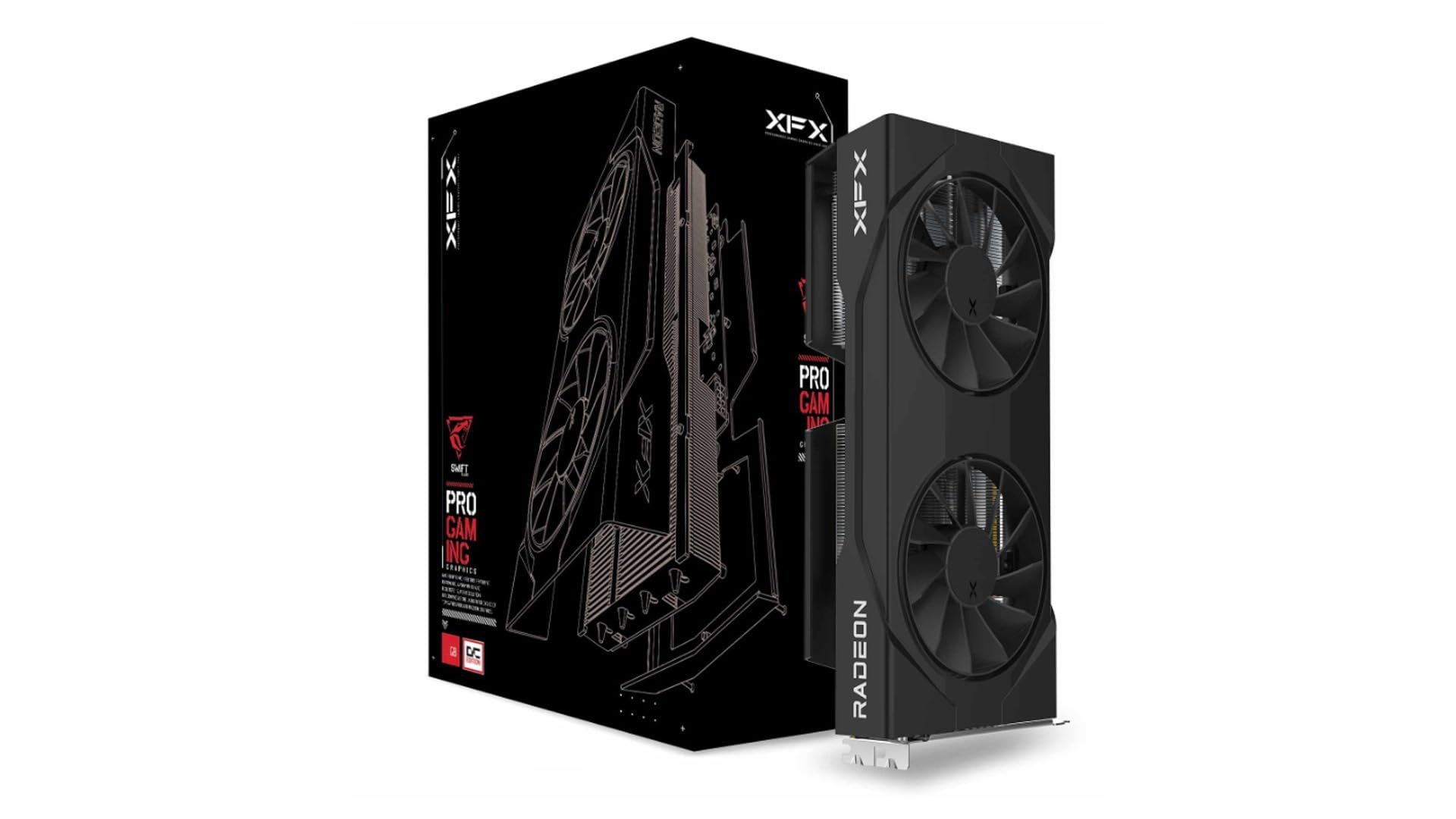
XFX delivers a strong mid-range contender with the Swift RX 9060 XT, packing 16GB of GDDR6 memory at a surprisingly accessible price point. The dual-fan SWFT cooling solution keeps the card around 60 degrees Celsius under load, with a 3320 MHz boost clock that delivers competitive frame rates at 1080p and solid 1440p performance.
Users upgrading from cards like the RX 6650 XT report a substantial performance gain — the RX 9060 XT handles 95 percent of modern AAA titles at 1080p max settings without issue. With a Time Spy score around 17000, it offers excellent rasterization performance for the price.
The card has only three output ports — two DisplayPort and one HDMI — which may be limiting for multi-monitor professional setups. It also measures 10.63 inches long, so small cases should be double-checked for clearance.
Why it’s great
- Generous 16GB VRAM for the mid-range tier
- Excellent 1080p max settings performance
- Low temperatures and quiet operation
Good to know
- Limited to 3 video outputs
- No ray tracing muscle for heavy RT titles
6. GIGABYTE RTX 5060 Windforce OC

The GIGABYTE RTX 5060 Windforce OC is a Blackwell-based entry point that offers modern features at a restrained price. The 8GB GDDR7 memory on a 128-bit bus paired with a 2512 MHz boost clock delivers solid 1080p and 1440p performance, hitting over 250 FPS in esports titles and handling Cyberpunk 2077 comfortably on medium to high settings.
Users coming from older cards like the GTX 1660 report roughly double the performance, making it a worthwhile upgrade for 1080p gaming. The WINDFORCE dual-fan cooling is effective and quiet, fitting well in standard mid-tower cases. DLSS 4 provides a noticeable quality-of-life improvement in supported titles.
Some users experienced installation issues that were resolved by running DDU before swapping cards — a recommended step for any GPU upgrade. The 8GB VRAM buffer requires some texture quality management in the most demanding titles, but for the price point, the balance is well struck.
Why it’s great
- Modern Blackwell architecture at good value
- Roughly doubles performance of older GTX cards
- Quiet and cool dual-fan design
Good to know
- 8GB VRAM requires texture setting adjustments
- Driver cleanup recommended before installation
7. ASRock RX 6600 Challenger D

ASRock’s RX 6600 Challenger D remains a viable budget option for 1080p gaming, built on the efficient RDNA 2 architecture. The 8GB GDDR6 memory and dual-fan cooler provide stable performance in esports titles and story-rich games at high settings. Users upgrading from older cards like the RX 570 see roughly double the performance with lower power draw.
The card features a zero-fan mode that keeps the fans off until the GPU reaches 50 to 60 degrees Celsius, making it nearly silent during desktop use and light gaming. Maximum temperatures around 80 degrees Celsius under full overclocking load are well within safe limits for daily driving.
Not all prebuilt or OEM systems will accommodate this card — check your power supply and motherboard compatibility before ordering. The RDNA 2 architecture lacks the ray tracing muscle of newer generations, but for pure 1080p rasterized gaming, it remains a solid choice.
Why it’s great
- Excellent value for 1080p gaming
- Near-silent operation with zero-fan mode
- Low power draw compared to competitors
Good to know
- Not compatible with all OEM systems
- Weak ray tracing performance
8. MSI RTX 3050 Ventus 2X 6G

The MSI RTX 3050 Ventus 2X 6G provides an accessible entry point into the NVIDIA RTX ecosystem for users upgrading from integrated graphics or very old dedicated cards. The 6GB GDDR6 memory on a 96-bit bus limits high-resolution textures, but for 1080p medium settings in popular titles, the card holds its own — one reviewer reports 50 to 60 FPS in Cyberpunk 2077 on high settings.
A standout feature is its 70W power consumption, which means no external PCIe power cable is needed — ideal for upgrading older OEM office PCs with limited power supplies. The dual-fan Ventus cooler is effective at keeping temperatures low, and the card supports HDMI 2.1a for modern displays.
The 96-bit memory interface is the main bottleneck here — textures in newer games may require compromises. The card is also priced higher than ideal for a two-generation-old architecture, but for users needing a simple drop-in upgrade for transcoding or light gaming, it works.
Why it’s great
- No external power cable needed — 70W only
- Perfect for modernizing old OEM PCs
- Supports HDMI 2.1a for high-res displays
Good to know
- Narrow 96-bit memory interface limits textures
- Premium for an older-generation chip
9. EVGA RTX 3090 FTW3 Ultra Gaming

The EVGA RTX 3090 FTW3 Ultra remains a powerhouse for workstation and content creation tasks thanks to its 24GB GDDR6X frame buffer. With a 384-bit memory interface and 1800 MHz boost clock, this card handles 8K video editing, 3D rendering, and machine learning workloads that challenge even modern cards. The all-metal backplate and adjustable ARGB add a premium feel.
The triple HDB fan iCX3 cooling system with nine thermal sensors keeps the card cool, but the 350W-plus power draw means it runs hot in summer conditions — one reviewer notes memory chips hitting 105 degrees Celsius before water cooling. The card is also heavy and requires a 1200W PSU for stability under sustained load.
For pure gaming at 4K, the RTX 3090 still delivers strong frame rates, though newer cards offer better ray tracing efficiency. The dual BIOS feature allows custom fan curves, and EVGA’s Precision X1 software makes overclocking straightforward. The power and heat requirements make it best suited for well-ventilated cases with active airflow.
Why it’s great
- Massive 24GB VRAM for professional workloads
- Excellent build quality with iCX3 cooling
- Dual BIOS and robust overclocking tools
Good to know
- Very high power draw and heat output
- Requires a heavy-duty 1200W PSU
FAQ
How much VRAM do I need for 1440p gaming in 2025?
Will a PCIe 5.0 GPU work in an older PCIe 3.0 motherboard?
What power supply wattage do I need for an RTX 5070 Ti?
Final Thoughts: The Verdict
For most users, the gpu for pc winner is the ASUS Prime RTX 5070 because it balances 1440p ray tracing performance, SFF compatibility, and modern GDDR7 memory at a reasonable price. If you want the best price-to-performance for high-refresh 1080p and 1440p, grab the XFX Swift RX 9060 XT. And for professional workloads that demand 24GB of VRAM, nothing beats the EVGA RTX 3090 FTW3 Ultra.