
Whether you are hunting for uranium glass at a flea market, verifying the safety of your microwave, or keeping tabs on background radiation near industrial sites, the right detector provides the difference between peace of mind and constant uncertainty. The market is flooded with cheap import options that report random numbers, making it critical to separate serious instruments from toys.
I’m Mohammad Maruf — the founder and writer behind Drink4Good. My research focuses on comparing sensor technology, energy compensation, and firmware maturity across consumer and professional radiation detectors to recommend models that deliver actionable data.
A reliable instrument must balance sensitivity with real-world usability, and this guide breaks down the core specifications that define a worthy geiger counter for home, hobby, and emergency use.
How To Choose The Best Geiger Counter
Selecting a radiation detector requires understanding what you will measure and under what conditions. Background levels, contaminated items, and emergency scenarios each demand different sensor capabilities.
Sensor Type: Geiger-Mueller Tube vs. Scintillator
Traditional Geiger-Mueller (GM) tubes detect beta, gamma, and X-rays but saturate in high fields and cannot identify specific isotopes. Scintillator-based detectors use a crystal that converts gamma energy into light, enabling spectroscopy — the ability to identify isotopes like Cs-137 or Ra-226 by their energy peaks. For general safety checks, a quality GM tube is sufficient. For serious enthusiasts and safety professionals, the scintillator provides orders of magnitude greater sensitivity.
Measurement Units and Range
Most consumer devices display counts per minute (CPM) and dose rate in microsieverts per hour (μSv/h) or milliroentgens per hour (mR/hr). Understanding the conversion — roughly 100 CPM equals 1 μSv/h for Cs-137 — helps you interpret readings. Ensure the instrument’s range covers both low background levels (0.05–0.25 μSv/h) and elevated emergency levels (10 mSv/h or higher).
Energy Compensation and Accuracy
Without energy compensation, a detector over-responds to low-energy gamma rays, producing falsely high readings. Quality instruments automatically adjust the dose rate based on incoming photon energy, delivering accurate results across a wide spectrum. This feature is essential for regulatory compliance and serious environmental monitoring.
Quick Comparison
On smaller screens, swipe sideways to see the full table.
| Model | Category | Best For | Key Spec | Amazon |
|---|---|---|---|---|
| Better Geiger S-2 | Solid-State | Emergency Prep & Rugged Use | 100x higher range than standard GM | Amazon |
| Radiacode-102 | Scintillator | Isotope Identification | 9.5% FWHM spectral resolution | Amazon |
| GQ GMC-500+ Plus | Dual Tube | Data Logging & World Map Upload | Built-in Wi-Fi and dual GM tubes | Amazon |
| SAF Aranet | Long-Term Monitor | Continuous Home Monitoring | 4-year battery life, E-Ink display | Amazon |
| GQ GMC-500 | Standard GM | Background Trend Monitoring | Wi-Fi upload to GMC Map server | Amazon |
| GQ GMC-320 Plus | Consumer Favorite | Everyday Carry & Hobby | Auto 180° swivel display | Amazon |
| FNIRSI GC-03 | 3-in-1 Meter | EMF & Radiation Combo | Measures electric and magnetic fields | Amazon |
| Forensics Detectors FD-5000 | Value GM | First-Time Buyer | 20-year sensor life, 10ft drop rated | Amazon |
| Images SI GCA-07W | Professional | Regulatory & Nuclear Inspections | ANSI N323A certification ready | Amazon |
In‑Depth Reviews
1. Better Geiger S-2

The Better Geiger S-2 uses a solid-state scintillator — a design that handles radiation levels up to 100 times higher than standard Geiger counters while remaining three times more sensitive to X-rays and gamma rays. The automatic energy compensation corrects the dose rate based on incoming photon energy, providing accurate readings across a wide spectrum. The palm-sized rubberized case and simple two-button interface make it ideal for emergency preparedness kits.
Power comes from two AA batteries with typical operating time exceeding 50 hours, and the bright transflective display stays legible in direct sunlight and complete darkness. User-adjustable alarms for both dose rate and total dose give you full control over safety thresholds. The detector includes a rubber shock protector and is designed and assembled in the USA.
Several users noted excellent company support, with one reviewer mentioning a swift replacement when the initial unit showed inconsistent readings. The lack of data logging or graphing is a deliberate trade-off to keep the interface focused on immediate, high-consequence measurements. For those serious about emergency readiness, this is the most capable compact detector on the market.
Why it’s great
- 100x higher radiation range than standard GM tubes
- Rugged rubberized build with shock protector
- Automatic energy compensation for accurate dose rates
Good to know
- No data logging or graphing capabilities
- Requires two AA batteries for operation
2. Radiacode-102

The Radiacode-102 is a gamma spectrometer in a pocket-friendly package, using a GAGG(Ce) scintillation crystal that measures 20 times faster than conventional Geiger counters. Its standout capability is isotope identification — the device displays the energy spectrum and identifies common emitters like Cs-137, Ra-226, Th-232, and U-238 decay products. The free mobile app overlays radiation data onto GPS maps for real-time logging.
Reference count rate is 30 cps per μSv/h on Cs-137, and the FWHM spectral resolution sits at 9.5 percent for solid peak separation. The unit detects gamma, X-ray, and hard beta radiation with up to seven alarm modes: adjustable sound levels, vibration, LED indicator, and three app-based alerts. Battery life exceeds a week on a USB-C charge.
Users praise the device for uncovering hot spots in antique ceramics and minerals, with one reviewer calling it the best gadget for physics nerds. The Android app is more mature than the iOS version, which lacked spectra saving at launch. This unit is not a substitute for a professional Ludlum Model 3, but for the price, it delivers laboratory-grade spectroscopy that no other consumer device approaches.
Why it’s great
- 20x faster detection with scintillation crystal
- Isotope identification via spectrum visualization
- GPS mapping with free mobile and desktop apps
Good to know
- iOS app had initial feature gaps vs Android
- Not a replacement for professional lab instruments
3. GQ GMC-500+ Plus
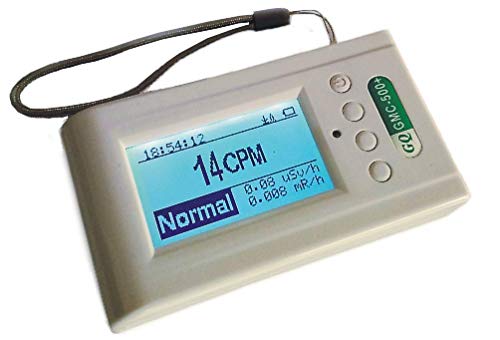
The GQ GMC-500+ Plus employs dual Geiger-Mueller tubes to extend the measurable count range and improve accuracy at both low and high radiation levels. The built-in Wi-Fi module connects to the GMC world map service, enabling unlimited online history storage and community-shared data mapping. This feature is unique among consumer detectors — you can see radiation trends across your region and contribute your own readings.
The device supports real-time testing evaluation for building materials, food, water, and hospital radiation therapy monitoring. Data logging runs independently, storing readings locally before syncing to the cloud. The bright display shows CPM, μSv/h, and mR/hr with multiple format options including text and graph views.
Reviewers consistently highlight the device’s accuracy and feature-rich design for the price. One long-term user reported five-star reliability after 1.75 years of use, while another noted the lack of repair service from GQ after two years. The unit is compact at 5 x 3 x 1 inches and runs on a rechargeable lithium-ion battery. For anyone wanting to track radiation trends over time, this is the most connected option.
Why it’s great
- Dual GM tubes for extended count range
- Built-in Wi-Fi with free cloud data storage
- GMC world map for community trend analysis
Good to know
- No manufacturer repair service after warranty
- Wi-Fi setup may require technical comfort
4. SAF Aranet
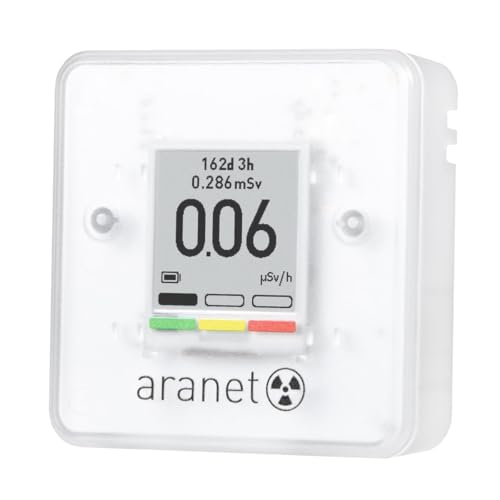
The SAF Aranet prioritizes long-term deployment over interactive use, with an E-Ink display that sips power and remains readable from extreme angles. Battery life reaches four years, making it the only set-and-forget detector for continuous home monitoring. It tracks both ambient equivalent dose rate and total dose accumulated over time, storing up to two years of history.
Bluetooth connectivity pairs with a free app for graphical playback and alarm configuration. The device detects gamma, beta, and X-ray radiation and triggers alarms at scientifically recommended thresholds. The industrial design from SAF Tehnika emphasizes reliability — the sensor is potted for environmental protection and the case is clean and minimal.
Users appreciate that the Aranet stays on 24/7 without battery anxiety, with one reviewer ordering a second unit for the car. The E-Ink display updates slowly, so it is not suitable for spot-checking hot objects, but it excels at rolling background averages. For safety-conscious households that want perpetual monitoring without maintenance, this is the definitive choice.
Why it’s great
- Up to 4-year battery life for continuous monitoring
- High-contrast E-Ink display readable in sunlight
- Bluetooth app with dose rate graphs
Good to know
- Slow display refresh unsuitable for rapid spot checks
- Requires Bluetooth connection for detailed data
5. GQ GMC-500

The GQ GMC-500 is a Wi-Fi-enabled dosimeter designed for background trend monitoring. It uploads readings directly to the GMC map server without requiring a computer, allowing you to track environmental levels from any browser. The device measures CPM, μSv/h, and R/h with audible tick and alarm settings.
At just 1.76 ounces, it is extremely lightweight and portable. The menu navigation is straightforward, though the printed instructions are tiny. The rechargeable battery holds charge for months when idle, and the USB charging cable is included. One watchmaker specifically praised its utility for detecting radium in vintage timepieces.
Users note that the response is slow for quick spot checks but ideal for measuring trends over hours and days. Food monitoring and total dose features are included and functional, and the Wi-Fi data sharing adds a social dimension to radiation awareness. For those seeking a capable entry into connected monitoring, this is a solid choice.
Why it’s great
- Wi-Fi upload directly to GMC map server
- Extremely lightweight at 1.76 ounces
- Battery holds charge for months in standby
Good to know
- Slow response for single-point measurements
- Instructions are very small and hard to read
6. GQ GMC-320 Plus
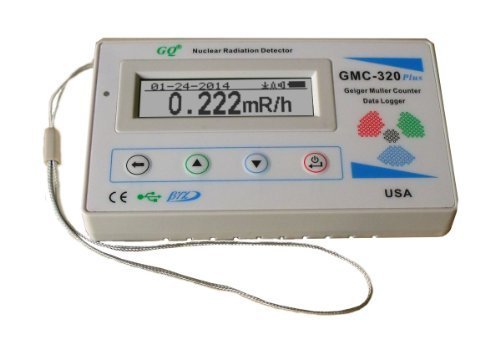
The GQ GMC-320 Plus is one of the most popular consumer Geiger counters on the market, earning trust through years of consistent performance. Its defining hardware feature is the auto 180-degree swivel display, which automatically rotates the readout when you flip the unit upside down — useful when scanning ore samples or hard-to-reach surfaces. The device logs data internally for playback on the unit itself without needing a computer.
Multiple display modes include text, large font, and a graph mode that visualizes radiation changes over time. The rechargeable battery supports extended field use, and the alarm system offers adjustable thresholds with audible alerts. It detects beta, gamma, and X-rays reliably.
Customer reviews highlight its effectiveness for real-world uses like monitoring a cat after radioactive iodine treatment — reviewers praised the audible clicking as both reassuring and fun. The screen can be difficult to read in direct sunlight, and a few users reported the wrist strap breaking quickly. At under three ounces, it disappears into a pocket or bag, making it the go-to for everyday carry and hobby scanning.
Why it’s great
- Auto-rotating display for awkward scanning angles
- Lightweight and unobtrusive for daily carry
- User-adjustable alarm levels with audible clicks
Good to know
- Screen washes out in bright sunlight
- Included wrist strap is not durable
7. FNIRSI GC-03
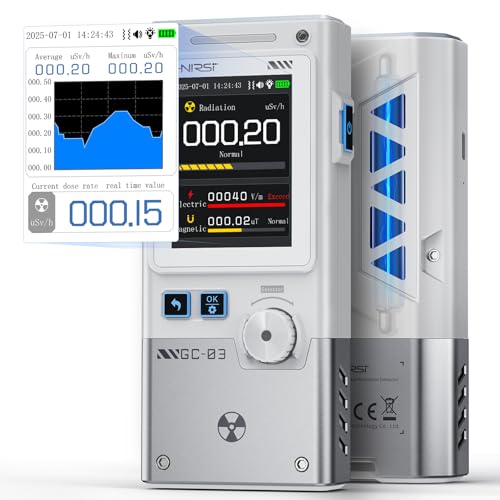
The FNIRSI GC-03 combines nuclear radiation detection with an electromagnetic field meter in a single handheld device. Nuclear sensing covers gamma, beta, and X-rays with a cumulative dose range up to 500 mSv, while the EMF side measures magnetic fields (0.01 µT to 99.99 µT) and electric fields (1 V/m to 1999 V/m). Note that RF detection is not supported — this is for low-frequency electromagnetic fields.
Three display modes include curve, professional, and quick view, and the device stores up to 50 alarm history entries. Visual, audible, and vibration alerts warn when radiation exceeds safety thresholds, and a day/night theme adapts to lighting conditions. The rechargeable battery lasts for months on standby according to user reports.
One reviewer specifically confirmed it detected a leaking microwave, and another uses it to find uranium glassware. A common disappointment is the lack of the classic Geiger clicking sound — the device relies on visual and haptic feedback instead. For those who want a single tool to check both radiation and appliance EMF emissions, this is a practical combo.
Why it’s great
- Measures nuclear radiation plus EMF in one unit
- Day/night display themes for any environment
- Excellent battery life on standby
Good to know
- No traditional Geiger clicking sound
- Does not support RF frequency detection
8. Forensics Detectors FD-5000
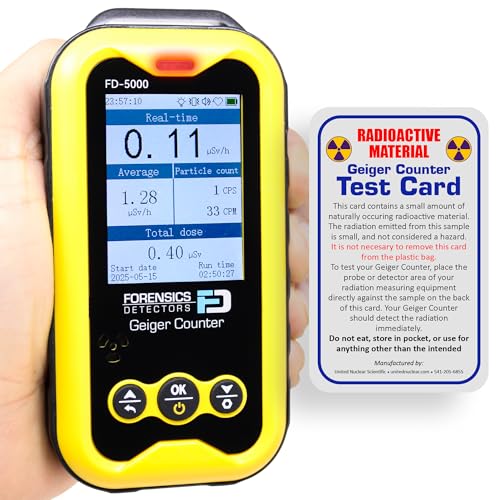
The Forensics Detectors FD-5000 is a modern entry-level Geiger counter built from the ground up for durability, with an ABS housing that passes a 10-foot drop test. The manufacturer claims a 20-year sensor life, making this a long-term investment for casual users. It detects beta, gamma, and X-rays and includes a test radiation card for immediate verification.
A large color LCD screen displays CPM, dose rate, and total dose in multiple modes: dosimeter, CPM count, and graph. The device uses a standard GM tube and covers a measuring range from 0.01 μSv/h up to 50 mSv/h for dose rates. Customer support is based in Los Angeles, California, with a 1-year warranty included.
User reviews are mixed but lean positive — several buyers confirmed it accurately detected industrial radiation exposure and fun thrift-store finds. One negative review questioned accuracy, but the majority praise value and simplicity. The included test card provides a known radioactive source for immediate confidence. For under , it is the lowest-risk entry point into serious radiation monitoring.
Why it’s great
- 20-year sensor life with 10ft drop certification
- Includes test radiation card for instant verification
- USA-based customer support in California
Good to know
- Mixed reviews on long-term accuracy consistency
- Basic GM tube without energy compensation
9. Images SI GCA-07W

The Images SI GCA-07W is a professional-grade instrument that meets ANSI N323A certification requirements, making it suitable for regulatory inspections and nuclear facility use. Its key differentiator is the external wand probe with an American-made LND712 GM tube that detects alpha particles above 3 MeV, beta above 50 KeV, and gamma/X-ray above 7 KeV. The resolution reaches 0.001 mR/hr with a range up to 1000 mR/hr.
The wand includes a metal screen for alpha detection and connects to the main unit by a durable coiled cable. Toggle switches control range and alarm settings, and the device outputs to a PC for data logging. The design prioritizes simplicity and ruggedness for field and lab work.
Users involved in nuclear medicine and industrial safety confirm its accuracy and reliability. A common critique is the protruding toggle switches, which are vulnerable to breakage, and the lack of printed instructions in the box — you must download a PDF from the manufacturer. For those who need compliance-ready equipment or work with NORM materials, this is the only choice on the list.
Why it’s great
- ANSI N323A certification ready for regulatory use
- External wand with alpha, beta, gamma detection
- 0.001 mR/hr resolution with 1000 mR/hr range
Good to know
- Toggle switches prone to damage
- Instructions must be downloaded separately
FAQ
What is the difference between CPM and μSv/h on a Geiger counter reading?
Can a consumer Geiger counter detect alpha radiation reliably?
Final Thoughts: The Verdict
For most users, the geiger counter winner is the Better Geiger S-2 because it combines solid-state sensitivity, emergency-level range, and simple operation in a rugged package. If you want isotope identification and GPS mapping, grab the Radiacode-102. And for continuous, maintenance-free home monitoring, nothing beats the SAF Aranet.