
A 550W power supply sits in a narrow performance corridor. Too weak for the high-wattage flagships that demand 300W or more, yet perfectly capable of driving a massive chunk of the modern GPU market if you pick the right card. The trick is knowing which models respect that power ceiling without sacrificing the gaming or creative performance you actually need.
I’m Mohammad Maruf — the founder and writer behind Drink4Good. I spend my time analyzing GPU power draw data, VRAM configurations, and real-world thermal behavior to find the cards that match specific PSU budgets without leaving performance on the table.
A GPU paired with a 550W supply needs to stay under roughly 200W under load, leaving headroom for the rest of the system. The picks in this guide target that sweet spot — cards that deliver strong 1080p or even 1440p gaming without forcing you to upgrade your power supply. This is the definitive breakdown of the best gpu for a 550w psu.
How To Choose The Best GPU For A 550W PSU
Matching a graphics card to a 550W power supply requires a shift in mindset. You aren’t looking for the rawest compute possible — you are looking for the highest raster and ray-tracing performance that fits inside a strict thermal and electrical budget. A few key specs separate the cards that thrive from those that trip your PSU’s overcurrent protection.
Total Board Power (TBP) and Real-World Headroom
The official TBP rating tells you the maximum the card can draw under a sustained gaming load. For a 550W PSU, target a GPU with a TBP of 175W or less. This leaves roughly 100W for the CPU, drives, and peripherals — a comfortable margin for a mid-range processor like a Ryzen 5 or Core i5. Cards with a TBP over 200W can still work with a high-quality 550W unit, but you sacrifice overclocking headroom and risk instability during transient spikes.
VRAM Capacity and Memory Bus
VRAM size directly impacts how long a card remains viable at higher texture settings. For 1080p gaming, 6GB is the floor and 8GB is the sweet spot. Cards using a 128-bit memory bus paired with GDDR6 or GDDR7 offer sufficient bandwidth for modern titles without the power penalty of wider 256-bit designs. A 96-bit bus like the one found on some RTX 3050 6GB models is acceptable for lighter titles but will show limitations in texture-heavy scenes.
Generation Efficiency and Architecture
Newer architectures deliver more frames per watt, which is the single most important metric for a 550W build. NVIDIA’s RTX 40-series and 50-series Blackwell architecture, along with AMD’s RDNA 3, have made massive strides in performance-per-watt compared to the last-generation options. An RTX 5060 draws less power while outperforming older, hungrier cards like the RTX 3060. Always prioritize the most efficient generation your budget allows.
Quick Comparison
On smaller screens, swipe sideways to see the full table.
| Model | Category | Best For | Key Spec | Amazon |
|---|---|---|---|---|
| ASUS Dual RTX 5060 | Premium | Best Overall 1080p/1440p | 8GB GDDR7, 150W TBP | Amazon |
| GIGABYTE RTX 5060 | Premium | Great Value with DLSS 4 | 8GB GDDR7, PCIe 5.0 | Amazon |
| PNY RTX 5060 Ti | Premium | Highest Boost Clock | 8GB GDDR7, 2692 MHz | Amazon |
| XFX RX 7600 | Mid-Range | AMD Value Pick | 8GB GDDR6, 165W TBP | Amazon |
| ASRock RX 6600 | Mid-Range | Ultra-Low Power | 8GB GDDR6, 132W TBP | Amazon |
| MSI RTX 3050 8GB (Renewed) | Mid-Range | Budget 1080p Ray Tracing | 8GB GDDR6, 128-bit Bus | Amazon |
| MSI RTX 3050 LP 6GB | Budget | Small Form Factor Builds | 6GB GDDR6, Low Profile | Amazon |
| GIGABYTE RTX 3050 6GB | Budget | Entry-Level Upgrade | 6GB GDDR6, 96-bit Bus | Amazon |
| Maxsun RTX 3050 6GB | Budget | SFF Optiplex Compatible | 6GB GDDR6, 77W Load | Amazon |
In‑Depth Reviews
1. ASUS Dual NVIDIA GeForce RTX 5060 8GB GDDR7 OC Edition

The ASUS Dual RTX 5060 edges out the competition for the top spot because it compresses Blackwell architecture and GDDR7 memory into a 150W power envelope that a 550W PSU handles without sweat. The axial-tech fan design keeps noise low while maintaining GPU temps in the low 70s under sustained gaming loads. At 2565 MHz in OC mode, this card delivers rasterization performance roughly equivalent to a RTX 2080 Ti, making it a massive generational leap over any RTX 30-series option.
With 8GB of GDDR7 on a 128-bit bus, the memory bandwidth reaches levels that eliminate stuttering in texture-heavy 1440p titles. The card is also SFF-Ready Enthusiast certified, meaning it fits compact cases where space is tight. Multiple reviews confirm this card runs around 100W during typical gaming sessions, a figure that leaves huge headroom for a mid-range CPU and peripherals on a 550W supply.
DLSS 4 support gives this card a future-proofing advantage over AMD alternatives. When you enable frame generation, the effective frame rate jumps significantly without increasing power draw. The only limitation is the 8GB VRAM cap — heavy modding at 1440p may require texture setting adjustments, but for the vast majority of 1080p and 1440p scenarios, this card is the ideal match for a 550W system.
Why it’s great
- Exceptional performance-per-watt with GDDR7
- SFF-Ready for compact cases
- DLSS 4 frame generation extends longevity
Good to know
- 8GB VRAM may limit ultra textures in some upcoming titles
- Requires DDU utility for clean driver swap from older GPUs
2. GIGABYTE GeForce RTX 5060 WINDFORCE OC 8G

The GIGABYTE WINDFORCE variant of the RTX 5060 is nearly identical in performance to the ASUS Dual but comes with a slightly different cooling approach. The WINDFORCE system uses alternating-spin fan blades that reduce turbulence and push more air through the heatsink. The card runs at 2512 MHz base boost, and owners report over 250 FPS in titles like Cyberpunk 2077 when paired with a competent CPU — a testament to the efficiency of the Blackwell architecture.
This card requires a 750W PSU according to the official spec sheet, but real-world load testing places the TBP at around 150W with transient spikes staying well under 200W. A quality 550W unit with a single 8-pin PCIe connector handles this card without issue. The 128-bit GDDR7 memory interface provides roughly 448 GB/s of bandwidth, a significant jump over the 224 GB/s of a typical GDDR6 128-bit card.
One practical advantage of the GIGABYTE model is its slightly shorter 7.83-inch length, which fits more cases than the 9-inch ASUS. The card comes with a dual-BIOS switch that lets you toggle between silent and performance modes. For users who want DLSS 4 and GDDR7 but prefer a slightly more compact physical footprint, this is the pick.
Why it’s great
- GDDR7 delivers massive bandwidth boost
- Compact 7.83-inch length fits most cases
- Dual-BIOS for silent or performance tuning
Good to know
- Official spec recommends 750W, but real-world 550W works
- Has no RGB lighting for aesthetic builds
3. PNY NVIDIA GeForce RTX 5060 Ti OC Dual Fan
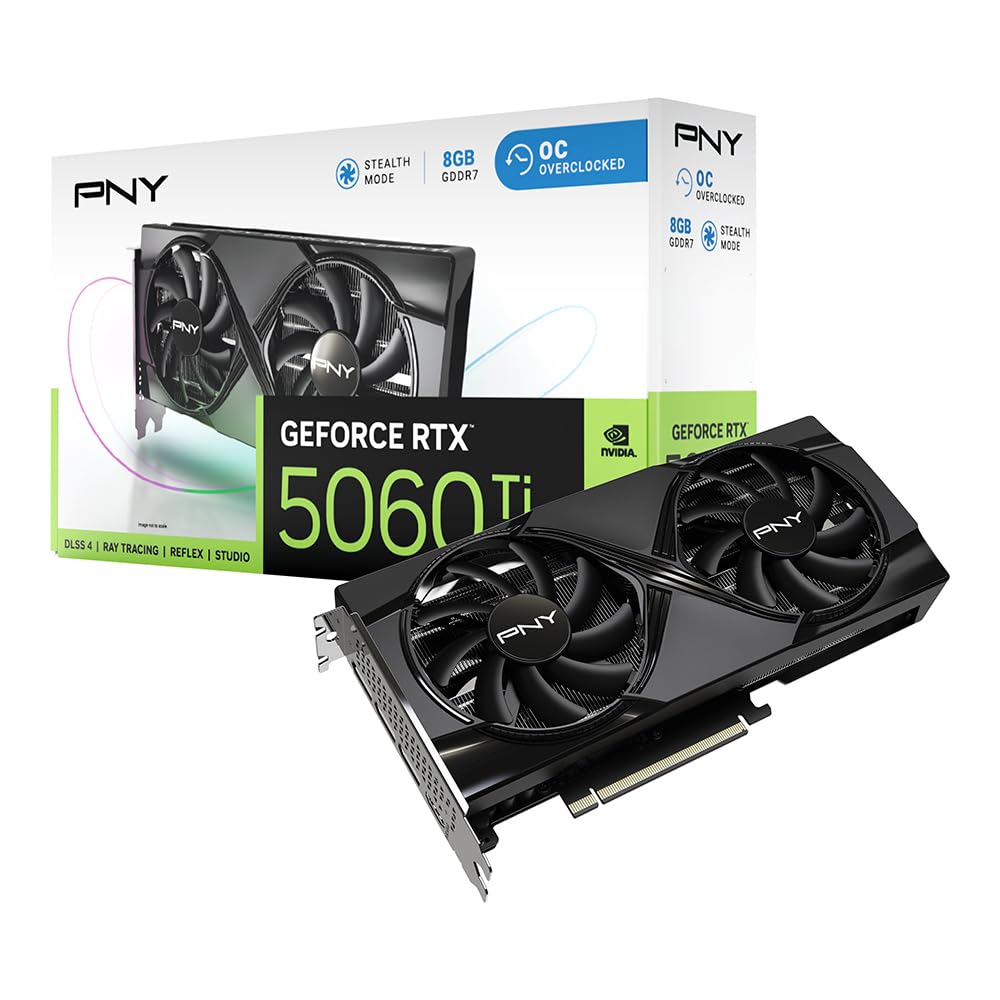
The PNY RTX 5060 Ti sits a tier above the standard 5060 with a boost clock of 2692 MHz, making it the highest-clocked card in this roundup. The 8GB GDDR7 memory runs on a 128-bit bus, but higher clock speeds translate directly to better frame rates in CPU-bound scenarios. The card uses a dual-fan open-air cooler that keeps temperatures manageable even during extended rendering sessions for creative workloads.
PNY includes fifth-gen Tensor Cores and fourth-gen Ray Tracing Cores, delivering DLSS 4 support that makes this card punch well above its 150W power class. At 1440p, this card handles Minecraft and Forza Horizon with no VRAM saturation according to verified purchasers. The PCIe 5.0 interface ensures you get full bandwidth on modern motherboards, though PCIe 4.0 backward compatibility means it still runs well on slightly older builds.
The power plug on this card sits close to the PCB edge, so cable management in tight cases requires some attention. The build quality is excellent, with a 2-slot design that pairs naturally with SFF cases. For gamers who prioritize maximum clock speeds out of the box and don’t want to manually overclock, the PNY 5060 Ti delivers the highest raw performance within the 550W envelope.
Why it’s great
- Highest factory boost clock in its class
- DLSS 4 with fifth-gen Tensor Cores
- Runs cool even at full load
Good to know
- Power plug positioning can be tight in small cases
- 8GB VRAM is the ceiling for heavy 1440p mods
4. XFX Speedster SWFT210 Radeon RX 7600 8GB

The XFX RX 7600 is AMD’s answer to the 550W PSU challenge, using the RDNA 3 architecture to deliver strong 1080p and respectable 1440p performance at a 165W TBP. The 8GB GDDR6 memory is paired with a 128-bit bus, and the boost clock can reach up to 2655 MHz. For users building on a Linux system, this card offers plug-and-play compatibility with open-source drivers that avoid the proprietary driver hassles of NVIDIA.
Gaming benchmarks show this card handles VR titles like Half-Life Alyx and Project Cars 2 at highest settings without issue, making it a strong choice for enthusiasts who want to run a headset. The SWFT dual-fan cooling solution keeps temperatures in the upper 70s under load at 60% fan speed, which is audible but not intrusive. The card draws roughly 130W in typical gaming scenarios, providing generous headroom on a 550W supply.
One area where the RX 7600 lags behind the RTX 5060 is ray tracing performance — RDNA 3 simply doesn’t match NVIDIA’s dedicated RT cores in path-traced titles. However, for raster-heavy games, esports titles, and productivity workloads, this card delivers excellent value. The 9.49-inch length is standard, so make sure your case has clearance before purchasing.
Why it’s great
- Excellent price-to-performance for 1080p
- Native Linux driver support works out of box
- VR-ready with good thermal behavior
Good to know
- Ray tracing performance trails NVIDIA equivalents
- Requires driver update to avoid initial crashes
5. ASROCK AMD Radeon RX 6600 Challenger D 8GB

The ASRock RX 6600 Challenger D is the most frugal card on this list with a 132W TBP, making it the safest drop-in upgrade for older 550W power supplies that may have degraded capacitors or loose tolerances. Despite the low power draw, this card delivers playable 1080p performance in modern titles and even handles 1440p at medium settings. The 8GB GDDR6 memory on a 128-bit bus is sufficient for current generation games at high settings.
Reviews highlight that this card runs incredibly cool, with the fans often staying off entirely at idle and reaching only 56°C under load after undervolting. Users report stable overclocks up to 2800 MHz on the core while keeping power draw under 135W. The card includes support for AMD FidelityFX Super Resolution, which extends its lifespan for more demanding titles by upscaling from a lower internal resolution.
The RX 6600 is based on the RDNA 2 architecture, which means it lacks the dedicated AI accelerators found in RDNA 3 and Blackwell cards. This makes it less future-proof for titles that will use frame generation extensively. However, for budget builders who want a reliable, cool-running GPU that won’t stress a 550W PSU even during peak loads, this card is the most conservative choice available.
Why it’s great
- Extremely low 132W TBP for maximum PSU safety
- Runs cool with fan-off at idle
- 8GB VRAM for reasonable texture settings
Good to know
- RDNA 2 lacks dedicated AI hardware
- Power cord installation can be tricky
6. MSI Gaming GeForce RTX 3050 8GB Ventus 2X XS (Renewed)

The renewed MSI RTX 3050 Ventus 8GB variant is noteworthy because it uses a full 128-bit memory bus, unlike the budget 6GB 96-bit models. This distinction gives it significantly better performance in texture-heavy games because memory bandwidth is the limiting factor at 1080p. With 8GB of GDDR6, this card handles modern titles like Witcher 3 at ultra settings without VRAM-related stuttering.
With a 1777 MHz boost clock and a TBP of around 130W, this card pairs effortlessly with a 550W PSU. The Torx Twin Fans keep the card quiet under load, and multiple reviewers report this card is a massive upgrade over older GPUs like the GTX 1060 or Radeon R9 380. The renewed status means the card has been tested and repackaged, typically saving around 30% compared to a brand-new unit.
The key downside is the Ampere architecture, which is two generations behind Blackwell. Ray tracing performance is significantly worse than the RTX 5060, and DLSS 3 frame generation is not supported. But for budget-conscious builders who need a reliable 1080p performer that fits a 550W budget, this card punches above its weight class in terms of raw raster performance.
Why it’s great
- Full 128-bit memory bus with 8GB GDDR6
- Very low power draw at 130W TBP
- Renewed pricing offers good value
Good to know
- Ampere architecture lacks DLSS 3/4 support
- Ray tracing performance is entry-level at best
7. MSI Gaming RTX 3050 LP 6G OC

The MSI RTX 3050 LP 6G OC is the go-to card for small form factor and pre-built office PC upgrades. At 6.9 inches long with a low-profile bracket included, this card fits inside Dell Optiplex and HP ProDesk cases that standard dual-fan cards cannot accommodate. The 6GB GDDR6 memory runs on a 96-bit bus, which is the primary bottleneck — but for esports titles and light gaming, it handles 1080p at 60 FPS on medium to high settings with ease.
The Twin Frozr cooling system is remarkably quiet, with reviewers noting that it’s nearly silent during desktop use and only becomes audible under sustained gaming load. The card draws power entirely from the PCIe slot, meaning it requires no external power connector — a critical feature for upgrading older office PCs whose power supplies lack PCIe power cables. The 1492 MHz boost clock is modest, but the card’s efficiency means it stays cool even in poorly ventilated cases.
For a 550W PSU, this card is overkill in terms of power headroom, drawing only about 75W under load. That leaves nearly 475W available for the rest of the system, making it safe even with the most power-hungry CPUs. The limitation is the 96-bit bus and 6GB VRAM — heavier titles like Cyberpunk 2077 will need reduced textures, but for the price and form factor, this is an unmatched upgrade for older systems.
Why it’s great
- No external power cable needed, runs on slot power
- Low profile fits SFF and office PCs
- Extremely low power draw at 75W
Good to know
- 96-bit memory bus limits texture performance
- 6GB VRAM is entry-level for 2025 titles
8. GIGABYTE GeForce RTX 3050 WINDFORCE OC V2 6G

The GIGABYTE RTX 3050 6GB is the most affordable entry point into the RTX 30-series ecosystem. With a 1477 MHz base clock and 6GB of GDDR6 memory, this card targets users upgrading from integrated graphics or very old dedicated GPUs. The 96-bit memory bus is the main limitation, but for light gaming, media consumption, and office productivity, it provides a noticeable performance boost. Importantly, this card requires no external power connection, drawing all its power from the PCIe slot.
Verified purchasers report that this card works well for basic 1080p gaming with ray tracing enabled in lighter titles like Minecraft. The WINDFORCE 2X cooling keeps the card quiet during normal operation, and the dual-fan design keeps temperatures in check during longer sessions. For non-gamers upgrading to Windows 11 or needing more VRAM for creative tasks, the jump from 2GB to 6GB is substantial.
The main trade-off with this card is the 96-bit memory interface, which limits bandwidth to roughly 168 GB/s. This puts it behind the 128-bit MSI variant in texture-heavy games. However, for users with extremely tight budgets who want a brand-new card with warranty support, the GIGABYTE RTX 3050 6GB provides a safe, reliable GPU that a 550W PSU can drive without any concerns about power draw.
Why it’s great
- Slot-powered, no external PCIe cable needed
- Affordable entry to RTX 30-series features
- Good for media center and office upgrades
Good to know
- 96-bit memory bus is a performance bottleneck
- 6GB VRAM is minimal for modern AAA games
9. Maxsun GeForce RTX 3050 6GB Slim Low Profile

The Maxsun RTX 3050 6GB is the smallest card in this roundup at just 6.65 inches long, designed specifically for slim small form factor cases like the Dell Optiplex 3060 SFF. The card draws a maximum of 77W, making it the most power-efficient RTX 3050 variant available. The low-profile design includes a standard bracket and a low-profile adapter, so it works in both standard ATX mounting and slim chassis configurations.
Performance-per-watt is the standout metric here. It works in 3D printer builds, HTPC systems, and very small office PCs that have minimal power supply headroom. The DLSS support helps extend the card’s performance in supported titles, and owners report it handles Solidworks and other CAD programs with excellent smoothness after driver tweaks.
The card runs loud under load due to the single-fan cooler having to spin faster to dissipate heat in the compact form factor. The 96-bit bus and 6GB VRAM limit its gaming potential to lighter titles, and the Maxsun brand is less established than MSI or Gigabyte, which may concern some buyers. However, for the specific use case of upgrading an ultra-small pre-built PC on a 550W or even smaller PSU, this card is uniquely positioned to deliver RTX-class features.
Why it’s great
- Incredibly low 77W maximum power draw
- Ultra-short length fits Optiplex and SFF cases
- Includes low-profile bracket
Good to know
- Fan is noticeably loud under gaming load
- Less established brand with shorter warranty period
FAQ
Can I use a GPU that draws 200W with a 550W PSU?
What happens if my GPU draws more power than my PSU can provide?
How do I check my PSU’s actual capacity before buying a GPU?
Final Thoughts: The Verdict
For most users building a new system, the best gpu for a 550w psu winner is the ASUS Dual RTX 5060 because it combines GDDR7 memory, DLSS 4, and Blackwell architecture in a 150W package that leaves headroom for a capable CPU. If you want the highest raw boost clocks and are willing to trade brand familiarity, grab the PNY RTX 5060 Ti. And for budget-focused upgrades of older office PCs, nothing beats the MSI RTX 3050 LP 6G for its external power-free operation and SFF compatibility.