
The wrong cycling shoe doesn’t just slow you down — it creates hot spots, numb arches, and wasted energy every time you pull up on the pedal. Whether you’re hammering intervals on a smart trainer or grinding through a metric century, the interface between your foot and the pedal defines how much power actually reaches the drivetrain. A flexible sole or a poor-fitting upper turns every watt into a negotiation with your own foot.
I’m Mohammad Maruf — the founder and writer behind Drink4Good. I’ve spent years analyzing sole stiffness indices, closure system durability, and cleat compatibility across dozens of brands to separate the shoes that lock in power from those that just lock in discomfort.
After reviewing the latest options, I’ve narrowed the field to the seven best models that genuinely improve your ride. This is your complete guide to the best footwear for cycling, covering everything from pre-installed SPD cleats to precision BOA dials.
How To Choose The Best Footwear For Cycling
Cycling shoes are a biomechanical interface. Unlike running or hiking footwear, a cycling shoe’s primary job is to remain rigid under pedaling load so the sole doesn’t absorb the energy your legs produce. The three decisions that matter most are sole material, cleat compatibility, and the closure system that locks your heel in place.
Sole Stiffness: The Power Transfer Number
Manufacturers rarely publish stiffness in a standardized unit, but the material tells the story. Nylon-composite soles, found on many entry-level and mid-range models, offer enough rigidity for spin classes, commuting, and recreational road rides. Carbon-composite and full-carbon soles, like the one in the Giro Cadet, minimize flex so every watt from your hip and quad goes straight through the pedal. If you regularly average over 200 watts or ride longer than two hours, carbon is a meaningful upgrade. For casual riders, a stiff nylon sole paired with a secure closure is often more comfortable and more than adequate.
Cleat Compatibility: 2-Bolt vs. 3-Bolt
Nearly every pedal system falls into one of two bolt patterns. Two-bolt (SPD) cleats are recessed into the sole, letting you walk without the clack of exposed metal. This makes SPD shoes the right choice for indoor cycling, commuting, and mountain biking. Three-bolt (Look/Delta) cleats protrude from the sole, creating a larger platform for maximum power transfer but making walking clumsy. Shoes like the Giro Cadet accommodate both patterns via a multi-position outsole plate, but most models are built for one or the other. Match the shoe to your pedal, not the other way around.
Closure Systems: Precision vs. Simplicity
Velcro straps are light, cheap, and easy to replace, but they can loosen mid-ride and distribute pressure unevenly. Laces offer infinite micro-adjustment and a classic fit, though they can come undone or get caught in the drivetrain. BOA dials, like the L6 system on the Giro Cadet, use a stainless steel lace that tightens in 1mm increments and releases instantly with a pull. They cost more and add a mechanical failure point, but the precise, even pressure across the instep is unmatched for long rides and irregular foot shapes. Choose based on how often you adjust on the bike: BOA for constant fine-tuning, Velcro or laces for set-and-forget simplicity.
Quick Comparison
On smaller screens, swipe sideways to see the full table.
| Model | Category | Best For | Key Spec | Amazon |
|---|---|---|---|---|
| Giro Cadet Men | Road / Indoor | Power-focused riders wanting BOA precision | Carbon-composite sole, BOA L6 dial | Amazon |
| Tommaso Indoor Cycling Shoes | Indoor / Gravel | Walkable SPD shoe with recessed cleats | Recessed SPD, dual hole positions | Amazon |
| Fizik M6 UOMO BOA | Mountain / Gravel | Long rides with reflective safety | Power strap, reflective upper | Amazon |
| Crankbrothers Stamp Lace Flat | Flat Pedal MTB | Trail riders on flat pedals | Gum rubber sole, lace hideaway | Amazon |
| SHIMANO SH-RP101 | Road / All-Rounder | Budget-friendly road clipless entry | Stiff nylon sole, Velcro strap | Amazon |
| Tommaso Strada Mens SPD | Indoor / Spin | Spin class with pre-installed cleats | Pre-installed SPD cleats, adjustable lever | Amazon |
| Tommaso Women’s Cycling Shoes | Indoor / Spin | Women-specific fit for spin class | Pre-installed SPD, walkable sole | Amazon |
In‑Depth Reviews
1. Giro Cadet Men Indoors and Outdoors Clipless Road Cycling Shoes

The Giro Cadet sits at the sweet spot where premium features meet a price that doesn’t require a second mortgage. Its carbon-composite outsole delivers the stiffness needed for efficient power transfer during hard climbs and sprint efforts, yet it retains 5mm of fore-aft adjustment for dialing in cleat position. The Synchwire stitch-less upper eliminates the pressure ridges you get from seamed sections, and the mono-filament mesh keeps feet from turning into saunas on warm rides.
The BOA L6 dial is the real differentiator here. Unlike Velcro straps that can only tighten in broad increments, the L6 adjusts in 1mm steps, so you can find exactly the tension that holds your heel without crushing your instep. The instant-release function is a lifesaver at stoplights and after a hard interval when you just want your foot free. Reviewers consistently note that sizing up a half-size makes the fit nearly perfect, and the dual-bolt pattern means the Cadet works with both SPD and three-bolt pedals.
Downsides are minor: the minimal cushioning offers little shock absorption if you’re walking on concrete, and the included insoles are basic enough that riders with high arches will likely swap them for a supportive aftermarket pair. But as an all-around clipless road shoe that performs equally well on a Peloton and on open asphalt, the Cadet is hard to beat.
Why it’s great
- Carbon-composite sole delivers stiff power transfer
- BOA L6 provides 1mm micro-adjustment on the fly
- Dual-bolt pattern fits almost any pedal system
Good to know
- Runs a half-size small in length and width
- Minimal cushioning makes walking uncomfortable
- Stock insoles offer little arch support
2. Tommaso Men’s Indoor Cycling Shoes – SPD Compatible – Pre-Installed Cleats
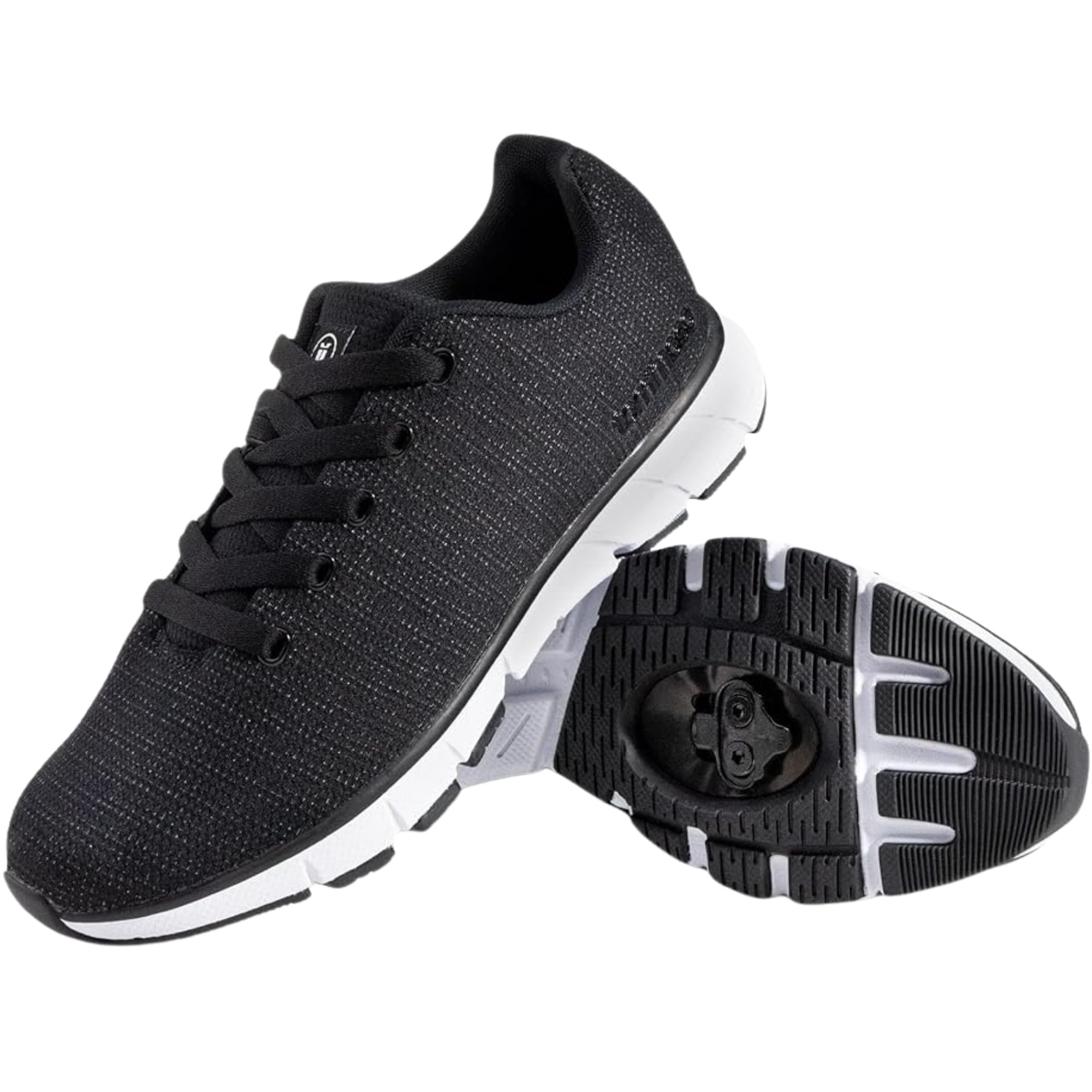
Most cycling shoes force you to choose between walkability and pedaling performance. The Tommaso Indoor Cycling Shoes split the difference with a recessed SPD cleat pocket that sits deep enough into the rubber outsole so you can stroll through a coffee shop or across a parking lot without scratching the floor or sounding like tap shoes. The laced closure gives you infinite tension control, and the low-key styling doesn’t immediately scream “cyclist” if you wear them into the gym.
Two sets of cleat mounting holes let you move the SPD interface closer to or farther from the toe, which is crucial for riders who feel unbalanced with the cleat too far forward. The sole is stiff enough to handle 75-mile days on gravel or casual road rides — one reviewer completed 408 miles on RAGBRAI without hot spots — but it has enough flex to make walking natural. The cleats are recessed so deeply that even on hard tile, the metal rarely touches down.
The sizing is the biggest headache. Multiple reviewers report needing to go one or even two US sizes up from their normal street shoe size. The shoe also runs narrow in the toe box, so if you have wide feet, this may not be the right fit. It’s not a race-day shoe; the nylon-composite sole lacks the snap of carbon. But for the rider who wants one pair of shoes that works for spin class, commuting, and a Saturday morning group ride, this Tommaso is a strong contender.
Why it’s great
- Recessed cleats allow quiet, floor-safe walking
- Dual hole positions for custom cleat fore-aft setup
- Stiff enough for long rides, flexible enough to walk
Good to know
- Runs significantly small; order 1-2 sizes up
- Narrow toe box may not suit wide feet
- Heavier than dedicated road racing shoes
3. Fizik M6 UOMO BOA Mountain Cycling Shoes

Fizik is known for wide, comfortable lasts, and the M6 UOMO continues that tradition. The fit is noticeably broader than Shimano’s typical D-width, making this a relief for riders whose feet feel pinched in more race-oriented shoes. The Power Strap system — essentially a wide Velcro band that wraps the midfoot — applies even pressure across the instep without creating the localized hot spots that BOA guides sometimes produce on bony feet. Riders have reported 140-kilometer days with 2,700 meters of climbing without any numbness, which speaks directly to the shoe’s load distribution.
The entire upper is covered in a reflective material that turns into a beacon under car headlights. For riders who train at dawn or dusk, this passive safety feature is more reliable than a clip-on light that can be forgotten. The sole stiffness rivals that of much pricier full-carbon models, despite being a composite. The neutral grey and black colorway matches any kit, and the pull-on loop at the heel makes entry quick.
The biggest issue is the stock insole. Multiple reviewers report that the factory footbed lacks arch support, and riders prone to plantar fasciitis felt pain after 200 miles until they switched to an aftermarket insole. The reflective material also shows dirt and scuffs easily, so white or light grey variants require regular cleaning. It’s not the lightest or most ventilated shoe on the list, but for comfort over ultra-distance, it holds its own against shoes costing significantly more.
Why it’s great
- Wide last fits broader feet without pinching
- Full reflective upper enhances low-light safety
- Sole stiffness rivals full-carbon at a lower weight
Good to know
- Stock insoles lack arch support; plan to replace
- Reflective material shows dirt and scuffs easily
- Less ventilated than dedicated race-day shoes
4. Crankbrothers Stamp Lace Flat, MTB Shoes

The Crankbrothers Stamp Lace is built for the growing segment of mountain bikers who prefer flat pedals over clipless systems. The rubber outsole uses a proprietary compound that grips aggressively on pinned flat pedals, keeping your foot planted through rock gardens and steep descents. The lace hideaway pocket on the tongue is a small but genuinely useful feature — it tucks the knot away so laces never wrap around the chainring or catch on brush.
The sole is noticeably rigid for a flat shoe. Unlike casual skate-style shoes that squish under pedaling load, the Stamp Lace has a stiff midsole that transfers power without absorbing it. The toe box is roomy enough for the toes to splay naturally, a feature that helps with balance on technical terrain. The polyester weave upper is easy to clean after muddy rides and offers decent ventilation for a closed-toe shoe.
Durability is a standout: one reviewer logged 1,200 to 1,500 miles across two seasons before the sole needed replacement. Sizing is the tripwire — these run a full half-size to one full size small compared to standard Adidas or Nike sizing, and the toe box on the standard width is narrow enough that riders with wider feet should look for the wide version. The lace-only closure lacks the quick-adjust convenience of a BOA dial, but the trade-off is a cleaner aesthetic and zero mechanical failure points.
Why it’s great
- High-grip rubber sole locks onto flat pedals
- Lace hideaway pocket prevents drivetrain snags
- Exceptional durability across 1,000+ trail miles
Good to know
- Runs a half-size to full size small
- Standard width is narrow for wider feet
- No quick-adjust closure; laces only
5. SHIMANO SH-RP101 High Performing All-Rounder Cycling Shoe

Shimano’s SH-RP101 proves you don’t need to spend triple digits to get a functional road shoe. The single Velcro strap across the instep, combined with a sock-like entry (there’s no tongue), makes putting these on faster than any laced or dialed shoe on this list. The nylon sole is stiff enough for steady-state road riding and indoor trainer sessions, and multiple reviewers note that the arch support is surprisingly good for a budget shoe.
The fit is where the RP101 earns its reputation. The size chart is accurate — most reviewers found their usual shoe size worked perfectly — and the toe box has enough vertical space that toes can move during long rides. The all-black finish is low-profile enough that the shoes don’t look out of place worn to the coffee shop after a ride (though the cleats still protrude). Several Peloton users specifically praise the shoe for resolving foot pain they experienced with the bike’s stock pedals.
The single Velcro strap is the limiting factor. It provides a solid closure, but the pressure is concentrated in one band across the midfoot. Riders with very narrow feet may find that the front half of the shoe bunches when the strap is pulled tight, and there’s no way to separately tension the forefoot and the heel. The strap material itself has raised durability questions in longer-term reviews. Still, at this price point, the RP101 is a legitimately good entry point that doesn’t feel like a compromise in stiffness or fit.
Why it’s great
- Accurate sizing and comfortable arch support out of the box
- Stiff nylon sole delivers solid power transfer for the price
- Fast entry with sock-like tongue-less design
Good to know
- Single Velcro strap can cause bunching on narrow feet
- Strap durability may be a concern over time
- Less breathable than mesh or synthetic upper alternatives
6. Tommaso Strada Mens SPD Shoes—Ready-to-Ride with Pre-Installed Cleats
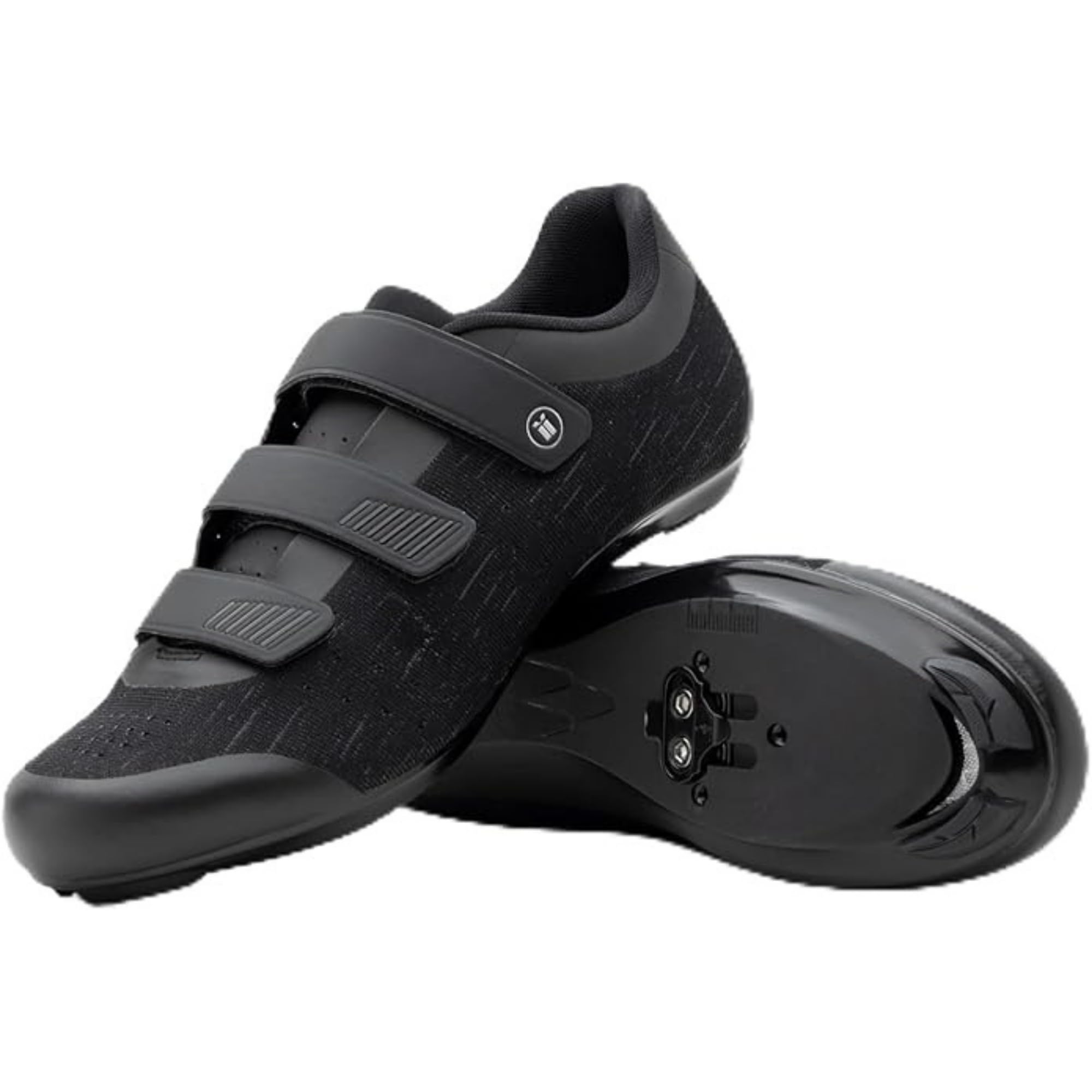
The Tommaso Strada solves the biggest friction point for indoor cyclists: cleat installation. The SPD cleats come pre-installed from the factory, torqued and positioned in a neutral fore-aft location so you can clip into a Peloton, Schwinn IC4, or studio bike immediately. The adjustable lever closure system uses a low-profile dial that tensions a wire across the instep — functionally similar to a BOA but without the lifetime guarantee — giving you quick loosen or tighten on the fly.
For riders recovering from injuries or dealing with foot sensitivity, this shoe is a notable upgrade over the rental shoes at spin studios. One reviewer recovering from an Achilles issue found that the stable platform and roomy toe box eliminated the foot pain they experienced with flexible sneakers. The breathable mesh upper keeps feet from overheating during high-intensity intervals, and the stiff sole provides enough leverage for standing climbs without excessive flex at the pedal interface.
The sizing is the main headache. The included size chart is inconsistent with actual EU measurements — one reviewer found that a US 10.5 (EU 44) fit like a larger EU 45. The SPD cleats also arrived with less torque than spec in some units, so checking tightness before your first ride is wise. The shoe is not designed for walking; the protruding SPD cleat makes movement on tile or hardwood noisy and potentially slippery. But as a dedicated indoor cycling shoe that saves you the labor of cleat setup, the Strada delivers convenience.
Why it’s great
- SPD cleats pre-installed for immediate use
- Breathable upper keeps feet cool during spin class
- Stiff sole provides solid leverage for standing climbs
Good to know
- Sizing is inconsistent; use EU sizing not US
- Cleat bolts may need re-torquing before first ride
- Not walkable on hard flooring — cleats protrude
7. Tommaso Women’s Cycling Shoes with Pre-Installed SPD Cleats
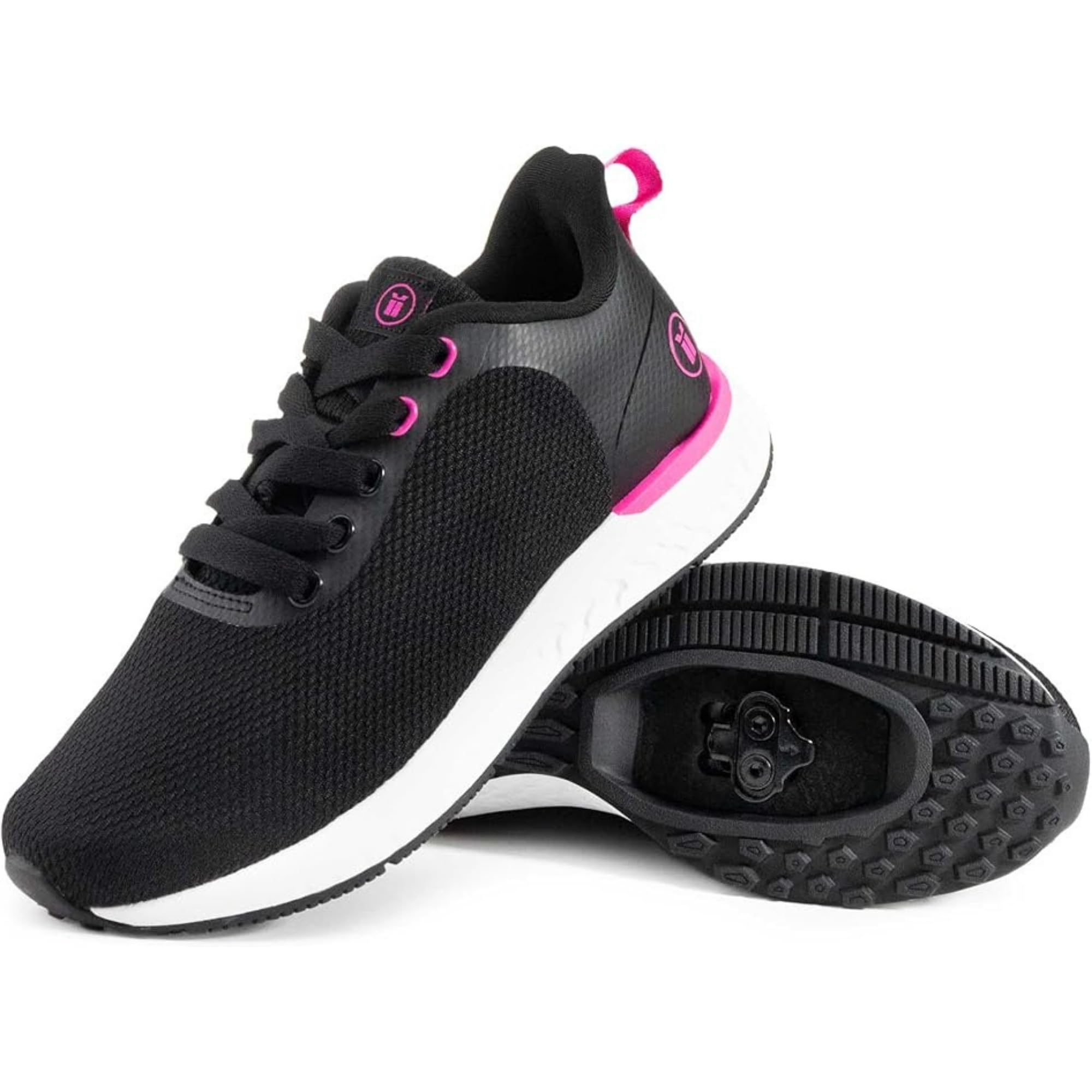
The women’s-specific version of Tommaso’s indoor shoe brings the same pre-installed SPD cleat convenience to a slightly narrower last, with a lower volume instep that fits female feet better than unisex models. The lace closure provides custom tension without the bulk of a BOA dial, and the recessed cleat pocket lets you walk around the studio lobby or locker room without the awkward tap of metal on tile. Riders who use orthotics will appreciate that the insole is removable, unlike some glued-in budget footbeds.
Fit feedback is generally positive, with most reviewers reporting true-to-size fitting for a women’s shoe — though several recommend ordering a half size up for wiggle room. The shoe works for 45 to 60 minute classes without hot spots, and the traction on the sole provides enough grip for leverage during high-resistance standing intervals. The styling is genuinely attractive, with a low-key color palette that doesn’t look out of place if you stop for errands post-ride.
Quality control is the weak spot. A small but notable number of owners report glue seepage around the SPD mounting area and shoelaces that fray after a dozen wears. One deeply negative review from an indoor cycling instructor describes the shoe causing such severe foot pain that it required a leave of absence — though that experience appears to be an outlier compared to the overall positive consensus. If you’re a casual-to-regular spinner looking for a dedicated shoe that handles ride, walk, and wash cycle in one package, this Tommaso delivers solid value.
Why it’s great
- Women-specific last provides better fit than unisex models
- Recessed cleats allow quiet, natural walking
- Removable insole makes orthotic use easy
Good to know
- Some units have glue residue and fraying laces
- Occasional reports of severe foot pain for high-intensity training
- Best for classes up to 60 minutes, not all-day rides
FAQ
Should I buy cycling shoes with pre-installed SPD cleats?
What’s the real difference between a BOA dial and Velcro straps?
Can I use road cycling shoes with mountain bike pedals?
How tight should a cycling shoe be when riding?
Final Thoughts: The Verdict
For most riders looking to balance performance and daily usability, the best footwear for cycling is the Giro Cadet because its carbon-composite sole, dual-bolt compatibility, and BOA L6 micro-adjustment deliver genuine race-level features at a mid-range price. If you prioritize walkability and want one shoe for both the bike and the gym, grab the Tommaso Indoor Cycling Shoes with their recessed SPD cleats. And for flat-pedal mountain bikers who need lasting grip in technical terrain, the Crankbrothers Stamp Lace offers the best durability-to-grip ratio on the list.