
Forget the fumes and noise of a traditional gas generator. A modern solar generator teams a portable power station with solar panels to give you quiet, emission-free electricity almost anywhere—from a remote campsite to a home during an outage. The challenge is wading through the specs: watt-hours, inverter types, battery chemistry, and charging speed.
I’m Mohammad Maruf — the founder and writer behind Drink4Good. I study solar generator hardware specs full-time, analyzing inverter efficiency, LiFePO4 cycle life claims, and real-world solar charge rates to separate marketing from true performance.
This guide cuts through the noise to help you choose the best solar generator for your budget, portability needs, and power demands—whether that’s keeping a fridge running overnight or running power tools on a job site.
How To Choose The Best Solar Generator
Buying a solar generator means investing in a device that carries your power needs for years. Getting it right comes down to three critical specs that define everything from runtime to recharging speed.
Battery Capacity (Watt-Hours) and Chemistry
Capacity, measured in watt-hours (Wh), determines how long your generator can run your devices. A 1024Wh unit might power a 60W fridge for roughly 17 hours, while a 2048Wh unit doubles that time. Equally important is the battery chemistry: LiFePO4 (lithium iron phosphate) cells offer 3000 to 6000 cycles and far better thermal stability than older NMC cells. This makes them safer and more cost-effective over a decade of use.
Inverter Rating and Surge Capability
The inverter’s continuous wattage rating dictates what appliances you can run. A 1800W inverter handles most household items, but appliances with motors—refrigerators, air conditioners, or power tools—can draw two to three times their running wattage on startup. That’s the surge rating. A unit with 2400W continuous and 3600W surge gives you headroom to start a fridge without tripping the inverter.
Solar Input and Charging Speed
The solar input rating (in watts) determines how fast the sun refills your battery. A station with 800W solar input recharges much faster on a sunny day than one limited to 200W. Some stations also support “dual charging” (AC + solar simultaneously), cutting recharge time dramatically. For off-grid living, prioritize units with MPPT charge controllers for efficient energy harvesting from panels.
Quick Comparison
On smaller screens, swipe sideways to see the full table.
| Model | Category | Best For | Key Spec | Amazon |
|---|---|---|---|---|
| Bluetti Elite 200 V2 | Mid-Range | High-efficiency daily use | 2073.6Wh / 2600W / 6000 cycles | Amazon |
| Anker SOLIX C2000 Gen 2 | Mid-Range | Ultra-fast charging | 2048Wh / 2400W / 58 min full charge | Amazon |
| BLUETTI AC200L | Mid-Range | Expandable home backup | 2048Wh / 2400W / 8192Wh expandable | Amazon |
| Growatt INFINITY 2000 Pro | Mid-Range | Cold-weather resilience | 2048Wh / 2400W / -22°F operation | Amazon |
| Dabbsson 2000L | Mid-Range | Semi-solid battery safety | 2048Wh / 2200W / 1 hr fast charge | Amazon |
| Jackery Explorer 2000 v2 | Mid-Range | Lightweight portable 2kWh | 2042Wh / 2200W / 39.5 lbs | Amazon |
| EF ECOFLOW Delta 2 | Value | Complete kit with solar panel | 1024Wh / 1800W / 3000+ cycles | Amazon |
| OUPES Mega 1 | Value | Budget entry with panel | 1024Wh / 2000W / 36 min fast charge | Amazon |
| AFERIY P310 | Premium | High-capacity home essential | 3840Wh / 3600W / 11.5kWh expandable | Amazon |
| ABOK Ark3600 | Premium | Wheeled high-capacity | 3840Wh / 3600W / 11.5kWh expandable | Amazon |
| Jackery HomePower 3000 | Premium | Whole-home backup | 3072Wh / 3600W / 4000 cycles | Amazon |
In‑Depth Reviews
1. BLUETTI Elite 200 V2

The BLUETTI Elite 200 V2 delivers 2073.6Wh of capacity paired with a 2600W continuous inverter (3900W surge), giving you headroom to start a fridge compressor or run a microwave alongside other devices. Its standout feature is the true automotive-grade LiFePO4 battery, CNAS-certified for over 6000 cycles—effectively a 17-year lifespan at daily use. The inverter efficiency also keeps standby power draw to just 10W, meaning less energy wasted when idle compared to other models in its class.
Charging speed is equally impressive: Turbo Mode hits 0–80% in about an hour via AC, and dual AC + solar input can undercut that timeline significantly. The unit also supports a Silent charging mode that keeps fan noise between 16-30 dB—quieter than a library. At 53 pounds, it is not ultralight, but the compact footprint (13.8 x 9.8 x 12.7 inches) saves valuable floor space in a home or RV.
Real-world users confirm it easily handles a shop vac, mitre saw, air fryer, and full camping setups without tripping. The HyperWatt technology is genuine—the 3900W power lifting mode runs resistive loads like coffee makers that exceed the continuous rating for short bursts. The app (WiFi/BT) provides granular control over charging speed, schedules, and load monitoring. The only missing feature for RV owners is a dedicated 30A RV port, but the four 20A AC outlets compensate for most use cases.
Why it’s great
- Industry-leading 6,000-cycle LiFePO4 battery
- 3900W Power Lifting handles heavy startup surges
- Ultra-quiet Silent Mode at 16-30 dB
- Compact design for its capacity class
Good to know
- No 30A TT-30 RV outlet
- 53 lbs still hefty for some
2. Anker SOLIX C2000 Gen 2
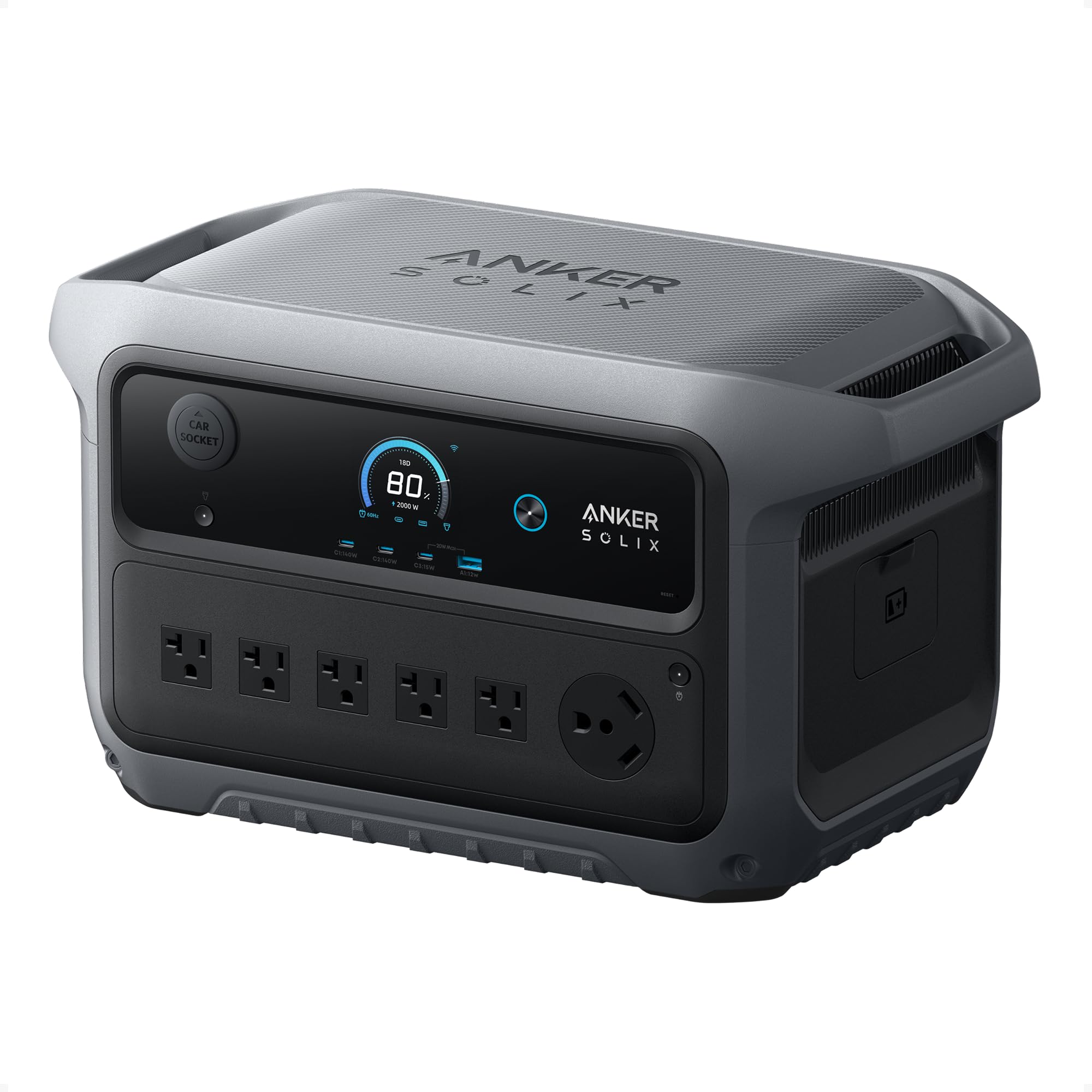
The Anker SOLIX C2000 Gen 2 is the speed champion of the 2kWh class: a full 0-100% AC charge takes just 58 minutes. That’s because the unit accepts up to roughly 1800W AC input, a figure typically reserved for larger stations. With 2400W continuous output and a 4000W peak, it can even start most window and RV air conditioners—a serious claim that many portable stations cannot back up.
At 41.7 pounds, it is 25% lighter than typical 2kWh rivals, and the dimensions (18.1 x 9.8 x 10.1 inches) make it easier to slide into a trunk or closet. Anker includes six ways to charge, including AC, solar (up to 800W), and 800W alternator charging (3 hours to full from a vehicle’s alternator). Standby power consumption drops to just 9W, so a dual-door fridge can run for up to 32 hours on a single charge.
User feedback consistently highlights the sturdy, tank-like build quality and the reliable time-of-use scheduling via the app, which lets you charge the station during off-peak utility hours for cheaper power. An expansion battery is available to push total capacity to 4kWh (64 hours of fridge runtime). The only real trade-off is the lack of a 30A RV outlet, though most users find the four 20A AC ports sufficient for household and camping gear.
Why it’s great
- Full charge in under one hour
- Super lightweight for 2kWh class
- 4000W peak output handles AC startup
- 800W alternator charging for on-the-go
Good to know
- No 30A RV port
- Expansion battery sold separately
3. BLUETTI AC200L

The BLUETTI AC200L is built for users who need capacity growth over time. Starting at 2048Wh with 2400W AC output (3600W Power Lifting), it can expand up to 8192Wh by connecting two B300 or B300K expansion batteries. That’s enough to run a full-size refrigerator, a TV, lights, and a router for days. The unit also features a dedicated 30A RV outlet (TT-30), making it a natural fit for RV owners who want plug-and-play power without adapters.
AC charging is fast: 0-80% in 45 minutes using the maximum 2400W AC input. Solar input tops out at 1200W, which means a full charge from panels in optimal sun takes around 1.7 to 2.2 hours. The UPS switching speed is under 10ms, so your computer or medical device won’t even flicker during a grid outage. At 61 pounds, the AC200L is on the heavier side, but the integrated handles make carrying manageable for one person over short distances.
Customer feedback over two years of use shows the unit reliably starts 12,000 BTU RV air conditioners and handles 1500W kettles alongside solar charging. The app (WiFi/BT) allows detailed monitoring of input and output, though some users note the proprietary AC power cord feels unnecessarily bulky. The five-year warranty adds confidence for a long-term investment in home backup.
Why it’s great
- Expands to 8192Wh capacity
- Integrated 30A TT-30 RV outlet
- Fast 45-min 0-80% AC charge
- Under 10ms UPS switching
Good to know
- Heavier than competitors (61 lbs)
- Proprietary AC charging cable
4. GROWATT INFINITY 2000 Pro
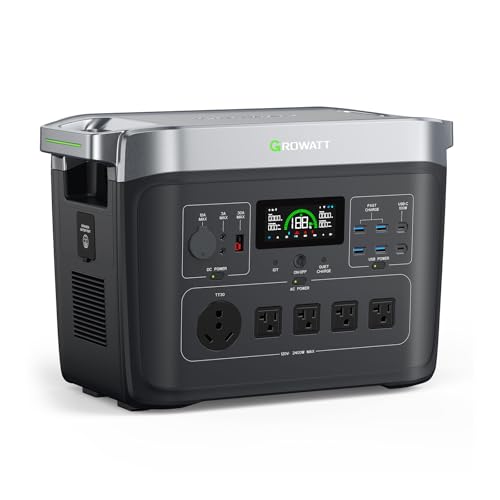
The Growatt INFINITY 2000 Pro takes a different approach: it packs 2048Wh of capacity with a 2400W inverter and a dedicated Cold Start technology that allows operation down to -22°F. No other station in this class guarantees functionality at such low temperatures, making it the only choice for winter camping, northern power outages, or unheated garages. The unit is also compact at 26 pounds—lighter than many 1000Wh stations—with a form factor that slides easily into tight spaces.
AC charging is surprisingly fast: 0-100% in about 90 minutes thanks to 1800W input. Solar input supports up to 1200W, so a full sun-top-up can happen quickly with the right panels. The INFINITY 2000 Pro also includes a TT-30 RV outlet and an Anderson port, ideal for overlanders. The UPS switching speed of 15ms is slower than some rivals but still safe for most electronics. Growatt backs this unit with a five-year warranty, reflecting confidence in the EV-grade LFP cells rated for 4000+ cycles.
User reviews consistently call out the quiet fan operation and the rock-solid app interface. One RV user reported running a diesel cabin heater for a full week straight without issues. Some reviewers warn of early units with quality-control problems (failure to turn on without grid power), so purchasing from a seller with a solid return policy is advisable. Overall, if you need a station that operates when the mercury drops, this is the clear leader.
Why it’s great
- Operates down to -22°F
- Lightweight (26 lbs) for its capacity
- TT-30 and Anderson ports for RV use
- Fast 90-minute full charge
Good to know
- Some early units had reliability issues
- Extended <15ms UPS switching
5. Dabbsson 2000L
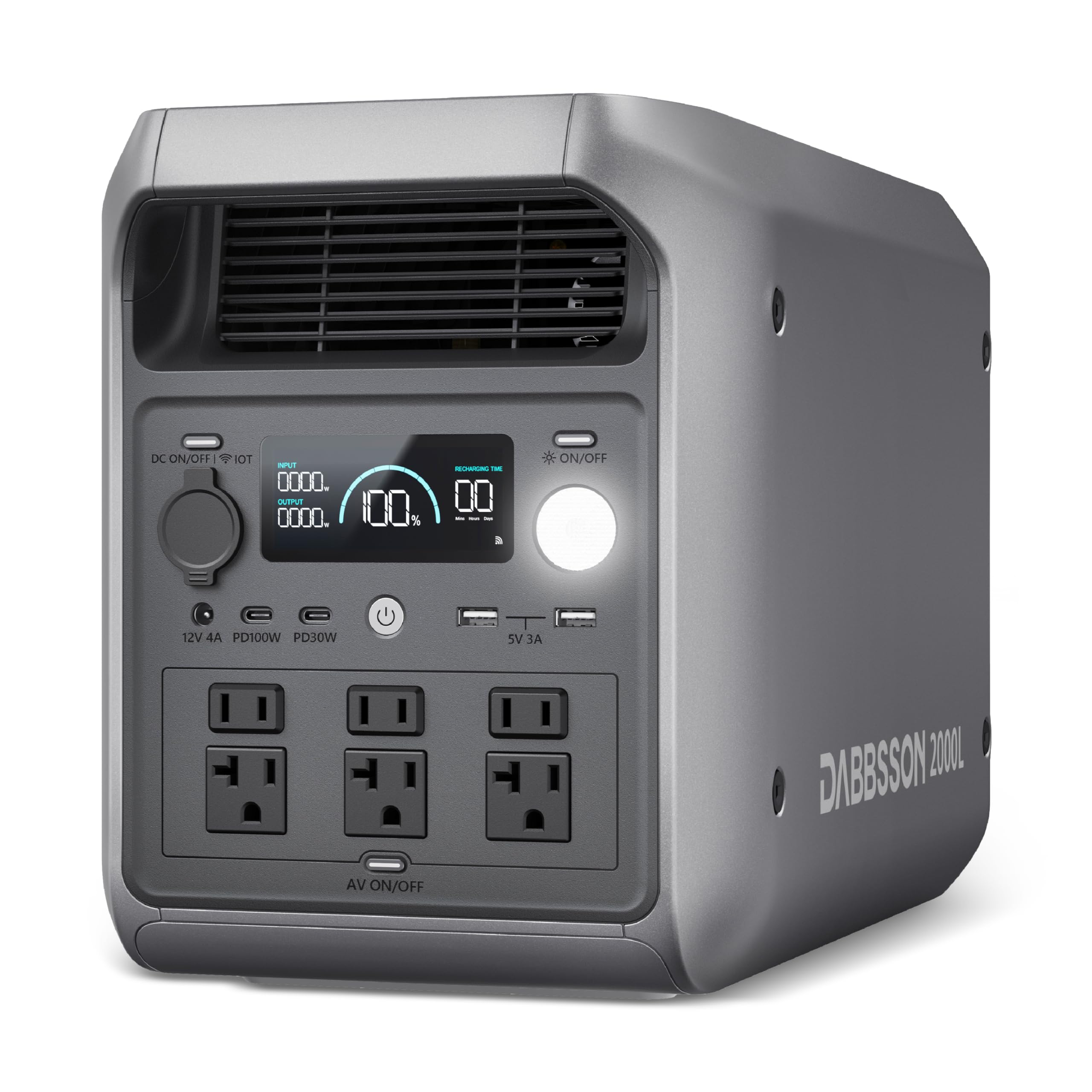
The Dabbsson 2000L uses an upgraded semi-solid LiFePO4 cell design, which offers higher thermal stability and energy density than standard LiFePO4 batteries. This translates to 1.3x longer runtime than typical 2048Wh stations and a 4000+ cycle lifespan. The UL94-V0 flame-retardant housing provides extra safety for indoor use. Despite the advanced cells, the unit weighs 41 pounds—still lighter than many full-metal rivals.
AC output is rated at 2200W continuous with a 3300W Power Boost for surges, enough for a refrigerator, heater, or power tools. AC charging hits full capacity in just 1 hour, which is competitive with the fastest 2kWh stations. Solar input maxes out at 800W via MPPT, giving an approximate 2.5-hour full charge from panels in good sun. Six AC outlets and a full set of DC ports allow simultaneous power for a family camp setup.
Real-world users praise the quiet operation and the intuitive display showing real-time input/output data. The EPS switchover (under 15ms) protects sensitive electronics during outages. The 5-year warranty (3 standard + 2 extended with registration) adds peace of mind. Some buyers note the plastic casing feels less premium than aluminum rivals, but it keeps the weight down without sacrificing durability.
Why it’s great
- Semi-solid LiFePO4 for better safety & runtime
- 1-hour full charge via AC
- Six AC outlets for multi-device power
- Flame-retardant housing certified UL94-V0
Good to know
- Plastic housing feels less premium
- Solar input capped at 800W
6. Jackery Explorer 2000 v2

Jackery’s Explorer 2000 v2 leverages the same Cell-to-Body (CTB) technology used in electric vehicles to cram 2042Wh into a package that weighs just 39.5 pounds—41% lighter than typical 2kWh stations. The resulting dimensions (13.2 x 10.4 x 11.5 inches) make it one of the most portable high-capacity units available. The inverter pushes 2200W continuous, enough for most household appliances, with a UL-certified UPS that switches within 20ms for seamless backup.
AC fast charging reaches 0-80% in 66 minutes, and an Emergency Super Charging mode via the app hits full in 102 minutes. Silent Charging mode drops noise to under 30dB, ideal for bedrooms or campsites. The unit also features a built-in flashlight with low, high, and SOS modes. Solar input supports up to 400W, charging fully in about six hours of good sun with a single panel.
Users frequently praise the intuitive app and the reliable pass-through charging that keeps connected devices running during grid-to-battery transitions. Many also appreciate the phone-style battery health management that recommends 50-80% storage levels. The only consistent complaint is that solar charging is slow with a single 200W panel; pairing it with the full 400W panel kit is recommended for meaningful solar top-ups.
Why it’s great
- Lightest 2kWh station at under 40 lbs
- UL-certified UPS with 20ms switchover
- Silent Charging mode (under 30dB)
- Built-in flashlight (low/high/SOS)
Good to know
- Slow solar recharge with smaller panels
- No 30A RV port
7. EF ECOFLOW Delta 2 + 220W Panel

EcoFlow’s Delta 2 is the gold standard for value-oriented solar generators. The base unit offers 1024Wh of LFP battery capacity with 1800W AC output, expandable up to 3kWh with extra batteries. The bundled 220W bifacial panel captures light from both sides, delivering up to 25% more energy than standard panels. That single panel can charge the Delta 2 from empty in about four to five hours in direct sunlight—impressive for an entry-level kit.
The Delta 2 supports up to 500W solar input, plus AC fast charging that fills the battery in about 1.6 hours. With 15 outlets (including two USB-C PD 100W ports), it can power a mini-fridge, laptop, phone, lights, and a fan simultaneously. The LFP battery is rated for 3000+ cycles to 80% capacity, meaning years of regular use before noticeable degradation. The unit weighs 27 pounds with the panel included at about 58 pounds total in the box.
Users consistently report that the Delta 2 handles weekend camping trips and short home outages with ease. The bifacial panel design is a genuine advantage in overcast conditions or when deployed near reflective surfaces (snow, sand, light-colored ground). The EcoFlow app is one of the better tools in the market, though some users note connectivity bugs with Bluetooth. For a first-time buyer who wants a complete, ready-to-use solar generator out of the box, this kit is tough to beat.
Why it’s great
- Complete all-in-one kit with panel
- Bifacial panel captures 25% more energy
- 3,000+ cycle LFP battery
- Expandable capacity to 3kWh
Good to know
- Base 1024Wh may be small for heavy users
- App occasionally has Bluetooth bugs
8. OUPES Mega 1 + 100W Panel
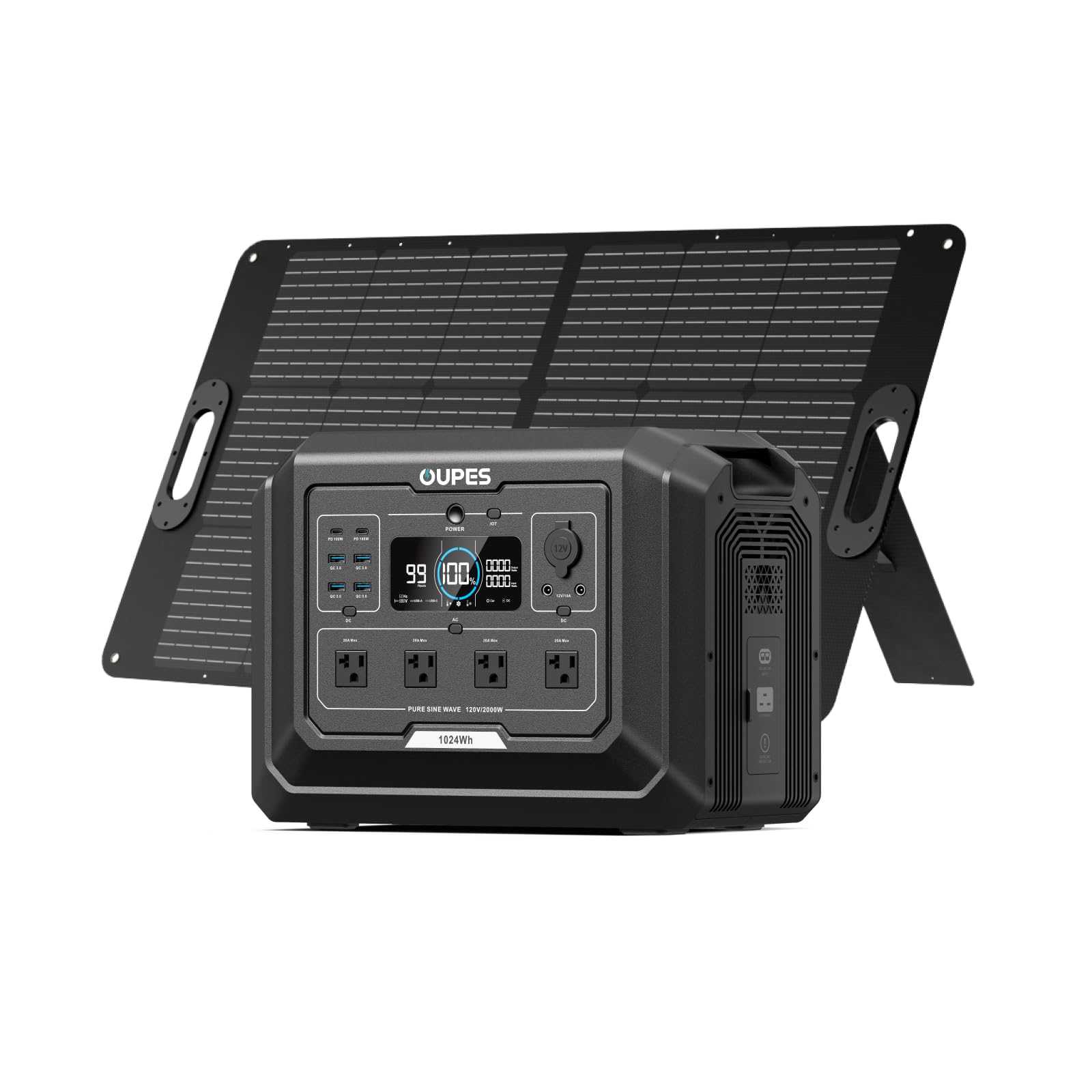
The OUPES Mega 1 delivers 1024Wh of LiFePO4 capacity with a 2000W pure sine wave inverter (4500W surge) at a price point that undercuts most competitors. The included 100W solar panel makes it a turnkey solar generator right out of the box. AC charging is genuinely class-leading: 0-80% in 36 minutes via AC, and hybrid AC + solar charging cuts that to just 26 minutes. This means you can top up the battery during a lunch break if needed.
The unit supports expansion up to 5120Wh via two B2 extra batteries, so you can start small and scale as your needs grow. Solar input maxes at 800W, allowing a full charge from panels in about 1.3 hours in ideal sun with three 240W panels. The 13 ports include two USB-C PD 100W ports for fast laptop charging and four USB-A QC3.0 ports. The UPS function switches under 20ms, safe for sensitive electronics.
Users report running a full-size fridge, freezer, WiFi, and laptop for 24 hours on a single charge. The unit weighs 27.8 pounds—light for a 1000Wh+ station—and the compact dimensions (15.1 x 9.1 x 11.6 inches) make it easy to stow. Some reviewers note that the solar panel connection requires tight cable management for optimal efficiency. A small minority reported units failing to recharge after heavy continuous load, so buying from a seller with a solid return policy is wise.
Why it’s great
- Fastest AC 0-80% charge in class (36 min)
- Expandable capacity to 5120Wh
- Includes 100W solar panel
- 27.8 lbs is very portable for capacity
Good to know
- Some units had durability issues
- 100W panel is small for meaningful solar top-ups
9. AFERIY P310

The AFERIY P310 jumps straight into high-capacity territory with a massive 3840Wh (3.8kWh) LiFePO4 battery and a 3600W inverter (7200W peak). That’s enough to run a refrigerator for 1-2 days, plus a TV, router, and lights simultaneously. The unit is expandable up to 11.5kWh via accessory battery packs, making it a viable whole-home backup solution for short-term outages. The UPS switchover is under 10ms—fast enough to keep desktop computers and medical gear running without interruption.
AC charging hits full capacity in 1.5 hours thanks to 2400W input. Solar input supports up to 2000W, meaning a full solar charge is possible in about two hours with a large panel array. The 15 output ports include USB-A, USB-C PD, XT60, and a 12V car socket. A telescoping handle and rugged wheels make the 104-pound unit easier to move than its weight suggests. The manufacturer offers a 7-year support period for added peace of mind.
User feedback is largely positive: buyers confirm it runs RVs (minus air conditioning), charges fast, and has excellent customer support from Aferiy. The Bluetooth app allows remote monitoring and scheduling. One reviewer noted a dark screen segment on the first unit, but the support team was responsive. A few reports of charging failures suggest quality control is not 100% perfect, so buying from a reputable seller with a return policy is recommended.
Why it’s great
- 3.8kWh base capacity, expandable to 11.5kWh
- 7200W peak handles heavy loads
- Fast 1.5-hour AC full charge
- Rugged wheels and pull handle included
Good to know
- Very heavy at 104 lbs
- Some quality-control reports
10. ABOK Ark3600 + 200W Panel
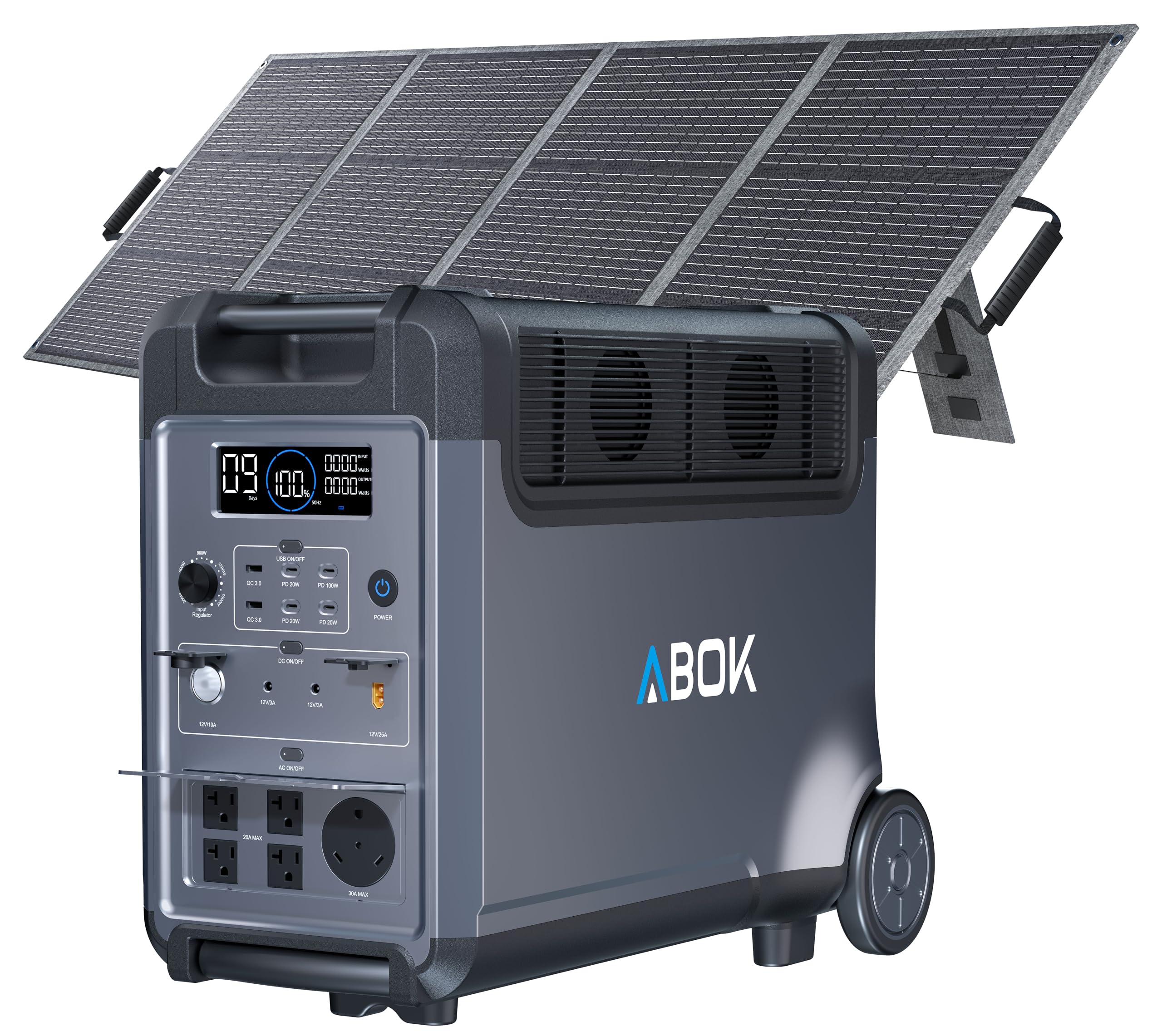
The ABOK Ark3600 is essentially the same class as the Aferiy P310 but includes a 200W solar panel and a slightly different port layout. It offers 3840Wh of LiFePO4 capacity with a 3600W inverter (4500W peak), expandable to 11,520Wh. The telescoping handle and durable wheels are built into the design, making it significantly easier to move than the AFERIY despite the similar 92-pound weight. AC charging takes about 3 hours (1500W input), and hybrid AC + solar can fill it in 1.29 hours.
The unit includes a dedicated 30A RV outlet (TT-30) plus three 20A AC outlets, two USB-C PD (one 100W, two 20W), and multiple DC ports. The Bluetooth app allows monitoring and schedule control. Solar input maxes at 2000W, making it compatible with large panel arrays for off-grid living. The UPS switchover is under 10ms, matching the Aferiy for speed.
Users report running full home essentials (fridge, lights, fan, TV, internet) for hours during outages, with solar panels keeping the battery topped indefinitely. The integrated wheel kit is a standout feature: one user called it a “game changer” for moving a 92-pound station. Some early buyers reported defective units that would not charge, but the seller provided return labels. The 3-year warranty (including extension) adds some coverage, though the build quality is generally solid.
Why it’s great
- Includes 200W solar panel
- Integrated telescoping handle and wheels
- Dedicated 30A RV outlet
- High 2000W solar input
Good to know
- Some early quality-control issues
- Heavy at 92 lbs despite wheels
11. Jackery HomePower 3000 + 2x 200W Panels
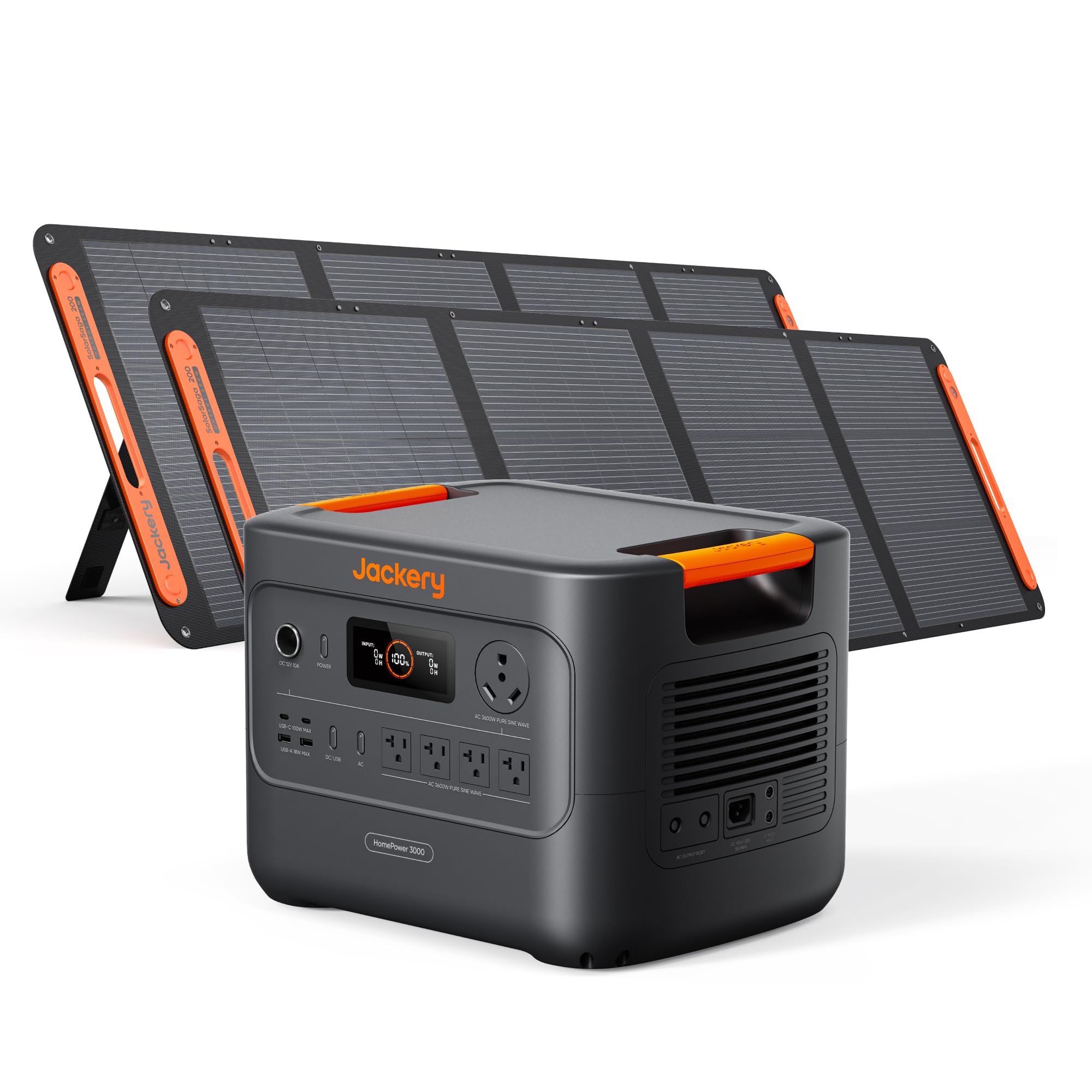
The Jackery HomePower 3000 targets serious home backup with a 3072Wh LiFePO4 battery, a 3600W inverter (7200W surge), and two included 200W solar panels. Jackery’s CTB technology makes it 47% smaller and 43% lighter than comparable 3kWh units, at 59.5 pounds. That weight is manageable with the optional wheel kit (sold separately). The 7200W peak is massive enough to start a well pump or central air compressor, though runtime will be short for such heavy draws.
AC charging hits full in 2.2 hours (1800W input), and hybrid AC + solar cuts that to 1.7 hours. Solar input supports up to 800W, so a full sun-only charge takes about 11 hours with the included 400W panel kit. The unit features dual 100W USB-C PD ports, a TT-30 RV outlet, and a UL-certified UPS that switches within 20ms. ChargeShield 2.0 uses AI algorithms to optimize charging speed while preserving battery life, and the LFP cells are rated for 4000 cycles to 70% capacity.
Users confirm the HomePower 3000 keeps a refrigerator running for 1-2 days, powers an RV (except air conditioning), and handles whole-home essentials during outages. The fan noise is noticeably low at partial load, and the app’s scheduling features let you charge during off-peak hours. The main drawback is the lack of user-expandable battery capacity—what you buy is what you get. The wheel kit being sold separately also feels like a cost-cutting miss for a premium-priced unit.
Why it’s great
- Massive 7200W surge for heavy appliances
- Compact and light for a 3kWh station
- Includes two 200W solar panels
- UL-certified UPS and 10-year lifespan
Good to know
- Not expandable beyond built-in capacity
- Wheel kit costs extra
FAQ
Can I run my refrigerator off a solar generator?
How long does it take to charge a solar generator from a wall outlet?
Is LiFePO4 battery only in premium solar generators?
Final Thoughts: The Verdict
For most users, the best solar generator winner is the BLUETTI Elite 200 V2 because it balances high capacity (2073.6Wh), excellent inverter efficiency, and an unmatched 6,000-cycle battery lifespan in a compact footprint. If you want the fastest recharge possible, grab the Anker SOLIX C2000 Gen 2 — you’ll go from 0-100% in under an hour. And for whole-home backup with a massive 3.8kWh base capacity, nothing beats the AFERIY P310 with its expandability and fast charging.