
A shed base that shifts under weight is a recipe for a warped floor, a stuck door, and a project you’ll redo within a season. The single most common mistake DIY builders make is treating gravel like a loose fill — dumping it on bare soil and expecting it to stay put. Without proper confinement, that gravel migrates sideways, sinks into the mud, and your shed slowly lists like a ship taking on water.
I’m Mohammad Maruf — the founder and writer behind Drink4Good. I’ve spent years analyzing construction materials for home foundations, evaluating how aggregate types, geotextile fabrics, and stabilization grids perform under real-world loads to prevent exactly this kind of settling failure.
This guide cuts through the noise to identify the materials that actually lock a gravel for shed base into a solid, level platform that resists spreading, rutting, and sinking season after season.
How To Choose The Best Gravel For Shed Base
Building a shed base is a structural exercise. The gravel you choose must do three things: bear the shed’s weight without compacting further, drain water away from the floor joists, and resist spreading outward under load. Three spec categories matter most — the stone shape, the separation layer, and the confinement system.
Angular Crushed Stone vs. Smooth River Rock
Angular crushed stone, typically 3/4-inch minus, interlocks mechanically as you compact it. The jagged edges bite into each other and create a nearly solid mat. Smooth river rock, like polished pebbles, rolls under pressure — it will never lock into a stable base. For a shed foundation, always spec angular, fractured-face aggregate.
Geotextile Fabric: The Separation Layer
A non-woven geotextile fabric placed between the soil and the gravel prevents the two from mixing. Without it, the gravel punches into the dirt under the weight of the shed, and the soil wicks up into the stone layer, destroying drainage. A fabric with a tensile strength of at least 350N is the baseline for shed base work.
Ground Grids for Problem Sites
On level ground with good soil, 4 to 6 inches of compacted stone on geotextile fabric is usually sufficient. But on slopes, soft ground, or for sheds heavier than a garden tool store, a ground grid (geocell) traps each cubic inch of gravel in a honeycomb cell. These grids boost load capacity well beyond 1,800 pounds per square foot and eliminate rutting permanently.
Quick Comparison
On smaller screens, swipe sideways to see the full table.
| Model | Category | Best For | Key Spec | Amazon |
|---|---|---|---|---|
| VEVOR Ground Grid | Geocell Grid | Sheds on soft or sloped sites | 1885 lbs per sq ft load capacity | Amazon |
| MIWOOYY Ground Grid | Geocell Grid | Walkways and RV parking | 1885 lbs per sq ft load capacity | Amazon |
| PioneerWorks Geotextile Fabric | Separation Fabric | Underlayment before gravel | 350N tensile strength | Amazon |
| NUPICK Polished Pebbles | Decorative Stone | Top-dressing over compacted base | 0.5–0.7 inch smooth pebbles | Amazon |
| Concrete Floor Supply Epoxy Flake | Epoxy Chip | Interior flooring additive | 1/4 inch epoxy chips | Amazon |
In‑Depth Reviews
1. VEVOR Ground Grid 27 ft x 4 ft

The VEVOR Ground Grid is the most direct solution for locking gravel in place under a shed. Measuring 27 feet by 4 feet with a 2-inch depth, each honeycomb cell measures 7.9 inches square and confines the aggregate so it cannot migrate sideways. The supersonically welded HDPE construction handles up to 1,885 pounds per square foot when filled, which is more than enough for any residential shed — even one loaded with heavy equipment. Users report that heavy vehicles like well-drilling rigs and Caterpillar equipment roll over this grid without ruts forming over a six-month period.
The 108-square-foot coverage area is generous enough for a medium-sized shed base in a single unit. The grid is cuttable with scissors, so you can trim it to irregular shed footprints. The included plastic stakes and clips are a weak point — long-term buyers recommend replacing them with galvanized 1/4-inch bolts and washers along the edges and seams. For a flat site, this grid installs in a morning and eliminates any chance of gravel spread.
Water permeability is excellent — the open-cell design allows rain to drain straight through into the ground, preventing pool water under your shed floor. The HDPE material resists photooxidation and acid/alkali exposure, so it will not degrade from soil contact over the decades. This is the one-stop solution for anyone who wants to pour gravel once and never think about it again.
Why it’s great
- High load capacity of 1,885 lbs per sq ft locks gravel permanently
- Cuttable with standard scissors for custom shed footprints
- Water-permeable honeycomb design prevents standing water
Good to know
- Plastic stakes and clips are flimsy — budget for galvanized bolts
- Must be staked thoroughly to prevent shifting during gravel filling
2. MIWOOYY 2″ Thick Gravel Ground Grid 6.5ft x 16.5ft
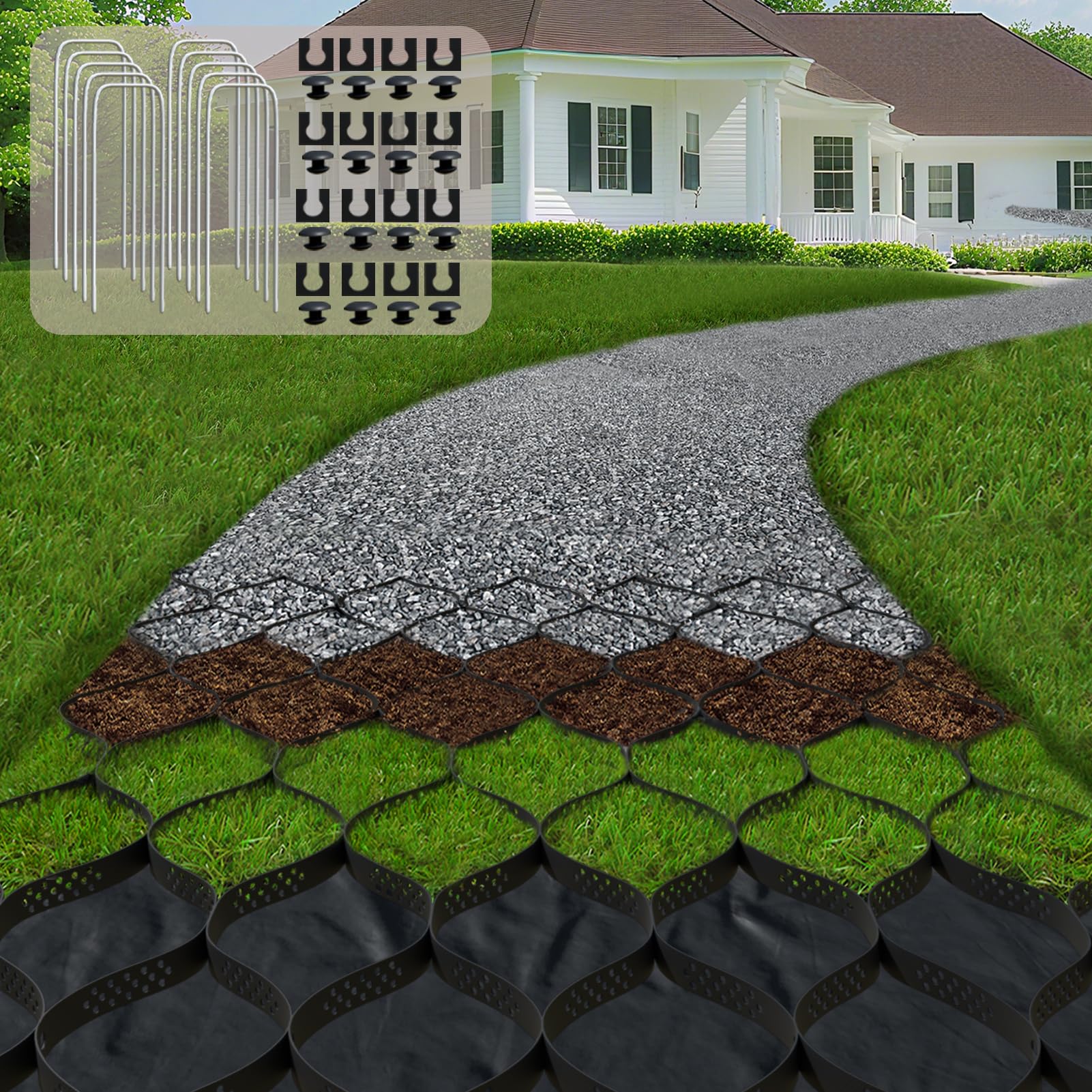
The MIWOOYY grid covers a smaller footprint — 6.5 by 16.5 feet — with the same 2-inch cell depth and an identical 1,885-pound-per-square-foot load rating. Each cell is a full 10 inches by 10 inches, slightly larger than the VEVOR, giving you slightly more room per cell for the gravel to settle. The HDPE construction is lightweight at 5 pounds per unit, making it easy to move into position for weekend DIY work.
Real-world use cases show this grid excels on slopes. Buyers report using it on steep hillsides for erosion control and as a base for pathways and garden pads. The 2-inch height is ideal for a shed base — deep enough to hold a proper layer of 3/4-inch crushed stone without wasting fill material. The foldable design expands like an accordion once you stake it into place.
The flimsiness of the raw sheet before filling is a consistent note in reviews. The grid needs aggressive staking with 6-inch metal staples every few feet to stay put while you pour gravel. Once filled and compacted, the structure becomes rigid. Several buyers on their third or fourth purchase confirm that the material lasts years with periodic re-mulching or re-graveling.
Why it’s great
- Large 10-by-10-inch cells lock gravel without migration
- Lightweight at 5 pounds — easy to transport and position
- Proven slope performance for erosion and shed base use
Good to know
- Requires many stakes initially to keep shape before gravel fill
- Some units shipped with cell walls that need manual opening
3. PioneerWorks Geotextile Landscape Fabric 4ft x 50ft

Before any gravel touches the ground, a geotextile separation layer is mandatory. The PioneerWorks fabric is a heavy-duty 6-ounce-per-square-yard non-woven material with a 350N tensile strength and a 440N load capacity rating. This is not standard weed-barrier cloth — it is engineered to prevent gravel from punching into soft subsoil while allowing water to drain through. The 4-foot width by 50-foot length gives you 200 square feet of coverage, enough for most medium shed bases.
The fabric is woven, not spun-bond, which gives it superior tear resistance compared to the thin membranes sold as landscape fabric at big-box stores. Users report struggling to drive landscape staples through it — that is a good sign because it means the material is dense enough to separate soil from gravel effectively. Water flows through the fabric readily, so it will not create a perched water table under your shed that leads to rot.
One important distinction: the 4-foot-wide version has a woven side and a non-woven side, unlike the 6-foot version. For shed base work, lay the woven side down against the soil and fill with gravel on top. The manufacturer states the material is designed for heavy-load construction like driveways and French drains, not for weed suppression. For a gravel shed base, this fabric ensures your stone layer stays clean and draining for decades.
Why it’s great
- 350N tensile strength withstands heavy loads without tearing
- Woven construction resists puncture from angular crushed stone
- High water permeability prevents drainage problems
Good to know
- 4-foot and 6-foot versions differ in weave — check before buying
- Not intended for weed suppression, only soil separation
4. NUPICK 10 Pound Gravel Rocks 0.5-0.7 Inch Polished Pebbles
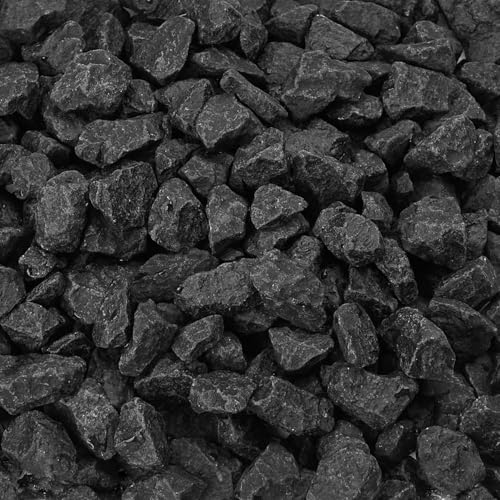
The NUPICK polished pebbles are not a structural base material. These are decorative river rocks, 0.5 to 0.7 inches in diameter, with smooth rounded surfaces. A 10-pound bag covers about 3 square feet at a thin layer — this is strictly for top-dressing over a compacted structural base if you want a finished look, not for the load-bearing layer itself. The color shifts from gray when dry to black when wet, which gives a nice aesthetic contrast around a shed perimeter.
Buyers praise the quantity-to-price ratio for decorative use around bird baths, planters, and fish tanks. For a shed base, these pebbles will not interlock. Under the weight of a shed, they will roll and shift, causing the structure to settle unevenly. They are a visual finish, not a foundation. If you use them, place them above the functional gravel layer after it is compacted and the shed is set.
The bags are fade-resistant and long-lasting as a decorative mulch. But for the structural layer of a shed base, you need angular crushed stone with fractured faces. Save these pebbles for the landscaping ring around the shed, not the base underneath it.
Why it’s great
- Attractive polished finish for top-dressing around shed perimeter
- Fade-resistant and long-lasting for decorative use
- Good value for the stone count per bag
Good to know
- Smooth pebbles do not interlock under compression
- Only 3 sq ft coverage per bag — needs many bags for a base
5. Concrete Floor Supply Epoxy Flake 5 lbs Creek Bed

The Concrete Floor Supply epoxy flakes are not gravel and they are not designed for a shed base. These are 1/4-inch decorative chips intended to be broadcast into 100% solids epoxy coatings on garage floors, basements, and dog kennels. A 5-pound box covers about 12% of a standard garage floor square footage when fully broadcast. The material is epoxy resin, not stone.
If you are building a gravel shed base, this product is irrelevant to that task. The chips are too small, too light, and too weak to bear any structural load. One buyer noted the flakes arrive in a plastic jar that prevents breakage — a nice detail for the intended use, but meaningless for foundation work. The product earns a strong reputation for garage floor aesthetics, but it belongs in an epoxy coating article, not a shed base guide.
This entry is included for completeness because the keyword space can sometimes attract buyers looking for decorative toppings. If you need a functional shed base, skip this product entirely. If you are finishing a concrete shed floor with a decorative epoxy coating, this is worth considering for the finish coat only.
Why it’s great
- Excellent quality for epoxy floor coating projects
- Comes in a protective jar that prevents chip breakage
- Large color selection for matching shed interior
Good to know
- Not gravel — epoxy resin chips cannot bear structural weight
- 1/4 inch size is too small for any foundation layer
FAQ
How deep should the gravel base be for a shed?
Can I use smooth river rock as my shed base?
Do I need a ground grid for a small garden shed?
What type of gravel is best for under a shed?
Final Thoughts: The Verdict
For most users, the gravel for shed base winner is the VEVOR Ground Grid because it eliminates the single biggest failure mode of gravel foundations: lateral spreading. The honeycomb grid locks every stone in place and handles 1,885 pounds per square foot, giving a shed a solid, permanent platform. If you prefer a simpler approach without a grid, pair the PioneerWorks Geotextile Fabric with 4 inches of compacted 3/4-inch crushed stone. And for steep or problematic sites, the MIWOOYY Ground Grid provides a slightly larger cell that handles slope erosion just as well as the VEVOR.