
Waking up to brown, patchy sections of lawn that peel back like a cheap rug signals one thing: hungry grubs have moved in. These C-shaped larvae feed on grass roots just below the surface, and by the time the damage is visible, the population has already reached destructive levels. Choosing the wrong treatment wastes time and leaves the turf vulnerable for the next hatch cycle.
I’m Mohammad Maruf — the founder and writer behind Drink4Good. I’ve spent years filtering through granular insecticide formulations, analyzing active ingredients like bifenthrin and carbaryl, and cross-referencing application coverage against real-world user results to find what actually stops soil-dwelling pests.
This guide cuts through the marketing noise to deliver targeted, research-backed recommendations so you can select a grub killer that matches your lawn size, pest pressure, and treatment philosophy without overpaying for ineffective products.
How To Choose The Best Grub Killer
Selecting a grub killer requires more than grabbing the brightest bag on the shelf. You need to match the active ingredient to the current life stage of the grub, consider whether you want a curative or preventive approach, and ensure the coverage rate fits the size of your turf. Ignoring these factors leads to wasted product and continued lawn damage.
Matching Active Ingredient to Grub Life Cycle
Curative grub killers rely on fast-acting chemicals like carbaryl or bifenthrin that kill grubs within hours of ingestion. These work best when grubs are actively feeding near the surface in late summer or early fall. Preventive products use slower-acting ingredients like halofenozide or imidacloprid that stop eggs from hatching, requiring application in early summer before grubs emerge.
Coverage Rate and Granule Distribution
Every bag specifies a square footage coverage range, but real-world results depend on even distribution. Larger bags covering 10,000 square feet or more require a broadcast spreader set to the correct flow rate to avoid hot spots. Spot treatments on visible damage zones can work for small infestations, but full-yard applications prevent grubs from migrating from untreated areas.
Environmental and Pet Safety Considerations
Chemical grub killers can affect beneficial soil organisms and non-target insects. Biological options like milky spore use a bacteria that targets only Japanese beetle grubs and leaves earthworms unharmed. If pets or children play on the lawn, look for products that specify safe re-entry intervals and avoid watering-in granules that could run off into storm drains.
Quick Comparison
On smaller screens, swipe sideways to see the full table.
| Model | Category | Best For | Key Spec | Amazon |
|---|---|---|---|---|
| Sevin Lawn Insect Granules | Chemical | Large-area curative treatment | 20 lb bag, 320 oz unit count | Amazon |
| Bifen Granules | Chemical | Perimeter barrier & ant control | 25 lb bag, bifenthrin 0.2% | Amazon |
| Ortho Bug B Gon Max | Chemical | Multi-pest lawn & garden protection | 10 lb bag, 10,000 sq ft coverage | Amazon |
| St. Gabriel Organics Milky Spore | Biological | Long-term Japanese beetle prevention | 10 oz powder, 2,500 sq ft | Amazon |
| Terro T901-2 Ant Killer Plus | Chemical | Small-area general insect control | 3 lb bag, 2-pack, granular | Amazon |
In‑Depth Reviews
1. Sevin Lawn Insect Granules, 20 Pounds

The Sevin Lawn Insect Granules deliver a hefty 20-pound payload of carbaryl, a fast-acting curative that works on contact with grubs actively feeding on grassroots. This bag covers large properties efficiently when used with a broadcast spreader, and the active ingredient penetrates quickly when watered in within 24 hours of application. Users consistently report visible dead patches turning green again within two weeks after treating severe infestations.
Unlike biological options that require weeks to build up, carbaryl provides knockdown within hours, making this choice ideal for homeowners who see sudden brown patches in late summer. The 320-ounce unit count also treats ornamentals and perimeter zones around the house, offering multi-surface protection.
The granular texture flows well through most drop and rotary spreaders without clogging, though some users note that applying directly around tree bases by hand works better for concentrated infestations. Reapplication may be necessary for heavy ant pressure, but for grub-specific damage, a single full-yard treatment typically breaks the cycle for the season.
Why it’s great
- 20-pound bag provides exceptional coverage for large lawns
- Carbaryl kills grubs on contact within hours of application
- Effective on ornamentals and home perimeter, not just turf
Good to know
- One reviewer reported no results, possibly from degraded product
- May require reapplication for persistent ant populations
2. Bifen Granules — 25 Pounds

The Bifen Granules pack 25 pounds of bifenthrin at 0.2% concentration, a synthetic pyrethroid that creates a long-lasting chemical barrier against grubs and surface-feeding insects alike. Professional landscapers and turf managers favor this formulation for its rain-resistant properties and residual activity that can suppress ant colonies and flea populations for up to three weeks per application. The sand-like granule texture spreads cleanly even in high humidity without clumping in the spreader hopper.
Users who apply this product twice per year — once in early spring and again in late summer — report near-complete elimination of visible ant mounds and grub damage throughout the growing season. The bifenthrin molecule binds tightly to organic matter in the soil, reducing runoff risk compared to more water-soluble alternatives. This chemical stability also means you can apply a lighter rate over large areas and still achieve effective control.
Because bifenthrin is toxic to aquatic life, it is critical to avoid overspray onto hardscapes that drain directly into storm sewers. The label specifies outdoor use only on lawns, turf farms, golf courses, and sports fields. For the average homeowner with a quarter-acre lot, one bag typically lasts two full treatment seasons if stored properly in a dry location.
Why it’s great
- 25-pound bag is the largest capacity, ideal for multi-acre properties
- Bifenthrin provides rain-resistant residual control lasting 3 weeks
- No odor and low dust during application
Good to know
- Highly toxic to fish — avoid runoff into drains and ponds
- Over-application reduces efficacy; use a calibrated spreader
3. Ortho Bug B Gon Max Insect Killer for Lawns

The Ortho Bug B Gon Max Insect Killer covers up to 10,000 square feet with a single 10-pound bag, making it one of the most coverage-efficient granular options for the mid-range price tier. This product targets over 100 listed insects including chinch bugs, fleas, ticks, and surface-feeding grubs, giving homeowners a single-tool solution for multiple lawn pests. The active ingredient works both above and below the soil surface, killing grubs chewing roots while also eliminating adult beetles that may be laying new eggs.
Long-term users report this product has kept their yards nearly tick-free for seasons, with anecdotal evidence of reduced tick attachment on pets after regular perimeter applications. The granules can be applied to lawns, ornamentals, vegetable gardens, and flower beds without damaging edible crops when used according to the label. This versatility reduces the need for separate products for different zones of the property.
For best grub control, apply the granules in late summer when newly hatched grubs are small and feeding near the surface, then water in immediately with at least half an inch of irrigation. The 10,000-square-foot coverage suits a typical suburban lot, but larger properties may need two bags for complete perimeter plus lawn treatment. Some users note that ant colonies may require a second application after the initial knockdown.
Why it’s great
- Kills over 100 listed insect types in one application
- Safe for use on vegetable gardens and flower beds
- 10,000 sq ft coverage fits standard suburban lots perfectly
Good to know
- Ant mounds may require a second treatment for full control
- Some retailers offer lower prices, so shop around
4. St. Gabriel Organics Milky Spore Powder, 10oz
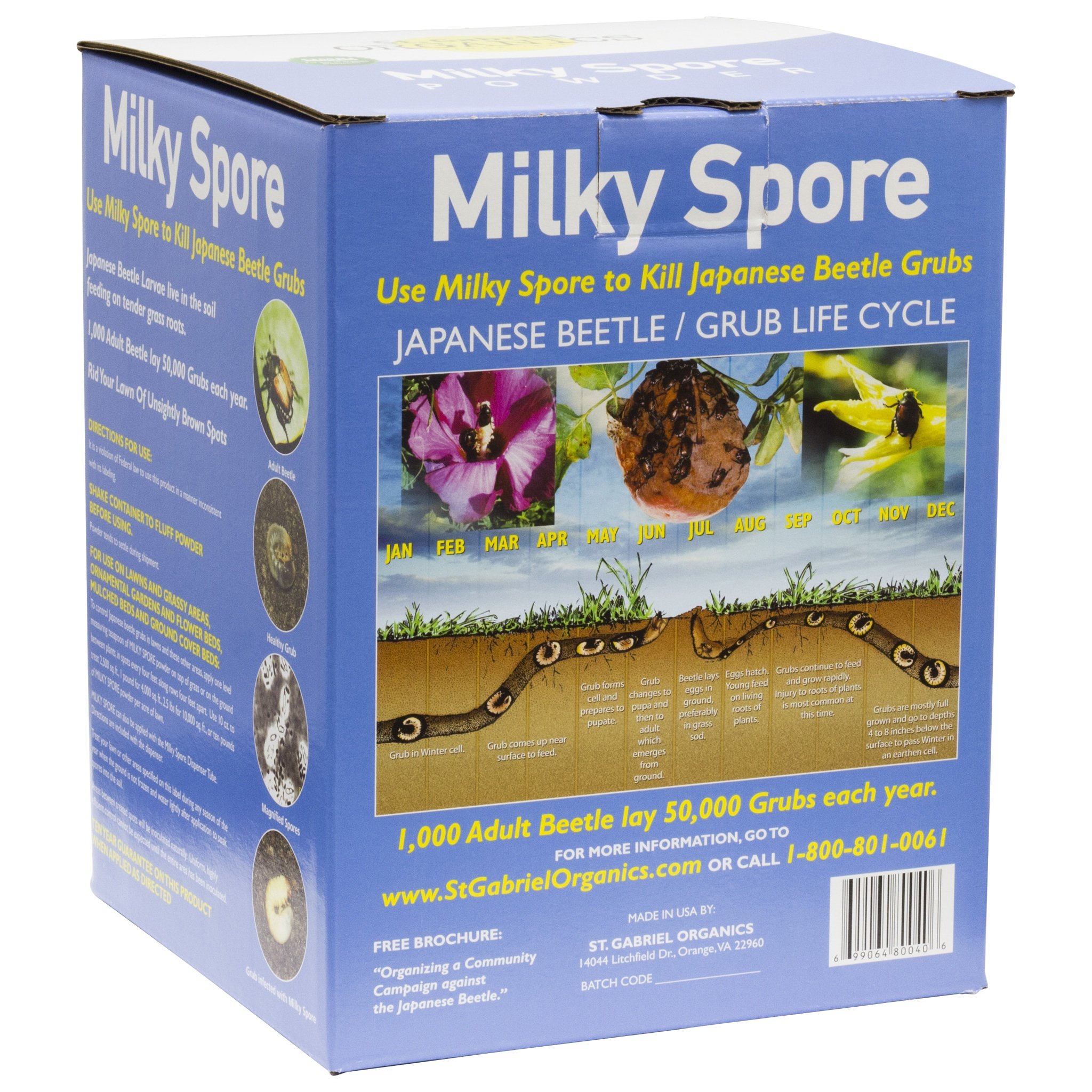
St. Gabriel Organics Milky Spore Powder takes a fundamentally different approach to grub control by introducing Bacillus popilliae, a naturally occurring soil bacterium that infects Japanese beetle grubs and causes them to turn milky white before dying. Once established, the spores persist in the soil for years, providing continuous suppression without annual reapplication. This biological method leaves earthworms, beneficial insects, and pets completely unharmed.
The application process requires patience — one teaspoon of powder placed every four feet along rows, watered in when soil temperatures exceed 50°F. Grubs become infected as they ingest the spores while feeding, and the dead grubs release billions of new spores back into the soil. Users report seeing the classic milky-white appearance in dead grubs within one to two weeks of application, and test patches of dead grass often begin regrowing in about a week.
Unlike chemical killers that provide instant knockdown, milky spore takes one to two full seasons to build to maximum effectiveness. This product works best as a preventive strategy for neighborhoods with recurring Japanese beetle problems. The 10-ounce bag covers 2,500 square feet, making it suitable for targeted treatment areas rather than whole-lawn applications for those on a budget.
Why it’s great
- Safe for pets, children, and beneficial insects like earthworms
- Self-sustaining spore cycle eliminates need for annual reapplication
- Environmentally responsible alternative to synthetic chemicals
Good to know
- Requires 1-2 seasons to reach full effectiveness
- Only targets Japanese beetle grubs, not all grub species
- No printed instructions included — check online for application details
5. Terro T901-2 Ant Killer Plus Insect Control, 3lb Bags (2-Pack)

The Terro T901-2 Ant Killer Plus provides a compact solution in a 2-pack of 3-pound resealable shaker bags, ideal for spot-treating ant hills and creating a band treatment around the home foundation. The fast-acting granules kill crawling insects within 24 hours of application and eliminate the need for a broadcast spreader — the shaker bag design allows for targeted application directly from the container. This granular formulation targets ants, fire ants, cockroaches, and fleas, making it a versatile option for perimeter pest control.
Users in Maryland and Delaware report that annual application around the house and tiny home structures completely eliminates ant activity for the season. The resealable bag keeps granules dry between uses, allowing for multiple spot treatments without waste. This product works best when applied as a barrier strip around the foundation and as a direct mound treatment for visible colonies.
Because the bag is smaller than full-lawn products, it is not designed for whole-lawn grub coverage. One user reported reduced effectiveness in a second year, possibly from an older batch, so checking the manufacture date before applying is recommended. For homeowners dealing with ant hills near the house rather than widespread lawn grub damage, this entry-level option provides a targeted, low-commitment solution.
Why it’s great
- Resealable shaker bags allow precise application without a spreader
- Kills ants, fleas, and cockroaches within 24 hours
- 2-pack provides good value for small property treatments
Good to know
- Small bag size limits coverage to spot treatments and perimeters
- Check manufacture date — older stock may show reduced efficacy
FAQ
How long does grub killer take to show visible results?
Should I apply grub killer before or after rain?
Can I use milky spore and chemical grub killer together?
Final Thoughts: The Verdict
For most users, the grub killer winner is the Sevin Lawn Insect Granules because its 20-pound carbaryl payload delivers fast curative action across large lawns with a single treatment. If you want a self-sustaining biological system that works for years, grab the St. Gabriel Organics Milky Spore Powder. And for professional-grade residual control on multi-acre properties, nothing beats the Bifen Granules in the 25-pound bag.