
Finding a gift that truly connects with a loved one experiencing memory loss or cognitive decline is a challenge. You want something that brings comfort, reduces agitation, and provides a sense of purpose without feeling childlike or overwhelming. The wrong choice can lead to frustration or disinterest, while the right one can unlock moments of calm and engagement.
I’m Mohammad Maruf — the founder and writer behind Drink4Good. I research therapeutic and adaptive products for seniors, analyzing how specific textures, visual cues, and cognitive loads affect engagement and anxiety levels in dementia care.
The most effective options combine familiar activities with sensory feedback to reduce restlessness and spark joy. This guide highlights the best gifts for dementia patients, focusing on items that prioritize safety, ease of use, and genuine therapeutic value for every stage of the condition.
How To Choose The Best Gifts For Dementia Patients
The best gifts for dementia patients prioritize safety and emotional well-being over novelty. Since cognitive abilities vary widely, you must focus on items that reduce anxiety, encourage gentle physical interaction, and do not require complex instructions. A successful gift meets the user exactly where they are, without forcing learning or new skills.
Prioritize Sensory Calming Over Mental Challenges
Many gifts marketed to seniors emphasize “brain games” or puzzles. For someone with dementia, especially mid-to-late stage, complex cognitive tasks can cause frustration and agitation. Instead, look for items that rely on tactile feedback—soft textures, smooth zippers, Velcro, or ribbons. These repetitive, soothing motions lower cortisol levels and provide a non-verbal outlet for nervous energy.
Check for Safety and Durability
Safety is non-negotiable. Avoid gifts with small parts that could become choking hazards or sharp edges. Items used in bed or in a chair should be made of soft, non-toxic materials and should be securely sewn or assembled. A dementia-friendly gift should also be easy to clean, as spills are common. Look for products often used in nursing homes, as those are designed to withstand constant use and strict hygiene protocols.
Match the Gift to the Stage of Dementia
An early-stage patient might enjoy a large-print clock that reduces disorientation about the time of day. A mid-stage patient often benefits from a fidget blanket or book that occupies their hands and reduces the urge to pick at clothing. A late-stage patient needs very simple, high-contrast visual stimulation and soft textures that feel safe. A single gift may not work for all stages, so consider the current behavior patterns like restlessness, wandering, or apathy.
Quick Comparison
On smaller screens, swipe sideways to see the full table.
| Model | Category | Best For | Key Spec | Amazon |
|---|---|---|---|---|
| Odoxia Fidget Book | Fidget Book | Anxiety relief & tactile stimulation | 18 pages of sewn sensory activities | Amazon |
| Mitoart Dementia Clock | Digital Clock | Orientation to time, day, and date | Voice announcement of time | Amazon |
| Pastigio Digital Clock | Digital Clock | Reducing sundowning confusion | 5 time-of-day phase indicators | Amazon |
| Keeping Busy Coloring Kit | Activity Set | Gentle cognitive engagement | Large print color-by-number pages | Amazon |
| SXLHKJL Fidget Blanket | Sensory Mat | Portable lap activity & warming | 18-in-1 activities, 19.7″x12″ lap size | Amazon |
In‑Depth Reviews
1. Odoxia Fidget Book for Elderly

The Odoxia Fidget Book is built like a fabric book with a variety of tactile challenges sewn directly onto each page. Instead of requiring reading or puzzle-solving, it offers zippers, buttons, snaps, ribbons, and textured patches that invite the hands to explore. This format is especially effective for someone with mid-stage dementia who needs a focal point to prevent wandering or picking at clothing.
Customer reviews from caregivers highlight that the different difficulty levels are a real asset. Simple tasks like pulling a zipper are mixed with more complex ones like braiding or buttoning. One reviewer caring for a 101-year-old patient noted hours of engagement. The book also includes Velcro items that can be repositioned, adding a layer of open-ended play without instructions.
At 0 pounds, 15.8 ounces, the book is lightweight but substantial enough to stay put on a lap or tray. The felt construction is soft and quiet, making it suitable for shared living spaces. However, the Velcro pieces are glued onto the pages rather than sewn, which some users note can be pulled off by an aggressive user. Supervision is advised for those prone to putting objects in their mouth.
Why it’s great
- Variety of tactile activities suits different attention spans
- Quiet, soft felt construction ideal for shared spaces
- Encourages fine motor skill practice without frustration
Good to know
- Velcro pieces are glued on, not sewn—potential choking risk
- Some tasks may be too difficult for severe arthritis
2. Mitoart Dementia Digital Alarm Clock
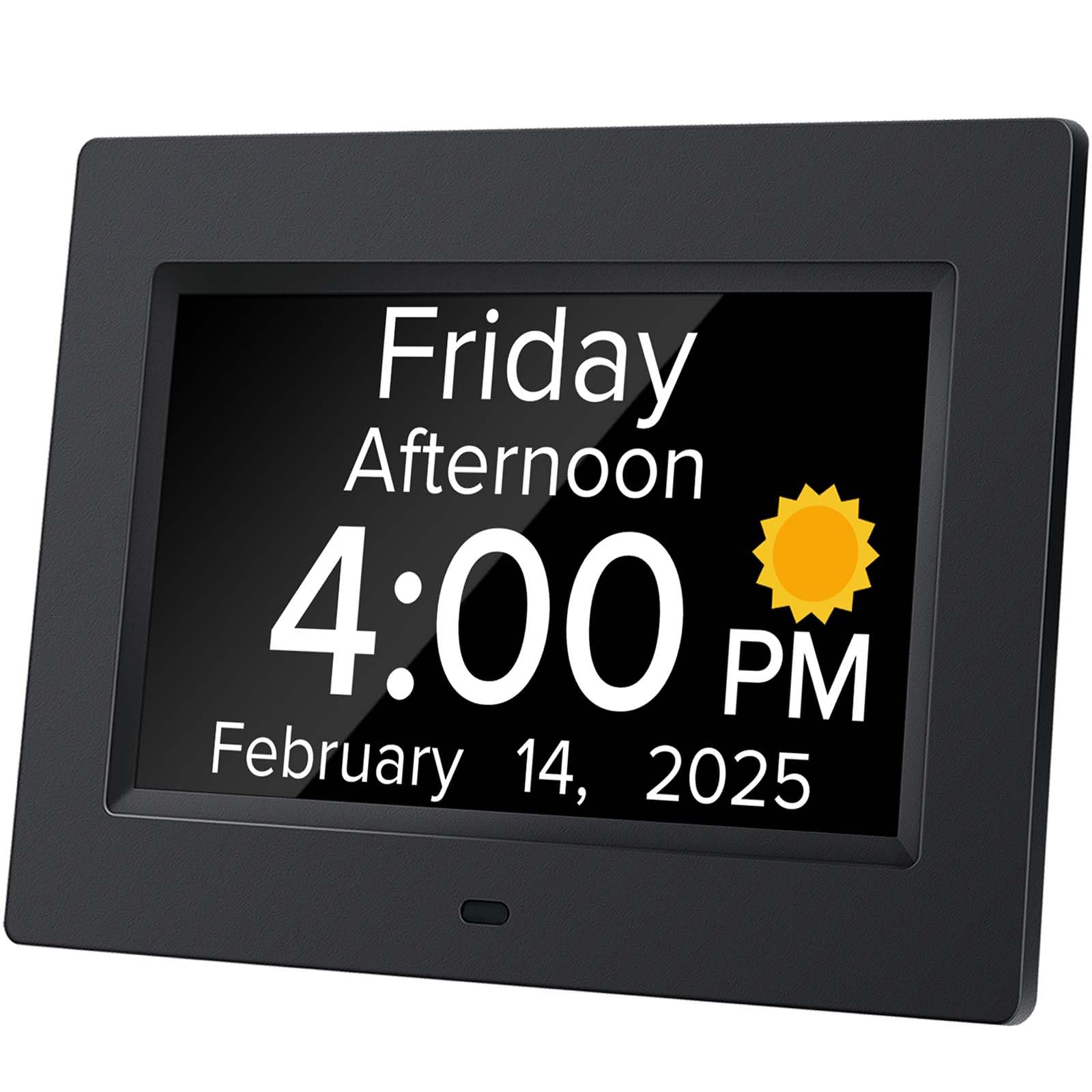
The Mitoart clock is all about orientation. Its 7-inch digital screen shows the day of the week, the full date, and the time in large, bold characters. For someone who wakes up confused about whether it is morning or night, this provides an immediate anchor. The voice announcement feature is a standout—tapping a button on the back or the remote speaks the time aloud, which is invaluable for those with significant vision loss.
Caregivers report that the automatic dimming function is a practical lifesaver. At 7:00 PM the display dims to 50 cd/m², preventing the bright light from disrupting sleep, and at 7:00 AM it brightens to 250 cd/m² for daytime clarity. This removes the need for the user to adjust settings as the day transitions. The multiple alarm settings also allow for gentle reminders for medication or meals.
The clock has a simple, intuitive interface with no front buttons, which prevents the user from accidentally changing the time or alarm settings. Setup is handled via a small remote control, which a family member can configure and then hide if needed. At just under a pound, it sits solidly on a nightstand. One caveat: the clock does not include batteries for the backup function, and a non-standard battery is required.
Why it’s great
- Large, bold text eliminates confusion about day and date
- Voice announcement aids those with low vision
- Auto-dimming prevents sleep disruption
Good to know
- Requires a specific non-standard battery for backup
- Display color is basic black and white—no color themes
3. Pastigio Dementia Clock With Time-of-Day Indicators
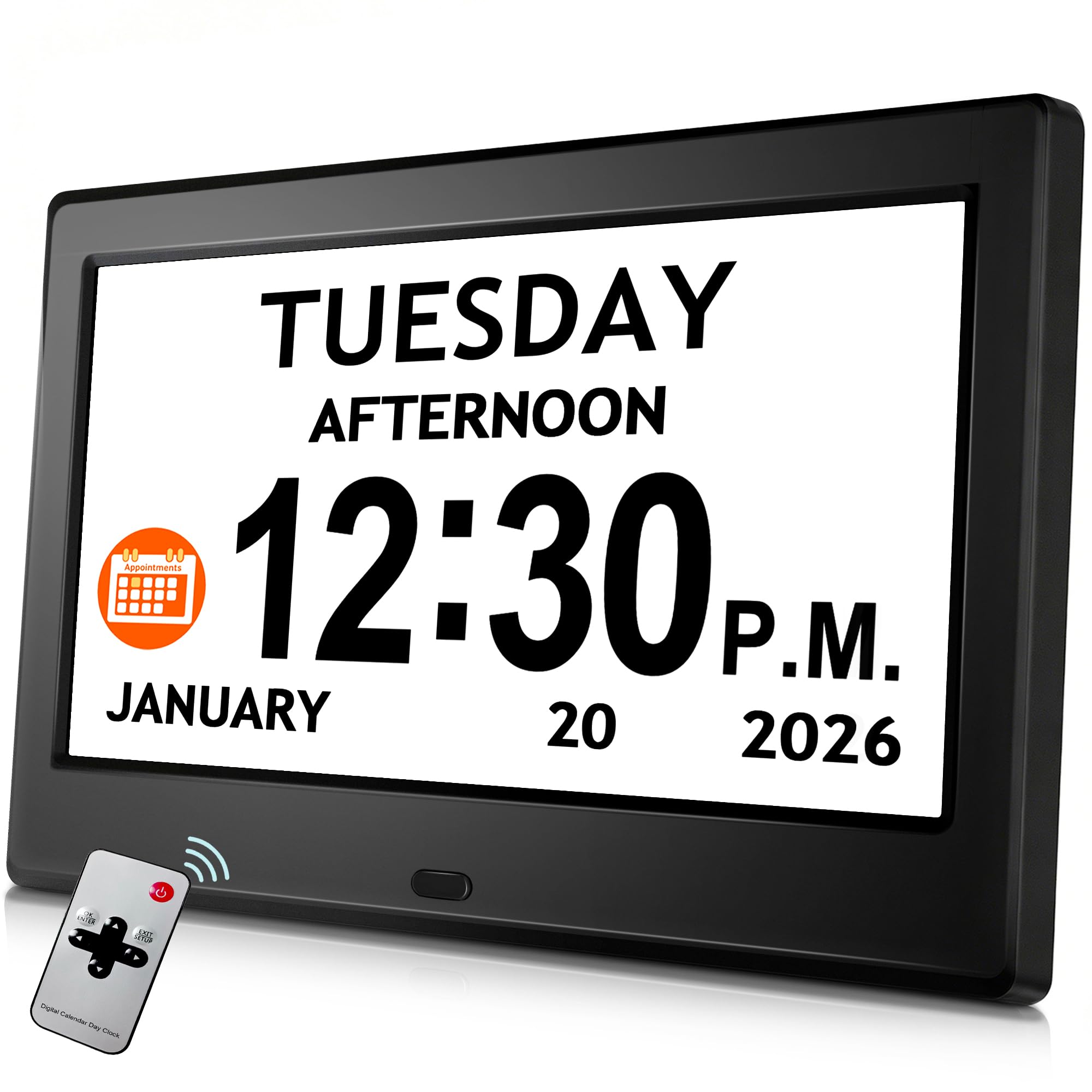
The Pastigio clock takes orientation a critical step further. Instead of just showing “10:00 AM,” it divides the day into five distinct phases: Before Dawn, Morning, Afternoon, Evening, and Night. This visual categorization directly addresses sundowning syndrome—a common symptom where a dementia patient becomes agitated or confused in the late afternoon and evening. The 7-inch IPS display at 1024×600 resolution is incredibly crisp and readable from any angle.
Beyond the time-of-day feature, this clock acts as a comprehensive daily assistant. It holds six custom alarms and ten daily reminders, each with visual icons for medication, hydration, and sleep. The 5 adjustable volume levels and 5 tones mean you can set a gentle chime rather than a jarring alarm. The auto-brightness and automatic Daylight Saving Time updates ensure the clock remains accurate and comfortable without any effort from the user.
Setup is flexible via onboard buttons or a remote control, and you can mount it on the wall using the built-in keyhole. The clock supports 8 languages and 5 display themes, allowing you to customize the color scheme to something that feels familiar. Some users noted a minor software glitch with month spelling that was patched, but overall the reliability is strong. It requires constant AC power, so placement near an outlet is necessary.
Why it’s great
- Time-of-day phases directly combat sundowning confusion
- High-resolution IPS screen is readable from wide angles
- Multiple reminders with icons for medication and hydration
Good to know
- Must be plugged into AC power at all times
- Initial month spelling bug required a firmware fix
4. Keeping Busy Coloring Kit for Dementia
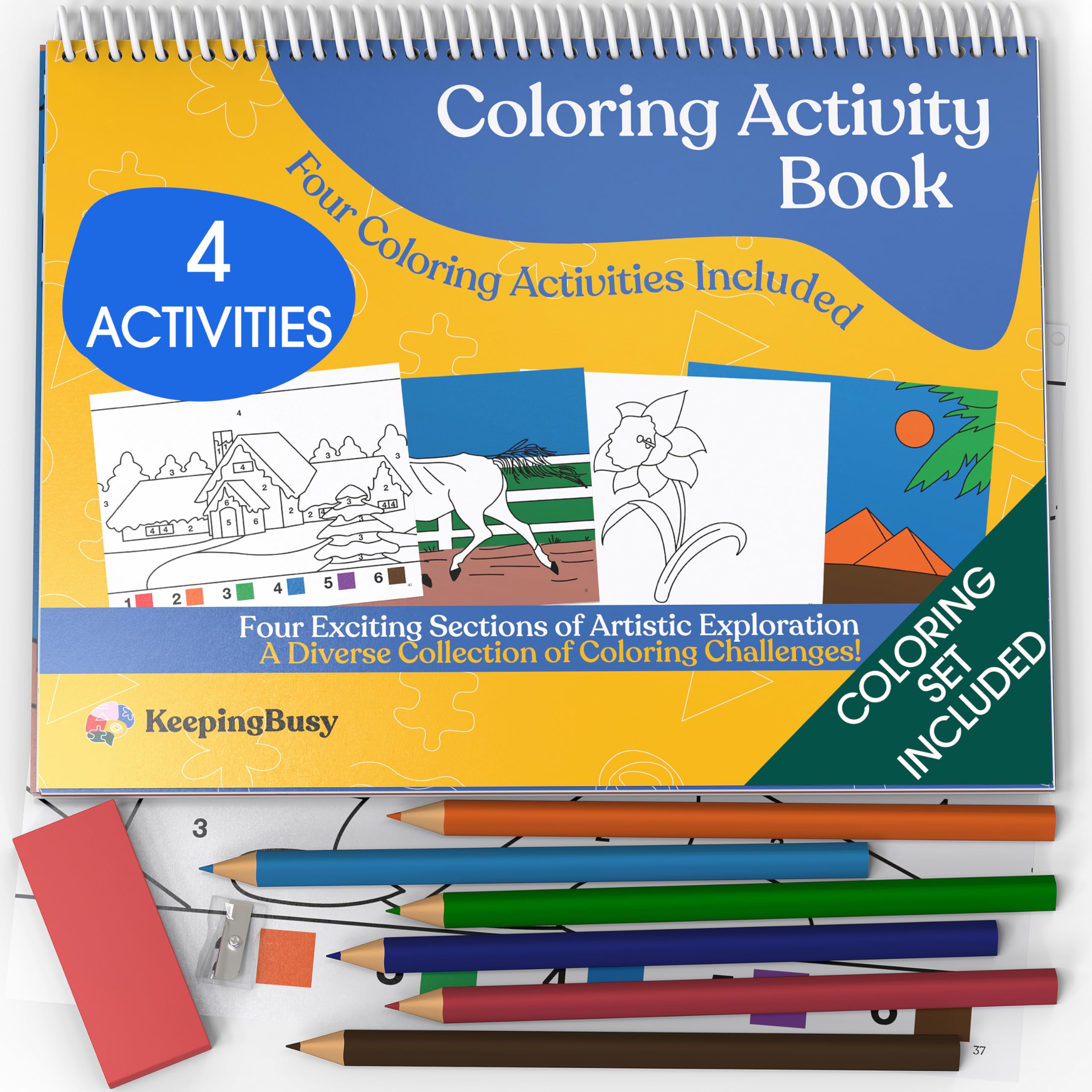
The Keeping Busy Coloring Kit is specifically designed for dementia patients who still enjoy visual creativity but need a low-cognitive-load activity. The kit includes four different activity types: guided coloring, color-by-number, free coloring, and a matching activity. The large-print pages (8.5 x 11 inches) are printed on thick, durable paper with a spiral binding that lies flat, making it easy for shaky hands to manage.
What sets this kit apart is the built-in visual guide. Each page has a small inset showing the correct color scheme, so the user does not have to guess or feel pressured to make artistic decisions. This eliminates the anxiety of “getting it wrong.” The included six colored pencils are thicker than standard ones, which helps those with grip weakness or arthritis hold them more comfortably.
Caregivers report that the act of matching pencil colors to numbered sections provides a gentle cognitive workout without causing frustration. One reviewer noted that her mother with Alzheimer’s and limited vision could still complete pages because the outlines are bold and clear. The kit is made in the USA and is lightweight at 0.58 kg. The main limitation is that some pencil colors do not perfectly match the printed key, causing minor confusion.
Why it’s great
- Large, thick pages with spiral binding for easy handling
- Pre-colored reference images reduce decision fatigue
- Thicker colored pencils aid those with weak grip
Good to know
- Color of pencils does not always match the numbered key
- Limited to 6 pencils—may need replacements over time
5. SXLHKJL 18-in-1 Fidget Blanket

The SXLHKJL Fidget Blanket is a lap-sized sensory mat designed to keep restless hands busy while also providing warmth and comfort. Measuring 19.7 by 12 inches unfolded, it drapes perfectly over a wheelchair, bed, or armchair. The non-slip bump velvet backing keeps it anchored on the lap, which is a thoughtful detail for a person who may not have the strength or awareness to hold a smaller object.
The “18-in-1” refers to a mix of tactile elements including fingertip zippers, shoelaces for tying practice, buttons, buckles, Velcro strips, ribbons, and a section of colorful sequins. One of the most engaging features is a clear photo pocket where you can insert a family picture. This turns the blanket into a memory trigger, prompting positive storytelling and emotional connection. The colors are deliberately calming—blues and neutrals—to avoid over-stimulation.
Safety is clearly a design focus: all components are hand-sewn to prevent them from being swallowed. The material is soft and skin-friendly. Customer feedback shows that it significantly reduces the urge to pull at bed sheets or clothing. However, some users note that certain pieces can still be pried off by a determined user, so initial supervision is recommended. The blanket is hand-wash and lay-flat dry only.
Why it’s great
- Lap-sized with non-slip backing stays in place on wheelchair
- Includes a family photo pocket for emotional memory trigger
- Hand-sewn components reduce choking hazard risk
Good to know
- Hand-wash only—not machine washable
- Some pieces may still be detachable for aggressive users
FAQ
What activities calm a dementia patient the quickest?
How do I stop a dementia patient from pulling off fidget pieces?
Final Thoughts: The Verdict
For most users, the best gifts for dementia patients winner is the Odoxia Fidget Book because it offers the broadest range of safe, quiet, and engaging tactile activities in a durable format that suits both mid and late-stage dementia. If you want a tool to reduce sundowning confusion, grab the Pastigio Clock. And for a warm, comforting lap pad that also triggers positive memories, nothing beats the SXLHKJL Fidget Blanket.