
That subtle vibration ruining a perfect tracking shot or the constant re-balancing when swapping lenses are the twin frustrations every mirrorless shooter knows. A gimbal that doesn’t disappear into the workflow—letting you focus on the composition and movement rather than fighting the hardware—transforms handheld footage from usable to cinematic.
I’m Mohammad Maruf — the founder and writer behind Drink4Good. I’ve spent years analyzing motor torque curves, payload margins, and battery chemistry across hundreds of stabilizer configurations to separate genuine engineering from marketing noise.
After stress-testing payload limits, axis-lock precision, and real-world battery endurance, these are the stabilizers that consistently deliver smooth results without the frustrating setup overhead. This guide breaks down the best gimbal for mirrorless camera options across different budgets and shooting styles.
How To Choose The Best Gimbal For Mirrorless Camera
Mirrorless cameras sit in a tricky middle ground—lighter than full-frame DSLRs but heavier than compact point-and-shoots, with lens combos that often push past advertised payload limits. Choosing the wrong stabilizer means either insufficient motor strength or carrying unnecessary bulk. Here are the key factors that separate a smart purchase from a frustrating one.
Payload Capacity and Motor Torque
Listed payload figures are optimistic maximums measured at ideal balance, not real-world operating limits. A mirrorless body with a 24-70mm f/2.8 zoom, a cage, and an external microphone can easily exceed 2.5 kg. A gimbal motor that struggles to hold position during rapid pans or uphill tilts produces micro-jitters that are nearly impossible to fix in post. Look for a 20–30% headroom above your heaviest expected setup, especially if you plan to add accessories like fill lights or wireless transmitters.
Axis Locks and Balancing Speed
Every time you swap lenses or change a battery, the balance shifts. Axis locks that physically secure each motor arm during transport and allow you to unlock and balance one axis at a time cut setup time from minutes to seconds. Sliding balance plates with memory markers let you return to a previously dialed-in configuration without redoing the entire process. This matters most on run-and-gun shoots where conditions change every few minutes.
Quick Comparison
On smaller screens, swipe sideways to see the full table.
| Model | Category | Best For | Key Spec | Amazon |
|---|---|---|---|---|
| FeiyuTech SCORP 2 | Mid-Range | AI tracking on a budget | 2.5 kg payload, built-in AI sensor | Amazon |
| DJI RS 4 Mini Combo | Mid-Range | Lightweight run-and-gun | 2 kg payload, auto axis locks | Amazon |
| Zhiyun Crane M3S | Mid-Range | Compact hybrid shooting | 705 g weight, built-in fill light | Amazon |
| ZHIYUN CINEPEER Weebill 3E | Mid-Range | Long battery life shoots | 3 kg payload, 16-hour battery | Amazon |
| DJI RS 4 | Premium | Professional mirrorless rigs | 3 kg payload, Teflon axis arms | Amazon |
| ZHIYUN Crane 4 | Premium | Full-frame and cinema cameras | 3 kg payload, 10W integrated fill light | Amazon |
| DJI RS 4 Pro Combo | Premium | Cinema camera stabilization | 4.5 kg payload, LiDAR focus module | Amazon |
| FeiyuTech SCORP-C | Budget | Entry-level mirrorless stabilizer | 2.5 kg payload, 13-hour battery | Amazon |
| FeiyuTech SCORP Mini-3-Pro | Budget | Multi-device content creators | 2 kg payload, detachable remote handle | Amazon |
In‑Depth Reviews
1. FeiyuTech SCORP 2

The SCORP 2 punches well above its price class by integrating an AI tracking module directly into the gimbal body—no clip-on sensors or smartphone tethering required. Making an OK gesture activates subject tracking that holds remarkably well during walking and moderate running shots. The 1.3-inch touchscreen provides quick access to motor strength and follow speed settings without diving into the app.
Instant vertical filming via the L-shaped mounting plate is a genuine time-saver for social media content. The scorpion tail handle design with fold-out legs lets you set the gimbal down on any flat surface without a tripod, which is surprisingly useful for solo timelapses or group photos. Battery runtime comfortably covers a full event day.
Setup requires a patient first attempt—the manual could be clearer about the five-way center-of-gravity adjustment process. Once balanced, the sliding memory markers make lens swaps painless. The multifunction control knob handles both axis rotation and electronic zoom, though the tactile feedback feels slightly vague compared to DJI’s joystick implementation.
Why it’s great
- Built-in AI tracking works without extra accessories
- Fold-out legs provide stable tripod-free setup
- L-shaped plate enables fast vertical shooting
Good to know
- Initial balancing instructions could be more detailed
- Multifunction knob feels less precise than dedicated joysticks
- 2500 mAh battery falls short of the 13-hour claim under heavy use
2. DJI RS 4 Mini Combo

DJI’s RS 4 Mini Combo brings auto axis locks that were previously reserved for larger rigs down to a sub-1 kg body. Press the power button and the motors unlock in sequence, cutting setup from fumbling with manual switches to a single second. The Teflon-enhanced balance arms slide with noticeably less friction than earlier Mini models, making fine-tuning fast.
The intelligent tracking module uses face detection that works reliably with a single subject, though it lacks the hand or animal tracking modes found on DJI’s Pro line. Responsive Follow Mode translates hand movements into immediate gimbal reactions, ideal for orbit shots around a static subject. A 10-second switch from horizontal to vertical framing keeps social media workflows efficient.
The non-replaceable battery is the main trade-off for the compact form factor—once it degrades after a few years, the entire unit requires replacement. Bluetooth and wired camera control cannot operate simultaneously, so monitoring and control must share one channel. For lightweight mirrorless bodies like the Canon R50 or Sony ZV-E10, this combo delivers premium stabilization in a genuinely travel-friendly package.
Why it’s great
- Auto axis locks enable sub-second setup
- Teflon-coated arms provide ultra-smooth balancing
- Compact and lightweight for travel
Good to know
- Battery is non-replaceable
- Bluetooth and wired control cannot run simultaneously
- Tracking module lacks animal and vehicle modes
3. Zhiyun Crane M3S

At 705 grams, the Crane M3S is among the lightest full-featured gimbals that still handles a mainstream mirrorless body. The all-in-one design accommodates not just cameras but also smartphones and action cameras through included adapters, making it a versatile tool for creators who switch between devices. Bluetooth shutter control eliminates cable clutter for basic start/stop and zoom functions.
The built-in fill light provides adjustable color temperature from 2700K to 5500K with a maximum output of 2000 lux—sufficient for close-up interviews or product detail shots without carrying a separate LED panel. The 1.22-inch color screen offers quick access to follow modes, motor parameters, and timelapse settings. PD fast charging reaches full capacity in about two hours.
The tilt-axis height adjustment mechanism can shift slightly when tightened, requiring a few extra seconds to lock in place. The payload limit works best with lightweight prime lenses rather than heavy f/2.8 zooms. Some users report the motor strength feels marginal when adding accessories like an on-camera microphone to a standard combo.
Why it’s great
- Extremely lightweight at 705 g
- Built-in fill light eliminates an extra accessory
- Bluetooth shutter control reduces cable clutter
Good to know
- Tilt-axis adjustment can shift during tightening
- Motor torque is marginal with heavy lens combos
- Limited stabilized movement range compared to larger gimbals
4. ZHIYUN CINEPEER Weebill 3E

The Weebill 3E offers a 3 kg payload capacity—enough to handle a full-frame mirrorless with a 24-70mm f/2.8 zoom comfortably—while remaining under 1 kg itself. Native vertical shooting is achieved by mounting the quick-release plate directly onto the vertical arm without disassembling the gimbal structure, a design choice that saves significant time on social media-heavy productions.
The 16-hour battery life claim holds up well in real-world mixed shooting, easily surviving a full event day without recharging. The 2.5 Sling Mode reduces arm fatigue during low-angle shots by shifting the center of gravity to a wrist rest and telescopic grip. The handle is contoured to fit the palm naturally, with silicone texture providing a secure hold even in humid conditions.
Prospective buyers should note that the package only includes a Panasonic control cable—Canon, Sony, and Nikon users must purchase cables separately, an uncommon omission at this price point. The record button on the gimbal triggers autofocus on Sony bodies even when the lens is set to manual focus, a quirk that may require a workaround through the camera menu.
Why it’s great
- 3 kg payload handles full-frame mirrorless kits
- 16-hour battery covers all-day shoots
- Native vertical shooting without extra accessories
Good to know
- No included control cables for Canon, Sony, or Nikon
- Record button may force autofocus on some Sony bodies
- Sling grip and wrist rest sold separately
5. DJI RS 4

The RS 4 refines DJI’s proven platform with Teflon-coated axis arms that reduce friction during balancing, making fine adjustments feel noticeably smoother than the RS 3 series. The 3 kg payload comfortably supports heavy mirrorless combos like a Sony A7S III with a 24-70mm f/2.8 and a wireless receiver. The extended tilt axis adds 8.5 mm of clearance, opening up more lens options without bumping the motor.
The 2nd-gen vertical shooting plate releases and locks into position without removing the camera from the gimbal, a workflow improvement over the original design. The joystick mode switch lets you toggle between gimbal control and zoom control without diving into the menu. RSA communication port allows connection to DJI’s Tethered Control Handle or third-party accessories for customized rig setups.
The 12-hour battery is sufficient for most single-day shoots, but the optional BG70 grip—which extends runtime to 29.5 hours—adds significant cost. Some users report the plastic extended grip/tripod feels less durable than the metal version included with the Pro model. The Ronin app must be downloaded from DJI’s website rather than Google Play, an extra step that can confuse first-time users.
Why it’s great
- Teflon-coated arms make balancing ultra-smooth
- Extended tilt axis provides more lens clearance
- RSA port opens up extensive accessory ecosystem
Good to know
- High-capacity battery grip sold separately
- Included tripod is plastic rather than metal
- Ronin app not available on Google Play
6. ZHIYUN Crane 4

The Crane 4 was designed with cinema cameras in mind—its longer arm length and stronger motors easily handle bodies like the Blackmagic Pocket Cinema Camera 6K Pro with a cage and side handle, a setup that overwhelms most consumer gimbals. Balance indicator lights on each motor turn green when properly balanced, removing the guesswork from a process that intimidates many shooters.
The integrated 10W fill light is the standout feature, delivering 3200 lux at full power with a CRI of 95+ for accurate color reproduction. The color temperature adjusts from 2700K to 5500K, covering most indoor and outdoor scenarios without needing a separate LED panel. Bluetooth control pairs reliably with most popular camera models, and the 1.22-inch touchscreen provides intuitive access to motion timelapse settings and motor parameters.
At 1.5 kg, the Crane 4 is noticeably heavier than comparable mid-range gimbals, and it lacks a true two-hand operation mode without attaching a separate ring or vest system. PD fast charging reaches full capacity in under two hours, but a full charge lasts only about 12 hours in moderate use. The vertical shooting mode requires more steps than the quick-release designs found on DJI’s latest models.
Why it’s great
- Strong motors handle cinema camera rigs
- Balance indicator lights simplify setup
- 10W fill light with high CRI and adjustable temperature
Good to know
- Heavier than most mid-range gimbals
- Vertical shooting requires more steps than competitors
- Two-hand operation requires additional accessories
7. DJI RS 4 Pro Combo
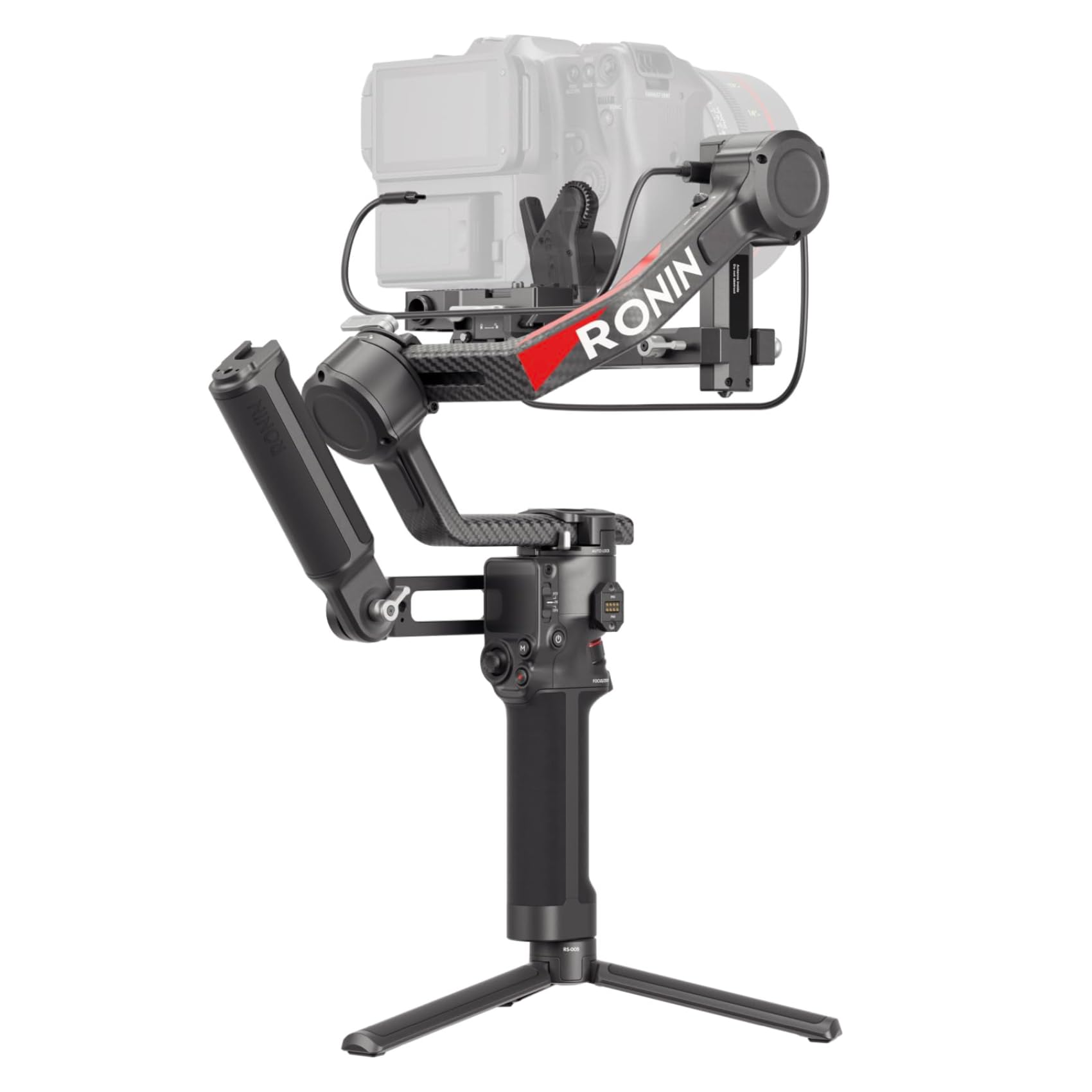
The RS 4 Pro Combo is the most capable handheld stabilizer DJI produces for mirrorless and compact cinema cameras. The 4.5 kg payload handles full cinema rigs like a Sony FX6 with a zoom lens and accessories, while the carbon fiber axis arms keep the weight manageable at 1.84 kg. Motor torque increased by 20 percent over the RS 3 Pro, providing the headroom needed for rapid whip pans and dutch angles without motor strain.
The Focus Pro LiDAR module projects 76,800 ranging points within 20 meters, enabling autofocus on manual cinema lenses—a feature that alone justifies the price for indie filmmakers using vintage glass. The Ronin Image Transmitter allows a separate operator to control gimbal movement and camera parameters from up to 200 meters away, essential for multi-camera productions. The combo includes the Focus Pro Motor, rod mount kit, and gear strip, so manual lenses can be added right out of the box.
The learning curve is steeper than any other gimbal on this list—configuring the LiDAR focus, image transmission, and motor settings takes multiple sessions to master. The high price limits this to serious professionals or rental houses. Some users report mechanical issues with the tilt axis that necessitate shipping the unit for repairs, and international shipping costs can be prohibitive.
Why it’s great
- 4.5 kg payload handles cinema cameras
- LiDAR module enables autofocus on manual lenses
- Image transmitter supports remote dual-operator control
Good to know
- Steep learning curve for advanced features
- Premium price limits accessibility
- Some users report tilt axis mechanical issues
8. FeiyuTech SCORP-C

The SCORP-C delivers a surprising amount of hardware for its entry-level price point. The three-axis motor locks keep the arms securely in place during transport, and the five-way center-of-gravity adjustment system with a memory slider makes lens swaps fast once the initial balance is set. The 2.5 kg payload covers most mirrorless and DSLR combos, including heavier bodies like the Canon 5D Mark IV.
The integrated hanging handle with beveled edges fits the palm comfortably and supports both upright and underslung shooting angles. The 2500 mAh battery delivers up to 13 hours of runtime according to the manufacturer, though real-world use with heavy setups and active tracking modes reduces that to around 8–10 hours. 18W fast charging provides an extra 30 minutes of runtime from just five minutes of charging.
The setup process is the main hurdle—the included instructions are sparse, and the lack of official YouTube tutorials makes the first balance attempt frustrating for beginners. The grip buttons can feel unresponsive under certain angles, requiring a firm press. The charging time to full capacity exceeds five hours, which is slow compared to the PD fast charging found on more recent models.
Why it’s great
- Solid metal build for a budget-friendly price
- Five-way balance adjustment with memory slider
- Integrated hanging handle for low-angle shooting
Good to know
- Setup instructions are unclear for beginners
- Full charge takes over five hours
- Grip buttons can feel unresponsive at certain angles
9. FeiyuTech SCORP Mini-3-Pro

The SCORP Mini-3-Pro is designed for content creators who switch between mirrorless cameras, compact cameras, action cameras, and smartphones throughout a single shoot. The four-in-one compatibility is achieved through a modular quick-release system and included adapters, eliminating the need to buy separate gimbals for different devices. The 2 kg payload covers lightweight mirrorless bodies with prime lenses.
The AI Tracking 4.0 algorithm detects subjects up to 18 meters away with a claimed 0.003-second response time and 360-degree infinite tracking capability. In practice, the tracking holds well during slow walking shots but loses subjects during sudden direction changes or occlusion. The detachable remote handle separates from the main gimbal body for solo operation, allowing the creator to start and stop recording from a distance.
The motor strength is the limiting factor—users report issues when attaching external lights or microphones to lightweight cameras like the Canon R50, and the motors struggle to maintain position with heavier lens combos. The setup instructions are incomplete, leaving first-time users to search online for calibration guides. The battery life is adequate for a full day of casual shooting but falls short of the advertised figures under continuous active use.
Why it’s great
- Compatible with mirrorless, action, and smartphone cameras
- Detachable remote handle enables solo operation
- AI tracking with 18-meter detection range
Good to know
- Motor torque limits accessory use with lighter cameras
- Setup instructions are incomplete for beginners
- Battery life falls short of claims under heavy use
FAQ
What payload capacity do I need for a typical mirrorless camera with a zoom lens?
Is built-in AI tracking worth paying extra for?
How important are axis locks on a gimbal?
Final Thoughts: The Verdict
For most users, the gimbal for mirrorless camera winner is the FeiyuTech SCORP 2 because it packs integrated AI tracking, a 2.5 kg payload, and instant vertical shooting into a package that undercuts the premium competition by a wide margin. If you want the smoothest balancing experience and a proven accessory ecosystem, grab the DJI RS 4. And for entry-level users who need a solid build without breaking the bank, nothing beats the FeiyuTech SCORP-C.