
Nothing ruins a season’s harvest faster than grain that spoils in the bin because you misjudged its moisture content. A single percentage point off can mean the difference between premium-grade grain you can sell at top dollar and a moldy, fermented loss that attracts insects and bacteria. That is the real cost of guessing — and why a reliable tester belongs in every grain handler’s kit.
I’m Mohammad Maruf — the founder and writer behind Drink4Good. Over the years I have combed through hundreds of product specifications, cross-referenced user-verified field reports, and studied the lab-grade calibration techniques that separate a passable meter from a genuinely useful one.
This guide breaks down the core specs and real-world performance factors that matter when choosing a grain moisture tester, helping you avoid the risk of spoilage and make a purchase you can trust season after season.
How To Choose The Best Grain Moisture Tester
Selecting the right moisture meter requires matching the tool’s capability to the types of grain you handle and the environments you work in. The factors below separate a disposable toy from a dependable instrument.
Grain Compatibility and Number of Presets
Different grains have different electrical properties, so a single universal reading is unreliable. Look for a meter that includes pre-loaded calibration curves for the crops you grow most — wheat, corn, soybeans, rice, coffee, millet, and so on. A meter supporting 9 to 22 grains covers most small-farm and commercial scenarios, but verifying that your specific grain is listed is critical.
Automatic Temperature Compensation
Moisture readings drift significantly with temperature changes. A tester with automatic temperature compensation adjusts the measurement based on the ambient environment, so you get consistent results whether you are testing grain fresh from a cold field or a warm storage bin. This is not a luxury feature for serious users — it is a baseline requirement.
Build Quality and Portability
A tester used in the field must survive dust, drops, and humidity. Models with a reinforced housing made from high-strength plastic (PC+ABS) and a compact, one-hand design are far more practical than larger benchtop units. Also check the battery type: common 9V batteries are cheap to replace, and a low-battery alarm prevents mid-season failure.
Quick Comparison
On smaller screens, swipe sideways to see the full table.
| Model | Category | Best For | Key Spec | Amazon |
|---|---|---|---|---|
| AMTAST MT-22 | Premium | Multi-crop accuracy | 22 grain presets | Amazon |
| AMTAST MT-9 | Mid-Range | Small farm / coffee | 9 grain presets | Amazon |
| Pokiphip TK100H | Mid-Range | Hay moisture testing | Hay-specific probe | Amazon |
| ZOEYEC TK100H | Budget | Basic hay / straw | Forage grass testing | Amazon |
| General Tools MM8 | Budget | Building material | Pinless / non-invasive | Amazon |
In‑Depth Reviews
1. AMTAST MT-22

The AMTAST MT-22 is the most versatile tester in this lineup, supporting 22 different grains including wheat, maize, soybean, coffee, sorghum, millet, and rapeseed. Its multi-point calibration system provides repeatable results — multiple verified users reported consistent readings within 0.1 percent across consecutive tests on green coffee beans. The memory function stores the last calibration offset, so you are not re-dialing every session.
Field feedback confirms the MT-22 matches the accuracy of meters costing three times as much, especially for small-scale coffee growers who need reliable moisture data before roasting. The automatic temperature compensation keeps readings stable whether the sample is coming out of cold storage or a warm drying floor. It uses a standard 9V battery with an automatic shutdown that prevents drain when you forget to power it off.
The only consistent complaint is the instruction manual, which is described as sparse and poorly translated — you may need to look up the calibration procedure online. The density reading mode (displayed in g/L) confuses some operators initially, but users who figured it out reported it works correctly.
Why it’s great
- 22 grain presets cover nearly all common crops
- Repeatable readings within 0.1% after calibration
- Automatic temperature compensation for field consistency
Good to know
- Manual is sparse and poorly translated
- Density reading unit (g/L) can be confusing at first
2. AMTAST MT-9
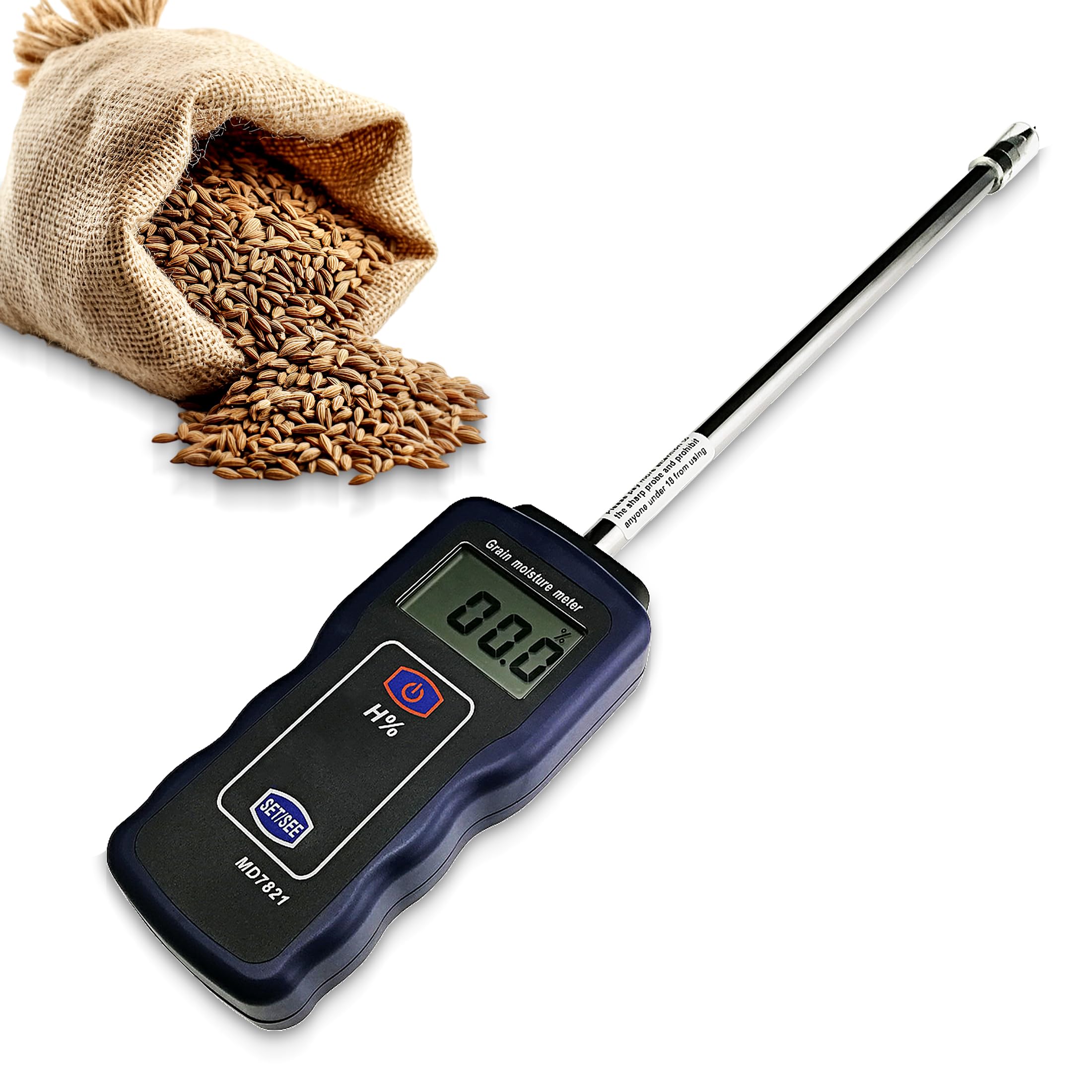
The MT-9 is a more affordable sibling to the MT-22, covering 9 grains including wheat, rice, corn, and millet. It uses the same microcomputer-based measurement technology and automatic environmental temperature compensation as the premium model, so the core accuracy is comparable for the crops it supports. Users testing green coffee beans reported reading 7.3 percent moisture consistently across four repeat tests.
The integrated single-probe design allows true one-hand operation, which is useful when you are balancing a sample cup and taking notes in the field. The housing is molded from PC+ABS plastic, giving it a solid feel that resists cracking if dropped. The included 9V battery has a low-voltage alarm that triggers before power loss, so you never get stuck mid-harvest with no usable data.
A few buyers reported that the manual lists only 4 of the 9 grain settings, leaving you to guess which preset corresponds to which crop. User forums have filled the gap, and the grain map is actually printed on the device itself, though it is easy to overlook. One unit arrived with a frozen display, which suggests QC can be inconsistent, but the majority of verified reviews rate the MT-9 as excellent for the money.
Why it’s great
- Accurate and repeatable on supported grains
- Durable PC+ABS housing suits field work
- Low-battery alarm prevents unexpected failure
Good to know
- Manual does not list all 9 grain settings
- Occasional QC issues with frozen display
3. Pokiphip TK100H

If your primary concern is hay moisture, the Pokiphip TK100H is purpose-built for that task. It uses a long probe that you stab directly into square or round bales, giving you a reading from the core rather than the surface. The backlit LCD is large enough to read in low-light barn conditions, and the auto-off function preserves battery life across a full season of use.
Several experienced hay farmers noted that the meter identified bales with moisture above 30 percent, allowing them to separate those bales to prevent mold and spontaneous combustion. That kind of real-world safety check makes the TK100H a valuable tool even if you have been making hay for decades.
Some users mention that the plastic housing feels flimsy when you are stabbing it into tight, wet bales — the probe is sturdy, but the body flexes more than you would expect. The accuracy is not certified by a lab, but side-by-side comparisons with name-brand meters gave matching readings, and the lower price makes it easier to replace if it eventually breaks. For small to mid-size hay operations, this is a sensible pick.
Why it’s great
- Long probe reaches bale core for accurate hay readings
- Backlit screen for use in low-light barns
- Battery lifespan exceeds one full season
Good to know
- Plastic body feels flexible during deep probing
- Not lab-certified for absolute accuracy
4. ZOEYEC TK100H

The ZOEYEC TK100H is a lower-cost variant designed for testing cereal straw, forage grass, and hay. It shares many physical features with the Pokiphip model but targets a different price tier. Novice hay farmers found it easy to use and sufficiently accurate for non-commercial operations, with one reviewer calling it “accurate enough for small farm use.”
It weighs only 3.5 ounces, making it the lightest tester in this list — convenient if you are carrying it across several fields, but the lightweight build does not inspire confidence when you press the probe into dense bales. The instructions are almost universally criticized as poorly translated, lacking calibration guidance, and failing to explain the secondary functions clearly.
Despite the rough documentation, the meter reliably indicates relative moisture differences between bales. One user reported finding bales above 30 percent moisture that would have otherwise been stored, preventing mold and fire risk. Accuracy is unverified by lab testing, so it is best used as a comparative tool rather than a certified measuring instrument. It gets the job done for small-scale hay growers on a tight budget.
Why it’s great
- Very affordable entry into hay moisture testing
- Ultra-light and easy to carry across fields
- Reliable relative readings for sorting wet vs dry bales
Good to know
- Manual is poorly translated and lacks calibration info
- Lightweight housing may not withstand heavy use
5. General Tools MM8

The General Tools MM8 is categorized here because it is a moisture meter, but it is critical to understand that this device is designed for building materials — drywall, hardwood, softwood, and masonry — not for grain. It uses a pinless, non-invasive sensor that reads moisture up to 19mm deep into flat surfaces. For a contractor checking wall leaks or floor moisture, the MM8 is an excellent budget tool with a clear 0-100 scale and color-coded LED alerts.
The backlit 2-inch white LCD is unusually large, making it readable from across a room. A 3-color LED bar graph provides an instant visual: green for dry, yellow for caution, red for wet. The auto-calibrating sensor adjusts offset automatically, and the audible alert sounds when the meter detects moisture above the set threshold. It runs on a single 9V battery with a low-battery alarm.
Do not buy this for grain testing. It lacks grain-specific calibration curves, temperature compensation, and a probe that can penetrate a seed sample. Verified reviews confirmed it works perfectly for drywall and tile, but one user noted false positives near wall corners due to metal trim interference. The unit is fairly priced for construction use, but it is a category error to treat it as a grain tester.
Why it’s great
- Large backlit display and color-coded alerts
- Non-invasive sensor protects finished surfaces
- Auto-calibrating and simple to use
Good to know
- Not suitable for grain or seed testing
- False positives near metal wall trims
FAQ
What is the ideal moisture level for storing wheat and corn?
Can a grain moisture tester measure coffee beans accurately?
Final Thoughts: The Verdict
For most users, the grain moisture tester winner is the AMTAST MT-22 because its 22 presets cover virtually every crop you might encounter, and verified users confirm it matches the accuracy of meters costing three times as much. If you want a more budget-friendly option that still delivers reliable results for a smaller set of crops, grab the AMTAST MT-9. And for hay-specific moisture testing where you need to probe deep into a bale, nothing beats the Pokiphip TK100H.