
Finding a capable graphics card when your budget stops at two hundred dollars used to mean settling for last-gen relics with barely enough VRAM for modern textures. Today, the sub- segment is surprisingly deep, offering genuine 1080p gaming performance, hardware encoding for media servers, and even entry-level ray tracing support—but the landmines are real. Counterfeit cards, misleading clock speeds, and mysterious 2048SP variants can turn a good deal into a frustrating paperweight.
I’m Mohammad Maruf — the founder and writer behind Drink4Good. I’ve spent years analyzing GPU market trends, benchmarking value-tier hardware, and dissecting the spec sheets that separate a smart buy from a regrettable one in this price bracket.
Whether you’re building a first gaming rig, upgrading an older office PC, or setting up a silent media transcoder, this guide cuts through the noise to help you pick the right gpu under 200 for your actual workload—without wasting a dollar on unnecessary overhead.
How To Choose The Best GPU Under 200
The sub- GPU market is a minefield of recycled chips, misleading model numbers, and third-party cooler designs that can either save you fifty bucks or leave you with a card that throttles within minutes. Understanding where to compromise and where to hold the line is essential.
VRAM Capacity and Memory Bus Width
Eight gigabytes of VRAM is the sweet spot for 1080p gaming in 2024, but not all 8GB cards are equal. A 256-bit memory bus (found on the RX 580 and Arc A580) delivers significantly more bandwidth than a 128-bit bus, directly impacting texture loading and frame time consistency. Cards with 6GB or 4GB can still work for esports titles and older games, but you’ll run into VRAM limits sooner in modern AAA releases.
Power Connectors and PSU Requirements
Many budget GPUs require a 6-pin or 8-pin PCIe power connector. If you’re upgrading a prebuilt office PC that only has a 300W power supply without spare connectors, you must choose a card that draws all its power from the PCIe slot alone (like the GT 1030 or RTX 3050 6GB LP). Ignoring this step is the single most common installation failure in this category.
Driver Maturity and Resizable BAR
Intel Arc GPUs offer excellent value but are heavily dependent on Resizable BAR (ReBAR) support in your motherboard’s BIOS. Without ReBAR, the A580 and A310 lose roughly 40 percent of their potential performance. AMD’s RX 580 and RX 5500 XT are more forgiving on older platforms, while NVIDIA’s GTX 1660 Super and RTX 3050 offer the most plug-and-play driver experience.
Quick Comparison
On smaller screens, swipe sideways to see the full table.
| Model | Category | Best For | Key Spec | Amazon |
|---|---|---|---|---|
| ASRock Arc A580 | Premium | 1080p High-Settings Gaming | 8GB GDDR6, 256-bit | Amazon |
| ZER-LON GTX 1660 Super | Mid-Range | 1080p High-FPS Esports | 6GB GDDR6, 192-bit | Amazon |
| MSI RTX 3050 LP | Mid-Range | SFF & HTPC Builds | 6GB GDDR6, 96-bit | Amazon |
| EVGA GTX 1070 SC | Mid-Range | 1440p Gaming (Renewed) | 8GB GDDR5, 256-bit | Amazon |
| NVIDIA GTX 1070 FE | Mid-Range | 4K Media & Light Gaming | 8GB GDDR5, 256-bit | Amazon |
| AISURIX RX 5500 XT | Mid-Range | Budget 1080p Gaming | 8GB GDDR6, 128-bit | Amazon |
| Maxsun RX 580 | Budget | Entry-Level 1080p Gaming | 8GB GDDR5, 256-bit | Amazon |
| Sparkle Arc A310 | Budget | Media Transcoding & SFF | 4GB GDDR6, 64-bit | Amazon |
| Asus GT 1030 | Budget | Basic Display & Office Use | 2GB GDDR5, 64-bit | Amazon |
In‑Depth Reviews
1. ASRock Intel Arc A580 Challenger 8GB OC
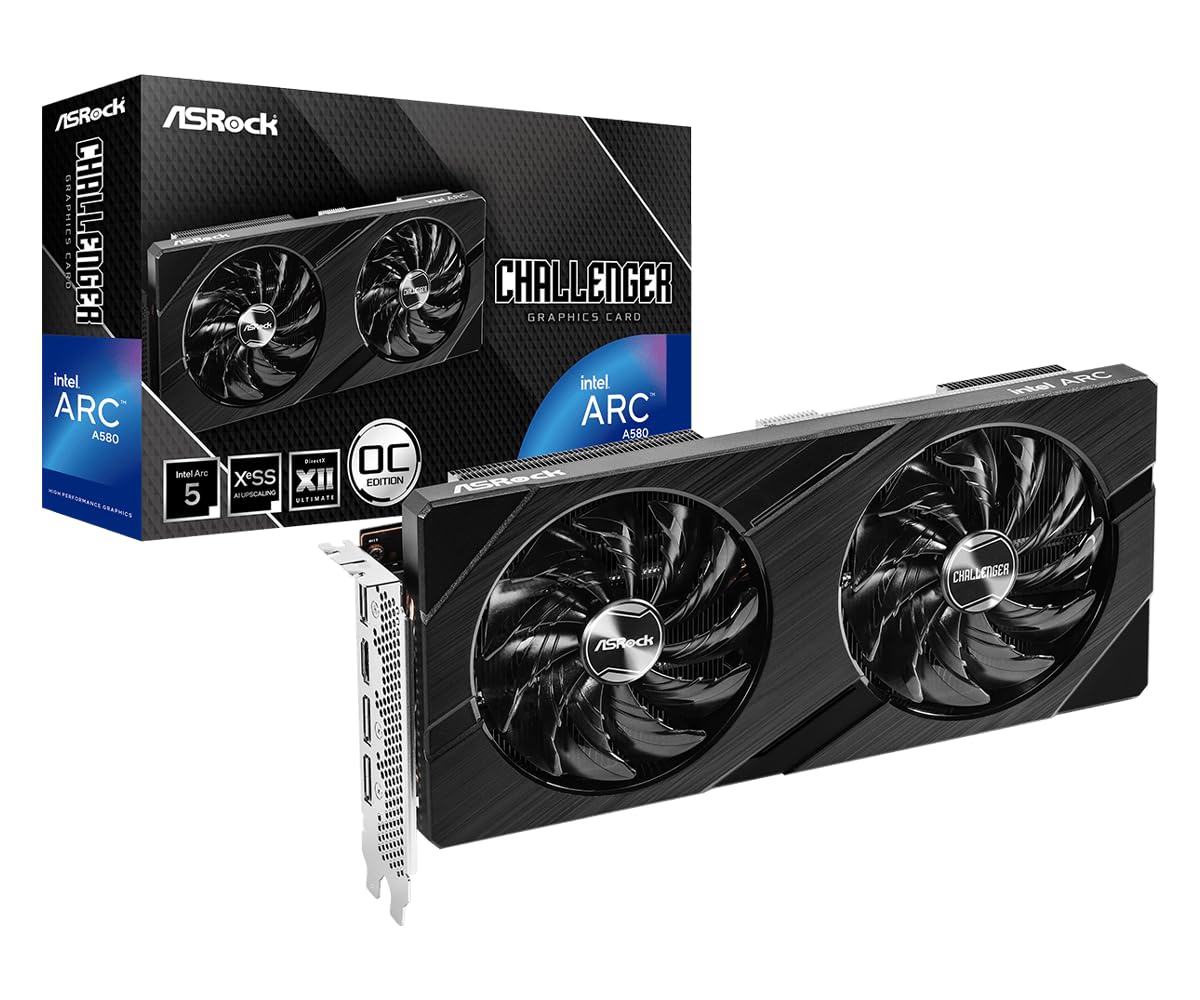
The ASRock Arc A580 is the most compelling new-architecture GPU you can buy under two hundred dollars. Its 8GB of GDDR6 memory running on a full 256-bit bus delivers bandwidth that rivals cards costing significantly more, and the factory 2000 MHz overclock ensures it punches above its weight class in modern 1080p titles. The dual-fan cooler with 0dB silent mode keeps noise levels near zero during light workloads, and the metal backplate adds rigidity that many budget cards lack.
This card excels at 1080p high-settings gaming in titles like Fortnite, Call of Duty, and Cyberpunk 2077 (with XeSS upscaling), consistently holding 60+ FPS without stuttering. The inclusion of three DisplayPort 2.0 outputs future-proofs your monitor setup for higher refresh rates, and the PCIe 4.0 interface ensures no bandwidth bottleneck on modern motherboards. Driver maturity has improved significantly since launch, though you still need a system with Resizable BAR enabled to unlock full performance.
The only real trade-off is power draw: it requires two 8-pin connectors and a recommended 650W PSU, which might necessitate a power supply upgrade in older prebuilt systems. The 2.4-slot cooler is also relatively large, so double-check your case clearance before ordering.
Why it’s great
- Full 256-bit memory bus for excellent texture bandwidth
- 0dB fan stop for silent operation at idle
- DisplayPort 2.0 support for high-refresh monitors
Good to know
- Requires Resizable BAR for full performance
- Needs two 8-pin power connectors and 650W PSU
2. ZER-LON GeForce GTX 1660 Super 6GB

The GTX 1660 Super has been the gold standard for budget 1080p gaming for years, and the ZER-LON version delivers that proven performance at a price that undercuts most competition. Its 6GB of GDDR6 memory on a 192-bit bus provides enough bandwidth to push high frame rates in esports titles like Valorant, Apex Legends, and Overwatch 2, while handling modern AAA games at medium-high settings without issue. The composite heat pipe cooler keeps temperatures in check under sustained load, and the dual fans spin down completely at idle for silent operation.
NVIDIA’s mature driver stack means this card works flawlessly out of the box on almost any system—no ReBAR fiddling, no platform conflicts. It also supports NVIDIA NVENC encoding, making it a solid choice for streamers or anyone who records gameplay. The compact dual-fan design fits in most mid-tower cases, though the 8-pin power connector is mandatory.
The lack of ray tracing cores is the obvious omission, but at this price point, any card advertising ray tracing at playable frame rates is selling compromise. The 6GB VRAM cap may become a limitation in future titles that require 8GB for high texture settings, but for today’s 1080p library, this card remains a strong performer.
Why it’s great
- Excellent 1080p high-FPS performance in esports titles
- NVENC encoder for streaming and recording
- Mature, plug-and-play NVIDIA drivers
Good to know
- No ray tracing hardware support
- 6GB VRAM may limit future high-texture games
3. MSI Gaming RTX 3050 LP 6G OC

The MSI RTX 3050 LP is the only card on this list that offers genuine ray tracing acceleration in a low-profile form factor. Its 96-bit memory interface is narrower than the competition, but the 6GB GDDR6 buffer and DLSS upscaling give it a unique advantage: you can enable ray tracing in supported titles at 1080p and still get playable frame rates by leveraging DLSS Quality mode. The Twin Frozr cooling system is remarkably quiet for a card this size, and the zero RPM mode keeps fans stopped during light workloads.
This card is specifically designed for small form factor (SFF) and HTPC builds. It fits comfortably in Dell Optiplex, HP EliteDesk, and other prebuilt office PCs that have a standard low-profile slot. It draws all its power from the PCIe slot itself—no external power connector needed—making it the easiest drop-in upgrade for systems with limited PSU headroom. The dual HDMI 2.1a outputs are also rare at this price and ideal for multi-monitor setups or connecting to modern 4K TVs.
The 1492 MHz boost clock is lower than full-size RTX 3050 cards, so raw rasterization performance is slightly behind the ZER-LON 1660 Super. But if your priority is fitting a modern, feature-rich GPU into a compact chassis, this is the best option available.
Why it’s great
- First low-profile card with ray tracing and DLSS
- Slot-powered, no external power connector needed
- Dual HDMI 2.1a for modern TV connectivity
Good to know
- 96-bit memory bus limits bandwidth compared to rivals
- Rasterization slower than GTX 1660 Super
4. EVGA GeForce GTX 1070 SC Gaming ACX 3.0 (Renewed)

The EVGA GTX 1070 SC is a renewed card that brings high-end 2016 performance to the sub- market. Its 8GB of GDDR5 memory on a 256-bit bus gives it enough bandwidth to handle 1440p gaming at medium settings—a resolution that most cards in this price range simply can’t touch. The factory overclock and ACX 3.0 dual-fan cooler keep temperatures comfortable even during long sessions, and the metal backplate adds structural rigidity.
This card is ideal for gamers who already have a 1440p monitor and want to play older or less demanding titles at native resolution, or for 1080p users who want the headroom to crank settings to ultra without worrying about VRAM limits. The GTX 1070 also supports NVIDIA’s simultaneous multi-projection, which improves performance in VR games—a rare bonus at this price.
Being a renewed product means the card’s history and remaining lifespan are unknowns. Some users report failure within months, while others get years of reliable service. The physical size (10.5 inches long) also makes it one of the largest cards here, so case compatibility should be verified. The lack of a native HDMI 2.0 output means you’ll need a DisplayPort-to-HDMI adapter for 4K 60Hz TV connections.
Why it’s great
- 8GB VRAM on 256-bit bus handles 1440p gaming
- VR-ready with NVIDIA multi-projection support
- Overclocked out of the box with excellent cooler
Good to know
- Renewed card with unknown prior usage history
- Long 10.5-inch design may not fit smaller cases
5. NVIDIA GeForce GTX 1070 Founders Edition (Renewed)

The Founders Edition GTX 1070 is a piece of GPU history that still delivers strong 1080p and respectable 1440p performance at a budget-friendly price. Its 8GB GDDR5 memory and 256-bit interface provide the same core capability as the EVGA version, but the blower-style cooler is the defining difference: it exhausts hot air directly out of the case, making it ideal for small form factor builds or multi-GPU setups where airflow is restricted. The all-metal construction feels premium, and the iconic NVIDIA design stands out in any build.
For non-gamers, this card is an absolute steal. It powers 4K desktop resolution effortlessly for photo editing, video streaming, and general productivity without breaking a sweat. Several verified buyers specifically mention using it for Linux-based workstations where AMD driver issues have been problematic, praising the seamless NVIDIA driver support. The single 8-pin power requirement means it works with a wide range of power supplies.
Renewed units vary in cosmetic condition—some arrive with minor scuffs or scratches on the backplate. The blower fan is also audible under load, spinning up to higher RPMs than open-air coolers to keep the card cool. Like all renewed products, warranty coverage is limited, so buying from a seller with a solid return policy is recommended.
Why it’s great
- Blower cooler exhausts heat outside the case, ideal for SFF
- Excellent 4K desktop performance for non-gaming tasks
- Reliable NVIDIA driver support across Windows and Linux
Good to know
- Blower fan is louder than open-air coolers under load
- Renewed units may have cosmetic scratches
6. AISURIX RX 5500 XT 8GB GDDR6

The AISURIX RX 5500 XT offers the rare combination of 8GB VRAM and a modern RDNA architecture at a price that undercuts most alternatives. Its 128-bit memory bus is narrower than the RX 580’s 256-bit interface, but the faster GDDR6 memory compensates in many scenarios, especially at 1080p. The semi-automatic intelligent fan system stops the fans completely at low temperatures, making this card virtually silent during desktop use and light gaming.
Gaming performance is solid for 1080p medium-high settings. Resident Evil 4 Remake runs at a smooth 60 FPS on medium without ray tracing, and esports titles easily push past 100 FPS. The three DisplayPort outputs plus one HDMI 2.0b port give you plenty of flexibility for multi-monitor setups. The composite heat pipe cooler keeps GPU temperatures below 60°C under load, which is impressive for a card at this price.
Quality control is the main concern here. Several buyers report receiving cards with bent brackets or defective DisplayPort outputs that require manual adjustment or RMA. The card also needs an 8-pin power connector, so older office PCs without GPU power cables won’t be compatible without a PSU upgrade. If you get a good unit, it’s excellent value—but the variance is higher than with established brands.
Why it’s great
- 8GB GDDR6 VRAM at a very competitive price
- Fan stop mode for silent operation at idle
- Excellent thermal performance under load
Good to know
- QC issues reported with bent brackets and faulty ports
- 128-bit bus limits bandwidth vs. older 256-bit cards
7. Maxsun AMD Radeon RX 580 8GB 2048SP

The Maxsun RX 580 8GB revives the legendary Polaris architecture that dominated the budget segment for years. Its full 256-bit memory bus and 8GB VRAM deliver texture bandwidth that newer 128-bit cards can’t match, making it particularly strong in games that load large textures. The white PCB and cooler design is a nice bonus for white-themed PC builds, and the dual-fan cooler keeps temperatures under 65°C under normal gaming loads.
In practice, this card handles 1080p gaming at high settings in most titles from the last five years. It pushes 144 FPS in esports titles and holds 60 FPS in AAA games at medium-high settings. The 2048SP variant has slightly fewer stream processors than the original RX 580, but the difference is barely noticeable in real-world use. It also supports AMD’s FreeSync technology for tear-free gaming on compatible monitors.
The main catch is power draw. The RX 580 pulls around 185W under load, and it requires a 6-pin power connector. Several buyers report that a 750W power supply is recommended to avoid boot failures—the card’s transient spikes can trip lower-rated PSUs. The Chinese brand has less robust customer support than ASUS or MSI, so you’re relying on Amazon’s return policy for any issues.
Why it’s great
- 8GB VRAM on a full 256-bit memory bus
- White color scheme fits themed builds perfectly
- FreeSync support for variable refresh monitors
Good to know
- High power draw may require PSU upgrade to 750W
- 2048SP variant is slightly cut down from original RX 580
8. Sparkle Intel Arc A310 ECO 4GB

The Sparkle Arc A310 is a single-slot, low-profile powerhouse designed for one specific job: media transcoding. Its Intel Xe Media Engine supports hardware encoding and decoding for nearly every modern codec, including AV1, HEVC, and VP9, making it the best choice for Jellyfin, Plex, or Emby media servers. The card draws only 50W at peak, runs cool enough to be passively viable in well-ventilated cases, and comes with an included short bracket for compact chassis installation.
For gaming, this is strictly a 720p to 1080p low-settings card. It can handle older titles and indie games at playable frame rates, but the 64-bit memory bus and 4GB VRAM cap mean modern AAA releases will struggle. The single-fan cooler is audible under load—several buyers note a droning noise when the fan ramps up—but this can often be tuned with a custom fan curve or firmware update.
The A310’s reliance on Intel drivers is the main compatibility hurdle. It absolutely requires Resizable BAR support in the BIOS to reach its full potential; without it, performance drops by roughly 40 percent. It also works best on Windows 10/11 or recent Linux kernels with the i915 or Xe drivers. If your use case is transcoding in a small form factor PC, this card is unmatched at the price.
Why it’s great
- Best-in-class media transcoding with AV1 support
- Single-slot, low-profile design fits any SFF case
- Ultra-low 50W power draw runs cool and efficient
Good to know
- Not suitable for modern AAA gaming
- Droning fan noise under load reported by some users
9. Asus GF GT 1030 2GB GDDR5
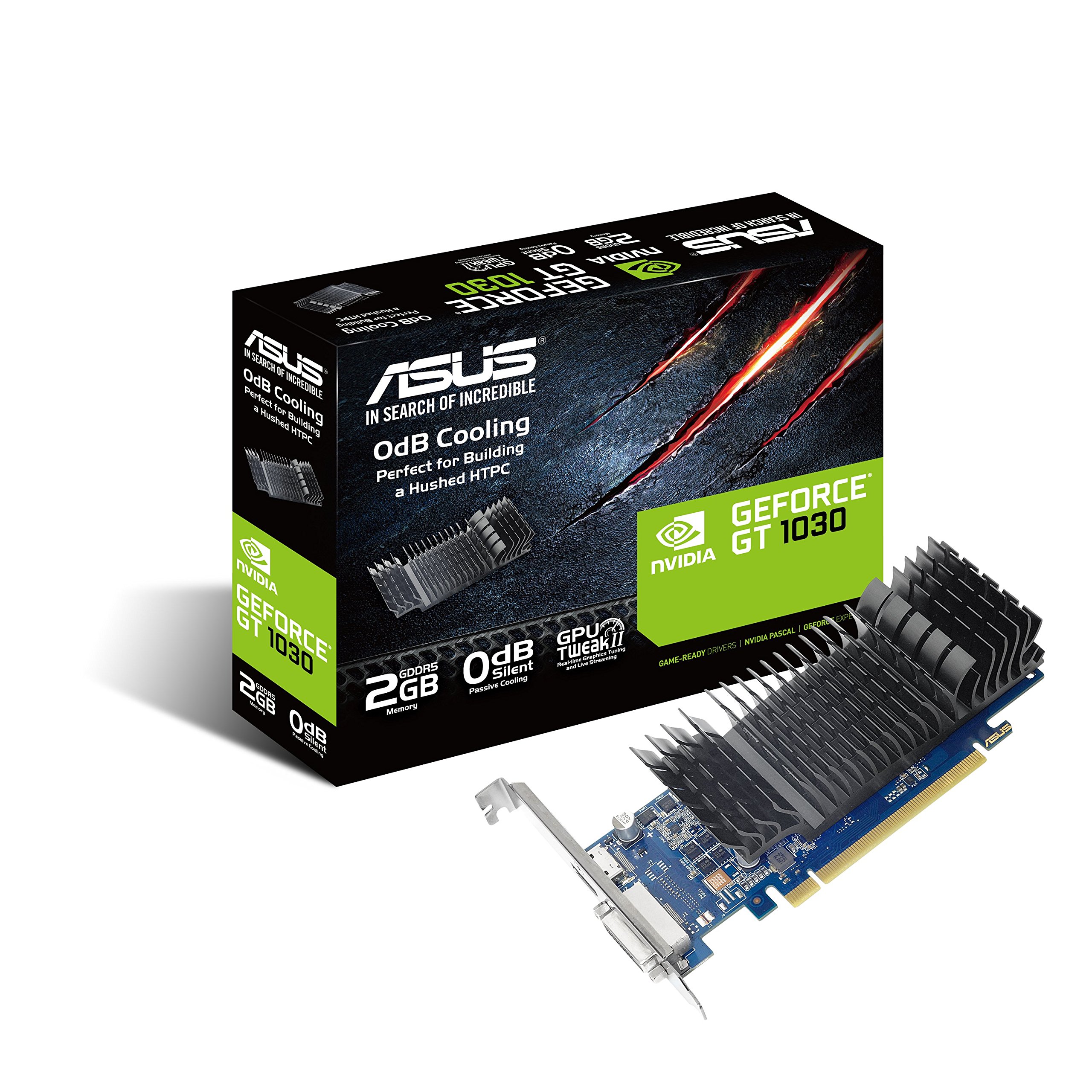
The Asus GT 1030 is the definition of a bare-bones discrete GPU. Its 2GB of GDDR5 memory and 64-bit bus are enough to drive a 1080p desktop at full resolution, accelerate video playback, and handle very light gaming—think Minecraft, older Valve titles, or 2D indie games. The card is slot-powered, requiring no external power connector, and its compact size means it fits in nearly any case, from slim office towers to small form factor HTPCs.
Where this card shines is in office productivity upgrades. If you have a Dell Optiplex or HP EliteDesk with integrated Intel graphics that chokes on 4K video or multiple monitors, the GT 1030 provides a massive upgrade at minimal cost. It also runs extremely cool and quiet, making it ideal for silent recording studios or media centers where fan noise is unacceptable. One buyer specifically praised its low noise and heat output for a music production workstation.
The GT 1030 is not a gaming GPU by modern standards. It will struggle with any 3D game released after 2017, and even older titles require reduced resolution and settings. Some third-party versions ship with DDR4 memory instead of GDDR5—the Asus model covered here uses GDDR5, but verify before buying. This card exists for a narrow use case, and if that’s your use case, it’s the right tool.
Why it’s great
- Slot-powered, fits any case without PSU upgrade
- Near-silent operation for quiet work environments
- Ideal for multi-monitor office setups and 4K video
Good to know
- 2GB VRAM severely limits gaming capability
- DDR4 versions exist—verify GDDR5 before purchase
FAQ
Can a GPU under run ray tracing games?
What power supply do I need for a budget GPU?
Is 8GB VRAM necessary for 1080p gaming?
How do I verify a GPU is not counterfeit?
Final Thoughts: The Verdict
For most users, the gpu under 200 winner is the ASRock Arc A580 because it offers 8GB of VRAM on a 256-bit bus with modern features like XeSS and AV1 encoding—all at a price that leaves room for a game or two. If you want proven NVIDIA drivers and a card that just works for high-FPS 1080p gaming, grab the ZER-LON GTX 1660 Super. And for compact, low-profile builds where every inch counts, nothing beats the MSI RTX 3050 LP.