
A trail that looks clear on a phone screen can dissolve into a maze of unmarked forks the moment you lose cell service. That sinking feeling of uncertainty — the one that turns a peaceful ridge walk into a stressful search for a trail marker — is exactly the problem a dedicated hiking GPS solves. These devices pull satellite signals from orbits your phone can’t reach, giving you a breadcrumb trail back to safety even when the pavement ends.
I’m Mohammad Maruf — the founder and writer behind Drink4Good. I’ve analyzed over a hundred GPS units across multiple hiking tiers, focusing on satellite lock speeds, battery endurance in cold conditions, and the real-world reliability of preloaded topo maps versus coordinate-only trackers.
Whether you are navigating dense forest, alpine scree, or open desert, finding a reliable gps tracker for hiking means balancing accuracy against battery life and understanding which satellite networks matter for your terrain.
How To Choose The Best GPS Tracker For Hiking
A hiking GPS is not a smartphone shortcut. It is a purpose-built tool designed to function when every other screen in your pack goes dark. Picking the right one starts with understanding how satellite reception, mapping, and power management interact in the field.
Satellite Networks and Lock Speed
Modern handhelds pull from multiple constellations — GPS (USA), GLONASS (Russia), Galileo (Europe), BeiDou (China), and QZSS (Japan). A device that supports three or more of these networks locks faster and holds a fix in steep canyons and under dense canopy. Look for multi-GNSS or multi-band support if you hike in technical terrain.
Maps: Topo vs. Coordinate-Only
Some units come preloaded with routable topo maps showing trails, contour lines, and water sources. Others only display your lat/long coordinates and compass bearing. For backcountry navigation, a preloaded topo map is essential — coordinate-only units are better suited for surveying or simple point-to-point return.
Power Source and Battery Life
Rechargeable lithium-ion packs offer convenience but degrade in sub-freezing temperatures. AA-powered units let you carry spare batteries that work in any climate. Check whether the manufacturer’s battery estimate assumes power-save mode — real-world runtime on a sunny ridge differs from a cloudy forest floor.
Quick Comparison
On smaller screens, swipe sideways to see the full table.
| Model | Category | Best For | Key Spec | Amazon |
|---|---|---|---|---|
| Garmin GPSMAP 65s | Premium Handheld | Multi-band accuracy | Multi-band GNSS + TopoActive maps | Amazon |
| Garmin GPSMAP 64sx | Premium Handheld | Reliable classic with quad helix | Quad helix antenna + preloaded TopoActive | Amazon |
| Garmin Instinct 2X Solar | Smartwatch | All-day wear + solar charging | Unlimited battery in smartwatch mode (solar) | Amazon |
| ACR ResQLink View PLB | SOS Beacon | Emergency-only satellite rescue | 406 MHz signal + 5W output, no subscription | Amazon |
| Bushnell BackTrack Mini | Compact Navigator | Simple point-to-point return | 35-hour rechargeable + Bluetooth sync | Amazon |
| NiesahYan A6 Handheld | Entry-Level | Budget-friendly track recording | 20-hour rechargeable + 4 GNSS support | Amazon |
| NiesahYan 3.2″ Topo GPS | Mid-Range Handheld | Large screen with USA topo maps | 36-hour battery + 32 GB memory + topo maps | Amazon |
| Spot Gen 4 | Satellite Messenger | Two-way communication + SOS | Globalstar satellite + SOS/check-in buttons | Amazon |
| NiesahYan ZL180 | Surveying Tool | Land area measurement | 0.003 acre accuracy + GPS/GLONASS | Amazon |
In-Depth Reviews
1. Garmin GPSMAP 65s

The GPSMAP 65s is the handheld to beat for serious hikers who need sub-10-foot accuracy in technical terrain. Its multi-band GNSS engine locks onto GPS, GLONASS, Galileo, and QZSS simultaneously, maintaining a fix under dense tree cover where single-band units drift. The 2.6-inch sunlight-readable display stays crisp even at midday, and the physical button layout works flawlessly with gloves or wet hands.
Battery life is a standout feature here — using two standard AA batteries, you get roughly 27 hours in GPS-only mode or 10 hours with full backlight and multi-band active. That flexibility means you can carry spare lithium AAs and never worry about a dead proprietary pack. The preloaded TopoActive maps include routable trails and public land boundaries across the U.S., and you can load additional custom maps via microSD. The 3-axis compass and barometric altimeter remain calibrated even when stationary, which is crucial in whiteout conditions.
Setup does require patience — Garmin’s BaseCamp software is clunky, and the default map detail is set to low out of the box. A firmware update is recommended before your first trip. Once configured, the 65s delivers the most accurate civilian-grade GPS navigation you can strap to a pack.
Why it’s great
- Multi-band GNSS locks fast and stays locked in deep cover
- AA battery compatibility works in freezing temps
- Preloaded TopoActive maps with routable trails
Good to know
- Garmin BaseCamp software is unintuitive
- Default map detail needs manual adjustment
- Some users report bricking with third-party .img files on microSD
2. Garmin GPSMAP 64sx

The GPSMAP 64sx is the proven workhorse of Garmin’s handheld lineup, built around a quad helix antenna that captures weak satellite signals in narrow canyons and under thick foliage. It supports GPS, GLONASS, and Galileo, delivering reliable positioning without the complexity of multi-band hardware. The 2.6-inch sunlight-readable display and dedicated button controls make it straightforward to operate in rain or snow.
Preloaded TopoActive maps cover the U.S. and Australia with routable roads and trails, and the microSD slot lets you add extra regions or custom map sets. Battery life reaches 16 hours in standard GPS mode, and since it runs on two AA batteries, you can swap in fresh lithium cells at any trailhead. Users report solid performance in the Grand Canyon and on off-trail desert routes, with accurate trail data that matches what you see on paper maps.
The main compromise is the lack of multi-band technology, which means slightly less precision in urban canyons and under extremely dense canopy compared to the 65s. Wireless connectivity via Bluetooth and ANT+ is available, but the interface feels dated compared to newer models. If you want Garmin reliability without the premium price tag, this is the sweet spot.
Why it’s great
- Quad helix antenna for weak signal environments
- AA batteries offer universal replacement in remote areas
- Preloaded TopoActive maps with routable trails
Good to know
- No multi-band frequency support
- Internal memory is small — microSD card recommended
- Interface feels dated compared to newer Garmins
3. Garmin Instinct 2X Solar — Tactical Edition

The Instinct 2X Solar radically changes what you expect from a hiking GPS by integrating it into a rugged smartwatch with a Power Glass lens that extends battery life indefinitely — in smartwatch mode, three hours of direct sunlight per day keeps it charged indefinitely. This is not a gadget for weekend warriors; it is a navigation tool for multi-day expeditions where every gram and every charge counts. The 50 mm fiber-reinforced polymer case meets military standard 810 for thermal, shock, and water resistance.
Navigation features include multi-band GNSS support for accurate positioning, a 3-axis compass, a barometric altimeter, and a built-in LED flashlight with SOS strobe. The flashlight alone has proven useful in real-world emergencies, guiding people through smoke and low-visibility conditions. Health tracking adds wrist-based heart rate, Pulse Ox, and sleep monitoring, but the core hiking functionality — waypoint recording, TracBack routing, and breadcrumb trails — is what makes this a true GPS tracker for hiking.
The trade-off is the small screen compared to a dedicated handheld. Reading topo maps on a 1.2-inch display requires zooming and scrolling, and the touchscreen-free button interface takes practice to navigate quickly. Battery life in heavy GPS mode drops to about 30 hours without solar, so heavy all-day tracking still requires occasional sun exposure. For hikers who want a single device for daily wear and backcountry navigation, this is the most practical option available.
Why it’s great
- Solar charging delivers unlimited smartwatch battery life
- Multi-band GNSS for accurate positioning
- Built-in LED flashlight with SOS strobe
Good to know
- Small screen makes map reading cumbersome
- Heavy GPS use drains battery faster than solar can replenish
- Button-based interface requires learning curve
4. ACR ResQLink View PLB

The ACR ResQLink View is not a GPS for daily navigation — it is a last-resort emergency beacon that sends a 406 MHz distress signal directly to global search-and-rescue satellites with no subscription fee. When you are beyond cell towers and your handheld GPS battery is dead, this device floats and fires a 5-watt signal that reaches COSPAS-SARSAT satellites, which relay your GPS coordinates directly to rescue authorities. The 121.5 MHz homing signal helps rescuers pinpoint your location within minutes.
The unit is small enough to clip to a pack strap or PFD inflation tube, weighing just 5.28 ounces. A bright LED strobe and infrared strobe provide visual cues for night rescues. The built-in screen confirms activation and GPS fix status, so you know your distress call is actually transmitting. Battery life is rated at 28 hours of continuous operation after activation, and the battery is replaceable with a five-year shelf life. Self-test and GPS test functions let you verify operation before each trip.
This is a one-way device — it sends your location to rescue services but cannot receive messages. It is not a substitute for a two-way satellite messenger if you need to coordinate with family or request non-emergency help. For solo hikers in remote alpine zones, coastal trails, or winter expeditions, carrying a PLB alongside a standard GPS handheld is the gold standard for safety.
Why it’s great
- Global 406 MHz signal reaches search-and-rescue without subscription
- Floats and is waterproof for water crossings
- 5-watt output is stronger than subscription-based messengers
Good to know
- One-way distress only — no two-way messaging
- Battery expires every 5 years
- Requires NOAA registration for full functionality
5. Bushnell BackTrack Mini GPS

The Bushnell BackTrack Mini is a purpose-built point-to-point navigator that strips away everything except the ability to mark a starting position and guide you back. It does not show topo maps or terrain — it simply displays a directional arrow, distance to your waypoint, and elevation changes. This simplicity makes it ideal for day hikes on established trails where you just need a safety net against getting turned around in fog or failing daylight.
Battery life reaches up to 35 hours on a single micro-USB charge, and the large, glove-friendly buttons are easy to operate without stopping. Bluetooth connectivity lets you sync trips and waypoints to the Bushnell Connect app, though functionality depends on app stability — some users report the app is currently non-functional. The unit tracks elevation gain and loss, barometric pressure, and provides sunrise/sunset times for trip planning. At under 3 ounces, it disappears into a hip pocket.
The biggest downside is the lack of mapping. If you veer off trail and need to navigate cross-country, a simple arrow is insufficient — you need coordinates and a topo overlay. Distance accuracy is also inconsistent, with some users reporting up to 60% overestimation on measured routes. This is a backup device for established trails, not a primary navigation tool for backcountry bushwhacking.
Why it’s great
- Ultra-light and compact for day hikes
- Long 35-hour rechargeable battery
- Large, glove-friendly buttons for quick operation
Good to know
- No topo maps — directional arrow only
- Distance overestimation reported on some routes
- Bushnell Connect app has stability issues
6. NiesahYan 3.2″ Handheld GPS with USA Topo Maps
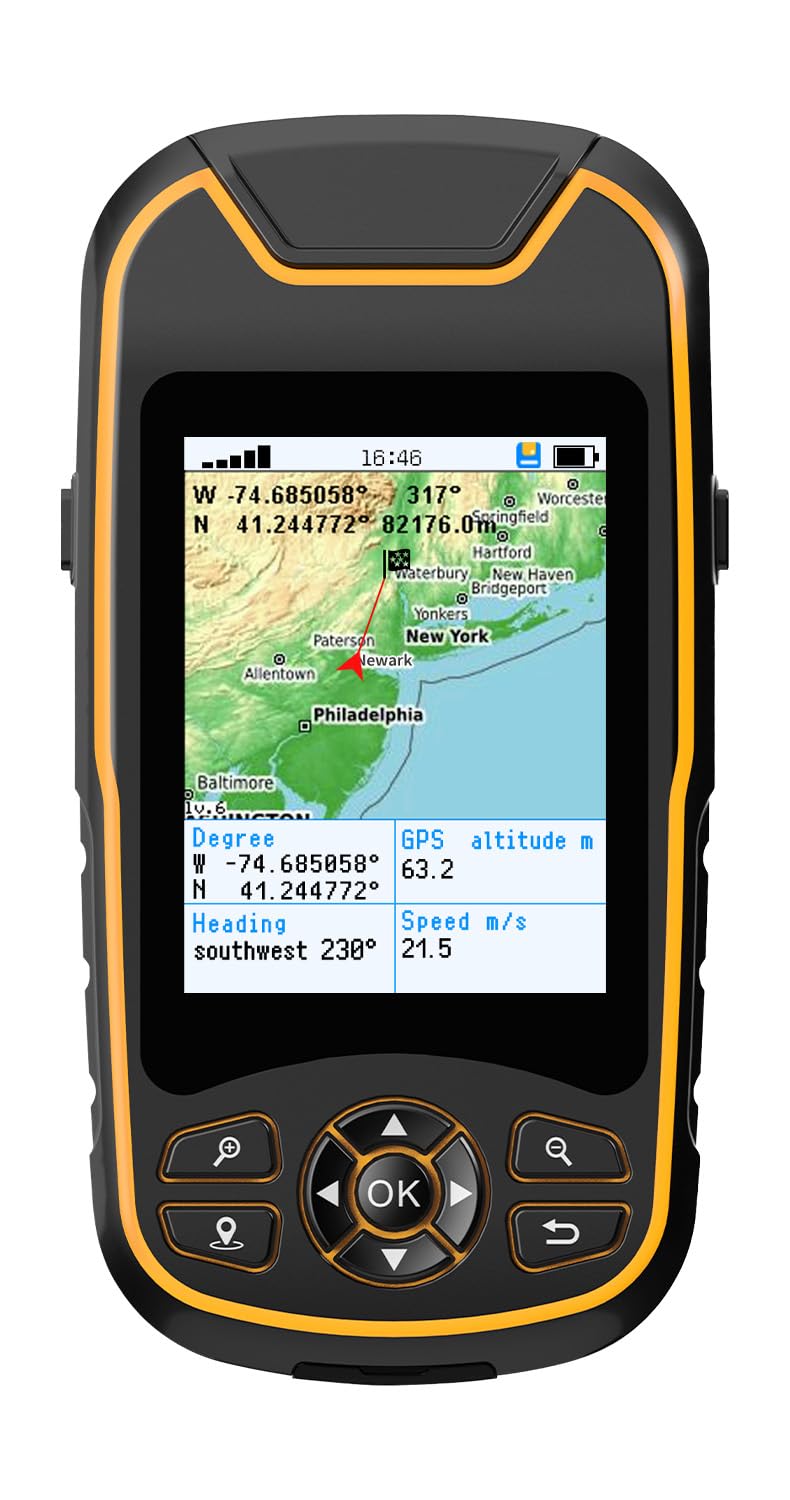
The NiesahYan 3.2-inch handheld stands out for its large, sunlight-readable display and preloaded USA topo maps — a rare combination at its price point. The 3.2-inch screen is noticeably larger than the 2.6-inch panels on most competing handhelds, making contour lines and trail junctions easier to read at a glance. Multi-GNSS support covers GPS, Galileo, BeiDou, and QZSS for accurate positioning within 6 feet.
Battery life is rated at 36 hours on a full charge, which edges out many premium models. The 32 GB of internal memory provides ample space for additional map downloads, and the IP66 water-resistant rating means it survives heavy rain and stream crossings. The inclusion of a 3-axis compass and barometric altimeter adds essential navigation redundancy when satellite signals are weak.
Build quality is a concern — one user reported a unit failing to boot after its first field test, and the rubber port cover has been described as difficult to reset. The interface is functional but not as polished as Garmin’s, and the instruction manual is sparse. For hikers who prioritize screen size and battery life over brand consistency, this is a compelling alternative, but reliability varies by unit.
Why it’s great
- Large 3.2-inch sunlight-readable display
- 36-hour battery life on a single charge
- Preloaded USA topo maps with 32 GB internal storage
Good to know
- Reports of unit failure after first field test
- Rubber port cover is fiddly to reseat
- Instruction manual lacks detail
7. Spot Gen 4 Satellite GPS Messenger

The Spot Gen 4 is a dedicated satellite messenger that lets you send predefined check-in messages and SOS alerts via the Globalstar satellite network, keeping loved ones informed even when you are miles from the nearest cell tower. The magnetic SOS and HELP buttons are designed for quick activation under stress, and the device uses two AA batteries for easily replaceable power. The Flex subscription plan allows you to activate service only for the months you need.
Messaging is nearly instantaneous in most areas, and the tracking feature updates your position as you move, providing a breadcrumb trail for family monitoring. Battery life is excellent — users report weeks of standby with occasional tracking. The new form factor is slimmer than previous generations, and the carabiner clip makes attachment to a pack strap straightforward.
The critical limitation is the subscription requirement — you must pay an annual or monthly fee for the satellite service, and activation is not immediately obvious from the packaging. Tracking reliability is inconsistent; some users report that the unit turns off after about an hour of inactivity, requiring manual re-engagement. Firmware updates require a Windows PC and involve removing four screws to access the battery compartment. The included cable is micro-USB, not USB-C. For hikers who want two-way communication and family peace of mind, the Spot Gen 4 works — if you accept its quirks.
Why it’s great
- Two-way check-in messaging from anywhere with sky view
- Easy SOS activation with magnetic button
- Flexible subscription model — pay only for active months
Good to know
- Requires ongoing subscription fee
- Tracking turns off after inactivity; must re-engage
- Firmware updates require removing screws and a Windows PC
8. NiesahYan A6 Handheld GPS for Hiking
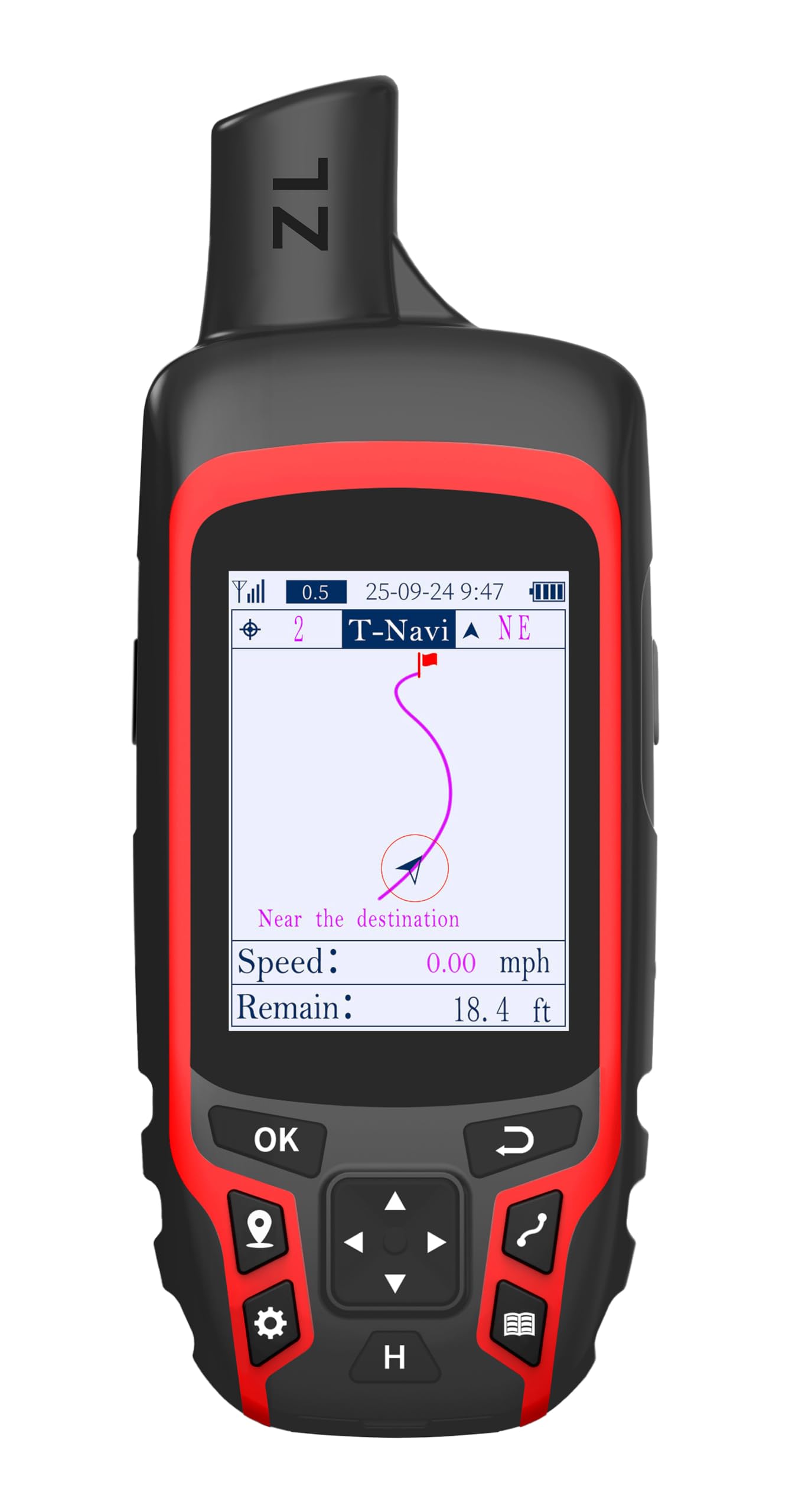
The NiesahYan A6 is an entry-level handheld GPS that brings multi-GNSS support (GPS, Galileo, BeiDou, QZSS) to a budget-friendly package, making it a solid choice for hikers who want satellite-based tracking without investing in premium Garmin hardware. The 2.4-inch color screen is bright enough for outdoor use, and the rechargeable battery delivers a claimed 20 hours of continuous operation, which is competitive with mid-range models.
This unit is designed for track recording and return navigation — it records your path and can guide you back to your starting position. The GPS compass provides heading information, and the barometric altimeter tracks elevation changes. Setup is straightforward: power on, wait for satellite lock, and start walking. The USB-C charging is a welcome modern touch.
The critical caveat is that this device has no built-in maps. It displays coordinates and compass bearings only, not trail networks or terrain contours. Several users found this confusing out of the box, assuming a handheld GPS would show roads or trails. Menu navigation is not intuitive and requires studying the manual. For experienced hikers who understand coordinate-based navigation, the A6 can serve as a backup tracker. For anyone expecting turn-by-turn trail guidance, it will disappoint.
Why it’s great
- Multi-GNSS support (4 constellations) for reliable lock
- 20-hour rechargeable battery with USB-C charging
- Compact and rugged design for trail carry
Good to know
- No built-in maps — coordinate and compass only
- Menu navigation requires manual study
- Not suitable for precise off-trail navigation
9. NiesahYan ZL180 Handheld GPS

The NiesahYan ZL180 is not a hiking navigation device — it is a handheld GPS surveying tool designed for measuring land area and distances on ranches, gardens, and farmland. It uses GPS and GLONASS satellites to calculate area with a stated accuracy of 0.003 acres, making it useful for property boundary verification or trail construction planning. The 2.4-inch FSTN LCD is simple and functional, and the unit weighs just 6.3 ounces.
It offers four measurement modes: two area measurement methods (for flat terrain) and two distance measurement methods (straight and curved line). The device requires a clear view of the sky and works best when measuring areas above 0.16 acres or distances above 328 feet for optimal accuracy. The waterproof design allows use in wet grass or light rain.
This device cannot save waypoints or navigate trails. Several users noted that accuracy is adequate for ballpark estimates but not for precise survey work — lat/long coordinates can drift. One reviewer described it as a budget tool that does what it says for the price. If you are looking for a hiking tracker, skip this. If you need to measure a trail corridor or campsite area, it is a functional, low-cost option.
Why it’s great
- Area measurement accuracy within 0.003 acres
- Waterproof and lightweight for field use
- Simple one-button measurement operation
Good to know
- Not designed for hiking navigation or waypoint saving
- Accuracy degrades on small or irregular areas
- No mapping or trail guidance functionality
FAQ
What is the difference between a GPS tracker and a personal locator beacon (PLB) for hiking?
Do I need a subscription for a hiking GPS?
How do I update maps on a Garmin GPSMAP 65s?
Final Thoughts: The Verdict
For most hikers, the best gps tracker for hiking is the Garmin GPSMAP 65s because it combines multi-band GNSS accuracy with the reliability of AA batteries, giving you sub-10-foot precision for days on end. If you want a wearable that eliminates battery anxiety, the Garmin Instinct 2X Solar is the smarter choice. And for those who need a dedicated emergency satellite beacon without subscription fees, the ACR ResQLink View PLB offers unmatched peace of mind.