
A hunting trip pivots on a single decision: do you know where you are the moment the game trail vanishes into thick timber? A reliable GPS for hunting eliminates that gamble, replacing guesswork with precise waypoints, accurate tracking, and the confidence to push deeper into the backcountry without risking your exit strategy.
I’m Mohammad Maruf — the founder and writer behind Drink4Good. I spend my research time digging into satellite acquisition chipsets, battery chemistries, map preloads, and durability ratings specific to handheld navigation devices.
This guide separates the rugged performers from the trail-side failures by comparing preloaded mapping, satellite support, battery endurance, and real-world usability. My goal is to help you find the absolute best gps for hunting that matches your terrain and your budget.
How To Choose The Best GPS For Hunting
Not all handheld navigators handle hunting terrain the same way. While a unit designed for car navigation might get you to the trailhead, it lacks the critical satellite support and map detail needed when you are miles from any road. Focus on these specific features before you buy.
Satellite Support and Multi-Band Technology
The depth of tree canopy in a mature hardwood forest or the walls of a steep canyon can block a standard GPS receiver. Look for units that support GPS, GLONASS, and Galileo networks. Multi-band frequency technology, available on premium models like the Garmin GPSMAP 65, further improves accuracy by pulling signals from two frequency bands simultaneously, reducing error to under six feet even in dense cover.
Mapping and Preloaded Topography
A hunting GPS should ship with routable TopoActive maps that show contour lines, elevation profiles, and public land boundaries. Trail data for game paths and access roads is essential for route planning. Models that accept microSD cards allow you to load additional map sets or custom layers like property boundaries. The Garmin Montana 700, for example, supports BirdsEye satellite imagery, which can reveal hidden terrain features like benches or saddles that hold game.
Battery Life and Power Options
Battery anxiety hits hard when you are three miles in and the screen starts dimming. Standard lithium-ion packs offer 16 to 18 hours, but models that accept standard AA batteries — such as the Garmin GPSMAP 65 — let you carry spares and swap in seconds. Units like the NiesahYan handheld stretch to 36 hours in battery-save mode, giving you multi-day trip coverage without a recharge.
Durability and Glove-Friendly Operation
Hunting conditions are wet, cold, and hard on gear. A waterproof rating of IPX7 or better ensures survival in rain and stream crossings. MIL-STD-810 certification, found on the Montana 700, adds shock and vibration resistance for rough mounts on ATVs or snowmobiles. Physical buttons remain essential — touchscreens can be unreliable with wet gloves or in freezing temperatures, so button-operated units like the GPSMAP 64sx provide reliable control in any weather.
Quick Comparison
On smaller screens, swipe sideways to see the full table.
| Model | Category | Best For | Key Spec | Amazon |
|---|---|---|---|---|
| Garmin GPSMAP 65 | Handheld | Multi-band accuracy | Multi-GNSS + Multi-Band | Amazon |
| Garmin GPSMAP 64sx | Handheld | Budget-conscious hunting | Quad-helix antenna | Amazon |
| Bushnell BackTrack Mini | Mini GPS | Simple point-to-point | 35-hour battery | Amazon |
| Spot X | Satellite Messenger | 2-way SOS | Globalstar network | Amazon |
| Garmin Montana 680 | Touchscreen | Large display | 4-inch sunlight screen | Amazon |
| Garmin Montana 700 | Rugged | MIL-STD-810 durability | 5-inch glove-friendly screen | Amazon |
| Garmin GPSMAP 86Sci | Marine | Waterfowl and boat use | Floating design | Amazon |
| Garmin Montana 750i | Satellite Communicator | inReach SOS capability | inReach + camera | Amazon |
| NiesahYan Handheld GPS | Budget Handheld | Entry-level navigation | 36-hour battery life | Amazon |
In‑Depth Reviews
1. Garmin GPSMAP 65

The Garmin GPSMAP 65 delivers the most precise satellite lock of any hunting GPS in the mid-range tier thanks to its multi-band frequency technology. It pulls signals from GPS, GLONASS, Galileo, and QZSS networks across two frequency bands, holding accuracy within roughly six feet even under a thick hardwood canopy or at the bottom of a steep ravine. The 2.6-inch sunlight-readable color display remains sharp in direct daylight, and the full button-operated control system works reliably with wet or gloved hands.
Preloaded TopoActive maps include routable trails and public land boundaries for the U.S., which saves hours of manual map loading. Battery life hits 16 hours in standard mode, but switching to battery-save mode on GPS-only stretches past 27 hours — enough for a multi-day backcountry hunt without swapping cells. The unit accepts two AA batteries, which means you can carry lithium spares and never worry about a dead internal pack.
The Garmin Explore app integration allows you to manage routes, waypoints, and tracks from a smartphone after the hunt, though the desktop BaseCamp software has a steep learning curve. Some users report a critical bug when loading third-party OpenStreetMap files into the Garmin folder, which can brick the device until the microSD card is removed. Stick with Garmin-sourced maps or test custom files before heading into the field.
Why it’s great
- Multi-band GNSS provides exceptional accuracy in dense cover and canyons
- Runs on standard AA batteries for easy field replacement
- IPX7 waterproof rating handles rain and stream crossings
Good to know
- Garmin BaseCamp desktop software is clunky and has a steep learning curve
- Third-party map files can cause device lockup
2. Garmin Montana 750i

The Garmin Montana 750i is the most feature-packed hunting GPS on this list, combining a rugged military-grade build with built-in inReach satellite communication. The 5-inch glove-friendly touchscreen is 50 percent larger than the previous generation model, making map reading and waypoint marking dramatically easier for hunters with aging eyes or when wearing thick gloves. The display is a transflective type, meaning it remains perfectly readable in full sunlight without cranking the backlight.
Satellite communication via the 100 percent global Iridium network allows two-way text messaging and an interactive SOS that connects to a 24/7 monitoring center. For solo hunters or those working remote public land, this feature alone justifies the upgrade. The unit also includes an 8-megapixel camera with geotagging, preloaded TopoActive and City Navigator maps, BirdsEye satellite imagery compatibility, and a full suite of ABC sensors (altimeter, barometer, three-axis compass). Multi-GNSS support covers GPS and Galileo networks.
Battery life is rated at 18 hours, though real-world use with tracking and messaging drops closer to 14 to 16 hours. The unit is heavier than standard handhelds — over 10 ounces — making it better suited for chest harness carry or ATV mounting than pocket storage. Some users report the preloaded topo maps lack sufficient contour detail for serious terrain reading, and the Garmin Explore app’s topo layer is similarly sparse. A satellite subscription is required for the inReach features, adding to the upfront cost.
Why it’s great
- Built-in inReach satellite SOS and two-way messaging for remote safety
- Large 5-inch glove-friendly transflective touchscreen
- MIL-STD-810 certified for shock, vibration, and temperature extremes
Good to know
- Heavy and bulky for extended handheld use
- Satellite subscription required for SOS and messaging features
3. Garmin Montana 700

The Garmin Montana 700 strips out the inReach satellite communication found on the 750i to offer the same rugged chassis and large screen at a lower entry point. It features the same 5-inch dual-orientation transflective touchscreen that works with gloves and remains clear in direct sunlight. The MIL-STD-810 rating covers thermal shock, vibration, and water immersion, making this unit a strong candidate for hunters who mount their GPS to an ATV, side-by-side, or snowmobile during the season.
Multi-GNSS support pulls from GPS, GLONASS, and Galileo networks for reliable positioning in heavy timber. The preloaded TopoActive maps include routable roads and trails, and the unit supports BirdsEye satellite imagery for additional terrain detail. Wireless connectivity includes Wi-Fi for direct map downloads, Bluetooth for smartphone pairing, and ANT+ for external sensors like heart rate or dog tracking collars. The three-axis compass and barometric altimeter provide heading and elevation data without needing satellite fixes.
Battery life is rated at 18 hours, and the included lithium-ion pack is user-replaceable; an optional AA battery adapter is available for extended backcountry trips. The initial setup process is time-consuming, and some mid-tier hunters find the preloaded topo maps lack the precision needed for analyzing bench and saddle features. If you do not need satellite SOS capability and want a large screen at a reasonable price, this model delivers the most screen real estate per dollar.
Why it’s great
- Rugged MIL-STD-810 construction survives rough mounts and weather extremes
- Large 5-inch glove-friendly touchscreen with excellent sunlight readability
- Wi-Fi direct download for BirdsEye imagery and map updates
Good to know
- Preloaded topo maps lack fine contour detail for terrain analysis
- No inReach satellite SOS without upgrading to 750i
4. Garmin Montana 680

The Garmin Montana 680 remains a strong contender for hunters who prioritize a large, responsive touchscreen and do not need the latest multi-band satellite technology. The 4-inch display is excellent in sunlight and offers fast touch response for marking waypoints and navigating menus. The unit includes a high-sensitivity WAAS-enabled GPS receiver with GLONASS support and Hotfix satellite prediction, which speeds up acquisition time when you power on in the field.
One standout feature is the 8-megapixel camera with automatic geotagging. You can photograph a trail junction, a creek crossing, or a game trail, and the coordinates embed directly into the image file for later route planning. The unit comes with 250,000 preloaded geocaches and a one-year BirdsEye satellite imagery subscription for downloading aerial photos. The Track Manager allows you to organize, start, and stop recording track logs easily — useful for navigating back to a specific stand location.
Battery life is average at 16 hours, though the included lithium-ion pack can be swapped. The altimeter is known to show large elevation swings — up to 275 feet on a four-mile hike — unless you calibrate it regularly at known points. The camera quality is acceptable for navigation documentation but not sharp enough for trophy photos. The Montana 680 uses an older processor, so screen redraws when zooming in map-heavy areas can lag.
Why it’s great
- Large 4-inch touchscreen with excellent sunlight readability
- 8-megapixel geotagged camera for documenting trail features
- Includes one-year BirdsEye satellite imagery subscription
Good to know
- Altimeter shows large elevation variations without frequent calibration
- User-reported boot failure after two years in some units
5. Garmin GPSMAP 86Sci

The Garmin GPSMAP 86Sci is purpose-built for waterfowl hunters, anglers, and kayak deer hunters who need a GPS that floats. The unit is designed with a floating, water-resistant chassis and a 3-inch sunlight-visible display with button operation, so wet hands or rain do not affect control. It is the only model on this list that can be dropped overboard without sinking to the bottom — a practical feature for any water-based hunt.
The unit is preloaded with BlueChart g3 coastal charts, which combine Garmin and Navionics data for accurate depth contours, hazards, and marina details. For hunters navigating tidal marshes or inland lakes, this chart detail is invaluable. The GPSMAP 86Sci also includes inReach satellite communication for two-way text messaging and interactive SOS via the Iridium network — a mandatory safety upgrade when hunting remote islands or big water. It can stream boat data from compatible chartplotters and even operate as a remote for compatible Garmin autopilots and Fusion audio systems.
Battery life runs approximately 24 hours with standard GPS use. The screen is small at 3 inches, and several users note the dimensions feel cramped for detailed map reading. The unit often triggers touch gestures even though the primary input is buttons, which can be confusing during the first few trips. A satellite subscription is required for inReach features, and the additional mapping subscription for BirdsEye or inland lakes adds ongoing cost.
Why it’s great
- Floating design prevents loss in water if dropped overboard
- BlueChart g3 coastal charts with detailed depth and hazard data
- Built-in inReach satellite SOS and two-way messaging
Good to know
- Small 3-inch screen limits map readability at glance
- Satellite subscription needed for inReach features
6. Garmin GPSMAP 64sx

The Garmin GPSMAP 64sx delivers proven multi-GNSS performance at a price that fits a dedicated hunting budget. It features a quad-helix antenna and high-sensitivity receiver that locks onto GPS, GLONASS, and Galileo satellites quickly, even when you start beneath an overcast canopy. The 2.6-inch sunlight-readable color display and full button operation make it a reliable tool for gloved-hand navigation in wet or snowy conditions.
Preloaded TopoActive maps are included for the U.S., covering routable roads and trails for both hiking and hunting. The unit supports microSD cards for adding custom maps, and wireless connectivity via Bluetooth and ANT+ allows pairing with compatible devices such as heart rate monitors or the Garmin Explore app for trip management. The 3-axis compass provides accurate heading data without needing to hold the unit level, and the barometric altimeter tracks elevation changes with reasonable accuracy.
Battery life is rated at 16 hours on two AA batteries, and real-world use with alkaline cells lands around 14 hours. Switching to lithium batteries extends runtime significantly. The screen could be slightly larger for users with reduced vision, and the buttons require a deliberate press — the tactile feedback is good but not as crisp as the GPSMAP 65. Some users report a learning curve when first navigating the menu system, especially if transitioning from a touchscreen device.
Why it’s great
- Quad-helix antenna with multi-GNSS delivers reliable lock in bad cover
- Compelling alternative to flagship models without losing essential features
- Runs on standard AA batteries for easy field swaps
Good to know
- Screen size is adequate but not large for intricate map work
- Menu interface takes a few trips to master thoroughly
7. Spot X

The Spot X is a dedicated 2-way satellite messenger with GPS tracking that prioritizes backcountry communication over mapping. It works on the Globalstar satellite network, allowing you to send and receive text messages and trigger an SOS directly from the device — even when you are completely out of cell range. The unit has its own dedicated U.S. mobile number, so family members can text you without needing a specific app.
Battery life is listed at 240 hours in standby, though continuous tracking at 10-minute intervals drops that closer to 10 days. The Spot X serves double duty as a navigation device by capturing waypoints and providing point-to-point directions back to your starting location. The Bluetooth sync feature allows you to connect your phone for easier message composing, though the device can operate completely independently without a smartphone.
The interface is button-driven but slow — scrolling through letters to type a custom message takes time, and the keypad can feel unresponsive with cold fingers. The Spot X is not a full-featured mapping GPS; it shows basic direction and distance to waypoints but does not load topo maps or trail data. The Globalstar network struggles near 5G cell towers and inside dense forest cover compared to Iridium-based options. A subscription plan is required for all satellite features.
Why it’s great
- Reliable 2-way satellite messaging and SOS in areas without cell service
- Dedicated U.S. mobile number for direct family communication
- Long standby battery life for multi-week backcountry trips
Good to know
- No topo mapping or trail display for route planning
- Keypad interface is slow for composing custom messages
8. Bushnell BackTrack Mini

The Bushnell BackTrack Mini is the lightest and most compact GPS in this lineup, designed for hunters who want a simple, reliable waypoint tool without the complexity of full mapping. It captures your starting position — truck trailhead or base camp — and then provides directional guidance and distance back to that point. The large, glove-friendly buttons and 35-hour battery life make it suitable for extended day hunts where you just need to know your bearing home.
The device also displays elevation gain and loss, barometric pressure, and the day’s sunrise, sunset, moonrise, and moonset times — useful for predicting game movement around dawn and dusk. The BackTrack Mini is IPX7 waterproof and rugged enough to survive a drop on rocks. It charges via Micro USB and syncs with the Bushnell Connect app over Bluetooth for sharing waypoints and trip data with your phone.
The display is small and can be difficult to read in bright glare, and the buttons require a firm press that might be annoying over time. Some users report the distance measurement can overestimate actual travel by 60 percent in certain conditions. The Bushnell Connect app has been flagged as non-functional by some users due to a recurring server-side error, and Bushnell support has not provided a fix timeline. It is best used as a simple breadcrumb tool, not as a primary navigation unit in unknown terrain.
Why it’s great
- Ultra-compact and lightweight for pocket or pack carry
- 35-hour battery life covers extended day hunts without recharging
- Provides waypoint direction, elevation, and celestial data
Good to know
- Small display is hard to read in bright sunlight
- Companion app has been non-functional due to server issues
9. NiesahYan Handheld GPS
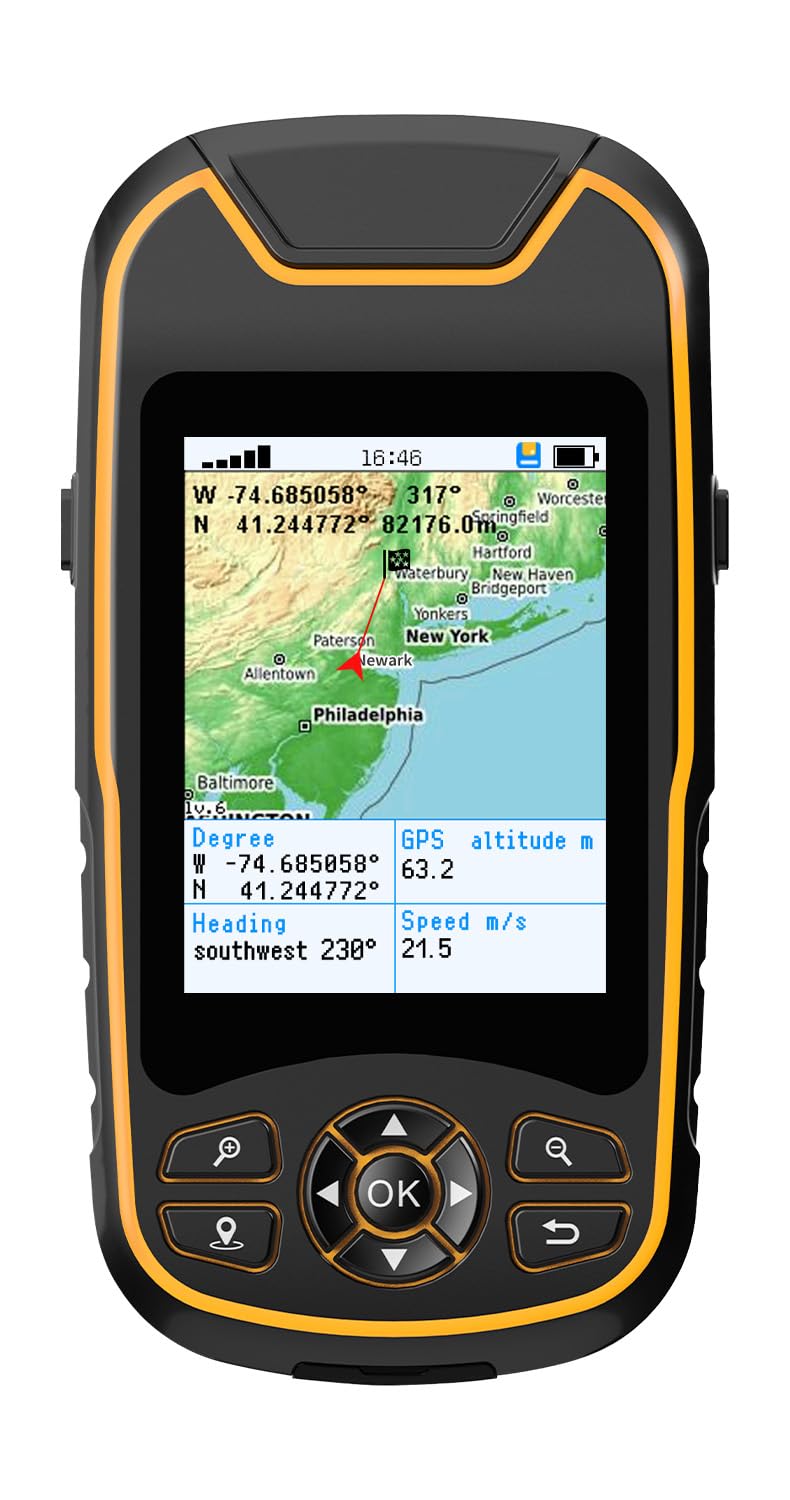
The NiesahYan Handheld GPS is an entry-level navigator that packs a surprising amount of hardware for the price, making it a viable option for first-time GPS buyers or hunters who want a low-risk backup unit. It features a 3.2-inch sunlight-readable screen — larger than most competitors at this level — with physical buttons for gloved operation. Multi-GNSS support covers GPS, Galileo, Beidou, and QZSS networks, providing positional accuracy within roughly six feet.
Preloaded USA Topo maps cover basic terrain features for hiking and camping, and the 32GB of internal memory provides ample space for additional map downloads. The 3-axis compass and barometric altimeter deliver heading and elevation data without needing satellite lock. The rechargeable battery claims up to 36 hours of runtime on a full charge via the standard USB-C port — an excellent endurance figure for multi-day hunts.
Build quality is a step below the Garmin units; the IP66 water resistance rating is sufficient for rain but not full submersion. A small subset of users report the device entering a boot loop after the first field use, and the included instruction manual is thin on detail, requiring you to search online for usage guidance. It is best suited for daytime hikes on established trails rather than demanding off-trail navigation in remote wilderness.
Why it’s great
- Large 3.2-inch sunlight-readable display with button controls
- 36-hour battery life covers extended multi-day trips
- 32GB internal memory for storing detailed map sets
Good to know
- Some units have reported boot loop failures after initial use
- Instruction manual is sparse and requires online research
FAQ
Do I need multi-band support for hunting in heavy timber?
Can I use my phone instead of a dedicated hunting GPS?
What satellite subscription plans work with the Spot X and Garmin inReach models?
Final Thoughts: The Verdict
For most users, the best gps for hunting winner is the Garmin GPSMAP 65 because it provides true multi-band satellite accuracy, accepts replaceable AA batteries, and includes preloaded TopoActive maps at a price that undercuts the flagship models while still delivering professional-grade navigation tools. If you want a large touchscreen and MIL-STD-810 durability, grab the Garmin Montana 700. And for backcountry waterfowling or island-facing tidal hunts, nothing beats the floating design and inReach SOS of the Garmin GPSMAP 86Sci.