
Nothing derails a weekend project faster than a stone repair that crumbles apart days later. Whether you are bonding a loose paver, filling a crack in a marble countertop, or rebuilding a chipped granite edge, the wrong adhesive wastes time and material. The chemistry behind a lasting bond demands more than stickiness — it requires a formula engineered for porous, dense, and often moist stone surfaces.
I’m Mohammad Maruf — the founder and writer behind Drink4Good. Over the past several years I have combed through thousands of data points, customer reviews, and manufacturer spec sheets to separate adhesives that merely claim strength from those that deliver measurable performance on natural and engineered stone.
Buying the right glue for stone means understanding the substrate, the cure speed you need, and whether the joint must withstand moisture or movement. The five products ahead represent the strongest performers across the most common stone repair scenarios.
How To Choose The Best Glue For Stone
Stone is a challenging adhesive substrate because its porosity, density, and mineral composition vary wildly across granite, marble, slate, limestone, and concrete. A glue that grips porous sandstone may bead up on polished quartz. Before you buy, match the adhesive type to the specific stone and the environmental demands of the repair.
Epoxy vs. Acrylic vs. Cementitious Pastes
Two-part epoxy is the gold standard for structural stone repairs — it delivers the highest shear strength and fills gaps without shrinking. Acrylic-based adhesives (often in syringe form) are non-toxic and cure crystal-clear, making them ideal for visible seams on kitchen countertops. Cementitious pastes are designed specifically for damp or underwater masonry repairs and can be applied thickly to rebuild missing sections of concrete or mortar.
Working Time and Cure Speed
Stone adhesives range from 5-minute quick-set formulas to slow-curing pastes that remain workable for 30–60 minutes. A fast cure is essential for vertical or overhead applications where sagging is a risk. A slower cure gives you time to align heavy stone slabs precisely before the bond locks in place.
Water and Weather Resistance
Outdoor stone repairs face freeze-thaw cycles, rain, and UV exposure. Look for adhesives rated for exterior use with a service temperature range that covers your climate. For landscaping applications like gravel binding or paver joints, water-based binders that remain flexible after curing prevent cracking under thermal expansion.
Quick Comparison
On smaller screens, swipe sideways to see the full table.
| Model | Category | Best For | Key Spec | Amazon |
|---|---|---|---|---|
| Starbond 5 Minute Epoxy Pro Kit | Epoxy Gel | General stone repair, high-stress joints | 2,600 lb shear strength | Amazon |
| HIMG Glue Adhesive for Granite | Acrylic Syringe | Countertop crack repair | 5-minute full cure | Amazon |
| Globalcom Marble & Granite Repair Kit | Resin Paste + Color | Color-matched chip filling | Hard-as-porcelain finish | Amazon |
| PC Products PC-Masonry Epoxy | Masonry Paste | Damp/wet concrete and masonry | Non-sag formula | Amazon |
| Shabebe Mulch Bond | Landscape Binder | Gravel and mulch stabilization | 12-month outdoor hold | Amazon |
In‑Depth Reviews
1. Starbond 5 Minute Epoxy Pro Kit

The Starbond Pro Kit delivers the highest measurable shear strength in this lineup at 2,600 lb, making it the clear choice for structural stone bonds — reattaching a broken granite tread, reinforcing a split limestone slab, or fixing a marble baluster. The tough-and-flex formulation absorbs vibration and thermal movement without brittle cracking, a critical feature for stone that expands and contracts with temperature swings.
The 5-minute working time is tight but manageable; you get roughly 90 seconds of positioning freedom before the epoxy gels. The kit includes reusable mixing trays and screw-cap bottles that keep the two components fresh far longer than syringe-based competitors. Curing to a clear finish in 24 hours, this epoxy handles wood, metal, glass, and ceramic as well, making it a versatile workshop staple.
Customer feedback highlights its reliability on basement crack repairs and crown molding joints (where one tester noted it held better than a leading competitor). A few users wish for a longer open time on large surface-area bonds, but for the vast majority of stone repairs the quick set is a net advantage — especially on vertical or overhead jobs where sagging would ruin the bond.
Why it’s great
- Industry-leading 2,600 lb shear rating for heavy stone bonds.
- Flexible cured formula resists thermal cracking.
- High-quality kit with reusable tools reduces waste.
Good to know
- 5-minute working time is short for large-area alignment.
- General-purpose epoxy; not optimized specifically for damp masonry.
2. HIMG Glue Adhesive for Granite, Marble, Stone

HIMG’s acrylic formula specifically targets the cosmetic repair market for polished stone surfaces. Unlike epoxy, which can yellow under UV exposure over time, this adhesive stays optically clear, making it the top choice for filling hairline cracks in white marble or bonding clear quartz seams in kitchen islands. It cures to full hardness in five minutes — faster than any other product here.
The syringe delivery system is precise and clean for small repairs, though each tube comes with only two mixing nozzles. For a single countertop crack or a broken marble edge, that is sufficient. For multiple repairs across a large surface, you will need to order extra nozzles separately. The odorless, non-toxic formulation means no fumes linger in your kitchen during application.
Reviewers report mixed results on polished granite — while many successfully repaired countertop seams, a few found the bond failed to grip the dense, non-porous stone. This makes HIMG better suited for porous marble, quartzite, and engineered stone rather than sealed granite. It is also not rated for exterior use; temperature extremes and moisture degrade the bond over time.
Why it’s great
- UV-stable clear formula will not yellow on white or light stone.
- Ultra-fast 5-minute cure for quick countertop repairs.
- Odorless and non-toxic for indoor kitchen use.
Good to know
- Limited bonding on dense, polished granite.
- Only two nozzles included; syringe is single-use.
3. Globalcom Marble & Granite Repair Kit

When a chipped corner on a quartz countertop or a deep scratch in a travertine floor needs to become nearly invisible, the Globalcom Repair Kit offers a system that goes beyond simple bonding. It includes seventeen color gels (white, beige, biscuit, thunder gray, and more) that let you blend the cured resin to match your stone’s exact vein pattern and undertone. After 12 hours of curing, the resin hardens to a density comparable to porcelain, resisting abrasion in high-traffic areas.
The kit is resin-based, not epoxy, which means it sands and polishes well after curing without the yellow tinge that some epoxies develop over time. It works on granite, marble, quartz, porcelain, ceramic, fiberglass, and acrylic surfaces — essentially any hard, non-flexible substrate in your home. Waterproof after full cure, it is suitable for sink repairs and outdoor applications as long as the surface does not undergo extreme freeze-thaw cycles.
Color matching is the clear strength here, but it is also the product’s main learning curve. Multiple reviewers note that achieving a seamless blend requires patience and practice on a test surface before attempting the actual repair. The small 3.7-ounce kit is best reserved for chips, holes, and pits smaller than a dime — large structural cracks are better served by the shear strength of an epoxy like the Starbond.
Why it’s great
- Seventeen color tints enable near-invisible seam matching.
- Hard as porcelain after curing for durable wear surfaces.
- Works on a wide range of stone, ceramic, and fiberglass substrates.
Good to know
- Color blending requires significant trial and error.
- Small 3.7-ounce kit; best for minor chips and pits only.
4. PC Products PC-Masonry Epoxy Adhesive Paste
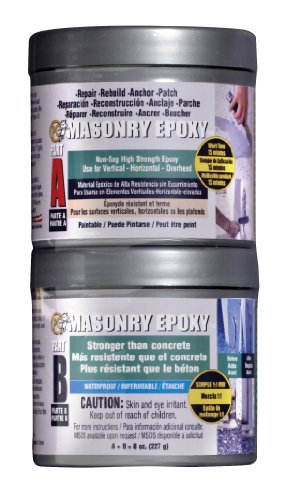
PC-Masonry Epoxy is the only product in this selection engineered specifically for wet and underwater masonry repairs. The two-part paste maintains its consistency even when applied to damp concrete — a scenario that would cause most epoxies to foam or lose adhesion. With a service temperature range from -20°F to +200°F, it handles freeze-thaw environments that destroy standard stone glues after one winter.
The non-sagging paste formula is a major advantage for overhead and vertical applications. Whether you are filling a spalled concrete beam, rebonding a loose step, or patching a pool tile step underwater (as one verified reviewer did with success), this paste stays exactly where you put it until it cures. Drying to a paintable, stainable gray surface, it integrates visually with concrete and mortar.
Mixing is straightforward but requires muscle — the thick paste demands thorough kneading to combine components fully. Reviewers note that the dough-like thickness makes application easy on vertical walls but that you will need rubbing alcohol and gloves to smooth out rough spots during the 3-hour set time. For pure masonry repair in challenging conditions, this is the most proven option available.
Why it’s great
- Works on wet surfaces and underwater for masonry repairs.
- Non-sagging paste stays put on vertical and overhead joints.
- Extreme temperature tolerance from -20°F to +200°F.
Good to know
- Thick paste requires forceful mixing; not a simple syringe.
- Gray color visible on non-masonry stone; needs painting or staining.
5. Shabebe Mulch Bond Rock Glue
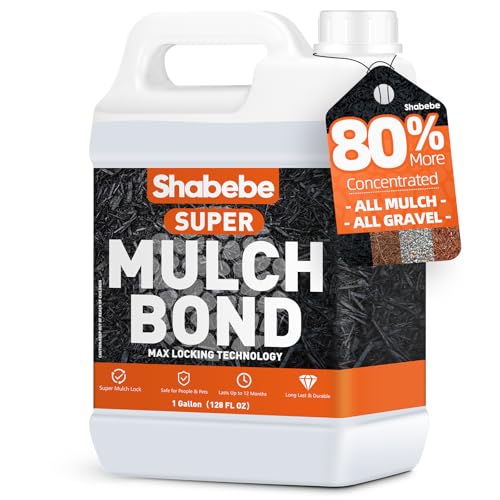
For outdoor landscaping projects where loose gravel, pea stone, or decorative pebbles need to stay put, the Shabebe Mulch Bond addresses a completely different adhesive need than the epoxy and resin products above. This water-based binder penetrates the gaps between individual stones and sets into a flexible clear matrix that holds up to 12 months through rain, wind, and leaf blower abuse. Its water-permeable nature means drainage is not compromised — an essential feature for walkways and slopes.
Application is straightforward: dilute the concentrate with water at a 1:0.2–0.5 ratio, apply via garden sprayer, and allow 12–24 hours to dry. The manufacturer recommends 2–3 coats for best results on loose gravel. Drying to a clear finish, the bond does not alter the natural appearance of the stone — a common complaint about cheaper acrylic seals that leave a glossy or whitish residue.
Customer feedback reveals that success depends heavily on surface preparation and coat count. One reviewer who applied the entire gallon to a small area with insufficient pre-wetting reported zero adhesion. Others who followed the 2–3 coat method praised the result, noting that it kept their mulch intact through heavy storms and eliminated the need to re-mulch the following season. This product is not for structural stone bonding — use it for landscape stabilization only.
Why it’s great
- Stabilizes gravel and mulch for up to 12 months outdoors.
- Water-permeable formula preserves drainage in walkways.
- Dries clear with no visible residue or shine on stone.
Good to know
- Requires 2–3 coats for reliable hold on loose gravel.
- Not suitable for structural bonding of cracked stone slabs.
FAQ
Can I use general-purpose epoxy on polished granite?
Will stone glue yellow over time under sunlight?
How do I color-match a glue repair on multicolored granite?
Final Thoughts: The Verdict
For most users, the glue for stone winner is the Starbond 5 Minute Epoxy Pro Kit because its 2,600 lb shear strength and flexible cured formula handle nearly every structural stone repair you will encounter — countertop cracks, broken treads, and loose balusters alike. If you need a precise color-matched finish for a visible chip or scratch, grab the Globalcom Marble & Granite Repair Kit. And for damp outdoor masonry or wet concrete work, nothing beats the PC Products PC-Masonry Epoxy for staying power and environmental tolerance.