
The difference between a fountain pen that writes like a dream and one that skips, feathers, or clogs almost always comes down to the ink inside it. A great blue ink doesn’t just look good on the page — it must flow consistently, dry at a reasonable speed, and refuse to bleed through cheap paper, all while delivering a shade that keeps you coming back to write more.
I’m Mohammad Maruf — the founder and writer behind Drink4Good. I’ve spent years analyzing fountain pen ink formulations, studying how different dye loads and lubricity levels affect flow across various nib sizes and paper stocks, and cross-referencing thousands of real-world user reports to separate the gems from the duds.
This guide focuses on the specific performance characteristics that matter most to everyday writers and collectors alike. Whether you need a waterproof daily driver for the office or a shimmering sheen monster for your journal, these are the bottles worth filling your pen with — my definitive list of the best blue fountain pen ink available right now.
How To Choose The Best Blue Fountain Pen Ink
Not all blue inks behave the same way. Some are engineered for heavy shading on premium paper, while others prioritize a consistent, professional appearance on standard office bond. Understanding the three factors below will help you avoid buying a bottle that fights your pen and paper combo.
Water Resistance and Document Safety
If you ever spill coffee on a letter or accidentally let a raindrop hit your journal, water resistance becomes a dealbreaker. Some blue inks are dye-based and wash away completely when wet; others use iron-gall or cellulose-reactive dyes that remain legible after a soaking. Check reviews specifically for water resistance — a beautiful blue that vanishes on first contact with moisture is useless for signatures or anything you want to archive.
Flow, Lubricity, and Nib Compatibility
Every pen has a feed that meters ink to the nib. A dry-writing pen in need of a wet ink with higher lubricity to prevent skipping — this is where brands like Lamy and Pilot often design their inks to pair perfectly with their own pens. Conversely, a very wet pen may need a drier ink to avoid flooding the page. If you run an extra-fine nib, look for inks that reviewers describe as “well-behaved” with minimal feathering, because thin lines expose poor flow properties faster than broad stubs do.
Dry Time and Feathering on Different Paper
Left-handed writers and fast note-takers care about dry time above all else. A high-saturation ink with heavy sheen often takes 25 seconds or more to dry on coated paper, but may dry in half the time on absorbent copy paper — only to feather more aggressively. The best blue inks strike a compromise: decent dry speed on cheap paper without so much absorbency that the color looks dull and lifeless. Always match the ink to the paper you actually use, not the paper you wish you had.
Quick Comparison
On smaller screens, swipe sideways to see the full table.
| Model | Category | Best For | Key Spec | Amazon |
|---|---|---|---|---|
| Pilot Namiki Blue | Mid-Range | Water-resistant daily writing | 60ml bottle | Amazon |
| Waterman Serenity Blue | Mid-Range | Vintage pen safety | 50ml bottle | Amazon |
| Lamy Blue Black | Mid-Range | Lamy pen pairing | 50ml bottle | Amazon |
| Diamine Majestic Blue | Premium | Red sheen on coated paper | 80ml bottle | Amazon |
| Pilot Iroshizuku Kon-peki | Premium | Luminous shading on good paper | 50ml bottle | Amazon |
In‑Depth Reviews
1. Pilot Iroshizuku Kon-peki
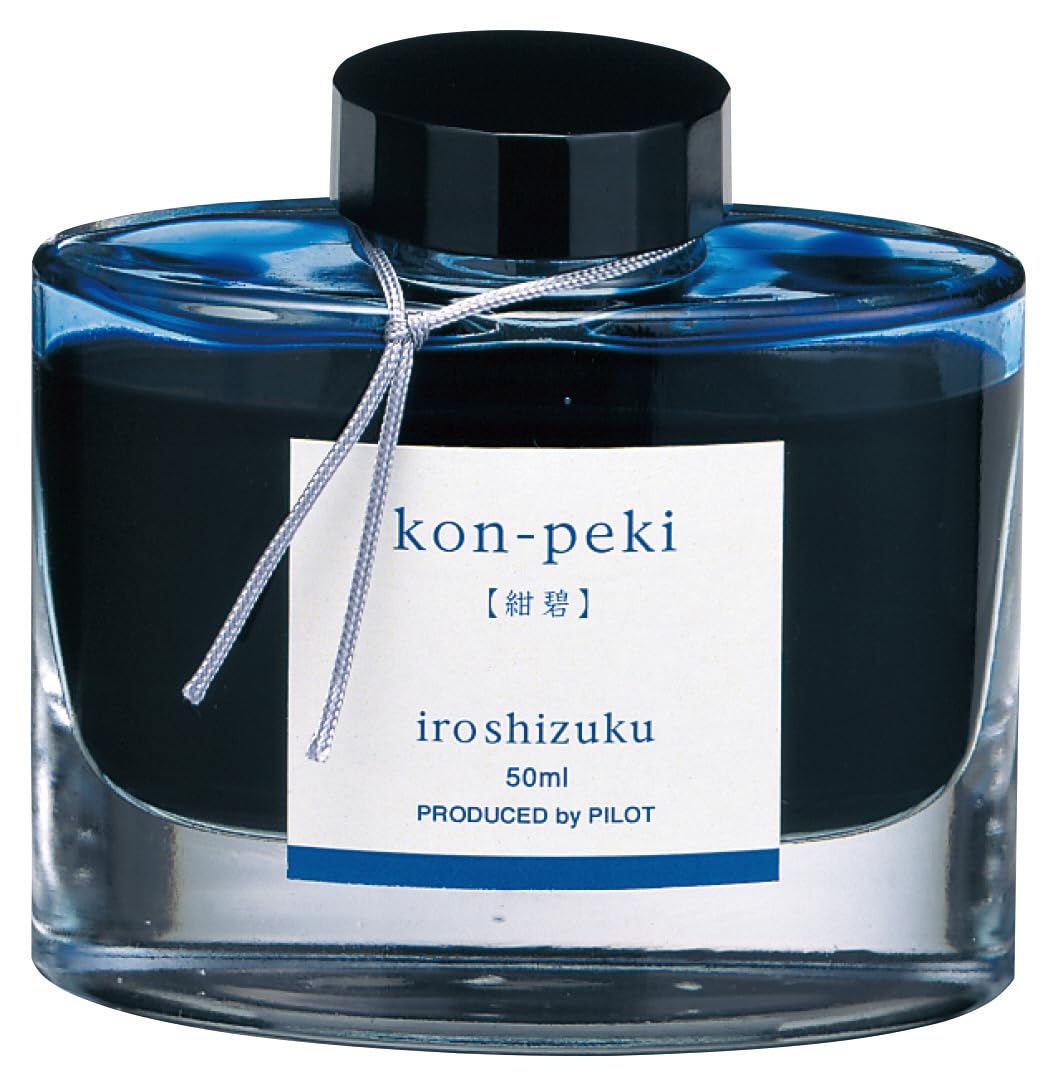
Pilot’s Iroshizuku line is celebrated globally for its exquisite color saturation, and Kon-peki (“deep azure blue”) is the entry point that turns casual writers into collectors. The dye-based formula delivers a luminous, slightly greenish blue that shades beautifully on Rhodia or Tomoe River paper, showing rich variation in every stroke. Dry time sits around 26 seconds on coated stock, so it rewards deliberate writing rather than frantic note-taking.
The bottle itself is a desk ornament — faceted glass with a wide base that feels substantial at 239 grams. Be aware that the cap design allows a small pool of ink to collect around the opening, and there is no built-in pen rest for filling. On standard copy paper, Kon-peki feathers less than most saturated blues, though it bleeds through aggressively on ultra-cheap stock. It is not waterproof at all, so keep it away from moisture if you intend to archive your work.
From extra-fine to broad nibs, Kon-peki flows smoothly without hard starts. It performs best in medium-to-wet feeds where its shading can fully express itself. The premium price reflects the color complexity and bottle design rather than any kind of document permanence, making this a top choice for the writer who values beauty over bulletproof performance.
Why it’s great
- Stunning color depth and shading on good paper
- Exceptionally smooth flow with no feathering on quality stock
- Beautifully designed glass bottle that looks premium on any desk
Good to know
- Not waterproof — fully washes away when wet
- Dry time is slow on coated paper
- Bottle cap can pool ink during filling
2. Diamine Majestic Blue

Diamine Majestic Blue is the ink that makes non-fountain-pen users stop and ask what you are writing with. On coated paper like Tomoe River or Rhodia, this water-based formula produces a dramatic red sheen that appears along the edges of heavy strokes — a party trick that belies its relatively modest price tag relative to its 80ml bottle size, which is the largest in this lineup by volume.
The ink flows freely and dries instantly on absorbent papers, but users report that on bond paper the sheen can transfer to fingers even after a full day of drying. The water resistance is minimal, so a spilled drink will erase your work entirely. Reviewers also note that on super fine nibs such as vintage Esterbrooks, the dye particles can clog the feed slot until flushed with pressure, so this ink is best matched with medium or broader nibs where its vibrancy truly shines.
On the positive side, there is zero feathering on high-quality bond and onion skin, and the color is a rich, consistent blue that outperforms many Japanese inks in the same price tier. The 80ml bottle offers excellent value per milliliter, making Majestic Blue a strong choice for the calligrapher or avid journaler who wants maximum sheen without committing to a boutique brand price.
Why it’s great
- Intense red sheen on coated paper for dramatic visual effect
- 80ml bottle provides more ink per dollar than any competitor here
- Flows smoothly with no feathering on good paper
Good to know
- Not waterproof and can transfer to fingers on bond paper
- May clog ultra-fine nibs due to dye particle density
- Dries quickly on the nib if pen is left uncapped during pauses
3. Pilot Namiki Blue

Pilot Namiki Blue is the ink that every fountain pen enthusiast should own at least one bottle of, if only to remind themselves that a great writing experience does not require a premium price tag. This 60ml bottle delivers a medium blue that closely matches the color of a disposable Pilot gel rollerball — professional, unpretentious, and immediately legible. The real star here, though, is the water resistance, which reviewers consistently describe as being far better than most dye-based blues in its price tier.
The flow is wet without being unruly, and the ink dries quickly on standard copy paper with minimal feathering or bleed-through. The bottle includes a built-in filling well at the base, making it easy to fill converters and piston-fillers even when the ink level runs low. The only trade-off is that the color feels a bit flat compared to shading-heavy options — Namiki Blue does not sheen or shade dramatically, and some users report a slight smell that they find noticeable but not offensive.
In use, this ink behaves beautifully in Pilot Custom pens and works reliably across the entire nib range from extra-fine to broad. It is a true workhorse that photocopies well and survives the occasional coffee spill. For anyone who needs a dependable blue that won’t let them down in a professional setting, Namiki Blue punches far above its weight class.
Why it’s great
- Strong water resistance for a dye-based blue ink
- Wet, smooth flow with fast dry time on standard paper
- Bottle has a built-in filling well for easy converter use
Good to know
- Color is basic and lacks shading or sheen
- Some users detect a noticeable chemical smell
- Can appear blotchy in very broad nibs
4. Waterman Serenity Blue

Waterman Serenity Blue has been in continuous production for roughly thirty years without a formula change, and there is a reason for that longevity: it is the most forgiving ink in existence. It works flawlessly in Parker 51s, Waterman 52s, Mont Blancs, and modern piston-fillers alike. The formula is pH-balanced and contains no particulate matter that could damage vintage sacs or feeds, making it the first recommendation for anyone restoring a classic pen.
The color itself is a calm, balanced blue — not too dark, not too light, with visible shading that never looks distracting. It writes smoothly with no clogging and produces crisp lines even on poor-quality office paper where many other inks feather aggressively. Reviewers consistently describe it as the safe, “Toyota Camry” of blue inks, meaning it gets the job done every single time without drama or disappointment. The 50ml faceted bottle is simple but elegant, with a secure screw-top closure that prevents evaporation over long storage periods.
Where Serenity Blue falls short is in excitement. It does not sheen, it does not offer dramatic shading, and it is not waterproof. This is an ink designed for correspondence and official documents, not for art journals or sheen-hunting. If you are a beginner who wants a bottle that will never cause a problem in any pen, Waterman Serenity Blue is the one to get.
Why it’s great
- Completely safe for vintage pens with delicate sacs
- Performs well on nearly every type of paper with minimal feathering
- Classic, professional blue color that is legible in any setting
Good to know
- No water resistance — fully washes away
- Lacks sheen and dramatic shading
- 50ml bottle is smaller than some competitors in the same price range
5. Lamy Blue Black
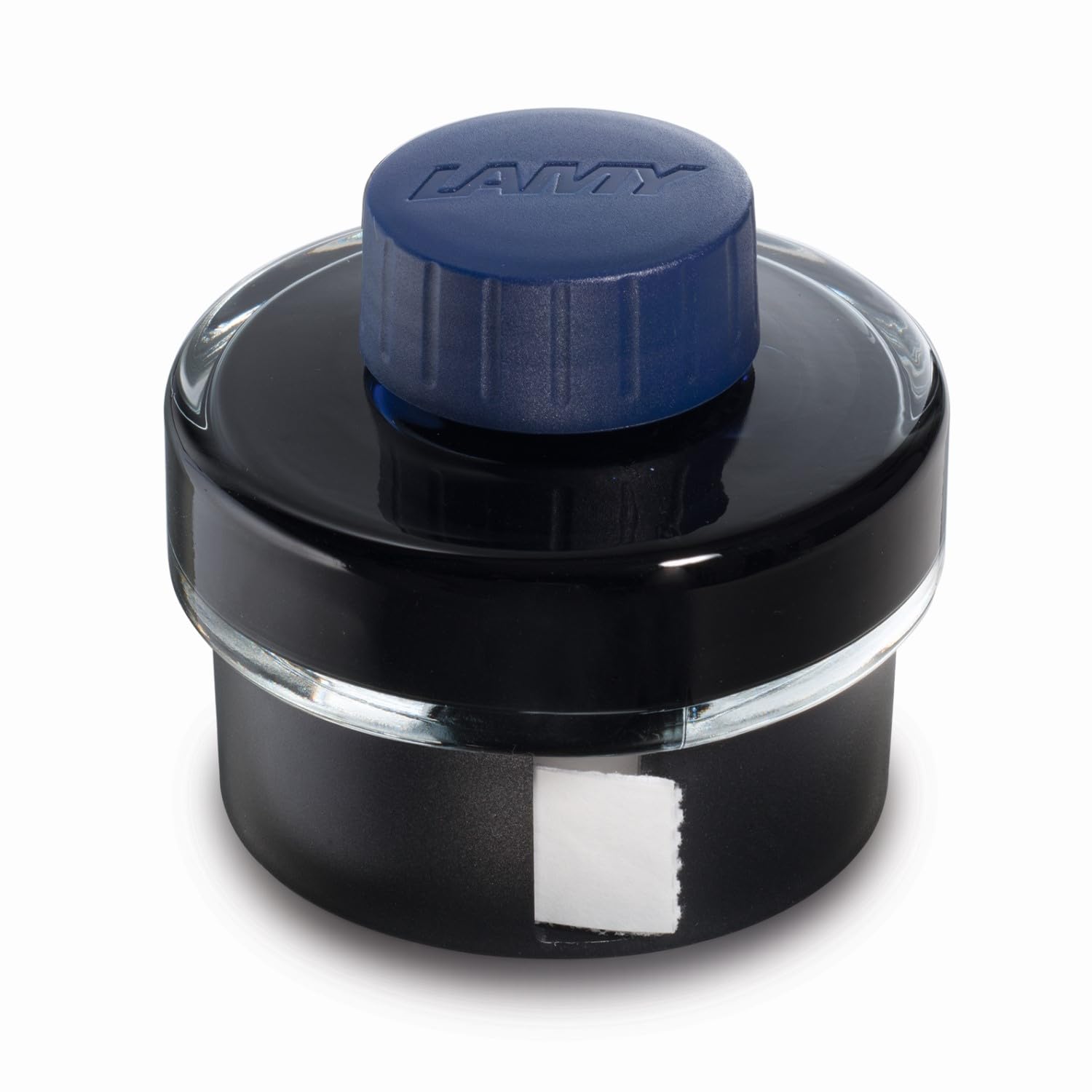
Lamy Blue Black is the official companion ink for Lamy pens, and for good reason: it is noticeably wetter than most competitor inks, providing the extra lubricity that Lamy feeds need to prevent the hard starts and drying-out issues that plague many third-party ink combinations. Lamy pens with fine nibs tend to run dry, and this ink compensates perfectly, delivering a smooth, uninterrupted flow that keeps even an extra-fine Safari writing effortlessly through long sessions.
The color is darker than a pure blue, leaning into a deep blue-black that looks almost navy in fine nibs and reveals subtle green undertones in broader strokes. It dries quickly on most paper, though some users report that the wet flow can cause feathering on low-grade office paper and that it tends to bleed through more aggressively than drier options. The 50ml glass bottle is simple in design — no fancy packaging — but the ink inside is engineered specifically to optimize Lamy pen performance.
The main drawback is that the heavy flow can make fine nibs write like mediums, which may not suit everyone’s preferences. Additionally, because it is formulated to be quite wet, it requires more frequent pen cleaning to prevent residue buildup. If you own a Lamy pen that has ever frustrated you with skipping, Lamy Blue Black is the most straightforward fix available.
Why it’s great
- Optimized for Lamy pens — prevents drying and skipping issues
- Wet, smooth flow that works well in dry-writing fine nibs
- Quick drying time on most paper types
Good to know
- Heavy flow may cause feathering on cheap paper
- Can make fine nibs write broader than expected
- Requires more frequent pen cleaning than drier inks
FAQ
How do I clean sheening ink from my pen after use?
Can I mix different brands of blue ink in one bottle?
Final Thoughts: The Verdict
For most users, the best blue fountain pen ink winner is the Pilot Iroshizuku Kon-peki because it delivers unmatched color richness, smooth flow, and a premium bottle experience that elevates every writing session. If you want a workhorse that survives accidental spills and works flawlessly in any pen, grab the Pilot Namiki Blue. And for explosive red sheen that turns heads on coated paper, nothing beats the Diamine Majestic Blue with its massive 80ml bottle and jaw-dropping visual effect.