
Plastic and rubber are two of the most stubborn materials to bond together, each with unique flex, oil, and temperature tolerances that make standard glues fail quickly. A brittle epoxy cracks under vibration, and a basic cyanoacrylate won’t hold against the constant flex that rubber demands. Finding a formula that stays pliable yet strong is the real challenge.
I’m Mohammad Maruf — the founder and writer behind Drink4Good. I’ve spent years researching adhesive chemistries, analyzing cure times, thermal limits, and real-world failure modes across consumer, automotive, and marine-grade bonding products.
After sifting through dozens of formulations and real user feedback, these picks provide the most reliable solutions for permanent, flexible, and durable bonds. This is the definitive guide to the best glue for plastic to rubber.
How To Choose The Best Glue For Plastic To Rubber
Choosing the right adhesive for plastic-to-rubber repairs is about more than just picking the strongest bottle on the shelf. You need a formula that stays flexible after curing, resists the oils and plasticizers that leach from rubber, and can handle the thermal expansion of both materials. Failure to match the glue type to your specific substrate combination and usage environment will result in a bond that snaps or peels apart under stress.
Flexibility vs. Rigidity
A rigid glue will shatter when the rubber part bends or twists. Look for adhesives explicitly described as “toughened,” “flexible,” or “vibration-absorbing.” Two-part epoxies like the G/Flex are engineered with rubber particles that create a semi-flexible matrix, ideal for rubber-to-plastic joints that undergo movement. Traditional super glues can work if the joint is supported, but they lack the elongation needed for high-flex scenarios.
Resistance to Plasticizers and Oils
Rubber, especially synthetic blends like neoprene and SBR, contains plasticizers that migrate to the surface over time. These oils can weaken many common glues, causing the bond to fail weeks or months later. A solvent-based contact cement (like S-18) or a high-grade cyanoacrylate (like the KRAFTPROTZ automotive glue) is formulated to resist this chemical leaching, maintaining a long-lasting hold even on oily rubber.
Surface Preparation and Application Environment
No adhesive can overcome a dirty or glossy surface. Both plastic and rubber require scuffing with fine-grit sandpaper and cleaning with isopropyl alcohol to remove mold-release agents, grease, and dirt. Additionally, consider ventilation, cure time, and temperature requirements. Some spray adhesives need 30 minutes of open time before positioning, while epoxy gels allow for slower adjustments. If you’re working outdoors or in a confined space, low-VOC options become critical.
Quick Comparison
On smaller screens, swipe sideways to see the full table.
| Model | Category | Best For | Key Spec | Amazon |
|---|---|---|---|---|
| G/Flex 655-1 | Flexible Epoxy | Marine & high-flex repairs | Full cure in 24 hours | Amazon |
| S-18 All-Purpose | Contact Cement | Rubber-to-metal & large surface areas | Suitable for neoprene bonding | Amazon |
| Gorilla Max Strength | Hybrid Paste | Gap-filling & discreet indoor repairs | Dries crystal clear | Amazon |
| KRAFTPROTZ Super Glue Gel | Cyanoacrylate Gel | Automotive trim & vibration-prone parts | Heat resistant up to 230°F | Amazon |
| 3M Hi-Strength 94 ET | Spray Adhesive | Large laminations & upholstery | 60-minute repositioning window | Amazon |
In-Depth Reviews
1. G/Flex 655-1 1 oz Syringe

The G/Flex 655-1 is a toughened two-part epoxy specifically formulated to bond dissimilar materials like plastic and rubber. What sets it apart is its ability to absorb the stress of expansion, contraction, shock, and vibration without cracking — a requirement when rubber meets a rigid plastic surface. It cures to a semi-flexible state that stays waterproof and clear, making it a top choice for marine kayak repairs, snowboard fixes, and any outdoor equipment that sees constant flexing.
Coming in a precise 1 oz syringe, the mixing and application is mess-free, though the full 24-hour cure time means you need to clamp or tape the parts together for a full day. Users report successful bonds on roto-molded kayak plastic, water tanks, and even split couch wood, demonstrating its versatility. The flexibility after cure is the key advantage — it won’t shatter when the rubber part twists or bends.
Because it’s a thicker epoxy, it also fills small gaps between uneven mating surfaces. The resin is slightly more expensive than basic epoxy, but the bond reliability in flexible joints justifies the cost. For any plastic-to-rubber repair that experiences movement or moisture, this is the standard to beat.
Why it’s great
- Fully flexible after curing — absorbs shock and vibration
- Waterproof and clear, ideal for marine and outdoor repairs
- Syringe format ensures accurate 1:1 mixing ratio
Good to know
- Full 24-hour cure requires clamping or taping
- Higher cost per ounce compared to rigid epoxies
2. S-18 All-Purpose Adhesive
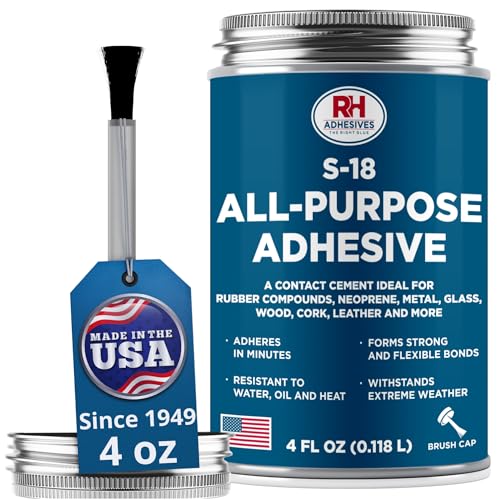
The S-18 from RH Adhesives is a solvent-based neoprene contact cement that excels at bonding rubber to metal and various plastics. Its thin liquid consistency penetrates porous rubber surfaces and creates a high-strength film that resists oil and aging. Made in America since 1949, this formula is designed for commercial and DIY projects where durability across temperature swings is needed.
Application requires brushing or rolling both surfaces and letting the solvent flash off before mating them — this creates an instant grab that only gets stronger over 24 hours. Users have successfully bonded leather boot soles, neoprene car covers, and rubber to metal brackets. However, the solvent has a strong chemical smell, so good ventilation is non-negotiable. One user noted that the glue degraded over time if the can was left open.
For projects where you need a strong, flexible bond on large surface areas like rubber sheeting to plastic panels, S-18 is reliable and proven. It is less suitable for small, precise repairs due to its thin viscosity, but for broad-area laminations, it’s the best option here.
Why it’s great
- Excellent peel strength and oil resistance on rubber
- Creates strong films for large surface laminations
- Trusted brand with decades of industrial use
Good to know
- Solvent has strong fumes — use only in ventilated areas
- Thin liquid can be messy for small spot repairs
3. Gorilla Max Strength Construction Adhesive
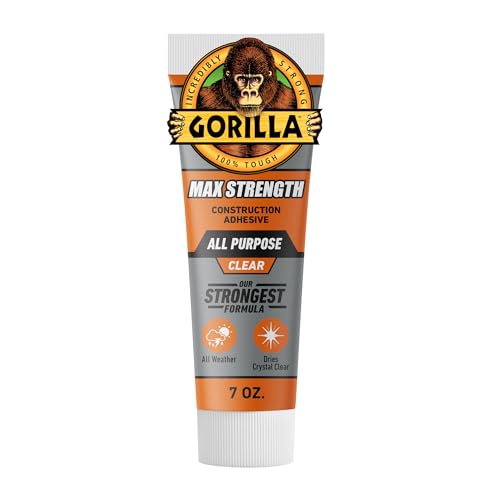
Gorilla Max Strength Construction Adhesive is a hybrid paste that bridges the gap between a caulk and a glue. Its crystal-clear formula is ideal for discreet repairs where you don’t want a visible glue line, and it doubles as a gap-filling adhesive. Gorilla claims this formula is twice as strong as their Heavy Duty Construction Adhesive, and it is waterproof even for underwater applications.
The paste consistency stays where you place it, making it excellent for vertical applications like repairing a plastic trim piece to a rubber gasket. It bonds in about 30 seconds and cures to a hard rubber-like feel that withstands car interior heat and vibration. Users report success bonding metal to wood, but also note the glue is very sticky and difficult to remove from skin — gloves are essential.
One limitation is that the 7 oz squeeze tube puts out more glue than needed for small repairs, and the tip can produce gobs if not controlled. It works best for medium to large repairs where gap-filling and a clear finish are priorities. The final bond has a slightly rubbery consistency that pairs well with flexible materials.
Why it’s great
- Dries crystal clear — nearly invisible bond line
- Fills gaps and is fully waterproof
- Quick initial tack in about 30 seconds
Good to know
- Squeeze tube can dispense too much product for precise work
- Requires clamping to prevent parts from sliding during cure
4. KRAFTPROTZ Automotive Super Glue Gel
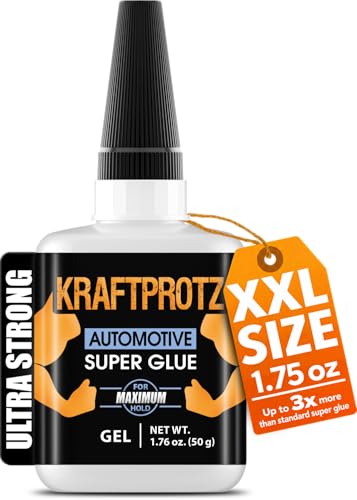
Engineered for vehicles, this cyanoacrylate gel from KRAFTPROTZ resists engine vibration, road shock, and temperatures up to 230°F. The no-drip formula stays in place on vertical car parts, making it perfect for plastic bumpers, rubber trim, mirror housings, and dashboard panels. Its XXL 1.76 oz bottle gives three times the glue of standard tubes, catering to mechanics and frequent repairers.
The anti-clog tip ensures consistent flow even after weeks between uses, and the gel viscosity allows for precise application into tight angles. Users report permanent fixes on split bumpers, broken car mirrors, and rubber RV molding that held through rain and heat. It has a slower setup than typical super glue, which is actually an advantage — you get 2-3 minutes to clamp and align parts before it grabs.
Because it’s cyanoacrylate, the bond is rigid once cured, so it’s best for non-moving joints or where the rubber part is supported. It should not be used on parts that require constant flexing or bending. For automotive trim, brackets, and plastic-to-rubber interior repairs that need heat resistance, this is the specialized solution.
Why it’s great
- Withstands heat up to 230°F and resists automotive fluids
- No-drip gel stays put on vertical surfaces
- Anti-clog tip prevents drying between uses
Good to know
- Rigid bond — not suitable for high-flex rubber parts
- Slower set time than standard super glue
5. 3M Hi-Strength 94 ET Spray Adhesive
The 3M Hi-Strength 94 ET is a heavy-duty spray contact adhesive ideal for bonding large surface areas of rubber, plastic, metal, and wood. Its stand-out feature is a 60-minute repositioning window — you can spray both surfaces, let the solvent flash off, and still adjust the parts for up to an hour before the bond becomes permanent. This makes it invaluable for upholstery, laminations, and foam-in-blind applications.
Users have successfully used it to stick foam soundproofing to plastic panels in freezing temperatures and for reupholstering cushion covers. The spray format provides fast, even coverage that would take ages with a brush. However, the solvent has a strong “airplane glue” smell, so a respirator and good ventilation are mandatory. One note: users report the can lasts about 18 months if stored properly.
Being GREENGUARD certified and low-VOC, it’s a better choice for indoor use than many solvent-based options, but the smell is still potent during application. For large-area plastic-to-rubber bonding where coverage speed and repositionability matter, this spray adhesive is unmatched. It’s not for small precision repairs, but for big jobs, it’s the top performer.
Why it’s great
- 60-minute open time allows precise positioning
- Even spray coverage for large surface areas
- Low-VOC and GREENGUARD certified
Good to know
- Strong fumes require mask and ventilation
- Not suitable for small, precise repairs
FAQ
Can I use standard super glue for plastic to rubber repairs?
How do I prepare rubber and plastic surfaces for gluing?
I need to glue rubber to plastic on a car exterior. What should I use?
Final Thoughts: The Verdict
For most users, the best glue for plastic to rubber winner is the G/Flex 655-1 because it delivers the flexibility, waterproofing, and shock absorption that both materials demand while remaining clear and easy to mix. If you need a contact cement for large rubber-to-metal bonding, grab the S-18 All-Purpose Adhesive. And for precise automotive trim and vibration-prone parts, nothing beats the KRAFTPROTZ Automotive Super Glue Gel.