
Chasing a stable 144 frames per second at 1080p without emptying your wallet is the defining challenge of modern PC gaming. You need a card that pushes enough raw raster performance without bottlenecking your high-refresh monitor, and the market is flooded with options that either fall short or offer far more than you actually need.
I’m Mohammad Maruf — the founder and writer behind Drink4Good. I spend my time dissecting GPU benchmarks, analyzing raster and ray tracing performance, and tracking driver maturity across hundreds of user reports to find the real-world value for specific monitor targets like 1080p 144Hz.
This guide breaks down nine graphics cards that can genuinely deliver on a high-refresh 1080p setup. Whether you lean toward team green or red, there is a gpu for 1080p 144hz that fits your performance expectations and build constraints without forcing you into a premium tier you don’t need.
How To Choose The Best GPU For 1080p 144Hz
Not every card that claims to be “for gaming” can keep frame times consistent at 144Hz. You need to look beyond the core clock speed and consider memory bandwidth, power delivery stability, and how the card handles the specific titles you play.
Raster Performance vs. Upscaling
At 1080p 144Hz, raw raster performance is still king. While DLSS and FSR can boost frame rates, the most reliable experience comes from a card that can hit 144 FPS natively in competitive shooters and stays above 100 FPS in demanding AAA titles without relying entirely on upscaling.
VRAM Size and Memory Bandwidth
8GB of VRAM is the absolute minimum for 1080p 144Hz in modern titles, but some games already push past that buffer with high-resolution texture packs. A 12GB or 16GB card provides future-proofing, but memory bandwidth — measured by GDDR generation and bus width — often matters more for sustaining high frame rates in the short term.
Power Draw and Thermal Headroom
Cards with a total board power under 200W are easier to cool and place less strain on your PSU, which is ideal for SFF builds or budget systems. Premium cards with higher TDPs offer more headroom for overclocking, but you need to pair them with adequate case airflow and a reliable power supply.
Quick Comparison
On smaller screens, swipe sideways to see the full table.
| Model | Category | Best For | Key Spec | Amazon |
|---|---|---|---|---|
| ASUS RTX 5060 | Mid-Range | Balanced 1080p high-refresh | 8GB GDDR7, PCIe 5.0 | Amazon |
| GIGABYTE RX 9060 XT | Mid-Range | Value-focused high-FPS gaming | 8GB GDDR6, 2700 MHz | Amazon |
| PNY RTX 5060 Epic-X | Mid-Range | Triple-fan cooling | 8GB GDDR7, 2280 MHz | Amazon |
| ASRock Arc B580 | Budget-Friendly | 12GB VRAM at low cost | 12GB GDDR6, 2740 MHz | Amazon |
| XFX Speedster RX 7600 | Budget-Friendly | Ultra-compact 1080p entry | 8GB GDDR6, 2655 MHz | Amazon |
| MSI RTX 5050 | Budget-Friendly | Entry-level 144Hz gaming | 8GB GDDR6, 2617 MHz | Amazon |
| GIGABYTE RTX 5070 | Premium | Maximum 1080p 144Hz+ headroom | 12GB GDDR7, 2625 MHz | Amazon |
| ASUS RX 9070 XT | Premium | Future-proof 16GB VRAM | 16GB GDDR6, 4000 MHz | Amazon |
| Sapphire RX 9070 XT | Premium | Silent high-refresh operation | 16GB GDDR6, Dual HDMI/DP | Amazon |
In‑Depth Reviews
1. ASUS Dual NVIDIA GeForce RTX 5060 8GB GDDR7 OC Edition

The ASUS RTX 5060 bridges the gap between entry-level and mid-range with GDDR7 memory and PCIe 5.0 support, fixing the bandwidth bottleneck that held back the previous generation. With a boost clock of 2565 MHz and 150W TDP, it delivers raster performance near a 2080 Ti while staying cool enough for SFF cases. In Fortnite at 1080p, users report hitting 140 FPS without issue, and the 0dB fan mode keeps the system silent during lighter workloads.
Build quality is excellent for a dual-fan card, featuring an axial-tech design with a reinforced backplate and a 2.5-slot footprint. The card supports DLSS 4 and multi-frame generation, which smooths out the 1% and 0.1% lows in demanding titles. While 8GB of GDDR7 is sufficient for 1080p 144Hz today, users have noted that ray tracing on an 8GB card is not recommended at high settings due to VRAM limitations.
Adobe Premiere users saw rendering exports improve by 5x to 10x compared to older GPUs, making this a solid choice for hybrid gaming and productivity builds. The card requires a PCIe 5.0 slot for full bandwidth, but it remains backward compatible with PCIe 4.0 systems at a minor performance cost.
Why it’s great
- GDDR7 memory eliminates previous generation bandwidth bottlenecks
- Excellent efficiency at 150W TDP with SFF-friendly dimensions
- DLSS 4 multi-frame generation improves frame-time consistency
Good to know
- 8GB VRAM limits ray tracing at high settings
- Requires PCIe 5.0 for optimal bandwidth
- No RGB lighting, which may disappoint some builders
2. Sapphire Nitro+ AMD Radeon RX 9070 XT Gaming OC 16GB

The Sapphire Nitro+ RX 9070 XT is a premium card that easily exceeds the requirements for 1080p 144Hz, offering 16GB of GDDR6 memory on a 256-bit bus. It runs incredibly quiet, with users describing it as “silent but deadly,” maintaining low temperatures even under sustained loads. At 1080p, this card will max out virtually any title at well over 144 FPS, giving you headroom for higher refresh rates or future 1440p upgrades.
The build quality is outstanding, with a massive heatsink and triple-fan design that keeps noise levels down even during extended gaming sessions. The card includes dual HDMI and dual DisplayPort outputs, which is uncommon for premium GPUs and useful for multi-monitor setups. The 16GB VRAM pool ensures that high-resolution texture packs in modern games won’t force you to dial down settings.
While this card is overkill for pure 1080p 144Hz gaming, it provides the most future-proof option if you plan to move to a higher resolution monitor within the next few years. The AMD RDNA 4 architecture also offers excellent ray tracing performance improvements over previous generations, bridging the gap with NVIDIA’s RT offerings.
Why it’s great
- Extremely quiet operation under full load
- 16GB VRAM provides maximum future-proofing
- Excellent build quality with dual HDMI outputs
Good to know
- Overkill for strict 1080p 144Hz use
- Larger card requires case clearance check
- Premium price tier
3. GIGABYTE GeForce RTX 5070 Gaming OC 12G

The GIGABYTE RTX 5070 Gaming OC is the sweet spot for users who want to push beyond 144 FPS at 1080p while maintaining quiet operation. With 12GB of GDDR7 memory on a 192-bit bus and a boost clock of 2625 MHz, this card handles demanding titles like Cyberpunk 2077 and Hogwarts Legacy at high settings without breaking a sweat. The WINDFORCE cooling system keeps temperatures low even at 100% load, and the dual BIOS allows you to toggle between performance and quiet modes.
The card features Halo RGB lighting on the side and a reinforced structure that prevents sagging in larger cases. Users have praised the build quality, noting that the card runs “quiet even at full fan speed.” The 12GB VRAM buffer is a significant step up from 8GB cards, providing more breathing room for texture-heavy games and future titles.
Multi-frame generation from DLSS 4 further smooths out frame pacing, ensuring that 1% lows stay above the 144Hz threshold. While this card is more than capable of 1440p 144Hz, its price-to-performance ratio for 1080p high-refresh gaming is exceptional, especially when compared to the premium tier of RTX 5080 or 5090 cards.
Why it’s great
- 12GB GDDR7 memory for future-proofing
- Quiet operation with dual BIOS options
- Great performance headroom for 144Hz+ at 1080p
Good to know
- Large physical footprint requires case check
- Premium price compared to mid-range options
- Overkill for less demanding competitive titles
4. PNY NVIDIA GeForce RTX 5060 Epic-X ARGB OC Triple Fan
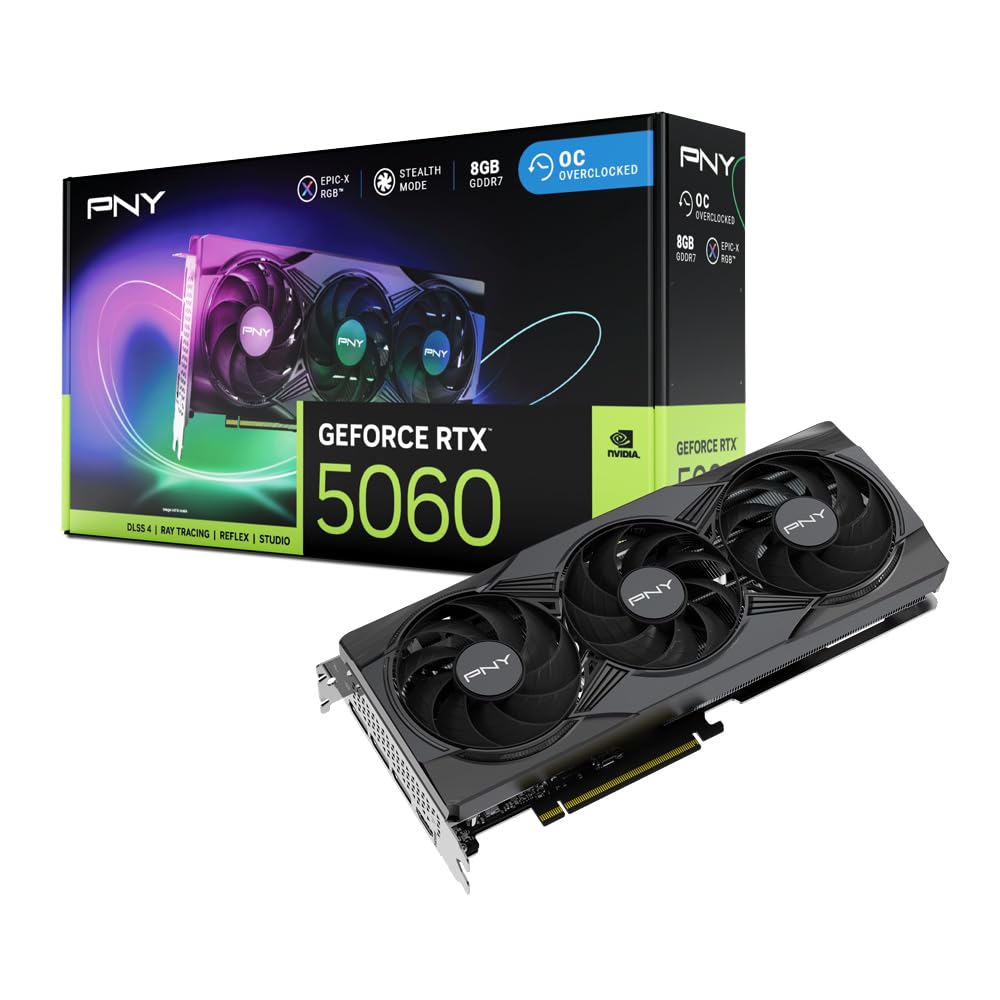
The PNY RTX 5060 Epic-X stands out in the mid-range segment with its triple-fan ARGB cooling solution, which keeps thermals in check even during extended gaming sessions. With 8GB of GDDR7 memory and a core clock of 2280 MHz, this card delivers reliable 100+ FPS performance in almost every game at 1080p high settings. Users report achieving 74 FPS in demanding PC titles and well over 100 FPS in competitive shooters, making it a strong contender for high-refresh gaming.
The card is SFF-ready and fits comfortably in most mid-tower cases, with a 2-slot design that doesn’t interfere with other components. It includes fifth-gen Tensor Cores and fourth-gen Ray Tracing Cores, giving you access to DLSS 4 and Reflex technologies for smoother gameplay and lower latency. The ARGB lighting on the fans adds a premium aesthetic touch that many gamers appreciate.
Installation is straightforward, and the card is compatible with AMD 5 9600X systems without issues. Power consumption is well-managed, and the triple-fan setup runs quietly under normal loads. Some users noted the need for a driver update after initial setup, but once configured, the card runs stable and cool.
Why it’s great
- Triple-fan cooling keeps temps low under load
- Supports DLSS 4 and Reflex for competitive gaming
- ARGB lighting adds visual appeal
Good to know
- May require initial driver update
- 8GB VRAM limits ray tracing potential
- PCIe x8 interface may impact bandwidth in some setups
5. GIGABYTE Radeon RX 9060 XT Gaming OC 8G

The GIGABYTE RX 9060 XT Gaming OC delivers exceptional value for 1080p 144Hz gaming, powered by AMD’s RDNA 4 architecture and a 2700 MHz boost clock. Users consistently report hitting 240 FPS in Fortnite and maintaining smooth frame rates in demanding titles like DCS at high settings. The WINDFORCE cooling system with Hawk fans keeps temperatures stable even when overclocked, and the zero-RPM idle mode ensures silent operation during lighter workloads.
The card features 8GB of GDDR6 memory, which is sufficient for 1080p high-refresh gaming in most current titles. It includes AV1 encoding support and FSR upscaling for titles that benefit from AI-enhanced resolution. The dual-slot design and standard 8-pin power connector make it easy to install in most mid-tower cases, though users note it is a large card that requires clearance.
Ray tracing on the RX 9060 XT has improved with RDNA 4, but it is still not a primary strength compared to NVIDIA’s RTX series. If ray tracing is a priority, you may want to look at the RTX 5060 or 5070. However, for pure raster performance, the RX 9060 XT offers the best dollar-for-dollar performance in its class, with users calling it “the best budget GPU right now.”
Why it’s great
- Excellent raster performance for 1080p 144Hz
- Zero-RPM idle mode for silent operation
- AV1 encoding and FSR support
Good to know
- Ray tracing is not a strength
- Large card requires case clearance check
- Some coil whine reported during initial use
6. ASRock Intel Arc B580 Challenger 12GB OC

The ASRock Intel Arc B580 Challenger is a compelling budget-friendly option that offers 12GB of GDDR6 memory — more than any other card in its price range. With a 2740 MHz engine clock and Intel’s Xe2-HPG architecture, it delivers 60+ FPS at 1440p in most titles and can handle 1080p 144Hz gaming in competitive shooters and less demanding AAA games. Users have praised it as “the best graphics card you can get for this amount of money,” noting its excellent value for esports and indie gaming.
The dual-fan cooling system with 0dB Silent Technology stops the fans completely during low loads, making it ideal for quiet builds. The card requires REBAR support (10th gen Intel or higher) for optimal performance; without it, the card underperforms significantly. This makes it less suitable for older systems but a great fit for modern budget builds.
Driver support has improved significantly since launch, with reviewers noting stable performance on both Windows and Linux. The card handles high bit-rate streaming tasks well, rivaling the RTX 3070 in encoding capabilities while consuming power similar to an RTX 3050. The 12GB VRAM buffer is particularly attractive for creative workflows and texture-heavy game mods.
Why it’s great
- 12GB VRAM at a budget-friendly price
- 0dB Silent Cooling for quiet operation
- Excellent encoding performance for streaming
Good to know
- Requires REBAR support for good performance
- Driver installation can be cumbersome
- Not ideal for maximum settings in demanding AAA titles
7. MSI Gaming RTX 5050 8G Shadow 2X OC
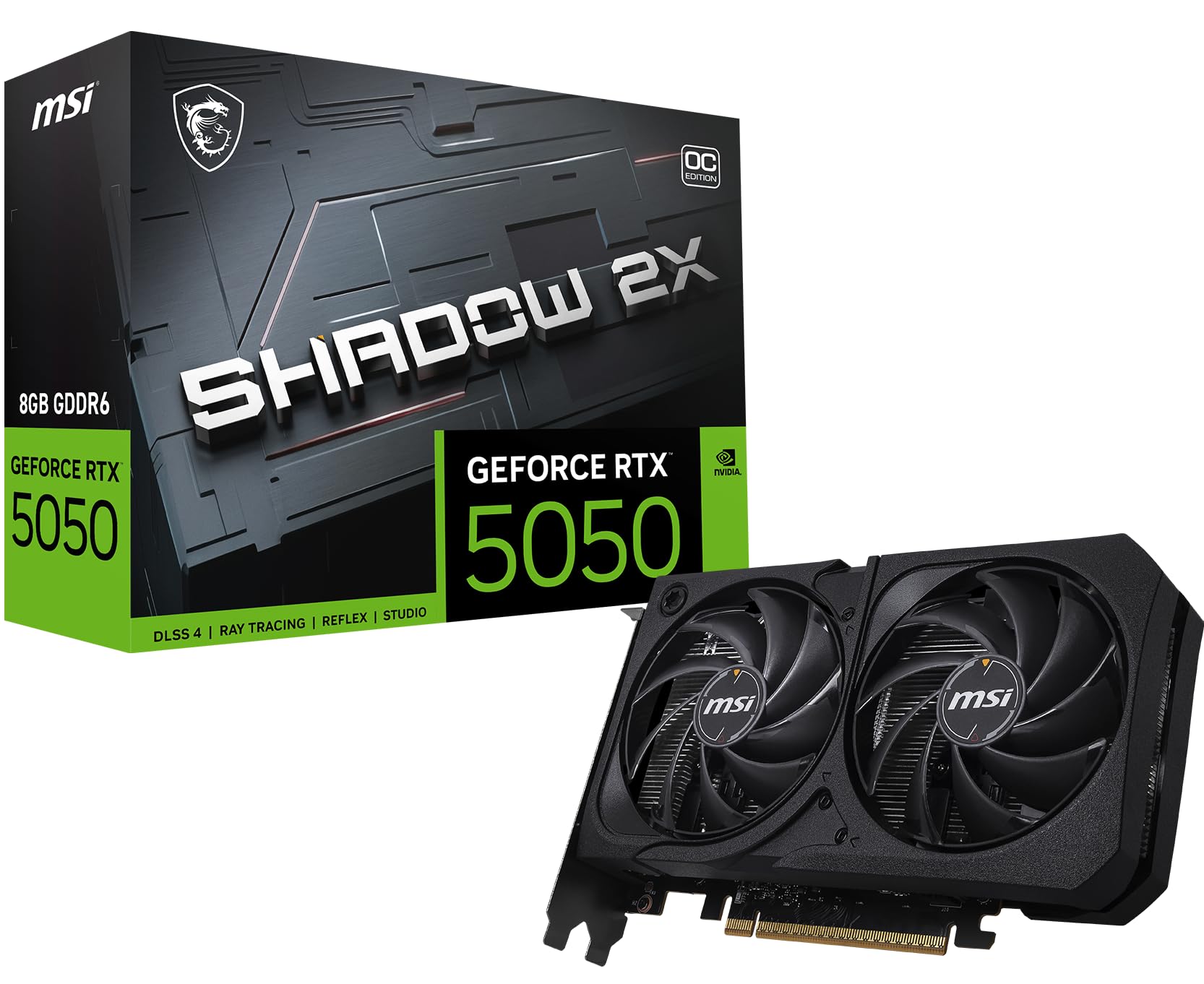
The MSI RTX 5050 Shadow 2X OC serves as the entry point for NVIDIA’s Blackwell architecture, offering 8GB of GDDR6 memory with a boost clock of 2617 MHz. It’s an excellent budget-friendly card for achieving 1080p 144Hz in competitive shooters like Fortnite, where users report 120-180 FPS on low-to-medium settings. The card is compact at 7.8 inches long and runs very quietly, making it a solid choice for smaller builds.
The TORX Fan 5.0 design with linked fan blades stabilizes airflow, and the heat pipe cooling system effectively draws heat away from the GPU. Users note that the card works perfectly with PCIe 3.0 motherboards, though PCIe 4.0 does improve performance. The card’s low profile and quiet operation make it a good upgrade for pre-built systems that lack extensive airflow.
While the RTX 5050 is not intended for high-end gaming, it handles older titles, indie games, and esports titles with ease. One user upgraded from an RX 580 and found that the RTX 5050 reduced clip encoding time from over a minute to just 10-15 seconds. The card is also compatible with DLSS 4, providing an additional performance boost in supported titles.
Why it’s great
- Budget-friendly entry to Blackwell architecture
- Compact size fits in smaller cases
- Quiet operation with efficient cooling
Good to know
- Manual overclocking is tricky
- Not suitable for high-FPS AAA gaming
- May require a power supply upgrade
8. XFX Speedster SWFT210 Radeon RX 7600 8GB

The XFX Speedster SWFT210 RX 7600 is a compact, dual-fan card that excels in 1080p 144Hz gaming for VR and esports titles. With 8GB of GDDR6 memory and a boost clock of 2655 MHz, it handles games like Assetto Corsa, Half-Life Alyx, and Project Cars 2 at the highest settings. Users shifting from a GTX 1650 Super saw a dramatic improvement, and the card’s small footprint made it easy to install in a compact HP PC case.
The card runs cool and quiet after a driver update, with maximum temperatures in the upper 70s Celsius at 60% fan speed. It supports all three displays immediately on Linux systems, and switching from Nvidia on Arch Linux was simple with the Vulkan-radeon and Mesa drivers. The card’s low power draw makes it a good fit for budget PSUs and smaller cases.
While the RX 7600 is not designed for high-resolution or high-FPS gaming, it is a solid performer for 1080p 144Hz in moderately demanding titles, emulators, and CAD work. Some users noted that the newer RX 9060 XT 8GB offers similar performance at a comparable price, but the RX 7600 remains a reliable option for those on a tighter budget.
Why it’s great
- Compact size fits in small cases
- Excellent for VR gaming at 1080p
- Runs cool and quiet after driver update
Good to know
- Requires driver update to fix initial high temps
- Not ideal for high-res/high-FPS gaming
- Newer alternatives offer better value
9. ASUS Prime AMD Radeon RX 9070 XT 16GB OC Edition

The ASUS Prime RX 9070 XT OC Edition is a premium card that delivers exceptional 1080p 144Hz performance with 16GB of GDDR6 memory and a 4000 MHz clock speed. The axial-tech fans and phase-change GPU thermal pad provide excellent cooling performance, keeping idle temperatures at 28-32 Celsius and stressed temperatures at 55-59 Celsius. Users have praised it as “the best affordable GPU currently” for its outstanding performance on both Windows and Linux.
The card features a 2.5-slot design for SFF compatibility, dual-ball fan bearings that last twice as long as standard sleeve bearings, and 0dB technology for silent operation during light gaming. It requires three PCIe power connectors and a 750W PSU, making it a higher-demand card in terms of power delivery. The dual BIOS switch allows users to toggle between performance and quiet modes.
While this card is overkill for strict 1080p 144Hz use, it provides massive headroom for future upgrades to 1440p or 4K gaming. Users report 100-110 FPS at 1440p ultra settings in Red Dead Redemption 2, which is 20-30 FPS faster than the RX 6800. The 16GB VRAM buffer ensures you won’t hit memory limits in demanding titles, and AMD’s RDNA 4 architecture offers competitive ray tracing performance.
Why it’s great
- 16GB VRAM provides maximum future-proofing
- Excellent cooling with dual-ball fan bearings
- Great performance on both Windows and Linux
Good to know
- Requires three PCIe power connectors
- Large card requires case clearance check
- ASUS warranty support has been noted as poor
FAQ
Is 8GB of VRAM enough for 1080p 144Hz gaming?
Do I need a PCIe 5.0 motherboard for these GPUs?
How much power supply do I need for a 1080p 144Hz GPU?
Can these cards handle ray tracing at 1080p 144Hz?
Final Thoughts: The Verdict
For most users, the gpu for 1080p 144hz winner is the ASUS RTX 5060 because it delivers the perfect balance of GDDR7 memory, PCIe 5.0 support, and DLSS 4 features at a mid-range price. If you want the best raster performance for your dollar, grab the GIGABYTE RX 9060 XT. And for maximum future-proofing with 16GB VRAM and silent operation, nothing beats the Sapphire RX 9070 XT.