
The real magic of a game night isn’t the snacks or the scorekeeping—it’s that moment when a single question stops the room cold, someone blurts out a wild guess, and the whole table erupts. Finding that specific energy in a box is harder than it looks. Most trivia titles fall flat after one round, party games lean too heavily on pop culture you’ve never followed, and the “classic” re-releases sometimes forget what made them fun in the first place.
I’m Mohammad Maruf — the founder and writer behind Drink4Good. I dig through customer test results, component quality reports, and real-world gameplay feedback to separate the genuinely replayable from the one-night wonders.
Whether you’re wrangling a multi-generational family dinner or a competitive couples’ night, this guide covers five of the most reliable game show games on the market right now, ranked by how well they hold up under real pressure.
How To Choose The Best Game Show Games
The game show category is deceptively broad. A fast word-association title plays completely differently from a tilt-based race, and a trivia deck with 500 questions can feel thin after one family gathering. The key is matching the core mechanic to your group’s attention span and competitive tolerance.
Core Mechanic vs. Question Depth
Some of the best game show games rely almost entirely on a physical timer or device to drive tension (Tilt ‘n’ Shout’s marble seesaw, Password’s scoring dial). Others depend on the quality and volume of the question deck. For groups that replay often, a high card count with multiple categories beats a smaller, niche deck every time. For party-first groups, the physical gadget creates the energy even when the questions run dry.
Age Range Honesty and Learning Curve
“Ages 14+” can mean anything from “mature historical content” to “the instructions are too complex for younger kids.” The real test is whether a 12-year-old and a 70-year-old can both contribute without one feeling hopelessly lost. Games with adjustable difficulty, team play, or cooperative variants extend the usable age range far beyond what the box claims.
Replay Value and Expansion Potential
A single 110-card deck will not survive ten game nights. Look for titles that offer standalone expansion editions, large question libraries (2,000+), or a core mechanic that creates different outcomes even with familiar prompts. Word association and category-style games naturally outlast pure trivia decks because human creativity changes the answer landscape each round.
Quick Comparison
On smaller screens, swipe sideways to see the full table.
| Model | Category | Best For | Key Spec | Amazon |
|---|---|---|---|---|
| HISTORY Channel Trivia Game | Trivia | Deep history and general knowledge buffs | 2,000+ questions across 5 categories | Amazon |
| Big Potato Tilt ‘n’ Shout | Party | Fast-paced, physical, high-energy groups | Marble-run seesaw timer | Amazon |
| Password – Original Word Association | Word | Classic, low-pressure party play | 50 password cards plus scoring dial | Amazon |
| Who Knows More? Kids or Adults | Trivia | Multi-generational family competition | Kids vs. adults team format | Amazon |
| I Should Have Known That Yes or No Edition | Trivia | Causal, compact travel or stocking stuffer | 400+ yes/no trivia questions | Amazon |
In‑Depth Reviews
1. HISTORY Channel Trivia Game – 2000+ General Knowledge Questions

This is the rare trivia game that actually lives up to the “2,000+ questions” claim without stuffing the deck with filler. It covers Arts & Culture, Sports & Recreation, Science & Technology, Geography & Landmarks, and People & Events, which means no single player dominates—everyone gets a category where they can shine. The rules are streamlined and board-free, so you spend zero time arguing over turn order and maximum time playing.
Reviewers consistently note the difficulty range across the six questions per card. Some are approachable for teens, while others stump adults with advanced degrees. The official HISTORY Channel partnership shows in the question rigor—this is not a mass-market trivia rehash. Games run 30–45 minutes, and the gold box packaging makes it a genuinely gifty item for history buffs or trivia lovers.
Owners who played it with multi-generational groups (ages 25–96) reported that the mid-20s players won rounds but the older players were never bored, thanks to categories pulling from events and cultural eras they remember firsthand. The included board adds structure for teams, but the card-only variant also works well for couples or small groups.
Why it’s great
- Massive question bank with five deep categories prevents knowledge overlap between rounds
- Modern, clear rules eliminate the usual trivia night arguments about scoring
Good to know
- Some questions are genuinely hard—casual trivia fans may feel intimidated
- Not ideal for young kids; best for 14+ knowledgeable players
2. Big Potato Tilt ‘n’ Shout

The physical seesaw timer is the star here. Two teams face off over a category, shouting answers while a steel ball runs down a tilted track. The seesaw speed changes unpredictably, giving losing teams a genuine catch-up mechanism—the underdog trajectory is built into the hardware, not a pity rule. The category cards are deliberately fresh and diverse, so repeating a session doesn’t feel stale.
Families report that the noise level is high and the laughter is louder. The game works for ages 5 and up because the core mechanic is primal: name something in a category before the ball drops. Adults struggle just as much as kids under the pressure, which is exactly the desired effect. The box includes the seesaw, a metal ball, and 150 category cards.
The tilt mechanism occasionally arrives misaligned, which can cause the ball to stick. A small rubber band fix resolves this for most users, but the build quality of the plastic tray is the weakest point in an otherwise brilliant design. If the hardware holds up, this is one of the most replayable party games on the market.
Why it’s great
- The seesaw timer creates organic suspense that a digital timer never could
- 150 diverse categories keep new rounds feeling fresh
Good to know
- The plastic tilt tray can be fragile; some units need a rubber band to function properly
- The metal ball is small and easy to lose if the game is played on a deep rug
3. Password – Original Word Association Game

Password is the cleanest example of a game show mechanic that works every time: give a one-word clue, get your partner to guess the secret word, repeat. The fewer clues used, the higher your score. This edition includes a scoring indicator dial and two “Magic Window” revealers that keep the game moving at a brisk pace. There are 50 password cards, which feels light, but the replay potential is high because each pairing creates different clue strategies.
Reviewers unanimously praise how easily it bridges age gaps. A 70-year-old can team up with an 11-year-old and compete fairly because clue creativity matters more than cultural knowledge. The game is also cooperative-friendly—you can drop the competitive scoring and just use the cards for word association practice or warm-ups. The compact box (4.9 x 2.5 x 7.9 inches) makes it a strong travel or stocking-stuffer option.
The instructions are a bit confusing for new players, and some of the secret words skew toward older cultural references that kids might not recognize. But the core loop is so intuitive that most groups internalize it after one round. If you want a low-physical, high-verbal game that sparks conversation instead of chaos, this is the pick.
Why it’s great
- One-word clue mechanic forces creative thinking and avoids shouting matches
- Compact design fits in a bag and sets up in under 30 seconds
Good to know
- Only 50 password cards means the deck runs thin after several sessions
- Some secret words reference older pop culture that kids won’t know
4. Who Knows More? Kids or Adults

The “kids vs. adults” premise is a proven crowd-pleaser, and this game executes it without overcomplicating things. You split into opposing teams, draw a trivia card, and take turns answering questions that span history, pop culture, science, and random facts. The first team to 20 points wins. The beauty is that the adult-targeted questions often trip up grown-ups, giving the kids a genuine shot at victory.
Customer feedback highlights that the game is harder than Trivial Pursuit for adults, which creates an underdog dynamic that keeps the energy high. The question difficulty varies, and some 10-year-olds need help reading the answers, but the cardstock quality holds up well. The box is compact (2 x 6.7 x 4.7 inches), making it suitable for travel or as a spontaneous game night centerpiece.
The main limitation is replay value—the card deck can be exhausted in two sittings, and there is no official expansion pack. The timed questions (6 words in 10 seconds) are nearly impossible without a separate timer, which is not included. Families who play weekly will want to mix in house rules or combine it with another deck to stretch the lifespan.
Why it’s great
- Team format naturally balances skill levels across generations
- Adult questions are genuinely challenging, creating fair competition
Good to know
- No expansion packs available—the deck will need supplements for regular play
- Timed questions are extremely tight and no timer is included in the box
5. I Should Have Known That Trivia Game Yes or No Edition
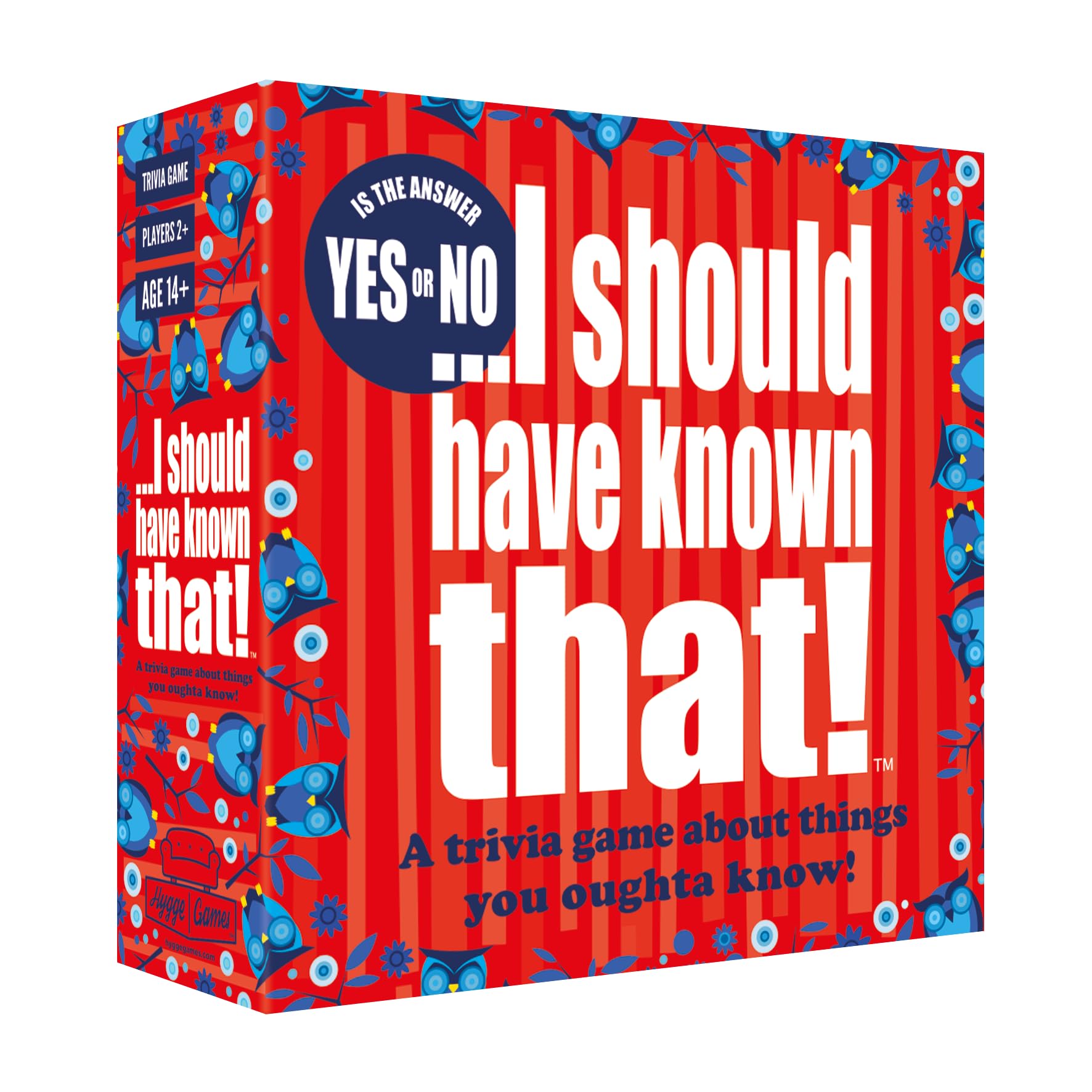
This is the trivia game that triggers the classic “ahhh… I should have known that!” reaction. The Yes or No format strips away all complexity—each card asks a simple question about things you ought to know, and you answer with a yes or no. Does Transylvania really exist? Is C the letter between V and N on a keyboard? The simplicity is addictive, and the compact box (5.7 x 5.7 x 1.8 inches) means it goes anywhere.
Reviewers from age 12 to 75 report strong engagement across the board. The family-friendly standalone edition contains 110 cards with over 400 questions, and it can be played on its own or combined with the original green edition for a larger deck. The game plays in about 30 minutes and requires no assembly.
The primary drawback is that the deck is relatively small—400 questions sounds substantial, but a competitive two-team game can burn through half the deck in one sitting. It also leans heavily on general knowledge that some groups may find too easy. But as a warm-up, travel game, or stocking stuffer, it outperforms its size class handily.
Why it’s great
- Extremely low barrier to entry—anyone can play within 30 seconds of opening the box
- Compact size fits in a large pocket or small bag for travel
Good to know
- Limited replay value; serious frequent players will exhaust the questions quickly
- Some questions are too easy for seasoned trivia fans, reducing challenge
FAQ
What makes a game show game different from a regular board game?
How many questions do I need for a group that plays weekly?
Are there game show games suitable for both young kids and grandparents?
Final Thoughts: The Verdict
For most users, the game show games winner is the HISTORY Channel Trivia Game because its massive 2,000+ question bank and five diverse categories guarantee months of play without repetition. If you want high-energy physical chaos that gets everyone shouting and laughing, grab the Big Potato Tilt ‘n’ Shout. And for a classic, low-pressure word association game that works for any group size, nothing beats the Password Original Word Association Game.