
A subfloor that squeaks, shifts, or delaminates underfoot isn’t just annoying — it signals a bond failure that can compromise the entire floor system above. Whether you’re fastening OSB to joists, adhering plywood over concrete, or laying down a vapor-tight barrier for hardwood, the adhesive you choose must resist moisture creep and deliver structural-grade shear strength. A wrong pick means costly repairs hidden beneath finished flooring.
I’m Mohammad Maruf — the founder and writer behind Drink4Good. I’ve spent years analyzing construction specifications and delving into the practical performance data of subfloor adhesives, from latex-fortified polymer blends to solvent-free formulas that meet modern VOC standards.
This guide breaks down the top options on the market, covering how each formula handles moisture, open time, and bonding strength so you can confidently choose the right glue for subfloor.
How To Choose The Best Glue For Subfloor
Subfloor adhesives are not one-size-fits-all. The right choice depends on the subfloor material (plywood, OSB, or concrete), the environment (above-grade, below-grade, or over radiant heat), and the type of finished flooring you plan to install. A subfloor bond that fails leads to squeaks, gaps, and potential moisture damage that can ruin thousands of dollars in finished flooring.
Shear Strength and Gap-Filling Ability
The primary job of a subfloor adhesive is to resist lateral movement between the subfloor panel and the joist or substrate. A high shear strength rating (often measured in psi) ensures the bond won’t slip under foot traffic or heavy loads. Equally important is the glue’s ability to bridge uneven gaps — look for formulas that can handle at least 1/4-inch to 3/8-inch gaps without losing adhesion.
Moisture Resistance and Environmental Compatibility
Subfloor glue must withstand the moisture conditions of its location. For below-grade or concrete slabs, a moisture-resistant, non-vapor-barrier formula is critical to prevent trapped moisture from degrading the bond. For above-grade wood subfloors, a water-resistant polymer adhesive provides long-term stability against humidity changes. Avoid solvent-based formulas over foam insulation boards or radiant heat systems, as solvents can attack the foam.
Quick Comparison
On smaller screens, swipe sideways to see the full table.
| Model | Category | Best For | Key Spec | Amazon |
|---|---|---|---|---|
| Liquid Nails LN902 VOC | Premium | General subfloor installation | Bridges gaps up to 3/8 inch | Amazon |
| ROBERTS Universal | Premium | LVT, LVP, vinyl-backed tile | Solvent-free acrylic latex | Amazon |
| Titebond 2104 | Mid-Range | Tongue and groove, floating floors | FloorScore certified | Amazon |
| SIKA SikaLatex R | Value | Cement and concrete repairs | 500 psi bond strength | Amazon |
| STARBOND Dark Brown CA | Specialty | Wood void filling and repairs | Medium-thick 500 CPS | Amazon |
In‑Depth Reviews
1. Liquid Nails LN902 VOC
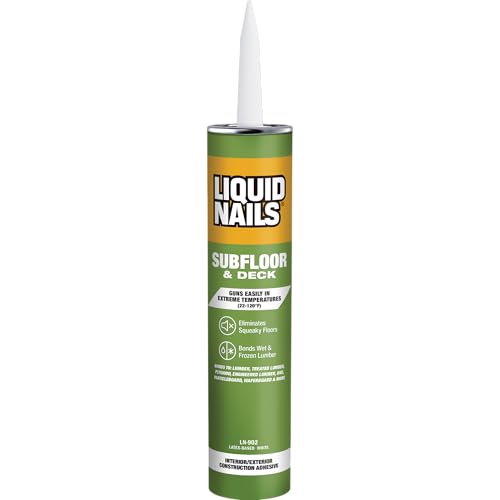
The Liquid Nails LN902 VOC is engineered specifically for subfloor work, meeting the American Plywood Association AFG-01 specification for structural bonding. Its heavy-duty, latex-based formula delivers instant holding power on wet, frozen, engineered, and treated lumber — exactly the conditions that cause many adhesives to fail. The 20-minute open time gives you room to reposition panels before the bond locks, while the gap-filling ability up to 3/8-inch handles uneven joists without losing adhesion.
Because it is low-solvent and VOC compliant, this formula works safely over foam board insulation where solvent-based adhesives would cause damage. The bond has proven strong enough to hold concrete blocks in adverse weather, showing a resilience that translates directly to demanding subfloor installations. Users report excellent results even when bonding wet lumber, a common pain point in basement or ground-contact applications.
The pack of six 10-ounce tubes provides a practical volume for medium-to-large subfloor projects. Its versatile compatibility with OSB, plywood, particleboard, and waferboard makes it a solid go-to for any subfloor material. The main caveat is that some users report issues with adhesion on smooth non-porous surfaces like vinyl, so ensure your substrate is properly prepared and porous for the bond. For structural bonding between wood panels and joists, this is the most balanced performer.
Why it’s great
- Meets APA AFG-01 spec for subfloor structural bonding
- Bridges gaps up to 3/8 inch for uneven surfaces
- VOC-compliant, safe over foam board insulation
Good to know
- Pack of 6 tubes may be more than needed for small repairs
- Adhesion on non-porous surfaces may require surface prep
- Dispensing requires a standard caulk gun
2. ROBERTS Universal Resilient Flooring Adhesive

The ROBERTS Universal Adhesive is the professional-grade choice for anyone installing luxury vinyl tile (LVT), luxury vinyl plank (LVP), or vinyl-backed carpet tile over a subfloor. Its solvent-free acrylic latex formula provides high initial tack and a pressure-sensitive bond that allows for some repositioning before final set. The incorporation of Microban protection helps fight stain-causing bacteria growth, a thoughtful addition for subfloors in basements or commercial settings.
With an extensive open time — users report it remains workable for hours and dries clear — this adhesive gives you real flexibility for large or complex layouts. It bonds securely to properly prepared concrete, APA-rated plywood, steel, marble, terrazzo, and even existing well-bonded vinyl tile floors (excluding self-stick). The product is rated for indoor residential and commercial use and works with radiant heated subfloors up to 85°F. Reports from RV users confirm that patches stay intact through snow, mud, and rain for over six months.
The one-gallon pail is a practical size for medium projects. Be aware that cleanup is easiest immediately after application — once cured, the bond is tenacious. Some users mention a medium odor during application, so ventilation is recommended. This adhesive is not designed for bonding plywood to joists; its purpose is securing resilient flooring to a stable subfloor. For that specific job, it delivers exceptional performance.
Why it’s great
- Long open time for large or intricate layouts
- Microban protection fights bacterial growth
- Works with radiant heated subfloors up to 85°F
Good to know
- Not intended for bonding subfloor panels to joists
- Medium odor requires ventilation during use
- Cleanup must be done promptly before cure
3. Titebond 2104 Tongue and Groove Glue

The Titebond 2104 is tailor-made for tongue and groove flooring installations, delivering a bond that is reportedly stronger than the wood itself. Recommended for all types of laminate floors and floating floors — even those over radiant heat systems — this glue is a specific fix for those annoying joint separations. Its polymer/synthetic rubber formulation resists both solvents and water once dry, making it a strong candidate for bathrooms or kitchens where moisture intrusion at the seams is a concern.
FloorScore certification confirms its low emissions, making it suitable for indoor air quality-sensitive environments. The bottle’s ergonomic design allows for controlled application directly into the groove, minimizing mess. Coverage is efficient — roughly one bottle per 100 square feet for 3-inch boards. Users consistently praise its holding power, with reviews noting repairs that remain solid months after installation. It is ideal for both nailed and floating installations, adding mechanical reinforcement to the joint.
This is a mid-range option that punches above its weight for its specific use case. Be aware that the applicator tip needs careful trimming to avoid applying too much glue, which can squeeze out and create cleanup hassles. It is not intended for general subfloor-to-joist bonding, but for locking together tongue and groove planks over an already prepared subfloor, it is the specialized tool the job demands.
Why it’s great
- Bond strength exceeds the strength of the wood itself
- Water-resistant once dry, ideal for moisture-prone areas
- FloorScore certified for low emissions
Good to know
- Applicator tip requires careful trimming to avoid excess glue
- Not designed for subfloor-to-joist structural bonding
- Bottle volume is best for medium-scale floor projects
4. SIKA SikaLatex R Concrete Adhesive

The SIKA SikaLatex R is a different beast — it is an acrylic latex admixture designed to be added to Portland-cement mortar or concrete, not a direct subfloor glue. When used as a bonding grout or coating primer, it turns standard concrete into a fortified material with 500 psi tensile bond strength. This makes it the correct choice for scenarios where you are patching a concrete subfloor, bonding new concrete to old, or creating a dense, durable surface layer that resists freeze-thaw damage.
Because it does not create a vapor barrier, it is suitable for below-grade applications where breathability matters. Users report excellent long-term holding for masonry repairs, with one review mentioning bricks held in place for years until a full renovation. The one-gallon pail is easy to store and requires no dilution, simplifying prep work. It can also be used as an acrylic coating primer for grout, giving it versatility on the job site beyond subfloor work.
This is not a glue you squeeze from a tube onto plywood. If your project involves concrete subfloor repair, crack filling, or bonding concrete to concrete, SikaLatex R is the right tool. It has a 30-day full cure time, so patience is required before heavy loads are applied. Check the expiration date on the pail — this product has a shelf life, and expired material will not perform as expected.
Why it’s great
- 500 psi bond strength when used as an admixture
- Resists freeze-thaw damage for exterior concrete repairs
- No vapor barrier, suitable for below-grade applications
Good to know
- Requires 30 days to reach full cure
- Not a direct-use adhesive; must be mixed with cement or mortar
- Check expiration date as shelf life is limited
5. STARBOND Dark Brown CA Glue
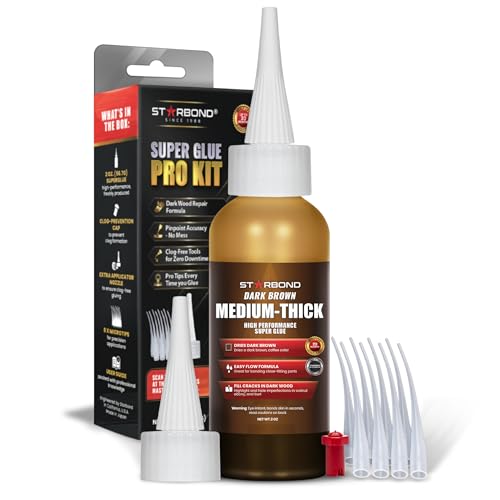
The STARBOND Dark Brown CA Glue is a specialty cyanoacrylate adhesive for filling knots, cracks, and voids in wood subfloor panels where a seamless repair is desired. Its medium-thick consistency (500 CPS) — roughly the viscosity of motor oil — allows it to wick into tight cracks while staying put in small gaps without excessive running. The dark brown tint cures to a coffee-brown color that blends naturally into dark woods like walnut, making it ideal for sealing imperfections that would otherwise telegraph through a finished floor.
This glue dries in about three minutes, which is forgiving enough to allow small adjustments to wood pieces before the bond sets, or can be accelerated with a spray accelerator for instant cure. The kit includes anti-clog caps, spare nozzles, and micro-tips for precise application in tight spaces. Users in instrument repair and woodturning consistently praise its predictable behavior and seamless color match. For filling nail holes in trim or accenting CNC carvings in dark wood, it performs better than any epoxy or wood filler.
This is not a structural subfloor adhesive. It is a repair and finishing tool for addressing surface defects on wood subfloor panels before the finished flooring goes down. It requires good ventilation and skin protection during use, as CA glue bonds aggressively to skin. The dark brown color is very deep — if you are working with medium-toned woods, you may also need a medium brown variant for a perfect match. For subfloor surface finishing and void repair, it is the right choice.
Why it’s great
- Dark brown tint blends seamlessly into dark wood subfloor panels
- Medium-thick viscosity stays in gaps without running
- Precision micro-tips and anti-clog caps included
Good to know
- Not a structural subfloor adhesive; for surface repairs only
- Strong fumes require good ventilation
- Dark color may not match lighter wood species perfectly
FAQ
What type of glue do I use to glue subfloor to joists?
Can I use construction adhesive on subfloor plywood?
What is the best glue for tongue and groove subfloor?
Final Thoughts: The Verdict
For most users, the glue for subfloor winner is the Liquid Nails LN902 VOC because it combines APA AFG-01 certification, a 20-minute open time, and 3/8-inch gap-filling ability into a versatile pack that handles virtually any subfloor-to-joist job. If you need a premium choice for attaching resilient flooring to a subfloor, grab the ROBERTS Universal. And for specialized tongue and groove or concrete repair work, nothing beats the Titebond 2104 or the SIKA SikaLatex R for their specific applications.