
You’ve watched the footage, read the forums, and now you’re ready to buy. But a drone without reliable GPS is just an expensive paperweight waiting to drift away in the wind. The difference between a thrilling flight and a lost aircraft comes down to satellite lock, return-to-home logic, and gimbal stabilization. Those specs separate toys from tools, and your investment depends on knowing the difference.
I’m Mohammad Maruf — the founder and writer behind Drink4Good. Over the past several years, I’ve analyzed hundreds of drone specifications, pored over flight logs and component datasheets, and compared transmission protocols and motor windings to understand what separates a stable aerial platform from a flyaway risk.
The right model gives you confidence to explore, capture, and create without second-guessing every gust. Whether you are a beginner stepping up from a toy quad or a hobbyist seeking a reliable second rig, this guide to the best gps drone breaks down the specs and trade-offs that matter for safe, smart flying.
How To Choose The Best GPS Drone
Selecting a drone that won’t drift away or tumble out of the sky requires more than comparing megapixel counts. The GPS module, motor quality, and firmware logic define the flying experience. Focus on these four areas to avoid a frustrating purchase.
Satellite Systems and Lock Speed
A good GPS drone uses multiple constellations — GPS, GLONASS, Galileo, or BeiDou — to triangulate its position. More satellites mean faster lock times and better precision. Look for models that support at least two systems. A drone that takes several minutes to lock onto satellites before takeoff wastes battery life and patience.
Return-to-Home Reliability
Return-to-home (RTH) is your safety net. The drone should automatically return when the signal is lost, battery is low, or you press the button. The best implementations allow you to set the return altitude and will land within a few feet of the takeoff point. Cheap drones may RTH to a random coordinate — read real user reports on RTH accuracy before buying.
Camera Stabilization and Gimbal Type
A 4K camera means little if the footage looks like a shaky phone video. Electronic image stabilization (EIS) helps, but a physical 2-axis or 3-axis gimbal is far superior. A 3-axis gimbal compensates for pitch, roll, and yaw, keeping the horizon level even in a banked turn. For cinematic shots, prioritize a mechanical gimbal over raw resolution.
Transmission Range and Latency
Real-time video feed quality and control distance depend on the transmission system. 5G Wi-Fi repeaters can reach up to 500 meters in open areas but suffer in urban settings. Dedicated digital transmission systems (like DJI’s OcuSync or similar proprietary protocols) offer ranges over 4 kilometers with lower latency. If you plan to fly far, invest in a model with a dedicated transmission link rather than standard Wi-Fi.
Quick Comparison
On smaller screens, swipe sideways to see the full table.
| Model | Category | Best For | Key Spec | Amazon |
|---|---|---|---|---|
| Bwine F7MINI 4K(RC3) | Premium | Built-in screen controller, no phone needed | 3-axis gimbal | Amazon |
| Holy Stone HS790 | Premium | Long range and 3-axis gimbal stability | 9km transmission | Amazon |
| Bwine F7GB2 Pro | Premium | Extended flight time with 3 batteries | 3 batteries, 75 min total | Amazon |
| Holy Stone HS600 | Mid-Range | FAA-compliant integrated Remote ID | 20,000 ft range | Amazon |
| Potensic ATOM LT | Mid-Range | Ultra-long flight time per battery | 40 min per battery | Amazon |
| DJI Neo 2 | Mid-Range | Palm takeoff and omnidirectional sensing | 151g weight | Amazon |
| REDRIE HK33 (B0F37MYK6N) | Value | 45-minute flight time with solid GPS features | 45 min total flight | Amazon |
| Oddire HK11 | Value | Beginner-friendly with 48 min total flight | 7.7V batteries | Amazon |
| REDRIE HK33 (B0DG9VCNG7) | Value | Entry-level price with GPS return-to-home | 2-axis gimbal | Amazon |
In‑Depth Reviews
1. Bwine F7MINI 4K(RC3)
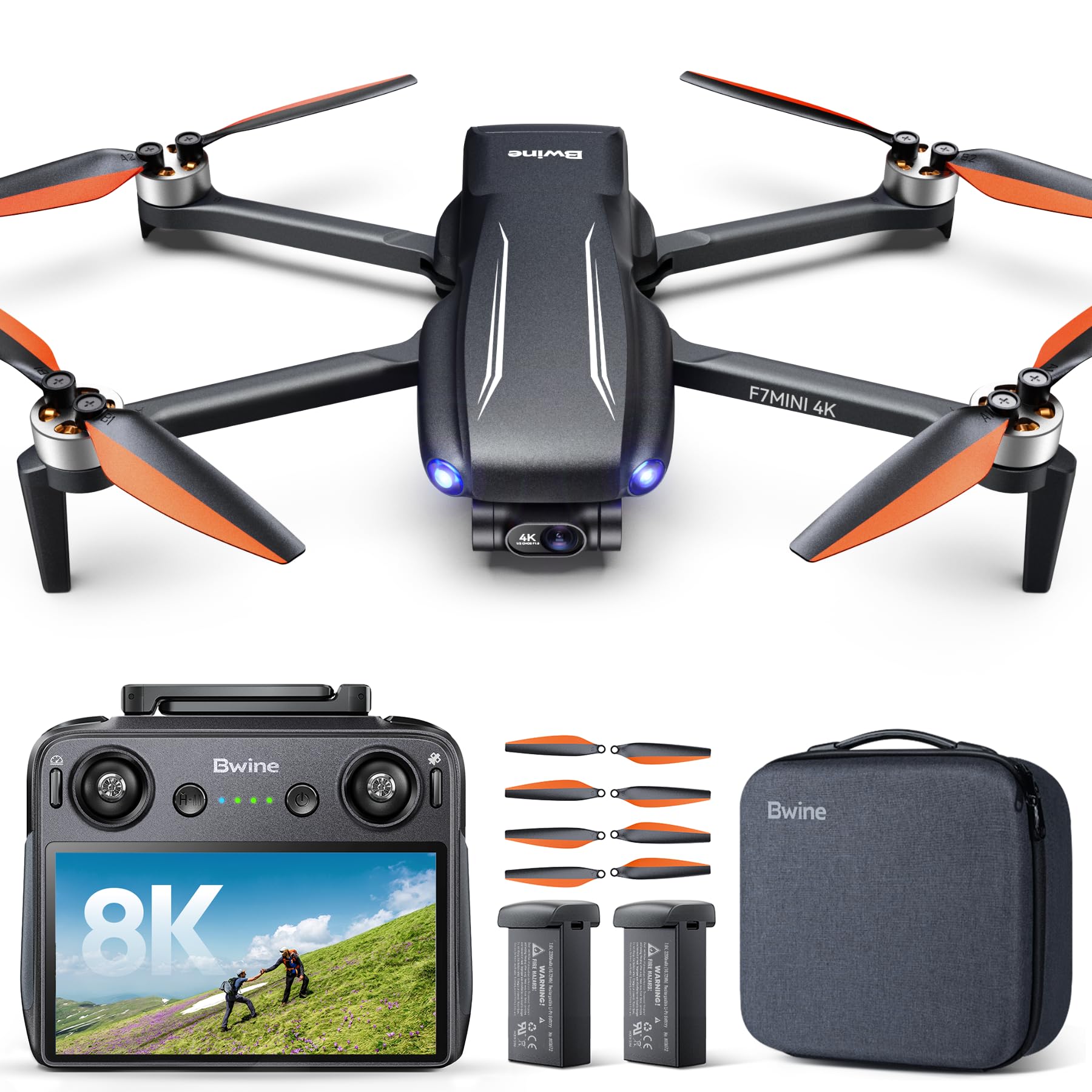
The Bwine F7MINI 4K(RC3) is the most complete package in this list if you want a premium experience without needing a separate smartphone to fly. Its remote control features a bright 5.5-inch 1080p screen, which eliminates the hassle of connecting a phone and frees up your device for other tasks. The drone itself weighs under 249 grams, so no FAA registration is needed, and it folds down to a very compact size for travel.
Video quality is impressive for this weight class, with 4K UHD capture at 30fps and 8K photo resolution. The 3-axis brushless gimbal paired with EIS keeps footage steady even in moderate wind, and the 20,000-foot transmission range (approximately 6 km) gives you room to explore. The GPS system locks onto satellites quickly and supports Active Track, Cruise Control, Orbit Flight, and Waypoint Planning — all accessible from the bright controller screen.
The two included batteries deliver a total flight time of about 64 minutes, and they support PD 3.0 fast charging. The Dynamic Home Point feature updates the return location as you move, which is a thoughtful touch for hiking or road trips. A 120dB buzzer via the app helps locate the drone if it lands out of sight. Overall, this is the most user-friendly high-end option for beginners and experienced pilots alike.
Why it’s great
- Built-in 1080p controller screen removes phone dependency
- 3-axis gimbal delivers professional-grade stabilization
- Under 249g weight means no FAA registration
Good to know
- PD fast charger not included in the box
- Transmission range may drop in dense urban areas
2. Holy Stone HS790
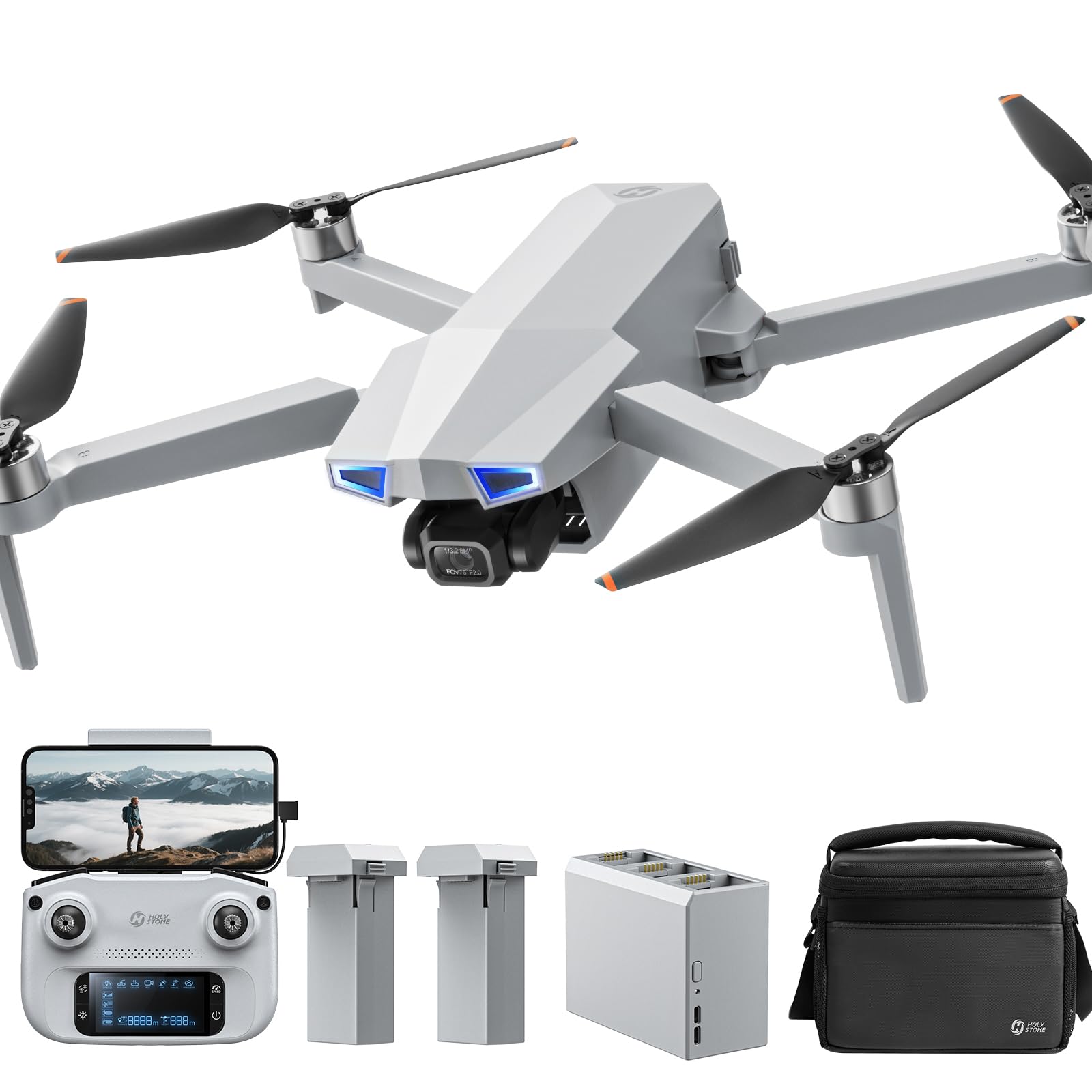
The Holy Stone HS790 hits a sweet spot between price and performance that makes it the top recommendation for most buyers. It packs a true 3-axis mechanical gimbal, which is rare at this price point, and delivers stable 4K/30fps video and 6K photos. The transmission system using a Wi-Fi repeater claims up to 9 km, but in real-world conditions you can expect a solid 3-4 km of stable feed.
Flight time is generous at 60 minutes total across two modular 3200mAh batteries. The included Smart PD Charging Hub doubles as a power bank, which is handy for field charging. Built-in Remote ID keeps you compliant with FAA regulations without needing an external module. The GPS functions are robust — Auto Return Home, Follow Me, and Waypoint Flight all work reliably, and the drone locks onto satellites quickly even in partially obstructed environments.
Night Mode with enhanced visibility LEDs sets the HS790 apart for twilight flights. The brushless motors provide Level 6 wind resistance, so it handles gusty conditions well. Beginners will appreciate the Altitude Hold and Headless Mode, while experienced flyers can unlock full manual control for cinematic shots. It’s a well-rounded package that delivers real gimbal stability without breaking the budget.
Why it’s great
- True 3-axis mechanical gimbal for smooth footage
- Smart charging hub doubles as a power bank
- Built-in Remote ID for FAA compliance
Good to know
- App can be buggy on some phones
- Weighs over 250g, requires FAA registration
3. Bwine F7GB2 Pro

The Bwine F7GB2 Pro is built for pilots who want maximum airtime without swapping batteries every 20 minutes. It comes with three 2600mAh intelligent batteries that provide a total flight time of up to 75 minutes — among the highest in this class. Each battery is UL 2054 certified for safety, which adds peace of mind during charging.
The camera system is a standout feature, using a one-click detachable 4K camera with a 120-degree FOV and a larger CMOS sensor for better low-light performance. The 3-axis gimbal combined with 5x digital zoom keeps your shots stable as you transition between distances and angles. The drone is rated for Level 6 wind resistance and can operate at altitudes up to 2000 meters, making it suitable for mountain terrain or coastal cliffs.
Transmission range is rated at 10,000 feet, and the remote includes a screen overlay that displays critical flight data. The app supports social media sharing with built-in filters and background music. The GPS functions — Follow Me, Waypoint, Orbit, and Return-to-Home — are all present and work reliably. The carrying shell case is robust and protects the drone well during transport. This is the best choice for extended survey or photography sessions.
Why it’s great
- Three batteries provide 75 minutes total flight time
- Detachable 4K camera with larger sensor and 3-axis gimbal
- UL 2054 certified batteries for safety
Good to know
- Remote control screen is hard to read in bright sunlight
- Requires FAT32 formatted SD card for recording
4. Holy Stone HS600

The Holy Stone HS600 is a solid mid-range option that prioritizes compliance and transmission range. It features integrated Remote ID, which means you don’t need a separate module to meet FAA requirements. The 2-axis gimbal paired with EIS stabilization produces smooth 4K/30fps video using a Sony sensor, and the 20,000-foot transmission range gives you plenty of room to explore.
Wind resistance is rated at Level 6, and the brushless motors provide enough power to handle gusty conditions. The remote controller uses a single data cable to connect your smartphone, eliminating Wi-Fi interference for a more stable video feed. Battery life is around 34 minutes per charge, with two batteries included in the package, giving you nearly 70 minutes of total flight time. The carrying case is sturdy and well-padded.
The GPS return-to-home function is reliable, returning within about 6 feet of the takeoff point. Follow Me and Waypoint modes work well for hands-free tracking. The app interface is straightforward, though some users report an initial learning curve. For the price, the HS600 delivers excellent value for a drone that is both long-range and fully FAA-compliant right out of the box.
Why it’s great
- Integrated Remote ID, no separate module needed
- 20,000-foot transmission range with stable feed
- Sony sensor camera for clear 4K video
Good to know
- 2-axis gimbal, not true 3-axis stabilization
- Camera zoom at max is blurry
5. DJI Neo 2
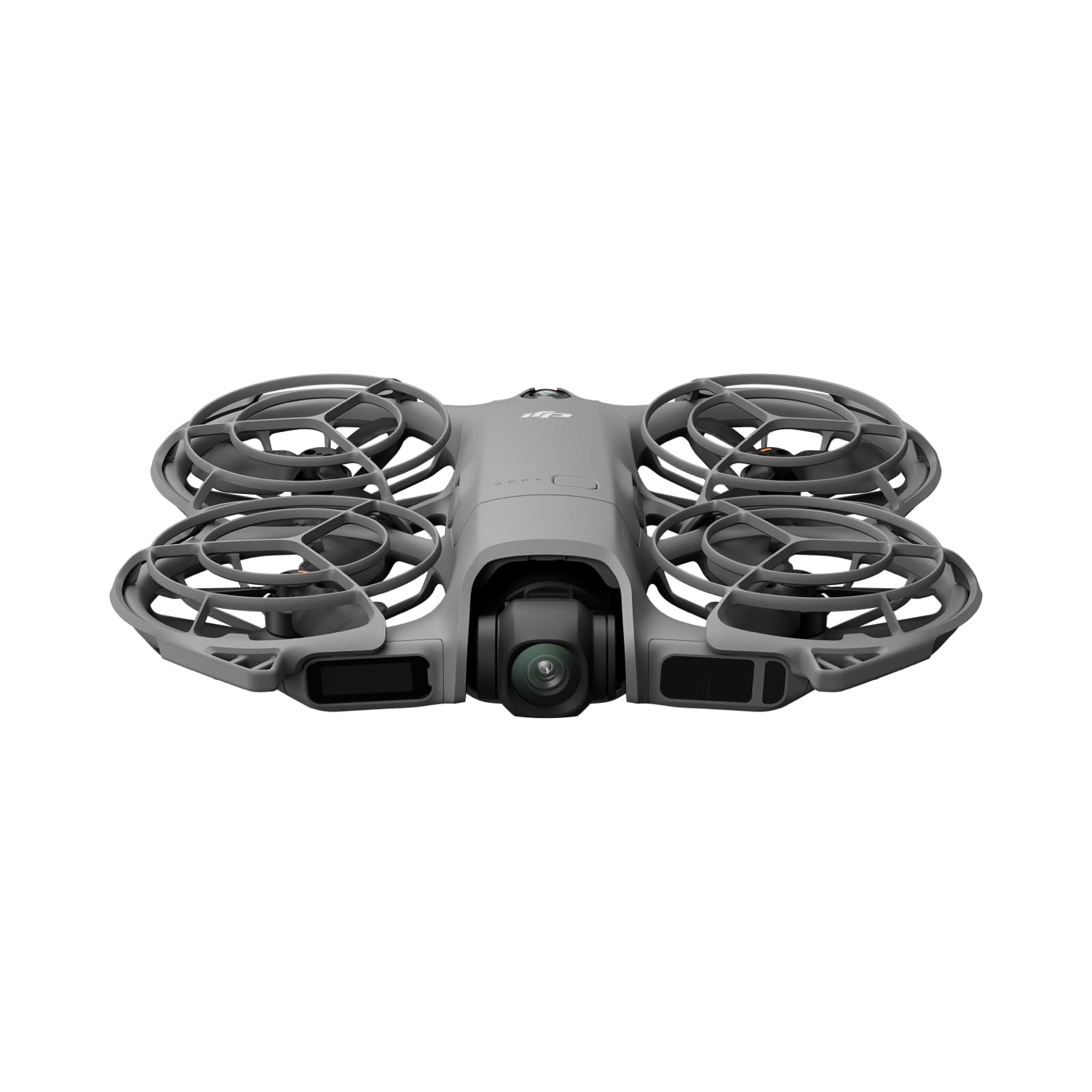
DJI brings its engineering pedigree to the Neo 2, a sub-151g drone that launches directly from your palm. It is the lightest model in this roundup, which makes it C0 certified and exempt from most regulations. The drone features omnidirectional obstacle sensing, full-coverage propeller guards, and gesture control — you can take off, land, and capture selfies without touching a controller.
The 4K camera with 12MP still resolution delivers sharp, lifelike images, and ActiveTrack keeps subjects in frame reliably. The drone connects to an Apple Watch for live feed viewing and voice control, which is a first in this class. Flight time is around 18-19 minutes per battery, which is shorter than some competitors, but the convenience of palm takeoff and the safety of obstacle sensing make up for it.
This drone is sold as a “drone only” kit — no remote control included — which means you operate it entirely via app and hand gestures. That design philosophy makes it ideal for spontaneous travel content, family gatherings, and quick social media posts. It is not built for long-range exploration or heavy wind, but for close-range creative work, the Neo 2 is in a class of its own.
Why it’s great
- Palm takeoff and landing with gesture controls
- Omnidirectional obstacle sensing for safe indoor/outdoor flight
- Ultra-light 151g weight, no FAA registration
Good to know
- Short battery life at 18-19 minutes per charge
- No remote controller included; phone app required
6. Potensic ATOM LT

The Potensic ATOM LT is designed around one standout feature: long flight time. Each of the two 3000mAh intelligent batteries delivers a full 40 minutes of airtime, giving you a combined 80 minutes of flight — the highest per-battery endurance in this list. The drone supports four GNSS systems (GPS, GLONASS, Galileo, and BeiDou), which means faster satellite locks and more precise hovering even in challenging terrain.
The camera uses a Sony sensor with EIS (ShakeVanish 2.0) for 2.5K video at 30fps and 2560×1440 photos. While it is not true 4K, the footage is clean and well-stabilized for social media and casual use. The 118-degree FOV lens is adjustable from +20 to -90 degrees, giving you dynamic framing options. The PixSync 2.0 transmission system claims up to 4 km range, and it uses a dedicated remote controller with adapter cables for your phone.
GPS functions include Auto Return Home, Follow Me, Waypoint, and Circle Fly. The weight is under 249 grams, so no FAA registration is required. The drone only flies in GPS mode, which means you must be outdoors in an open area. Some users report slow satellite acquisition on first use, but once locked, the hover is rock solid. For beginners who want maximum airtime per dollar, the ATOM LT is hard to beat.
Why it’s great
- 40 minutes per battery, 80 minutes total flight time
- Quad-GNSS support for fast satellite locks
- Under 249g, no FAA registration needed
Good to know
- Camera is 2.5K, not true 4K resolution
- GPS-only mode prevents indoor flight
7. REDRIE HK33 (B0F37MYK6N)
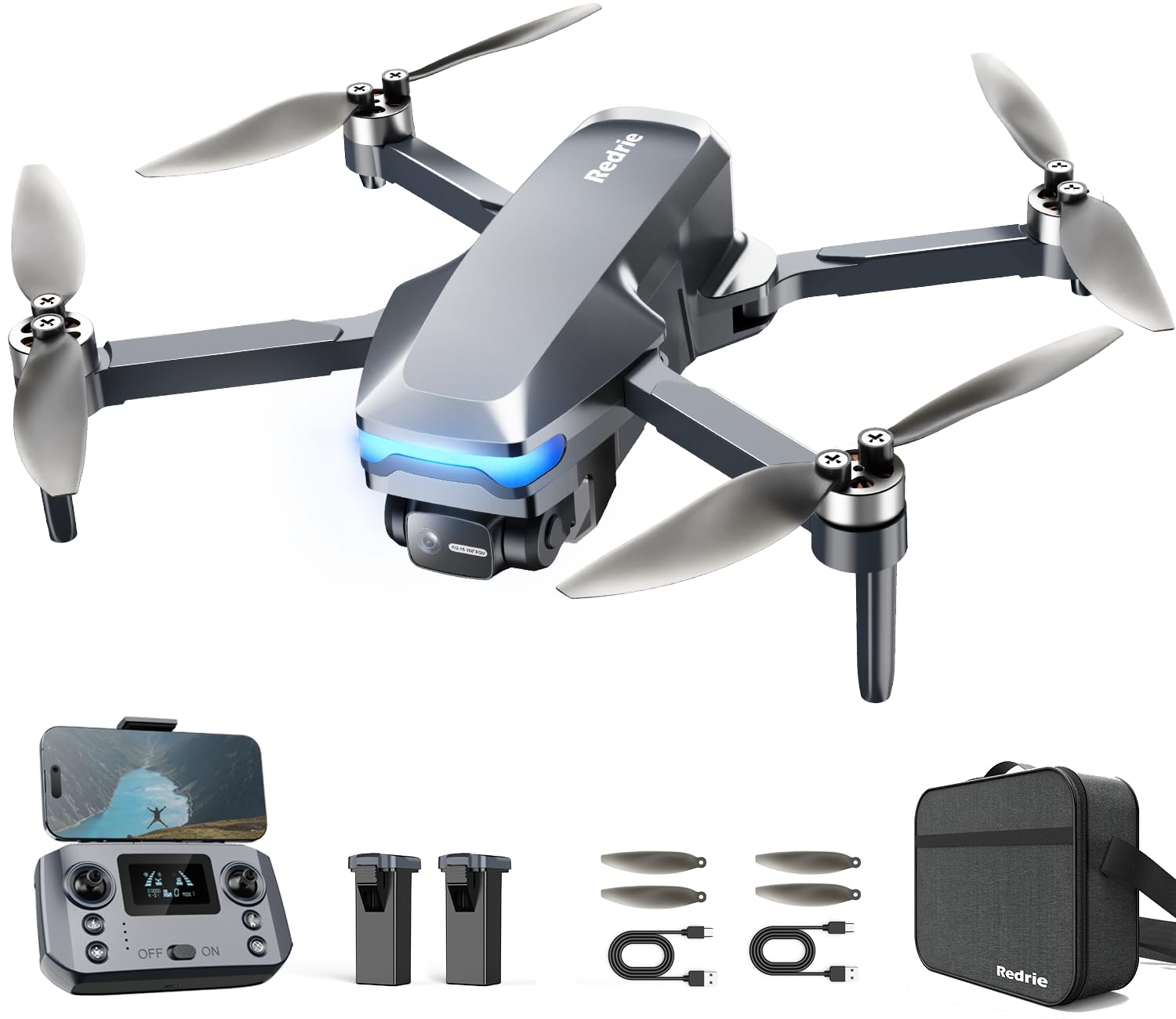
The REDRIE HK33 (black version) sits in the value tier but offers a well-rounded feature set that punches above its price point. Its 4K camera uses a 2-axis gimbal with physical vibration reduction and a 90-degree remote-controlled tilt, delivering stable 4096x3072P photos and 2048x1088P video. The camera quality is decent for the price, though the gimbal is only 2-axis, so you may see some roll drift in sharp turns.
Flight time totals 45 minutes across two 1800mAh batteries, which is competitive for this price tier. The 5G Wi-Fi transmission provides stable FPV out to 985 feet, with a signal repeater extending control range to 1640 feet. The brushless motors offer Level 5 wind resistance, which is enough for moderate breezes. The drone weighs under 249 grams and comes with a foldable design and carrying case.
GPS features include Auto Return Home on low battery or signal loss, Follow Me, Route Planning, and Fly Around. The app is easy to set up via QR code. Multiple users report that the customer service team is responsive and helpful when issues arise. This is a strong entry-level GPS drone for someone who wants reliable return-to-home without spending in the premium tier.
Why it’s great
- 45 minutes total flight time with two batteries
- 2-axis gimbal with physical vibration reduction
- Under 249g, no FAA registration needed
Good to know
- 2-axis gimbal only — no roll stabilization
- Transmission range limited to 500 meters
8. Oddire HK11

The Oddire HK11 is a budget-friendly GPS drone that still manages to pack intelligent features like Auto Return Home, GPS Follow, Waypoint Flight, and Orbit Mode. It uses 7.7V batteries, which are more powerful and durable than the more common 7.4V or 3.7V packs found in many entry-level drones. Total flight time reaches 48 minutes with two included batteries.
The 4K camera has an F2.15 110-degree wide-angle lens, adjustable within 90 degrees via remote or app, capturing 4096x3072P photos and 2048x1088P video. The 5G Wi-Fi transmission module with a signal repeater in the remote provides stable FPV out to 500 meters. The brushless motors are quiet and provide Level 5 wind resistance, making the flight stable in light breezes.
The drone weighs 249 grams, keeping it under the FAA registration threshold. It folds down compactly and includes a carrying case. The app supports gesture photo, gravity control, 3D flip, and even VR mode. User feedback consistently praises the smooth flight behavior and responsive customer service. This is an excellent entry-level choice for someone who wants a taste of GPS-assisted flying without a big investment.
Why it’s great
- 48 minutes total flight with 7.7V high-durability batteries
- GPS Follow, Waypoint, and Orbit modes at a budget price
- Under 249g, no FAA registration required
Good to know
- Camera stabilization is only EIS, no gimbal
- No SD card included in the package
9. REDRIE HK33 (B0DG9VCNG7)
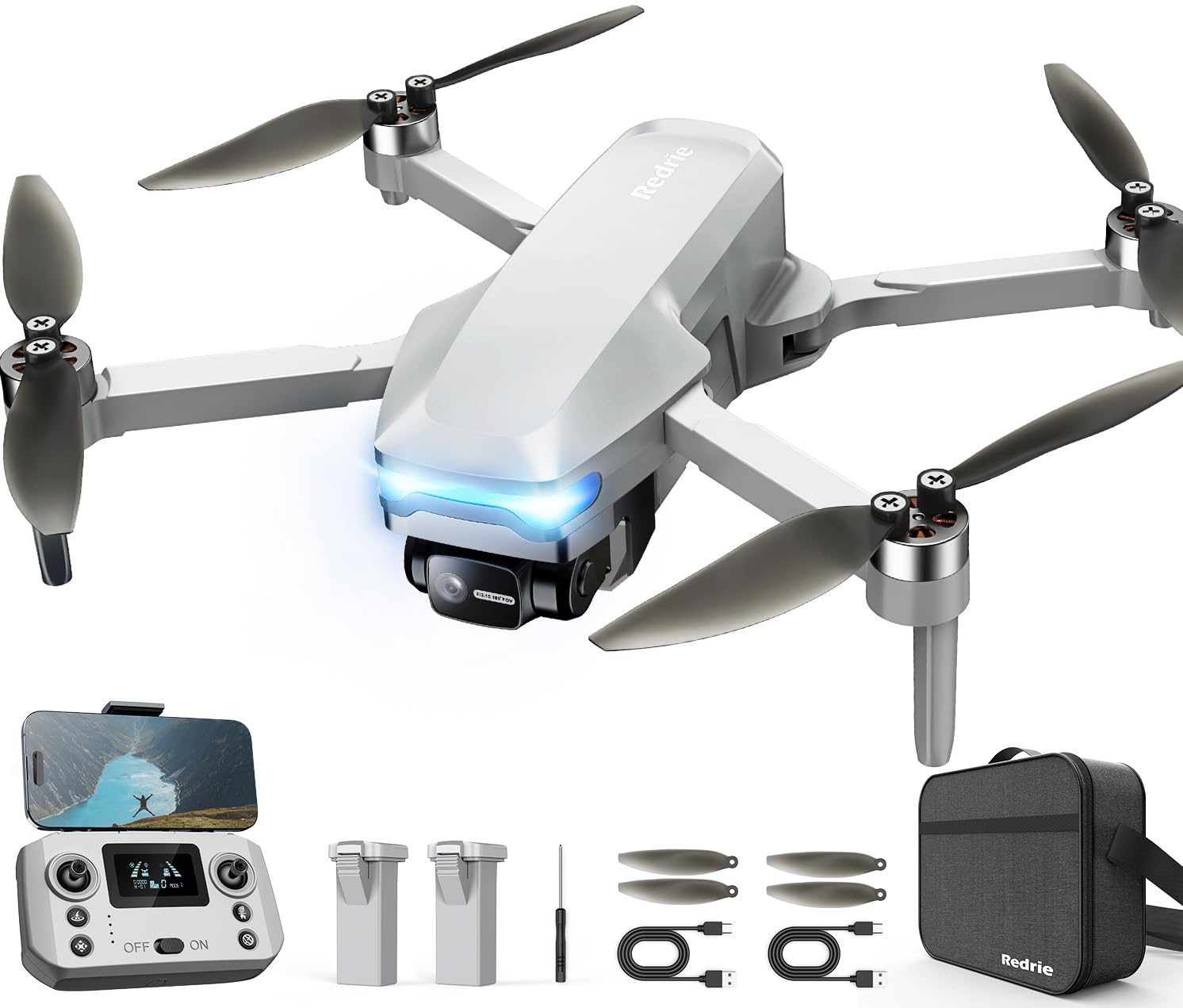
The REDRIE HK33 (light grey version) is the most budget-conscious entry into the GPS drone world. It features a 2-axis gimbal with an F2.15 110-degree wide-angle lens that captures 4K photos (4096x3072P) and 2K video (2048x1088P). The gimbal eliminates shake, and the 90-degree remote-controlled angle adjuster lets you switch between horizontal and vertical framing instantly.
Flight time totals 40-45 minutes across two 1800mAh batteries. The brushless motors provide Level 5 wind resistance, and the 5G Wi-Fi FPV feed is stable up to 985 feet, with a signal repeater extending control to 1640 feet. GPS functions include Auto Return Home on signal loss or low battery, Follow Me, Route Planning, and Fly Around. The drone weighs under 249 grams and ships with a carrying case.
User reviews consistently note that the customer support is outstanding — multiple users report quick resolution of issues and replacement parts. The camera quality is surprisingly good for the price, with sharp photos in good light. This is the lowest-cost way to get a true GPS drone with a gimbal and return-to-home feature.
Why it’s great
- Lowest entry price for a GPS drone with 2-axis gimbal
- 40-45 minutes total flight time with two batteries
- Excellent customer service reputation
Good to know
- Video resolution is 2K, not 4K
- Cell phone holder design is unrefined
FAQ
Do I need FAA registration for a GPS drone that weighs under 250 grams?
What does Return-to-Home altitude mean and how high should I set it?
Final Thoughts: The Verdict
For most users, the best gps drone winner is the Holy Stone HS790 because it combines a true 3-axis gimbal, long 9km transmission, and 60 minutes of flight time at a price that offers exceptional value. If you want the convenience of a built-in controller screen and no FAA paperwork, grab the Bwine F7MINI 4K(RC3). And for maximum airtime during long surveying or photography sessions, nothing beats the Bwine F7GB2 Pro with its 75-minute total flight time.