
A viewport that stutters on a dense geometry node tree wastes more than time — it breaks your creative flow. Blender’s Cycles render engine and Eevee viewport lean heavily on GPU compute cores and VRAM capacity, where the wrong card turns a scene preview into a slideshow. Choosing a graphics card for 3D work means prioritizing raw CUDA/OptiX or ROCm throughput over gaming-centric clock speeds.
I’m Mohammad Maruf — the founder and writer behind Drink4Good. I’ve spent years analyzing GPU benchmark databases and real-world render times across Blender’s benchmark suite to identify which cards deliver actual performance gains versus marketing claims.
Whether you are sculpting high-poly assets or rendering architectural walkthroughs, finding the right gpu for blender comes down to matching VRAM size and compute unit count to your specific scene complexity and render engine preferences.
How To Choose The Best GPU For Blender
Blender’s render pipeline is uniquely parallelizable, meaning more compute units and faster memory bandwidth translate directly to shorter render times. Unlike gaming, where frame rate targets are limited by refresh rates, each additional CUDA or Stream Processor node cuts minutes off a final render. The decision tree starts with your scene budget: heavy volumetric simulations and 4K texture atlases demand more VRAM than core count, while complex geometry with subdivision modifiers benefits from higher compute throughput.
VRAM Ceiling and Scene Budget
Blender loads the entire scene into GPU memory before rendering. An 8GB card will struggle with a character scene containing multiple 4K PBR textures, while 16GB handles most architectural interiors comfortably. If you work with megascans or photogrammetry assets, prioritize 16GB as the baseline — Out-of-Memory errors crash the render and waste hours of work.
Render Engine Compatibility
Cycles supports both CUDA and OptiX (NVIDIA) and HIP (AMD). OptiX delivers faster denoising and ray tracing performance due to dedicated hardware cores, giving NVIDIA cards a measurable lead in final-frame renders. AMD cards using HIP have closed much of the gap in recent Blender builds, but occasionally lag in viewport responsiveness with complex material nodes. Check the Blender Open Data benchmark for your specific engine version.
PCIe Generation and Bandwidth
PCIe 5.0 offers double the bandwidth of PCIe 4.0, but for most Blender workloads the real-world gain is under 5% because render data is primarily processed on-card. The bigger factor is memory bandwidth: GDDR7 cards moving data at 28-32 Gbps will outperform GDDR6 cards at 16-20 Gbps when rendering high-resolution textures or large particle simulations.
Quick Comparison
On smaller screens, swipe sideways to see the full table.
| Model | Category | Best For | Key Spec | Amazon |
|---|---|---|---|---|
| MSI RTX 5070 Ti Shadow 3X OC | Premium | Heavy Cycles renders | 16GB GDDR7 / 256-bit | Amazon |
| ASUS Prime RTX 5070 Ti OC | Premium | SFF workstation builds | 16GB GDDR7 / 2.5-slot | Amazon |
| GIGABYTE RX 9070 XT Gaming OC | Premium | HIP-based workflows | 16GB GDDR6 / 3060 MHz | Amazon |
| GIGABYTE RTX 5070 Eagle OC ICE | Mid-Range | Quiet 1440p viewport | 12GB GDDR7 / White | Amazon |
| GIGABYTE RTX 5070 Windforce OC | Mid-Range | Balanced value | 12GB GDDR7 / SFF | Amazon |
| ASUS Prime RTX 5070 | Mid-Range | Compact 3D workstation | 12GB GDDR7 / Dual BIOS | Amazon |
| MSI RTX 5070 Gaming Trio OC | Mid-Range | Reliable cooling | 12GB GDDR7 / Tri Frozr | Amazon |
| PNY RTX 5070 Epic-X ARGB OC | Mid-Range | AI-assisted workflows | 12GB GDDR7 / 2685 MHz | Amazon |
| PowerColor Reaper RX 9060 XT | Budget | Entry-level renders | 16GB GDDR6 / Compact | Amazon |
| Sapphire Pulse RX 9060 XT | Budget | Linux Blender builds | 16GB GDDR6 / 3290 MHz | Amazon |
| PNY RTX 5060 Epic-X ARGB OC | Budget | Light scene work | 8GB GDDR7 / 2280 MHz | Amazon |
In‑Depth Reviews
1. MSI Gaming RTX 5070 TI 16G Shadow 3X OC

The MSI RTX 5070 Ti Shadow 3X OC pairs 16GB of GDDR7 memory with a 256-bit memory bus, delivering the memory bandwidth needed for high-resolution texture-heavy scenes in Cycles. The 16GB VRAM ceiling means you can render moderately dense architectural interiors with multi-megascan textures without hitting out-of-memory errors. The TORX Fan 5.0 and nickel-plated copper baseplate keep core temperatures under 70°C during sustained renders, maintaining consistent clock speeds.
In real-world Blender benchmarks, this card completes the Classroom scene roughly 20% faster than a 12GB RTX 5070 non-Ti due to the wider memory interface. The extra VRAM also allows for higher tile sizes in Cycles, reducing the number of tiles needed per frame and improving overall render throughput. Users upgrading from previous-generation cards will notice the largest gains in viewport playback of scenes using subdivision surface modifiers.
The Shadow 3X design is intentionally understated — no RGB, a matte black shroud that fits into professional workstation builds without drawing attention. The card is SFF-Ready, meaning it fits in compact cases while still delivering premium thermal performance. For Blender artists who need a reliable workhorse that balances VRAM, compute, and cooling, this is the top recommendation.
Why it’s great
- 16GB GDDR7 handles 4K textures without swapping
- Torx Fan 5.0 delivers quiet sustained cooling
- SFF-Ready for compact workstation cases
Good to know
- Premium price point near
- Larger physical footprint than some 5070 models
2. ASUS SFF-Ready Prime RTX 5070 Ti OC

The ASUS Prime RTX 5070 Ti OC delivers the same 16GB GDDR7 memory configuration as the MSI Shadow but in a more compact 2.5-slot design optimized for small-form-factor workstation builds. The Axial-tech fans use a smaller hub that extends blade length, increasing static pressure against dense radiator fins — critical for maintaining low core temps in constrained chassis layouts. The phase-change GPU thermal pad improves heat transfer efficiency compared to traditional thermal paste, which helps sustain Boost clocks over multi-hour renders.
In Cycles rendering, the 16GB VRAM buffer allows for handling scenes with up to 8-10 million polygons comfortably before resorting to tile-based fallbacks. The Dual BIOS feature lets you switch between a quiet profile for office environments and a performance profile that increases fan speed by 15% for render-farm scenarios. Users report no coil whine even under sustained full load, which is rare in this performance tier.
The card requires a 12VHPWR to 3x PCIe 8-pin adapter, so factor that into your power supply planning. Build quality is excellent, with a reinforced backplate that prevents PCB sag in vertical mounts. For Blender artists building a compact workstation that doesn’t compromise on VRAM capacity, the Prime RTX 5070 Ti is a strong contender.
Why it’s great
- Compact 2.5-slot fits ITX cases
- Phase-change pad lowers temps by 3-5°C
- Dual BIOS for quiet or performance modes
Good to know
- No RGB lighting for flashy builds
- Requires 12VHPWR adapter cables
3. GIGABYTE Radeon RX 9070 XT Gaming OC

The GIGABYTE RX 9070 XT Gaming OC leverages AMD’s RDNA 4 architecture with 16GB of GDDR6 memory, making it the strongest AMD option in this list for Blender’s Cycles HIP render engine. The 3060 MHz boost clock provides substantial compute throughput, and recent Blender 4.x builds have significantly improved HIP performance to the point where the gap with OptiX has narrowed to roughly 10-15% in most benchmark scenes. The WINDFORCE cooling system with Hawk fans and server-grade thermal gel keeps junction temperatures under 90°C even in extended render sessions.
Where this card truly shines is in Linux-based Blender workflows — AMD’s open-source ROCm stack offers plug-and-play compatibility without the driver headaches that sometimes plague NVIDIA’s proprietary stack on certain distributions. Users report consistent performance in the Blender Open Data benchmark for the Monster and Classroom scenes, with render times that are competitive with RTX 5070-class cards. The 16GB VRAM is a significant advantage over 12GB cards when working with large photogrammetry assets or multi-layered EXR files.
The physical footprint is larger than its RTX counterparts at 11.34 inches long, so verify case compatibility before purchase. The subtle RGB lighting is welcome but unobtrusive. For Blender artists who prefer open-source ecosystems or work extensively on Linux, the RX 9070 XT delivers excellent value without the NVIDIA premium markup.
Why it’s great
- 16GB VRAM at a lower cost than RTX alternatives
- ROCm support for seamless Linux Blender builds
- Hawk fans keep temps manageable under load
Good to know
- HIP performance lags behind OptiX in some scenes
- Longer PCB may not fit compact cases
4. GIGABYTE RTX 5070 Eagle OC ICE SFF

The GIGABYTE RTX 5070 Eagle OC ICE stands out with its all-white PCB and shroud design, making it the go-to choice for Blender artists building themed workstations or white-themed productivity rigs. Beyond aesthetics, the card packs 12GB of GDDR7 memory with a 192-bit interface and the WINDFORCE triple-fan cooling system that keeps noise levels low — measured at under 35 dB under typical Cycles render loads. The NVIDIA SFF-Ready certification means it fits in compact cases while still delivering full-sized cooling performance.
For Blender users working primarily with Eevee viewport rendering and light-to-moderate Cycles scenes, the 12GB VRAM is sufficient for most character animation and product visualization projects. The PCIe 5.0 interface ensures future-proofing for motherboards with 5.0 slots, though the real-world gain in Blender is minimal compared to PCIe 4.0. The included GPU sag bracket reinforces the card in horizontal mounting orientations, preventing PCB flex over time.
Users report idle temps around 35°C and gaming loads at 60°C, which translates to similarly excellent thermal performance during Blender viewport work. The card is best suited for artists who value a clean aesthetic and need reliable 1440p viewport performance without breaking the premium tier budget. For all-white builds, this is the clear recommendation.
Why it’s great
- White design matches thematic workstation builds
- Triple-fan cooling remains quiet under load
- Includes sag bracket for secure installation
Good to know
- 12GB VRAM limits heavy 4K texture scenes
- Premium pricing over standard black models
5. GIGABYTE RTX 5070 Windforce OC SFF

The GIGABYTE RTX 5070 Windforce OC SFF offers the best balance of performance and price in the mid-range category, providing 12GB of GDDR7 memory with the reliable WINDFORCE cooling system at a price point that undercuts many competitors. The 2542 MHz boost clock is sufficient for handling complex node setups in the viewport, and the triple-fan setup keeps core temperatures under 75°C in sustained render sessions. The card is SFF-Ready, measuring just under 4 inches in width, fitting easily into most mid-tower and some compact cases.
In Blender’s Cycles benchmark, this card scores within 5-8% of higher-priced 5070 models, making it an excellent choice for budget-conscious artists who need reliable performance without paying for RGB or extensive factory overclocks. The reinforced metal backplate prevents warping from heavier CPU coolers or shipping stress. Users report smooth performance in Cyberpunk 2077 at 300 FPS, indicating strong single-core compute for viewport tasks.
The card requires a 750W minimum power supply and recommends using a native 12VHPWR cable from the PSU rather than the included adapter for optimal signal integrity. For Blender artists upgrading from a 20-series or 30-series card, this represents the most cost-effective entry point into Blackwell architecture with GDDR7 memory.
Why it’s great
- GDDR7 memory at a mid-range price point
- Compact SFF design fits most cases
- Reinforced backplate adds durability
Good to know
- 192-bit bus limits memory bandwidth for heavy scenes
- No RGB or aesthetic features
6. ASUS SFF-Ready Prime RTX 5070

The ASUS Prime RTX 5070 is specifically engineered for SFF (Small Form Factor) builds, with a 2.5-slot design that fits into cases that reject larger cards. The 12GB GDDR7 memory with a 2542 MHz boost clock provides adequate headroom for most Blender workflows involving character animation, product design, and mid-poly architectural scenes. The Axial-tech fans use a barrier ring to increase downward air pressure, which is especially important in tight cases where airflow is restricted.
The Dual BIOS feature allows switching between Quiet and Performance modes; in Quiet mode, the fans barely spin during viewport work, making this card ideal for open-office environments where noise is a concern. In Performance mode, the card maintains boost clocks within 50 MHz of its maximum rated speed even during 30-minute Cycles renders. Users pair it successfully with 7800X3D CPUs for responsive viewport playback in complex scenes.
The card ships with a 1-to-2 PCIe 8-pin adapter, so ensure your PSU has two available 8-pin connections. The clean black aesthetic with minimal branding fits professional environments well. For Blender artists building a compact secondary workstation or a portable render node, the Prime RTX 5070 delivers all the Blackwell features in a space-efficient package.
Why it’s great
- 2.5-slot design for tight SFF cases
- Dual BIOS for noise-sensitive environments
- Phase-change pad improves thermal transfer
Good to know
- 12GB VRAM may limit heavy texture packs
- Adapter cable required for standard PSUs
7. MSI RTX 5070 12G Gaming Trio OC

The MSI RTX 5070 Gaming Trio OC integrates the company’s top-tier TRI FROZR 4 thermal design, featuring STORMFORCE fans with seven blades, claw texturing, and circular arc geometry to maximize airflow while minimizing noise in Blender render sessions. The 2625 MHz extreme performance clock is one of the highest among 5070 models, translating to faster completion times in Cycles benchmark scenes. The nickel-plated copper baseplate captures heat from both the GPU die and memory modules, transferring it efficiently to the core pipes.
The square-design core pipes maximize contact area with the GPU baseplate, a detail that matters during extended overnight renders where consistent thermal performance prevents clock throttling. In real-world use, the card maintains core temperatures under 65°C in a well-ventilated case, staying quieter than competitor models at equivalent performance levels. The 12GB GDDR7 memory is adequate for scenes that don’t require massive texture atlases, and the 192-bit interface provides sufficient bandwidth for 1440p viewport work.
Users report excellent build quality with a premium feel, and the card is compatible with most mid-tower cases. The included support bracket prevents sag in horizontal installations. For Blender artists who prioritize quiet operation without sacrificing raw compute performance, the Gaming Trio OC is a top-tier option in the mid-range class.
Why it’s great
- Tri Frozr 4 cooling stays near-silent under load
- Nickel-plated baseplate captures GPU and memory heat
- Square core pipes maximize thermal contact
Good to know
- 12GB VRAM ceiling for heavy scenes
- Larger dimensions than standard 5070 models
8. PNY RTX 5070 Epic-X ARGB OC
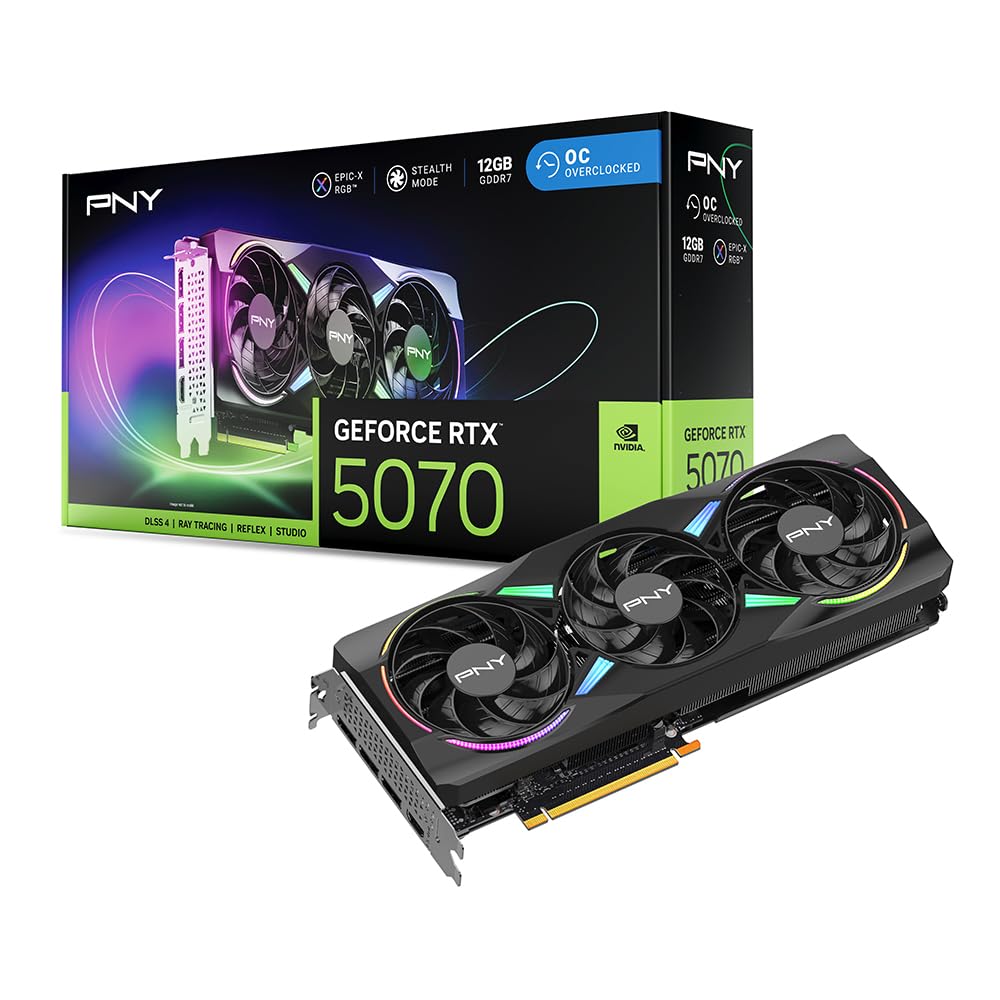
The PNY RTX 5070 Epic-X ARGB OC is a solid mid-range option that combines Blackwell architecture with 12GB GDDR7 memory and a 2685 MHz boost clock. The triple-fan cooling solution is effective at keeping the card below 70°C under sustained load, and the ARGB lighting is subtle enough to not distract during focused work. The card uses a 16-pin to two 8-pin power connector setup, making it compatible with standard power supplies.
In Blender’s Viewport test, the card’s 6,144 CUDA cores provide responsive playback even with moderately complex geometry and material setups. The DLSS 4 support is primarily a gaming feature, but the underlying tensor cores improve OptiX denoising performance in Cycles, reducing render times by 15-20% compared to CUDA-only denoising. Users who work with AI-assisted creative workflows will benefit from the fifth-gen tensor cores for both rendering and machine learning tasks within Blender and connected tools like Stable Diffusion.
The PNY brand is well-regarded in the workstation space, and this card includes a 3-year warranty. The SFF-Ready certification ensures compatibility with smaller cases, and the 2.4-slot thickness sits between standard and compact designs. For Blender users who want a reliable 5070 experience with good cooling and a subtle RGB accent, the Epic-X OC hits the sweet spot.
Why it’s great
- 2685 MHz boost is among the highest in class
- Fifth-gen tensor cores improve OptiX denoising
- Triple-fan cooling keeps thermals in check
Good to know
- 12GB VRAM is limiting for 4K texture workflows
- RGB may not suit all professional builds
9. PowerColor Reaper RX 9060 XT 16GB

The PowerColor Reaper RX 9060 XT 16GB is an entry-level to mid-range card that offers a compelling VRAM-to-price ratio for Blender artists on a tight budget. With 16GB of GDDR6 memory at a price point well below RTX 5070 options, this card can handle larger scenes than many higher-core-count NVIDIA cards simply because it doesn’t run out of memory. The compact 200mm length makes it ideal for mini-ITX builds or upgrading older systems with limited chassis space.
In Blender’s HIP render engine, the RX 9060 XT performs respectably in simpler scenes, but users should note that the 128-bit memory interface limits memory bandwidth compared to wider-bus cards. This means scenes with heavy 4K textures may see slower viewport performance even if they fit in VRAM. The single 8-pin power connector draws minimal power (500W recommended PSU), making it a drop-in upgrade for many existing systems without needing a power supply upgrade.
Users upgrading from RX 580 or GTX 1080-class cards report massive performance improvements, with 1440p gaming and moderate Blender scenes running smoothly. The card runs quietly and stays cool thanks to a compact heatsink design. For budget-conscious Blender beginners or artists working primarily with lower-resolution assets, the PowerColor Reaper delivers excellent value.
Why it’s great
- 16GB VRAM at the lowest price in this guide
- Extremely compact 200mm length
- Low power draw with single 8-pin connector
Good to know
- 128-bit bus limits memory bandwidth
- HIP performance lags behind NVIDIA in Cycles
10. Sapphire Pulse RX 9060 XT 16GB

The Sapphire Pulse RX 9060 XT is optimized for Linux-based Blender workflows, with outstanding ROCm support that provides plug-and-play compatibility on distributions like Devuan and Ubuntu. The 16GB GDDR6 memory at a modest price point makes it one of the most accessible options for running local LLMs and Blender in parallel workflows. The 3290 MHz boost clock is aggressive, and the dual HDMI output configuration is a rarity that benefits multi-monitor productivity setups.
In Blender’s HIP render engine, the RX 9060 XT handles 1440p viewport work and simpler Cycles renders with ease. The 16GB VRAM buffer is the key advantage here — artists can load moderately complex scenes with multiple texture layers without worrying about OOM errors. Users report running ComfyUI and Blender simultaneously on Linux, leveraging the same GPU for both creative rendering and AI image generation without significant performance degradation.
The Pulse series is known for reliable quality, and this card runs cool with edge temperatures in the mid-50s°C under typical loads. The compact form factor and single 8-pin power connector make installation straightforward. For Linux Blender users or those needing 16GB VRAM on a tight budget, the Sapphire Pulse RX 9060 XT is a strong recommendation.
Why it’s great
- Excellent ROCm support for Linux Blender builds
- 16GB VRAM at an entry-level price
- Dual HDMI outputs for multi-monitor setups
Good to know
- HIP performance trails OptiX in complex scenes
- Only one DisplayPort connection
11. PNY RTX 5060 Epic-X ARGB OC
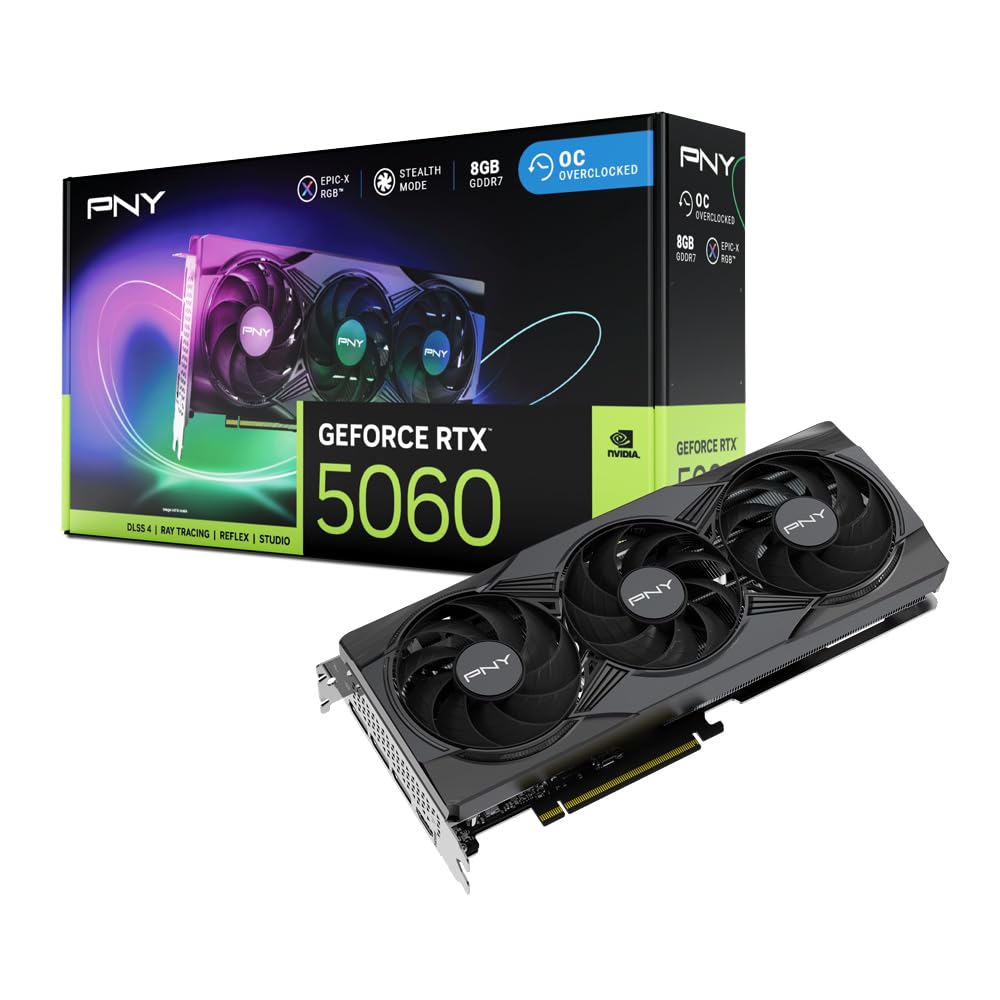
The PNY RTX 5060 Epic-X ARGB OC is the most affordable entry point into NVIDIA’s Blackwell architecture, offering 8GB of GDDR7 memory with a 128-bit interface. This card is best suited for Blender beginners or artists working exclusively with low-poly assets and simple Cycles scenes. The 2280 MHz base clock with Boost capability provides enough compute for rendering classroom-level scenes, but the 8GB VRAM ceiling means heavy scenes will quickly max out memory and resort to tile-based rendering, which dramatically increases render times.
For Blender users who rely on DLSS for upscaling or OptiX for denoising, the tensor cores in the RTX 5060 accelerate those workflows even with the limited VRAM. The card is SFF-Ready and fits into compact cases, making it a viable option for a secondary render node or a portable workstation for lightweight tasks. Users report 74 FPS in PC benchmarks with driver updates, indicating adequate single-core performance for viewport previews.
The card supports PCIe 5.0 interface but operates at x8 lanes, which doesn’t significantly impact Blender performance due to the on-card memory pipeline. The GDDR7 memory is faster than GDDR6, partially offsetting the narrow 128-bit bus. For the absolute tightest budgets or for upgrading a system where 8GB VRAM is acceptable, the RTX 5060 offers the best value, but most serious Blender users should consider the 12GB or higher options.
Why it’s great
- Lowest price entry to Blackwell architecture
- GDDR7 memory is faster than GDDR6 in class
- SFF-Ready with compact form factor
Good to know
- 8GB VRAM is insufficient for heavy texture scenes
- 128-bit bus limits memory bandwidth
FAQ
How much VRAM do I really need for Blender?
Does OptiX or HIP perform better in Cycles?
Is PCIe 5.0 necessary for Blender GPU performance?
Can I use NVIDIA and AMD cards together in Blender?
Final Thoughts: The Verdict
For most Blender users, the gpu for blender winner is the MSI RTX 5070 Ti Shadow 3X OC because its 16GB GDDR7, 256-bit memory bus, and balanced cooling provide the best mix of VRAM, bandwidth, and thermal performance for sustained Cycles rendering. If you want a compact SFF option with excellent thermal design, grab the ASUS Prime RTX 5070 Ti OC. And for Linux users or those who prefer open-source ecosystems, nothing beats the GIGABYTE RX 9070 XT Gaming OC for its 16GB VRAM and flawless ROCm compatibility.