
Cardboard bricks that assemble into a castle you can walk through. Foam cubes that float in the bath. Wooden planks cut precisely so a four-year-old engineer can balance a bridge. Giant play blocks have evolved far beyond the simple stacking toy, and choosing the right set for an educational setting—whether a preschool classroom, a living room, or a daycare center—means weighing material safety, piece count, and the specific developmental skills each type unlocks.
I’m Mohammad Maruf — the founder and writer behind Drink4Good. I’ve spent years analyzing early-childhood construction toys, cross-referencing ASTM and CPSIA compliance data, and mapping product specs to developmental milestones so caregivers and educators can make informed purchases.
After comparing foam density, cardboard thickness, and hardwood finish across seven leading contenders, this guide delivers a clear breakdown of the best giant play blocks for educational purposes for classrooms, playrooms, and family rooms alike.
How To Choose The Best Giant Play Blocks For Educational Purposes
Every set of giant blocks serves the same broad goal—hands-on, screen-free construction play—but the material, density, shape variety, and safety certifications differ wildly. Picking the right one for a classroom or home requires matching those specs to your child’s age, the intended play surface, and your tolerance for assembly time.
Material Matters: Foam, Cardboard, or Hardwood
Foam blocks are the quietest, lightest option, making them ideal for toddlers under three who are still building balance. The key spec is EVA foam density: high-density blocks resist compression and teeth marks far better than budget foams. Cardboard blocks offer a middle ground—lightweight, collapsible for storage, and capable of building life-sized forts—but require initial assembly of each brick. Hardwood blocks deliver the densest feel and most precise edges, which helps older preschoolers learn structural stability, though they are heavy and loud when toppled.
Piece Count and Geometric Variety
A 34-piece set with cubes, half-cubes, and quarter-circles opens up far more architectural possibilities than a 10-piece set of identical squares. Look for sets that include at least three distinct shapes—rectangles, squares, and wedges or arches. Sets that top 40 pieces generally allow two or three children to build simultaneously without conflict, a crucial factor for preschool group play.
Safety Certifications You Can Trust
For classroom or daycare use, GREENGUARD Gold certification (for low VOCs) and CertiPUR-US certified foam ensure the blocks won’t off-gas chemicals during hours of indoor play. For wood sets, BPA-free and non-toxic finishes are non-negotiable. Always verify that the manufacturer lists CPSIA compliance or ASTM F963 testing—this is the standard that confirms a toy is safe for children under three.
Quick Comparison
On smaller screens, swipe sideways to see the full table.
| Model | Category | Best For | Key Spec | Amazon |
|---|---|---|---|---|
| BiggoBlocks 96-Piece Set | Jumbo Plastic | Large-group indoor/outdoor forts | 96 pieces, 31 lbs total | Amazon |
| ECR4Kids SoftZone Earthtone | Premium Foam | Babies and toddlers 9mo–3yr | GREENGUARD Gold Certified | Amazon |
| Migargle 64-Piece Wood Blocks | Hardwood Premium | Classic Montessori construction play | 12 shapes, wooden storage tray | Amazon |
| Nat Geo Jumbo Cardboard 45-Pc | Castle Cardboard | Themed castle-building play | Includes drawbridge & crowns | Amazon |
| Nat Geo Cardboard 40-Pc | STEM Cardboard | STEM-based learning with activity cards | Game spinner & activity cards | Amazon |
| LOLO TOYS 30-Piece Foam | Mid-Range Foam | Bath-time and sensory play | High-density EVA, floatable | Amazon |
| CRAFTY HAPPITOYS 34-Piece Foam | Budget Foam | Entry-level stacking for ages 3+ | 34 pieces, storage bag included | Amazon |
In‑Depth Reviews
1. BiggoBlocks Big Blocks 96-Piece Standard Set

The BiggoBlocks set towers above the competition with 96 hollow-core plastic blocks designed for children ages 3 through 8. Each block is lightweight enough for a four-year-old to carry but large enough to build a fort a parent can sit inside. The interlocking studs and cavities create a satisfying snap that keeps structures stable during active play, and the four-color palette (red, blue, green, yellow) supports color-recognition lessons built into the curriculum.
What sets this set apart for educational settings is the sheer scale of collaborative building it enables. Two children can construct a playhouse while a third builds a tower beside it, all from the same bin. The 31-pound total weight is manageable for an adult to move between rooms, and the blocks are made in the United States with non-toxic materials that pass CPSIA standards. Teachers report that the open-ended nature of the block design promotes divergent thinking—kids modify their structures based on real-time problem solving rather than following picture instructions.
The blocks clean easily with a damp cloth and show negligible wear after months of daily use. Some reviewers note that the surface texture is slightly softer than competing plastic blocks, which actually reduces noise when towers fall. For a preschool, kindergarten, or family playroom that prioritizes group creativity over individual quiet play, this set delivers the highest ratio of educational value per block.
Why it’s great
- Massive 96-piece count enables large-scale group builds and forts.
- Lightweight plastic design is safe for both indoor and outdoor use on grass or carpet.
- Non-toxic, US-made materials with CPSIA compliance for school safety standards.
Good to know
- Storage bin not included; blocks are shipped in a cardboard box.
- Some pieces may show minor bending if stacked too high without interlocking.
2. ECR4Kids SoftZone Toddler Foam Building Blocks, Earthtone, 7-Piece
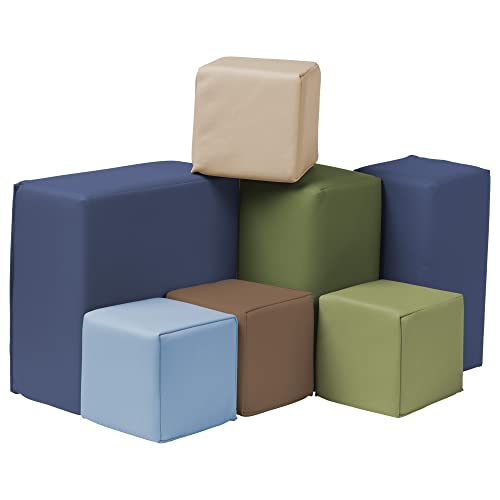
ECR4Kids is a trusted name in institutional early-childhood furniture, and this 7-piece foam block set reflects that pedigree. The earthtone color palette is deliberately muted—tan, sage, and clay—which helps the blocks blend into a Montessori or Reggio-inspired classroom without visual overstimulation. The foam core is CertiPUR-US certified, meaning it contains no ozone-depleting substances and has low VOC emissions, and the covers are UL GREENGUARD Gold Certified, making this one of the safest options for infants and toddlers under three.
The set includes four 6x6x6-inch cubes, two 12x6x6-inch rectangles, and one 12x12x6-inch large rectangle. That limited piece count is intentional: educators use these blocks for gross-motor development—reaching, carrying, stacking, and knocking down—rather than complex architectural challenges. The velcro-style hook-and-loop strips on each block allow them to stick together, which prevents the frustrating toppling that can discourage very young children. Multiple reviewers note that the blocks double as soft climbing steps for toddlers learning to stand or walk.
The downsides are the price per piece and the small total number of blocks. For a home with a single toddler, seven blocks offer enough variety, but a daycare serving six children will need at least two or three sets. The covers are moisture-resistant but not waterproof, so they require spot cleaning rather than submersion. Still, for the youngest age bracket, this set sets the standard for certified-safe, developmental foam play.
Why it’s great
- GREENGUARD Gold Certified for low VOCs—ideal for enclosed classroom environments.
- Hook-and-loop strips keep blocks connected, reducing frustration for toddlers.
- Versatile shapes double as climbing steps for gross-motor skill development.
Good to know
- Only 7 pieces, which limits the scale of group play without purchasing multiple sets.
- Covers are not machine-washable; spot-cleaning with mild soap is recommended.
3. Migargle Large Wood Building Blocks with Wooden Storage Tray, 64-Piece
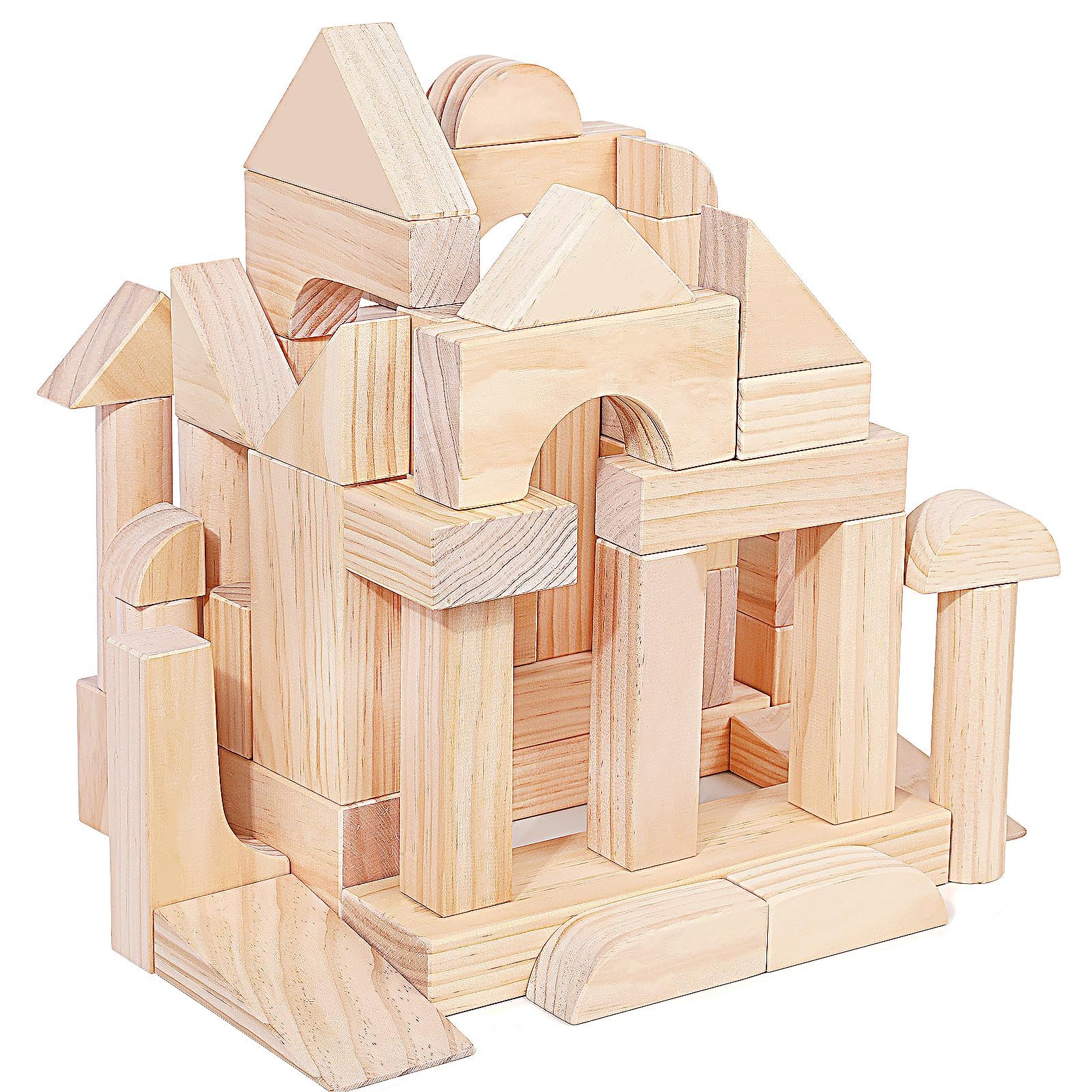
This 64-piece hardwood set revives the Montessori approach to block play, where natural finishes, precise dimensions, and a wide variety of geometric shapes replace bright colors and themed decals. Each block is sanded smooth, treated with BPA-free and non-toxic finishes, and sized substantially larger than typical unit blocks—the largest rectangle measures 5.5 inches long and 1.375 inches thick. The included wooden storage tray doubles as a construction base, and the divided compartments help children sort shapes as part of a cleanup routine that reinforces categorization skills.
Educational value comes from the math and physics concepts embedded in the block design. The set includes cubes, half-cubes, double-unit blocks, pillars, arches, triangles, and curved pieces, allowing children to explore symmetry, balance, and weight distribution without adult guidance. Teachers report that the weight of each block—dense enough to feel substantial but light enough for a three-year-old to lift—provides proprioceptive feedback that foam blocks cannot match. The wooden tray also solves a common storage complaint, because each block has a designated spot, which teaches children to replace materials precisely.
On the practical side, the blocks have held up well against drops and occasional gnawing, with no reported splintering or chipping. The neutral finish means blocks stay looking clean even after months of play. The only limitation is noise: hardwood blocks clatter loudly when knocked down, which may be disruptive in a quiet classroom or apartment setting. But for any parent or educator who values open-ended, sensorially rich construction toys rooted in the Montessori tradition, this set is a clear frontrunner.
Why it’s great
- 12 distinct geometric shapes support advanced math and physics learning through block play.
- Natural, non-toxic finish with no paints or dyes that could peel or chip.
- Wooden storage tray with compartments encourages independent cleanup and sorting.
Good to know
- Hardwood blocks are loud when dropped or knocked over—less ideal for quiet spaces.
- Heavier than foam or cardboard, making them less portable for travel or outdoor use.
4. National Geographic Jumbo Cardboard Building Blocks, 45-Piece Castle Set

This 45-piece cardboard set from National Geographic’s Blue Marble line is built around a single immersive theme: medieval castles. The blocks are printed with stone textures, window cutouts, and torch sconces, and the kit includes a working drawbridge and two paper crowns. Each hollow cardboard brick requires folding and securing during initial assembly—a process that takes roughly an hour for the full set—but once built, the blocks are sturdy enough to support a child leaning on them. The lightweight cardboard construction means that even a full tower toppling over onto a toddler results in a soft, harmless collapse.
From an educational standpoint, this set excels at sparking narrative-driven play. Children naturally invent knights, princesses, and siege scenarios, which builds language skills and social cooperation. The included Learning Guide provides historical context about castle architecture and medieval life, bridging construction play with early social-studies concepts. Parents and teachers report that the set encourages hours of sustained group play, especially when combined with action figures or dolls that populate the castle’s rooms and ramparts.
The durability is the main trade-off. Cardboard blocks will show corner wear after a few months of frequent use, and they cannot withstand moisture or outdoor play. Assembly also requires adult involvement, and some caregivers report that the odd-shaped pieces (arches and triangular roof pieces) are more challenging to fold correctly than the rectangles. However, for a birthday party, a rainy-weekend project, or a classroom castle unit, the narrative immersion this set provides is unmatched by any foam or wooden alternative.
Why it’s great
- Highly detailed castle graphics and a functional drawbridge inspire immersive pretend play.
- Lightweight cardboard folds safely—no injuries when towers fall.
- Included Learning Guide adds historical context for cross-curricular enrichment.
Good to know
- Initial assembly of all 45 blocks takes approximately one hour with adult help.
- Cardboard corners compress over time; blocks are not suitable for wet or outdoor environments.
5. National Geographic Kids Jumbo Cardboard Building Blocks, 40-Piece STEM Set
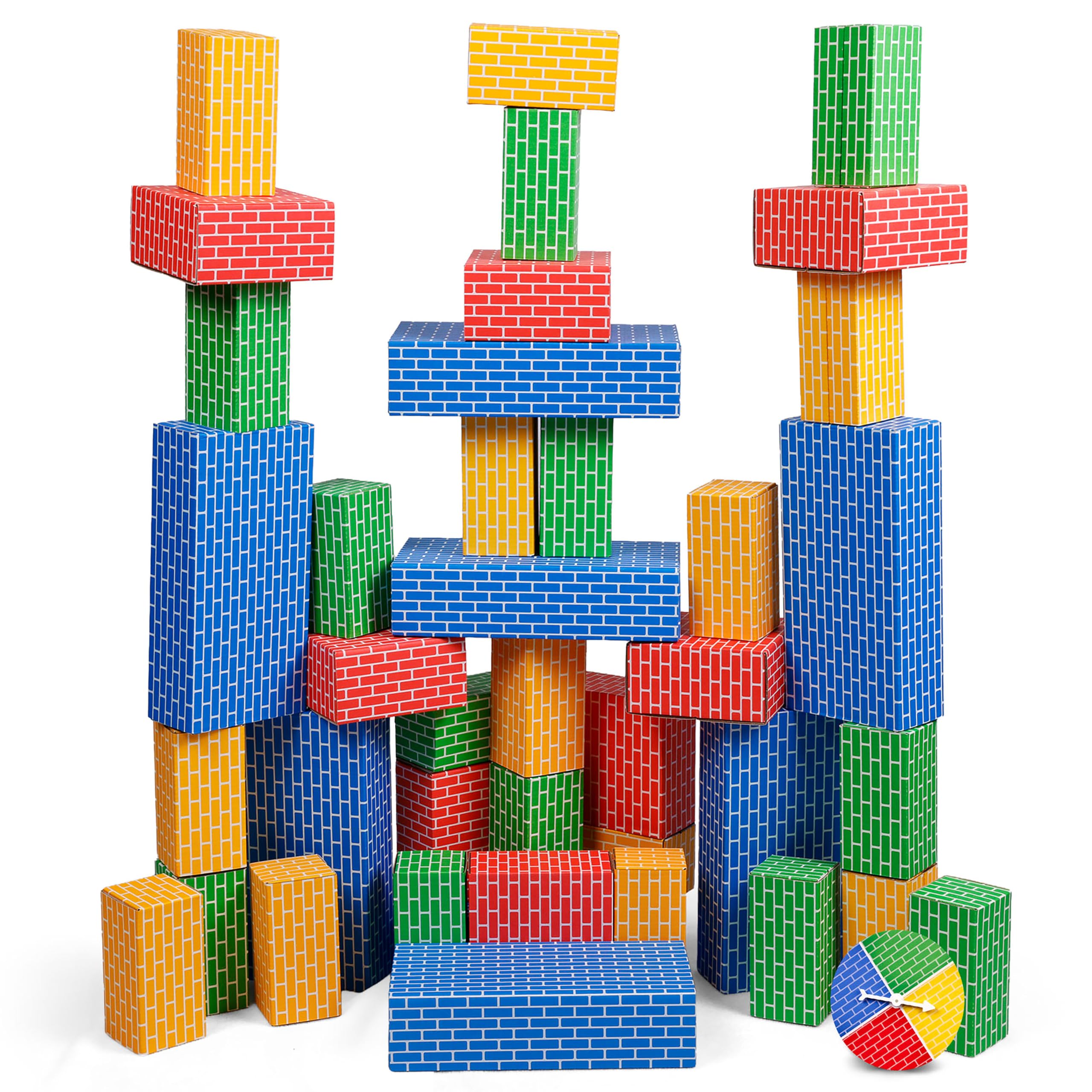
This companion to the castle set takes a different approach: instead of a themed build, it focuses on STEM learning through activity cards and a game spinner. The 40-piece kit includes bricks in three sizes (colored red, blue, yellow, and green) along with illustrated cards that prompt engineering challenges like “Build a bridge that a toy car can drive under” and “Construct a tower taller than your arm.” The spinner randomizes building prompts, turning solo construction into a turn-based group game that teaches patience and collaboration.
The cardboard construction is identical in quality to the castle set—each brick is made of extra-thick cardboard with a honeycomb internal structure that provides surprising rigidity. Blocks lock together securely using a tab-and-slot system, so a two-foot-tall tower holds its shape even when bumped. The educational prompts are aligned with early STEM standards, introducing vocabulary like “balance,” “support,” and “foundation” in a context that a four-year-old can grasp through hands-on trial and error. Multiple teacher reviewers note that the spinner activity works well in preschool circle time, because it keeps all children engaged rather than allowing one dominant builder to control the play.
The trade-offs mirror those of the castle set: assembly time, eventual corner wear, and sensitivity to moisture. Additionally, the blocks lack the aesthetic appeal of the castle version—they are plain colored bricks without surface graphics—so children who prefer fantasy play may gravitate toward the themed set. For families and classrooms that prioritize guided STEM learning over freeform pretend play, however, this kit delivers a more structured educational experience than any other giant block set on this list.
Why it’s great
- Activity cards with engineering prompts turn block play into structured STEM lessons.
- Game spinner introduces turn-taking and group problem-solving dynamics.
- Tab-and-slot assembly creates sturdy structures without glue or adhesive.
Good to know
- Plain colored surfaces lack themed graphics—less inspiring for fantasy-driven pretend play.
- Like all cardboard blocks, susceptible to moisture damage and corner wear over time.
6. LOLO TOYS Large Building Foam Blocks for Toddlers, 30-Piece

LOLO TOYS offers 30 pieces of high-density EVA foam blocks in six colors, making this one of the best value options for sensory-rich play that transitions seamlessly from the playroom floor to the bathtub. The foam is dense enough to hold its shape during stacking but soft enough to prevent injury, with a smooth finish that is gentle on sensitive skin. Each block floats in water, which opens up a unique sensory play dimension—children can build floating towers in the tub or use wet blocks to stick to tile walls through surface tension.
The set includes cubes, rectangles, and half-circles, which are enough shapes to construct simple houses, bridges, and towers. The blocks are made larger than many competing sets to provide an ideal grip for toddler hands, and the included clear zippered storage bag keeps all 30 pieces organized between play sessions. Preschool teachers appreciate the educational breadth: the blocks support color identification, patterning, counting, and the development of bilateral coordination as children lift and place pieces with two hands.
The primary limitation is the number of pieces relative to the price. At 30 blocks, the set works well for one or two children, but larger groups will exhaust the supply quickly. Some users also note that the blocks can develop bite marks if an aggressive chewer gets hold of them, though the high-density construction resists chunking better than softer foam alternatives. For parents seeking a versatile, washable, floatable set that supports both quiet stacking and active water play, this is the strongest mid-range option.
Why it’s great
- High-density EVA foam floats in water, enabling unique bath-time sensory play.
- Six bright colors support color identification and sorting exercises.
- Smooth, non-toxic finish is gentle on sensitive toddler skin.
Good to know
- 30 pieces limit the scale of group construction play with multiple children.
- Foam surface may show bite marks from aggressive chewers despite the dense core.
7. CRAFTY HAPPITOYS Set of 34 Jumbo Large Foam Blocks for Toddlers
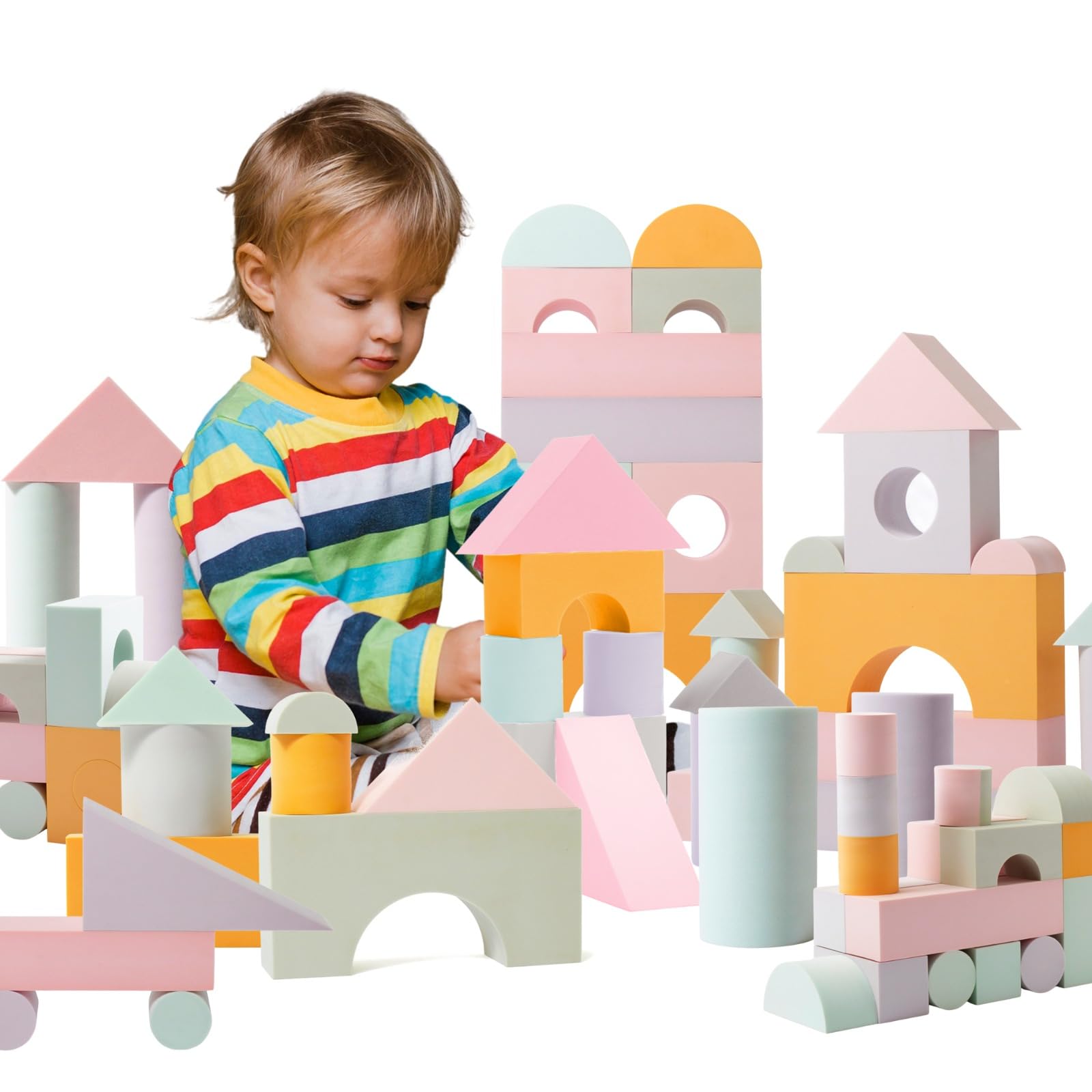
This 34-piece foam set from CRAFTY HAPPITOYS offers the most blocks per dollar in this review, making it an accessible entry point for families who want to test giant block play without a major investment. The blocks are made from non-toxic foam tested to U.S. safety standards, and the multicolor set includes cubes, half-cubes, and quarter-circles that support basic stacking, sorting, and pattern recognition. A clear plastic storage bag with a zipper closure keeps the set portable and organized, a feature often missing from budget-priced alternatives.
The foam is softer and less dense than the LOLO TOYS or ECR4Kids options, which makes the blocks extremely lightweight and easy for a two-year-old to lift, but also means they are more susceptible to compression damage. Multiple verified reviews note that children who are still teething or prone to chewing can bite chunks out of the foam, rendering some pieces unusable. The softer structure also means that tall towers wobble more than they would with high-density foam, which can be frustrating for older preschoolers aiming for complex architectural builds.
For its intended age range—children aged three and up who have passed the heavy-chewing phase—this set delivers solid value. The 34-piece count allows two children to build simultaneously, and the foam is machine-washable if spots are treated promptly. Homes and classrooms operating on a tight budget will find this set functional, though investing in a denser foam set is advisable for long-term durability in group settings.
Why it’s great
- Highest piece-to-price ratio in this review—34 blocks at an entry-level cost.
- Ultra-lightweight foam is easy for young toddlers to lift and carry independently.
- Clear storage bag keeps the set organized and portable for travel or classroom storage.
Good to know
- Low-density foam is prone to bite marks and chunking from teething children.
- Soft structure reduces stacking stability for tall or complex constructions.
FAQ
What age is appropriate for giant foam blocks versus giant cardboard blocks?
How many giant blocks do I need for a preschool classroom of 12 children?
Can giant cardboard blocks be used outdoors?
Final Thoughts: The Verdict
For most users, the giant play blocks for educational purposes winner is the BiggoBlocks 96-Piece Standard Set because it combines a massive piece count with durable, lightweight plastic that works indoors and out, supporting collaborative play and divergent thinking for children ages 3 to 8. If you need certified-safe foam for a classroom of infants and toddlers, grab the ECR4Kids SoftZone Earthtone 7-Piece set with its GREENGUARD Gold certification. And for a classic Montessori experience that teaches geometry, balance, and independent organization, nothing beats the Migargle 64-Piece Hardwood Set with its 12-shape variety and wooden storage tray.