
Every note you play lives or dies by your tuning stability. A pedal tuner that drifts, lags, or washes out under stage lights turns your performance into a guessing game. Worse, a cheap unit can suck tone through your signal chain before you even strike a chord.
I’m Mohammad Maruf — the founder and writer behind Drink4Good. I’ve spent years analyzing the circuitry, display technologies, and buffer designs that define how a tuner pedal behaves on a real pedalboard under true live conditions.
Built to survive stompbox abuse and deliver sub-cent accuracy night after night, the right guitar pedal tuner is your first line of defense against stage silence. Below are the models that earn a spot on a serious board.
How To Choose The Best Guitar Pedal Tuner
Choosing a tuner pedal means balancing accuracy, display readability, and how it integrates into your signal chain. The worst time to discover a tuner is hard to read is during a live set. Focus on the specs that affect real-world use rather than flashy features you will never touch.
Tuning Accuracy and Display Type
Entry-level tuners often offer +/- 1 cent accuracy, which is fine for quick stage checks. For intonation work or alternate tunings, a strobe tuner with 0.1 cent precision is the standard. The display matters equally — a bright LED or LCD that cuts through direct sunlight and stays visible in the dark is non-negotiable for live players.
Bypass and Buffer Circuitry
A true-bypass tuner completely disconnects your signal when disengaged, preventing any tone coloration. A buffered bypass strengthens your signal over long cable runs, which can actually preserve high-end frequencies. Most modern premium tuners let you switch between both modes, giving you flexibility depending on your pedalboard layout.
Power and Pedalboard Footprint
Mini tuners save critical space on crowded boards but often lack battery compartments, requiring a dedicated 9V output from your power supply. Standard-sized units are easier to stomp blindly and usually include a battery slot for quick setup. Check the current draw — anything over 50 mA matters if your power supply is already near its limit.
Quick Comparison
On smaller screens, swipe sideways to see the full table.
| Model | Category | Best For | Key Spec | Amazon |
|---|---|---|---|---|
| BOSS TU-3W | Premium | Studio & Stage Professionals | 21-Segment Blue LED Meter | Amazon |
| Peterson StroboStomp Mini | Premium | Luthiers & Intonation Work | 0.1 Cent Strobe Accuracy | Amazon |
| Korg Pitchblack X | Mid-Range | Versatile Stage Use | Four Display Modes | Amazon |
| TC Electronic Polytune 3 Noir | Mid-Range | Quick Polyphonic Tuning | Built-In Bonafide Buffer | Amazon |
| Mooer Baby Tuner | Budget | Ultra-Compact Pedalboards | Miniature Footprint | Amazon |
| Donner DT-1 | Budget | Budget-Conscious Beginners | Strobe Mode, +/-1 Cent | Amazon |
| Mooer Autuner MVP1 | Specialty | Vocal Pitch Correction | Vocal Synthesizer Engine | Amazon |
In‑Depth Reviews
1. BOSS TU-3W Waza Craft Chromatic Tuner

The BOSS TU-3W sits at the summit of pedal tuner engineering. It inherits the bulletproof reliability of the industry-standard TU-3 and adds Waza Craft mojo — refined audio circuitry that delivers an exceptionally pure signal pass-through. The 21-segment blue LED meter is dramatically easier to read on dark stages compared to the red standard version, and it tracks low G on a 7-string without hesitation.
You get the best of both bypass worlds: a premium buffer that strengthens your signal over long cable runs and a switch to toggle true-bypass mode when you want zero coloration. The real-time tracking feels instant, locking onto notes faster than most digital displays can refresh. Musicians consistently report that the fine-tuning resolution is slightly better than competing standard tuners.
The only trade-off is the lack of a dedicated mute function that doesn’t engage the tuner — you have to tune to silence the signal. The premium price reflects the Waza Craft badge, but for a touring professional who needs one less thing to worry about, the TU-3W is the final word in stage tuning.
Why it’s great
- Ultra-fast note tracking with sub-cent accuracy
- Superior Waza buffer preserves high-end frequencies
- Blue LED display cuts through direct sunlight and pitch-black stages
Good to know
- No mute function that bypasses the tuner
- Premium pricing; best value found during sales
2. Peterson StroboStomp Mini
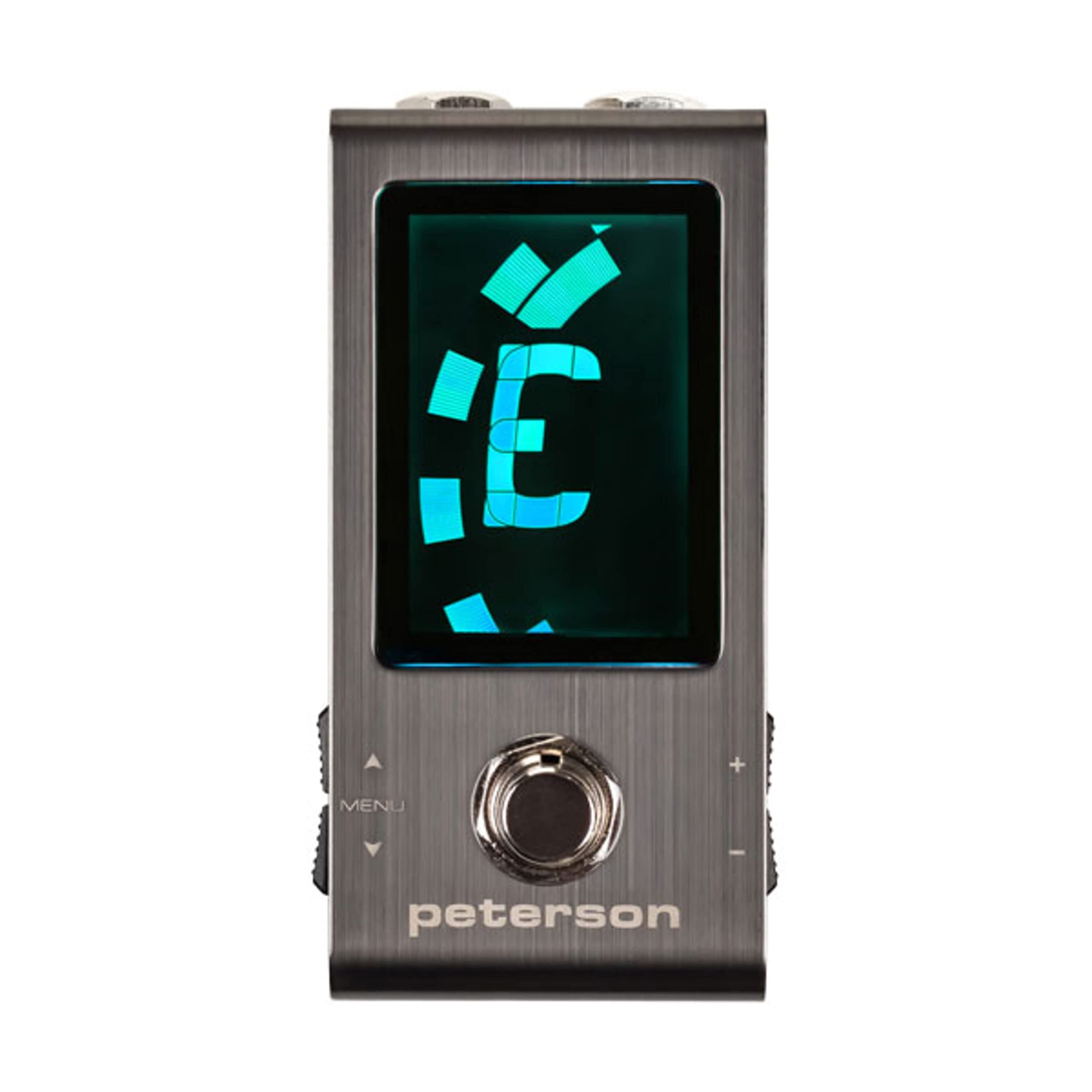
Peterson is the name that luthiers and repair techs trust for intonation work, and the StroboStomp Mini brings that laboratory-grade accuracy into a pedalboard-friendly package. The high-definition LCD with LED backlight remains fully readable in direct sunlight or under blinding stage lighting — a rare feat for any tuner display. The true selling point is the real strobe engine delivering 0.1 cent precision, which is essential for setting up a guitar’s intonation with confidence.
You get over 80 sweetened and guided tunings built in, meaning you can dial in specific temperaments that make certain chords ring more harmonically. The top-mounted jacks save space, and the power options are flexible: standard 9V DC or USB-C bus power. The aluminum case feels dense and premium, and the solenoid-based switching eliminates that audible pop you sometimes get with mechanical switches. Reviewers praise its B-string tracking on 5-string basses as flawless.
The learning curve is real — navigating the settings menu is not as intuitive as a simple stomp-and-tune pedal. The side buttons require a bit of extra clearance on a crowded board. But for anyone who spends as much time setting up guitars as playing them, the StroboStomp Mini is the most capable tuner you can fit on a mini pedal.
Why it’s great
- Professional 0.1 cent strobe accuracy for intonation
- Over 80 sweetened tunings for alternate temperaments
- USB-C power option frees a DC output on your supply
Good to know
- Menu navigation is cumbersome without the manual
- Side buttons need extra pedalboard clearance
3. Korg Pitchblack X Chromatic Tuner

Korg re-engineered the Pitchblack line with the X model, and the most noticeable upgrade is the massive, high-visibility display that puts even the BOSS TU-3 to shame in brightness. You get four tuning modes in one unit — regular, strobe, half-strobe, and mirror — giving you the flexibility to choose your preferred visual feedback. The new Ultra Buffer mode maintains signal integrity over long cable runs, and you can switch between that and true bypass depending on your board’s needs.
The calibration button lets you adjust reference frequencies from 436 Hz to 445 Hz, which is critical for playing along with older recordings or orchestras that tune sharp. It runs on either a standard 9V power supply or a battery, making it a great option for quick jams where you don’t want to drag out a power brick. Build quality is solid, with a metal chassis that feels like it can survive a dropped guitar case.
Some users note that the strobe mode, while accurate, is not quite as precise as the Peterson at 0.1 cent — the Pitchblack X operates closer to 1 cent resolution. But for 99% of stage tuning needs, that is more than adequate. The adjustable brightness is a welcome feature that the BOSS TU-3 lacks, letting you dim the display in a dark studio.
Why it’s great
- Adjustable brightness for day and night use
- Ultra Buffer mode preserves tone through long signal chains
- Runs on battery for cable-free setup
Good to know
- Strobe mode is not as precise as dedicated strobe tuners
- Display is very large — may dominate a mini board
4. TC Electronic Polytune 3 Noir
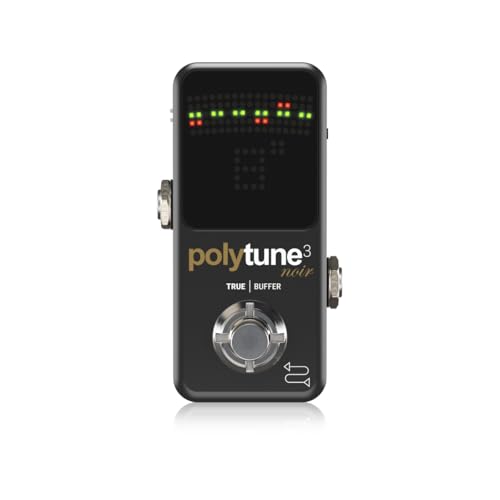
The Polytune 3 Noir packs TC Electronic’s signature polyphonic tuning technology into a compact Noir finish that looks sleek on any board. Strum all six strings at once and the display shows you exactly which strings are sharp or flat in a single glance — a massive time-saver during quick stage checks between songs. The built-in Bonafide Buffer is one of the best in the business, preventing signal degradation without adding unwanted noise.
Despite the polyphonic party trick, many users end up relying on the individual chromatic mode for standard tuning because it feels more precise for fine adjustments. The Noir version uses a crisp, high-contrast display that is easier to read than the original Polytune, and the mini form factor frees up real estate for additional pedals. Reviewers consistently praise its accuracy, noting it replaced full-size Boss tuners without any loss of performance.
The polyphonic mode works best with standard tuning and clean playing — heavy distortion or dropped tunings can confuse the algorithm. A plastic screen protector is pre-installed, which some buyers mistakenly report as scratches. It is a mid-range price point that delivers professional features without the boutique price tag.
Why it’s great
- Polyphonic tuning shows all strings at once
- Bonafide Buffer preserves signal integrity
- Compact Noir design looks great on dark boards
Good to know
- Polyphonic mode struggles with heavy distortion
- Some users prefer individual chromatic mode for precision
5. Mooer Baby Tuner

The Mooer Baby Tuner proves that a mini footprint does not have to mean a tiny, unreadable display. Despite measuring barely wider than a standard pedal switch, the LCD screen is large, bright, and easy to read from a standing position. It operates as a mute-style tuner, silencing your signal completely while you tune — a clean implementation that prevents any unwanted noise bleeding through the PA.
Reviewers report that it locks onto notes faster than the Polytune series, although some note a slight shift before it settles, suggesting the initial read is approximate before the final 1 cent accuracy locks in. The silver and white finish stands out on a dark pedalboard, and the overall build quality feels solid for its budget-friendly price range. It draws only 30 mA, making it easy to power on a daisy chain.
The biggest concern is intermittent instability reported by some users — occasionally the pedal stops responding until the DC power is reset. A few reviewers also note that the tuning resolution is closer to 1 point versus the 0.5 cent resolution you get on a Polytune, which matters if you are particular about fine-tuning. For the price and size, it is a reliable stage tuner for guitarists who need to save every inch of board space.
Why it’s great
- Ultra-compact size saves significant pedalboard space
- Large, easy-to-read LCD display for a mini pedal
- Fast note locking compared to similar-sized tuners
Good to know
- Occasional unresponsiveness requiring power reset
- Accuracy is 1 cent, not suitable for intonation work
6. Donner DT-1 Chromatic Tuner

The Donner DT-1 is the entry-level tuner that punches well above its price tag. It features a strobe mode with +/- 1 cent accuracy and a tuning range from A0 (27.5 Hz) all the way to C8 (4186 Hz), covering everything from a low bass B to the highest violin notes. The LCD screen is paired with specially adjusted LED beads that maintain visibility on large outdoor stages, a feature usually reserved for premium units.
The DT-1 operates with a mute function that cuts signal output during tuning, and switches to true bypass mode when disengaged, so your tone stays pure when you are not tuning. The metal case has a matte finish and rubber pads on the bottom that let you attach velcro without removing them, a small detail that simplifies pedalboard mounting. Reviewers consistently note that it outperforms more expensive tuners in terms of accuracy and build quality for the price.
The catch is power — the DT-1 does not include a power adapter, and you need a 9V supply capable of delivering at least 500 mA, which is unusually high for a simple tuner. There is also no battery compartment, so you are tethered to a power source. The LED indicator lights are extremely bright, which some users find overpowering in low-light settings, making the LCD harder to read until the green center LED activates.
Why it’s great
- Impressive strobe accuracy for a budget-friendly pedal
- True bypass ensures no tone coloration when disengaged
- Wide tuning range covers bass and extended-range instruments
Good to know
- Requires a 500 mA power supply, not included
- No battery compartment — must be plugged in at all times
- LED indicators may be too bright in dark rooms
7. Mooer Autuner MVP1 Vocal Processor

The Mooer Autuner MVP1 is a different beast entirely — it is a vocal effects processor that includes pitch correction as its core feature, designed for solo singer-guitarists who need to process their voice without a separate mixer. It offers three unique vocal tone settings, plus high-quality delay and reverb specifically tailored for vocal performance. The dual footswitch control includes a tap-tempo feature for syncing delay timing mid-song.
The MVP1 features separate guitar and microphone inputs, with independent reverb for the guitar signal. You can output mixed signals or keep them separate depending on your setup. The built-in microphone amplifier works with the LINE IN for traditional stompbox use, and optional 48V phantom power means you can run condenser microphones without an external preamp. Reviewers praise the pitch correction for producing professional-sounding vocals once properly dialed in.
This is not a dedicated tuner — it is a vocal workstation that happens to tune. The pitch correction works well through the XLR input, but the instrument input does not process the guitar signal for harmonization, which some users found misleading. The knobs are sensitive and the effects can swing from too quiet to over-the-top quickly, requiring careful tweaking. If you are a solo performer looking for an all-in-one vocal solution, the MVP1 is worth considering, but guitarists seeking a pure tuner should look elsewhere in this guide.
Why it’s great
- Pitch correction plus delay and reverb in one pedal
- 48V phantom power supports condenser mics
- Tap-tempo delay syncs with your performance
Good to know
- Not a pure guitar tuner; focuses on vocal processing
- Instrument input does not process harmonization
- Knobs are sensitive and effects can be hard to dial in
FAQ
Should I place my tuner pedal first in the signal chain?
What is the difference between a chromatic tuner and a strobe tuner?
Can a pedal tuner handle bass guitar and extended-range instruments?
Why does my tuner pedal make a clicking or popping sound when I engage it?
Final Thoughts: The Verdict
For most users, the guitar pedal tuner winner is the BOSS TU-3W Waza Craft because it combines bulletproof accuracy, a premium buffer that preserves your tone, and a stage-readable blue display in a package built to last a lifetime. If you need 0.1 cent strobe precision for intonation work, grab the Peterson StroboStomp Mini. And for space-saving versatility with polyphonic tuning, nothing beats the TC Electronic Polytune 3 Noir.