
Choosing a camera for your FPV rig is the single most important decision that dictates whether you fly with confidence or fight static and blur. The wrong sensor and transmitter pairing can introduce a latency that makes gates feel impossible, while the right one delivers a locked-in, immersive feed that feels like an extension of your own vision.
I’m Mohammad Maruf — the founder and writer behind Drink4Good. I spend my time analyzing the specifications of FPV transmitters and camera sensors, breaking down how CMOS versus CCD sensors handle lighting transitions, and identifying which AIO units deliver the best balance of weight, power, and durability for serious builders.
This buying guide is built for pilots who want clear, low-lag video without wasting money on setups that overheat or drop signal mid-flight. I have analyzed the specifications and real-world feedback for the most competitive options on the market, and the result is a curated list of the best fpv camera options that match different flying styles and budgets.
How To Choose The Best FPV Camera
Selecting the right camera for your build is a balancing act between latency, low-light performance, and durability. Before you look at resolution numbers, you need to understand the environment you are flying in and the space you have to work with.
CMOS vs. CCD: The Lighting Trade-Off
Most modern FPV cameras use a CMOS sensor, which handles mixed lighting—like flying from shade into direct sunlight—very well thanks to Wide Dynamic Range (WDR). CCD sensors, on the other hand, tend to have less smearing and lower noise in overcast conditions, but they are becoming harder to find in new models. For general freestyle and racing, a CMOS sensor with Global WDR is the safer bet.
Output Power (mW) and Antenna Selection
The transmitter power, measured in milliwatts (mW), determines how far your video signal will penetrate before it starts to break up. For indoor whoops, 25mW is usually enough, but for park flying you want at least 200mW. A switchable VTX that lets you toggle between 25mW, 50mW, and 200mW is the most versatile. The antenna type matters just as much: a cloverleaf provides better coverage than a simple dipole but is much more fragile on a crash.
Physical Size and Mounting
Check whether the camera uses a standard 19x19mm or 22x22mm mounting pattern. Most whoop and micro frames require the smaller size. The weight of the camera and transmitter combo also needs to be under 10g for ultra-light 1S/2S builds to avoid affecting flight dynamics.
Quick Comparison
On smaller screens, swipe sideways to see the full table.
| Model | Category | Best For | Key Spec | Amazon |
|---|---|---|---|---|
| AKK BA3 | AIO Combo | Ultra Micro Builds | 4.7g weight, 1S power | Amazon |
| Wolfwhoop WT03 | AIO with Cloverleaf | Tiny Whoop Drones | 200mW switchable | Amazon |
| RunCam Phoenix 2 | Micro Analog | Durable Freestyle | Global WDR, 1000TVL | Amazon |
| AKK KC04 | Separate VTX+Camera | Long Range Ground | 600mW output, 3km range | Amazon |
| FOXEER Razer Mini V3 | Nano Micro | Pro Racing & Park Flying | 1200TVL, 4-25V input | Amazon |
| RunCam Spotter V2 | AIO Kit | Cars, Boats, Beginners | Integrated mic, FOV 170° | Amazon |
| DJI Neo FPV Combo | Digital System | Immersion FPV Beginners | 4K UHD, 135g total | Amazon |
In-Depth Reviews
1. FOXEER Razer Mini V3

This is one of the few nano cameras that actually delivers on the promise of higher resolution without adding noticeable latency. The 1200TVL CMOS sensor with a 1/3-inch format handles the transition from bright sunlight into deep shadow much better than the 700TVL or 600TVL alternatives. The low-lux performance is surprisingly clean for a camera this size, which matters when you are flying freestyle through tree lines just after sunset.
The setting menu is easy to navigate using the standard OSD board, and the ability to switch between 4:3 and 16:9 aspect ratios makes it versatile for both racing quads and long-range wings. The wide input voltage range from 4.5V all the way up to 25V eliminates the need for a separate voltage regulator—a critical advantage when wiring a lightweight build. The shutter speed auto-adjusts between 1/25 and 1/10,000 of a second, which drastically cuts down ghosting during fast yaw spins.
The big differentiator compared to cheaper micro cameras is how well the sensor handles complex lighting. You get more detail in the shadows and less blooming in the highlights. If you are building a mid-range freestyle quad or a 3-inch ripper, this is the sweet spot between price and image clarity for an analog system.
Why it’s great
- Excellent light handling with low latency
- Can run directly on 4S packs without a regulator
Good to know
- No integrated transmitter; you need a separate VTX
- Some users report the mounting tabs needing careful tightening
2. RunCam Phoenix 2 SPV5
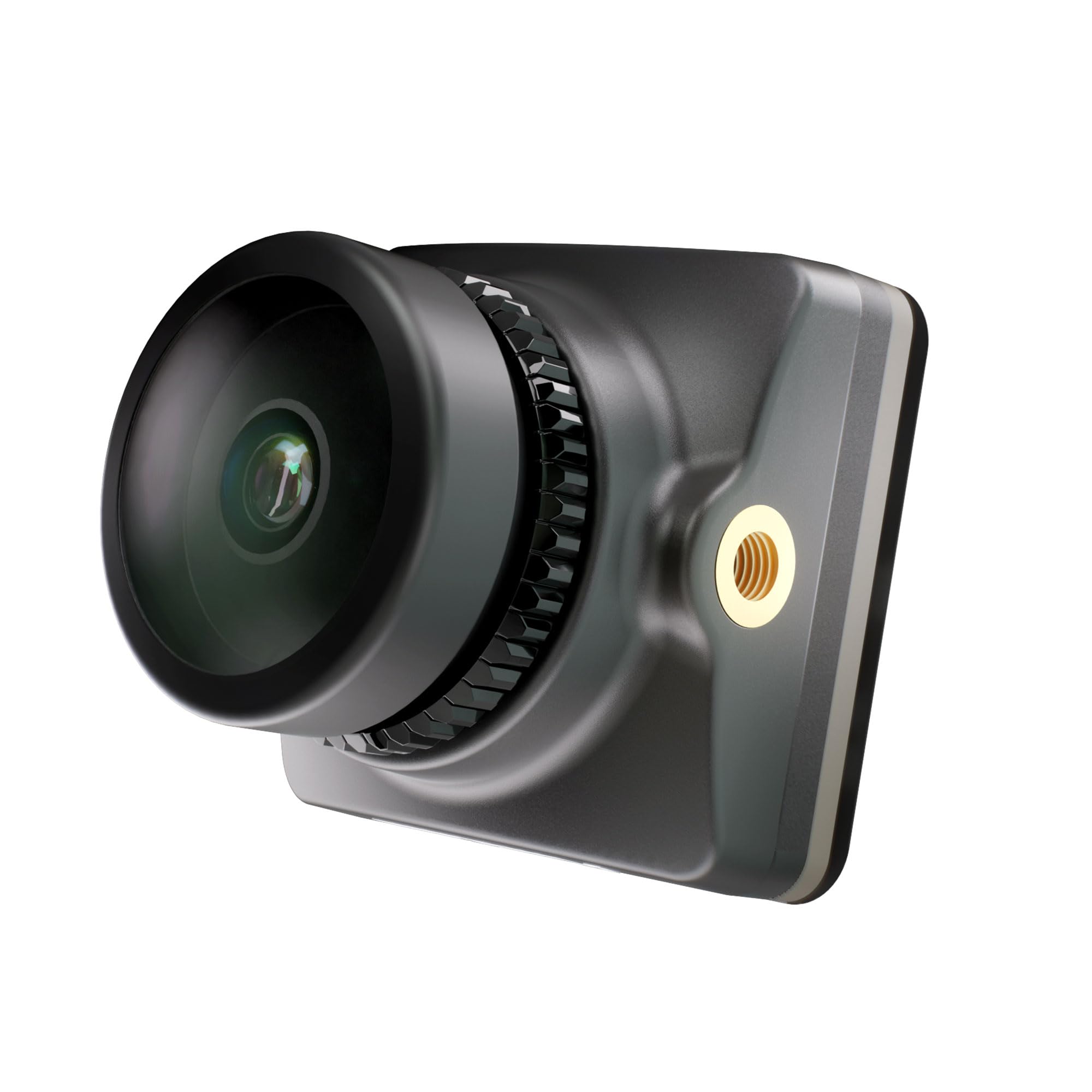
The Phoenix 2 uses a 1/2-inch CMOS sensor with Global WDR, which is a rare combination in the micro format. The larger sensor gives it a natural advantage in low-light scenarios, and the Global WDR ensures that a sudden shift from a dark tunnel into daylight doesn’t wash the entire image out. It also produces a true 1000TVL image that is noticeably sharper than the older Phoenix standard.
What sets this camera apart from many competitors is the fully enclosed back cover design. Most micro cameras leave the rear exposed, making them vulnerable to dust and shorts from carbon fiber frames. The Phoenix 2 uses a sandwich-style shell that seals the board completely. The included replaceable lens hood cuts down on glare from the sun when flying at certain angles, and the lens itself is recessed into the frame for better crash protection.
The menu system is accessible via a standard 6-pin OSD connector or directly through a compatible VTX, which simplifies tuning without needing a special breakout board. It supports both 4:3 and 16:9 formats. This is the camera to choose if you crash often and need a rugged body that keeps the lens board aligned.
Why it’s great
- Sandwich back cover prevents dust and shorts
- Large 1/2 sensor delivers very good low-light video
Good to know
- Video quality is not as sharp as 1200TVL units
- Mounting bolts can pop out in hard crashes
3. DJI Neo FPV Combo

The DJI Neo represents a very different path from the analog cameras above. This is a complete digital FPV system, meaning you get a crisp 4K stabilized feed from the camera to the goggles without any analog static or noise. The camera is built into a 135g airframe with a full-coverage propeller guard, making it the safest way for a beginner to experience FPV flight without needing to learn soldering or Betaflight configuration.
The kit includes the DJI RC Motion 3 controller, the Goggles N3, and three batteries with a charging hub. The palm-takeoff feature eliminates the need for a launch pad, and the subject-tracking mode means the drone can act as a camera operator during hikes or family events. The app allows voice control in English and Chinese, which makes it simple to trigger quick shots while on the move.
For anyone who wants to enjoy the FPV experience without building a custom quad, this is the most polished option currently available. The video quality is vastly superior to analog, and the safety features are race-proven for beginners. It is also light enough to avoid FAA registration and Remote ID requirements in the United States.
Why it’s great
- 4K stabilized video with no analog static
- Palm launch and follow-me mode for easy flying
Good to know
- Significantly more expensive than analog solutions
- Goggles N3 fit poorly over prescription glasses
4. RunCam Spotter V2

The Spotter V2 is an all-in-one solution that combines the camera, transmitter, and microphone into a single 10-gram unit. The 700TVL camera is not the highest resolution on this list, but the 170-degree field of view makes it one of the widest available. This is especially valuable for RC crawlers, cars, and boats where you need to see obstacles close to the chassis without fisheye distortion.
The transmitter covers all 40 channels on the 5.8GHz band and is adjustable from 20mW up to 200mW. The integrated microphone captures clean audio, which adds to the immersion when driving a car or flying a plane. Everything comes ready to install with a simple plug-and-play cable, and the package includes a mounting bracket and antenna. The antenna is surprisingly durable for an AIO unit and can be bent back into shape after a rollover.
The main limitation is thermal management. At 200mW output, the unit starts to get quite hot after about ten minutes of continuous use. For short flights and ground-based driving sessions, this is rarely an issue, but it is something to consider if you plan long flight times in a enclosed canopy.
Why it’s great
- Widest field of view at FOV 170 degrees
- Very durable antenna and housing
Good to know
- Heats up quickly at maximum power output
- Range is limited to roughly 50 feet at high power
5. AKK BA3 AIO

Weighing in at only 4.7 grams, the AKK BA3 is the lightest all-in-one solution on this list. It combines the 600TVL camera, the 40-channel transmitter, and a brass dipole antenna into a single board that runs off a standard 1S LiPo battery. This makes it the default choice for ultra-micro builds like the Tiny Whoop, Blade Inductrix, or FT Gremlin where every gram matters for flight performance.
The output power is switchable between 25mW, 50mW, and 200mW, which gives you flexibility between indoor flying and short outdoor sessions. The camera features improved low-light circuitry compared to the older AKK models, so flying in a dim living room is still possible without the feed turning completely black. The image is clear enough for proximity flying, and many users report that the unit survives dozens of crashes without breaking.
The most common issue reported across long-term use is that the IR filter can become loose after many hard impacts, causing a red-tinted square to appear on the left side of the image. At this price point, the cost is low enough that you can keep a spare ready. This is the simplest path to getting FPV on a micro drone.
Why it’s great
- Extremely light, perfect for 1S builds
- Cost-effective for multipule builds
Good to know
- IR filter can loosen causing image tint
- Gets very hot at max power
6. AKK KC04 Combo

The KC04 takes a different approach from the AIO units by offering a separate 600mW transmitter and a 700TVL camera module. The transmitter output is significantly higher than the standard micro VTX, giving it a claimed range of up to 3 kilometers in line-of-sight conditions. This makes it ideal for long-range wing flying or ground-based inspection vehicles where you need the signal to punch through obstacles.
The camera module uses a 2.8mm lens with a 120-degree field of view, which provides a more natural perspective compared to the ultra-wide 170-degree lenses. It uses the NTSC signal system, and the transmitter has double push buttons for quickly changing channels and frequency bands. The aluminum case on the transmitter provides decent heat dissipation, which is critical when running at 600mW for extended periods.
The setup is more involved than an AIO unit. Both the camera and VTX require a constant 12V input, so you cannot wire them directly to a 1S or 2S battery. You will need a regulated power source or a 3S/4S connection. Some units have had quality control issues with overheating, so it is important to bench test the camera right away to ensure it stays cool after 8 minutes of operation.
Why it’s great
- Very high 600mW output for long range
- Aluminum housing on the transmitter helps cooling
Good to know
- Requires 12V power for both camera and VTX
- Quality control is inconsistent across units
7. Wolfwhoop WT03 AIO

The Wolfwhoop WT03 is the most popular budget AIO alternative to the AKK BA3. It uses the same basic 600TVL sensor and switchable power (25/50/200mW), but it ships with a cloverleaf antenna instead of a simple dipole. The cloverleaf antenna provides better circular polarization and wider coverage, which reduces signal dropout when the drone is banking or changing orientation.
Setup takes just a few minutes out of the box, and the camera quality is generally described as being slightly better than the AKK in low-light conditions. The blue LED on the transmitter makes it easy to find the channel you are on when syncing with goggles. It runs off a standard 1S battery and has enough power to outrun the range of most micro receivers, so you will likely lose control signal before the video feed drops out.
The critical weakness is the cloverleaf antenna itself. The lobes are very fragile and will snap off on the first hard crash. If you plan to fly indoors or over grass, this is less of an issue, but for concrete parking lots or tight gaps, you will want to protect the antenna with a zip tie or heat shrink. For the price, this is still a very capable unit for getting started with FPV.
Why it’s great
- Better video coverage with cloverleaf antenna
- Easy channel selection using the blue LED
Good to know
- Antenna breaks on the first crash
- Unit gets very hot at 200mW output
FAQ
What does AIO mean in an FPV camera context?
Can I use a 1200TVL camera with a standard analog VTX?
Why does my FPV camera overheat after a few minutes?
Final Thoughts: The Verdict
For most users, the best fpv camera winner is the RunCam Phoenix 2 because it provides the best mix of a durable enclosed body and excellent Global WDR for handling varied lighting. If you want the highest analog resolution without breaking the budget, grab the FOXEER Razer Mini V3. And for beginners who want a low-risk entry into digital FPV, nothing beats the DJI Neo FPV Combo.