
A guitarist who can’t lock in with the beat will never sound tight in a mix. The right metronome does more than count — it trains your internal clock, exposes rushing or dragging, and turns sloppy practice into deliberate progress.
I’m Mohammad Maruf — the founder and writer behind Drink4Good. I’ve spent years evaluating musical accessory hardware, focusing on the metronome features that actually improve timing accuracy without getting in your way.
This guide breaks down the top options from simple dial-driven units to multi-function digital devices, helping you find the best guitar metronome for your playing style and practice environment.
How To Choose The Best Guitar Metronome
Not all metronomes fit guitar practice the same way. Phone apps drain the battery and produce weak speaker output that competes with an amplified guitar. A dedicated unit delivers real volume, haptic or visual feedback, and reliable buttons you can hit mid-song. Focus on these specifics before you buy.
Mechanical Click vs Digital Beep
A mechanical metronome uses a pendulum and spring to produce a wood-block or clacking sound. The attack is sharp and cuts through your amp’s noise floor. Digital units generate electronic tones — beeps, voice counts, or sampled percussion. Mechanical clicks are generally preferred for rhythm training because they feel more natural under your fingers. Digital units often include a blinking LED, which helps if you need visual reinforcement.
BPM Range and Resolution
Standard guitar practice sits between 40 and 208 BPM. Some digital models extend this further, but the real concern is whether you can dial in an exact tempo. Mechanical units with a pendulum scale are limited to printed markings (e.g., 72, 76, 80) and cannot hit every integer. Digital units let you target any specific BPM, which matters when you are working on a part recorded at 83 BPM or 97 BPM.
Headphone Jack and Silent Practice
If you share a living space or practice late, the headphone jack is essential. An ⅛-inch output lets you route the click directly into your headphones without disturbing anyone. Some digital metronomes also offer a silent mode that uses flashing lights instead of sound — useful for saving battery life and keeping the room quiet.
Beat Patterns and Time Signatures
Basic metronomes accent the downbeat of 4/4 time. Better units support 0 through 9 beats per measure, plus triplet subdivisions. If you play jazz, Latin, or progressive rock, look for models that handle compound time signatures and accent patterns. The ability to change the subdivision mid-practice helps during rhythm drills.
Built-in Tuner vs Dedicated Unit
Some digital metronomes integrate a chromatic tuner, which reduces the number of devices on your music stand. The trade-off is that combo units often have smaller displays and less intuitive metronome controls. If you already own a clip-on tuner, a dedicated metronome with a larger tempo dial or screen may serve you better.
Quick Comparison
On smaller screens, swipe sideways to see the full table.
| Model | Category | Best For | Key Spec | Amazon |
|---|---|---|---|---|
| Korg KDM-3 | Digital | Versatile practice | 8 sounds, 19 beat patterns | Amazon |
| Wittner 865061 | Quartz | Loud acoustic click | Wood block sound, 40-208 BPM | Amazon |
| LEKATO 3-in-1 | Digital Combo | Beginner multi-tool | Vocal count, rechargeable | Amazon |
| Yamaha MP-90BK | Mechanical | Classical/teaching | Pendulum, wind-up, loud | Amazon |
| Ueteto Digital | Digital | Quiet practice | 16 hr battery, voice count | Amazon |
In‑Depth Reviews
1. Korg KDM-3 Digital Metronome

The Korg KDM-3 packs the widest sonic palette of any unit in this roundup. Eight distinct sounds — including mechanical metronome, cowbell, rimshot, and voice — let you choose a click that cuts through your amplifier or blends into an acoustic session. The 19 beat patterns cover 0–9 beats per measure plus triplets and clave, making it usable for classical drills, Latin grooves, or odd-meter progressive riffs. A built-in Sound Out mode generates reference tones from C4 to B4 at adjustable A4 calibration (410–480 Hz), doubling as a basic tuning fork for ear training.
The interface centers on a large start/stop button that lights up during playback, plus a tempo dial that adjusts in single-number increments. An auto-power-off function kicks in after 20 minutes to preserve battery life, and the memory backup saves your last tempo, beat, and tuning settings even when the unit is off. The compact body — roughly half the footprint of a traditional pyramid metronome — sits easily on a music stand or amp top.
Customer feedback highlights the loud internal speaker and the ability to switch between clicks quickly. Some users note that the LED indicator sits on the top face rather than the front, which can reduce visibility if the unit is placed low on a stand. Battery removal has been reported as slightly tight with certain brands, but overall the KDM-3 earns high marks for print clarity and build quality.
Why it’s great
- 8 distinct click sounds reduce ear fatigue
- 19 beat patterns support complex time signatures
- Memory backup retains tempo and settings
Good to know
- LED is on the top, less visible from a stand height
- Battery compartment can be tight with some brands
2. Wittner Metronome 865061

The Wittner 865061 is a quartz-driven metronome that produces a real wooden block clack — not a synthesized beep. This acoustic attack is naturally percussive and cuts through the noise of a strummed acoustic or an overdriven electric tone. The analog-style dial lets you set any tempo between 40 and 208 BPM with a single turn, bypassing the need to scroll through menus. There is no digital display to squint at; the large printed scale is readable from arm’s length.
Measuring just 3.54 x 1.57 x 5.1 inches and weighing 3.68 ounces, this unit slides into a guitar case accessory pocket without adding bulk. A 3.5mm headphone jack provides silent practice capability, and the included earphone works well enough for quiet use. The blinking red light offers a secondary visual reference, though multiple reviews mention it is dim and hard to see from an angle. The battery compartment takes a single 9V battery, which is a less common format today but widely available.
Wittner is a legacy German brand with decades of metronome manufacturing experience. The build uses a stainless steel interior mechanism paired with an alkaline body material, giving it a dense, premium feel that resists knocks on a crowded music stand. Owners consistently report the unit working reliably for years, and the lack of volume control is the only recurring critique — the clack is fixed at a fairly loud level.
Why it’s great
- Authentic wooden block clack cuts through loud amps
- Single-dial tempo setting with no digital scrolling
- Compact, pocket-sized, case-friendly
Good to know
- No volume adjustment — click is fixed at loud
- Blinks dimly; hard to see in bright light
3. LEKATO 3-in-1 Rechargeable Metronome Tuner
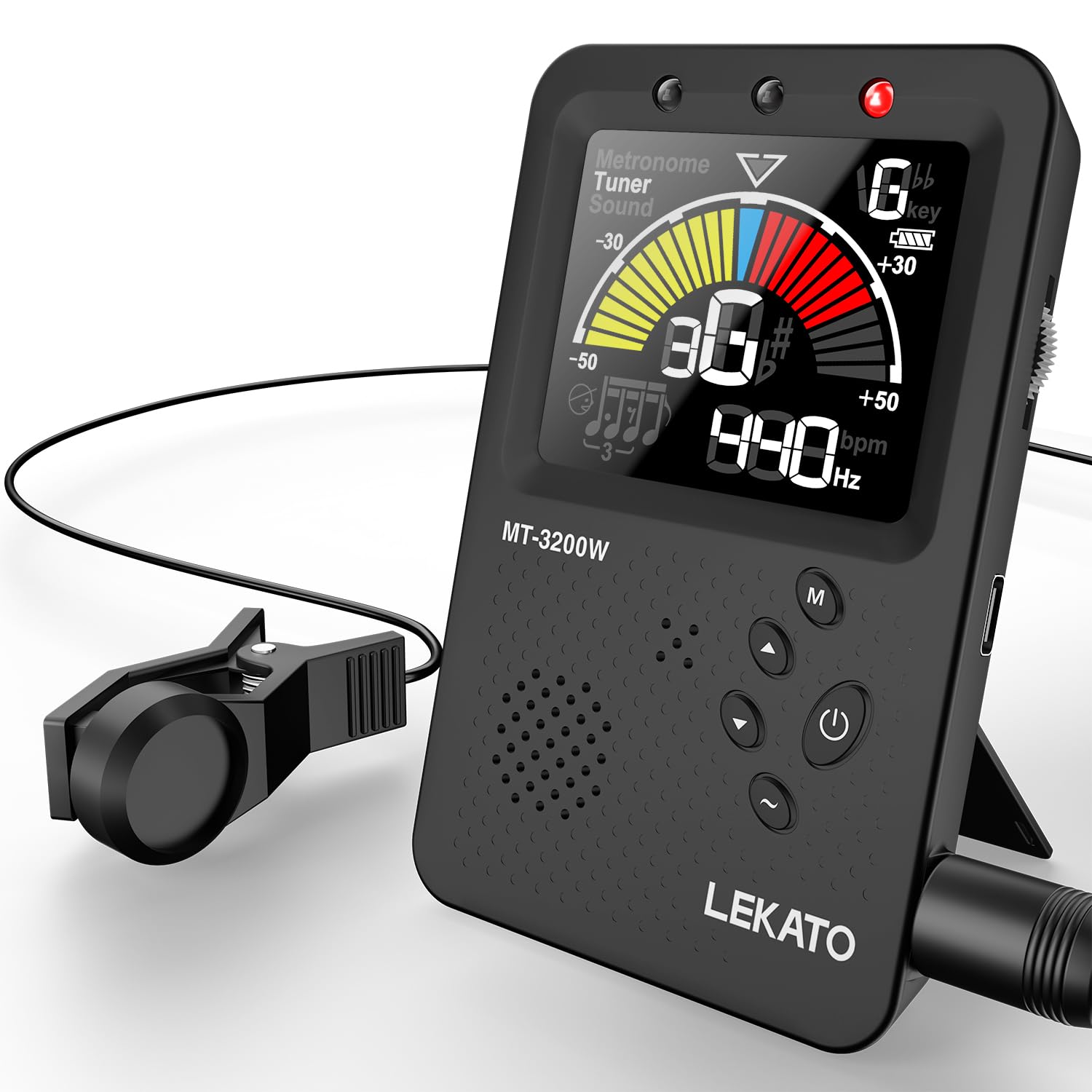
The LEKATO 3-in-1 combines a quartz metronome, a chromatic tuner, and a tone generator into a single pocket-sized device. For guitarists who want to eliminate separate gadgets on their music stand, this is a practical all-in-one. The metronome section spans 30 to 250 BPM with 0–6 beat patterns, and includes a human voice counting mode that speaks the beat number in English — helpful for beginners who need verbal reinforcement alongside the click.
The chromatic tuner covers A0 to C8 with multiple tuning modes and adjustable pitch calibration. The large color LCD display shows both tuning and metronome readouts clearly, and the built-in kickstand lets you prop it on a table or amp. A USB rechargeable lithium battery eliminates the need for disposable cells, charging fully in a couple of hours for extended practice sessions. The unit also includes a headphone output with its own volume control, plus a clip-on external pickup for tuning in noisy environments.
Reviewers consistently praise the loud internal speaker and the bright LED indicator that flashes in sync with the beat. The main drawback reported is the included clip-on pickup — several users found it less accurate than the internal microphone. If you tune using the mic, the device performs well, but the included clip may not satisfy precision-oriented players. The plastic-and-metal build feels durable enough for regular transport in a guitar bag.
Why it’s great
- Tuner, metronome, and tone generator in one device
- Voice counting mode helps beginners lock tempo
- Rechargeable battery saves long-term cost
Good to know
- Included clip-on pickup is less accurate than internal mic
- Plastic construction may not survive repeated drops
4. Yamaha MP-90BK Mechanical Metronome

The Yamaha MP-90BK is a traditional pyramid-style mechanical metronome with a wind-up mechanism. It produces a loud, percussive click that carries across a rehearsal room without amplification. This makes it a favorite among string teachers and ensemble leaders who need everyone in the room to hear the beat clearly. The pendulum swing provides a strong visual reference — the motion alone helps lock in a tempo even without listening to the sound.
Tempo selection is limited to the printed markings on the scale (e.g., 72, 76, 80, 88), meaning you cannot hit every intermediate BPM. The wind-up key provides roughly 20 minutes of run time per full wind, which aligns with typical practice session lengths. The body is plastic rather than wood, so the sound is slightly brighter and less woody than premium mechanical units, but the overall volume is significantly higher than most digital devices.
Several users mention the sound level as both the best feature and a potential drawback — the click can be uncomfortable if the metronome sits right next to you. For teaching scenarios where the instrument is across the room, the loudness is exactly what is needed. The unit stands firmly on flat surfaces and requires no batteries, making it a reliable option for players who dislike managing power supplies.
Why it’s great
- Extremely loud click carries across a full ensemble
- Clear pendulum swing provides visual tempo reference
- No batteries needed — pure mechanical mechanism
Good to know
- Preset tempo markings only — no in-between BPM values
- Plastic body feels lighter than traditional wood units
5. Ueteto Digital Metronome
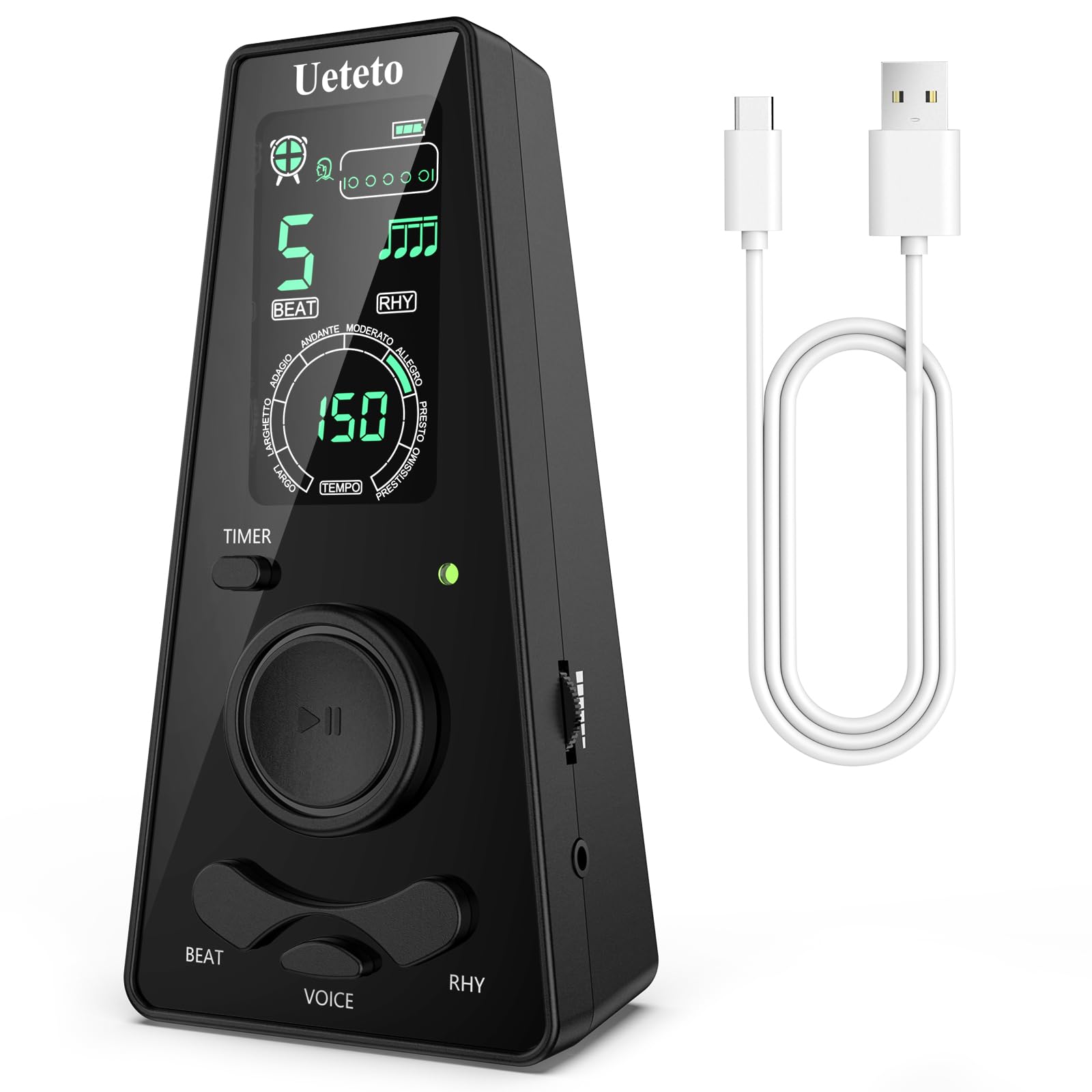
The Ueteto Digital Metronome is designed specifically for quiet practice. Its rechargeable lithium polymer battery provides up to 16 hours of continuous use on a single charge, making it one of the longest-lasting portable metronomes on the market. The included 3.5mm headphone jack lets you route the click directly into your ears, and the screen automatically dims after 30 seconds to conserve power while staying active enough for instant tempo changes.
The interface is built around a central scroll wheel that adjusts BPM in single-step increments from 40 to 208. The top face includes buttons for beat selection (0–9 beats per measure), timer mode (15/30/45/60 minutes), and volume control. Three English voice counting modes speak the downbeats aloud, which helps guitarists internalize rhythmic phrasing during slow practice runs. Nine rhythm patterns cover standard subdivisions, from simple quarter-note pulses to more complex dotted and triplet feels.
At 0.33 pounds, the unit is lighter than most pocket-sized metronomes. The screen is a clear LCD that remains readable under stage lighting. Some users noted that switching time signatures requires eight separate button presses, which can feel slow during a drill. The beep is intentionally sharp and loud through the internal speaker, but the headphone output provides full isolation when needed.
Why it’s great
- 16-hour battery life for extended practice sessions
- Headphone jack enables silent late-night practice
- Simple scroll-wheel tempo adjustment
Good to know
- Changing time signatures requires multiple button presses
- No integrated tuner — metronome only
FAQ
Can I use a phone metronome app instead of a dedicated device for guitar practice?
What BPM range should I look for in a guitar metronome?
Is a mechanical or digital metronome better for electric guitar practice?
How loud should a guitar metronome be for band rehearsals?
What does the human voice counting function do?
Final Thoughts: The Verdict
For most users, the best guitar metronome winner is the Korg KDM-3 because its eight sound options and 19 beat patterns cover every practice scenario from classical to progressive rock, and the memory backup keeps your settings ready for the next session. If you want a loud acoustic click that needs no batteries, grab the Wittner 865061. And for practicing in silence without disturbing anyone, nothing beats the Ueteto Digital Metronome with its 16-hour battery and headphone jack.