
MIG welding demands a specific balance: you need a glove that deflects spatter and radiant heat during long bead runs, yet maintains enough fingertip feel to feed wire and position pincers without stripping off your PPE. Too thick and you fight the trigger; too thin and you’re nursing burns by the end of the shift.
I’m Mohammad Maruf — the founder and writer behind Drink4Good. I’ve spent years analyzing material blends, stitch strength, and thermal ratings across every major welding glove lineup to find the pairs that actually hold up to real shop conditions.
After sifting through thousands of field reports and comparing leather grain, liner construction, and reinforcement patterns, I’ve identified the the pairs that deliver genuine protection without sacrificing the dexterity you need for clean MIG work. Whether you are a weekend fabricator or a production-line veteran, the following guide breaks down the best mig welding gloves that consistently earn their place on the bench.
How To Choose The Best MIG Welding Gloves
MIG welding is a constant trade-off between heat resistance and fingertip feedback. The wrong glove leaves you either burning through liners every month or fighting with the gun trigger because the leather is too stiff to curl. Here are the critical factors to prioritize when shopping for a pair that will last.
Leather Type and Hide Quality
The hide determines how a glove performs under heat, abrasion, and repetitive flexing. Pigskin stays soft after repeated wet-dry cycles and breathes better than cowhide, making it ideal for long shifts in hot shops. Cowhide, especially shoulder split, offers higher density and resists puncture and sparks but requires a break-in period before dexterity improves. Goatskin delivers the best tactile sensitivity and natural tear strength for precise work, but it comes at a premium. Deerskin is the softest option out of the box, offering high comfort with lower long-term abrasion resistance compared to cowhide or goatskin.
Liner Construction and Insulation
Single-layer cotton liners keep the gloves light and flexible, which is great for MIG where you need to manipulate small parts and the trigger. Multi-layer liners that combine foam with a flame-retardant fabric like FlameSoft or Nomex add a serious heat barrier, allowing you to hold onto hot material longer, but they add bulk that reduces dexterity. For general MIG, a foam-and-flannel liner provides a good balance. For heavy-duty or stick welding, a thicker fleece-and-foam layup is safer, but expect to sacrifice some finger feel.
Reinforcement and Stitch Thread
Standard cotton thread can melt or shear under the concentrated heat of a MIG puddle. Look for Kevlar or Nomex stitching on all high-stress seams, especially across the palm pad, thumb crotch, and index finger. A DragPatch side reinforcement and a RestPatch at the wrist reduce abrasion wear on the contact points where you lean or drag the gun hand. The thumb and index finger areas often fail first, so double-layer leather patches in those spots dramatically extend usable life.
Quick Comparison
On smaller screens, swipe sideways to see the full table.
| Model | Category | Best For | Key Spec | Amazon |
|---|---|---|---|---|
| Revco BM88L BSX | Pigskin/Cowhide | Daily industrial MIG | Kevlar stitched, padded palm | Amazon |
| Revco GM1611 | Top Grain Cowhide | Comfort & dexterity | Seamless forefinger, Kevlar | Amazon |
| DEWALT Premium | Buffalo Leather | Hobbyist MIG/TIG | 100% buffalo leather palm | Amazon |
| Lincoln K4082-XL | Cowhide | Heavy MIG & Stick | Multi-layer foam/fleece liner | Amazon |
| Superior 505GP | Goatskin | Precision MIG | ANSI A3 Heat Level | Amazon |
| Caiman 1878-5 | Deerskin | Extended comfort | Sock-lined foam/fleece | Amazon |
| Lincoln K2980-M | Grain Leather | Professional all-purpose | Nomex stitched seams | Amazon |
In‑Depth Reviews
1. Revco Industries BM88L BSX Extreme Pig Skin MIG Gloves, Large

The Black Stallion BM88L uses a 55% cowhide and 35% pigskin blend that hits a sweet spot between durability and tactile feedback right out of the box. The pigskin palm provides excellent grip when handling hot base material, while the cowhide back resists spatter burn-through better than a single-hide glove. Users consistently report that the fingers do not shrink from heat, a common failure point in cheaper gloves that use thinner leather.
The Kevlar stitching runs through all high-stress seams, and the DragPatch side reinforcement protects the glove on the table edge where you drag your gun hand during long bead runs. The padded RestPatch at the wrist absorbs some of the fatigue from leaning on hot pipe, and the fine-grain pigskin fingertips retain enough sensitivity to pick up dropped wire without pulling the glove off. This is a glove built for production shifts, not just weekend garage projects.
One recurring note from users is that the sizing runs slightly small, so if you normally wear a Large, the Large fits more like a Medium once the pigskin breaks in. The glove is not intended for high-amperage stick welding above 200 amps, but for MIG and flux-core work in the 150–200 amp range, the heat protection is more than adequate. For the price point, this is the most balanced all-rounder for a daily MIG welder.
Why it’s great
- Pigskin/cowhide blend provides both dexterity and burn resistance
- Kevlar stitching prevents seam failure under heat stress
- DragPatch and RestPatch extend glove life on high-wear zones
Good to know
- Runs a half-size small; consider ordering up
- Not suitable for sustained 200+ amp stick welding
2. Revco GM1611 Top Grain Cowhide MIG Welding Gloves, 2XL

The GM1611 is built with a top-grain cowhide palm and a split cowhide back, which gives it a slightly stiffer feel initially compared to the pigskin blend above, but the seamless index finger design reduces internal chafing and improves trigger feedback dramatically. The soft cotton lining is not bulky, so you do not lose the fine motor control needed for feeding wire and positioning pincers. Users with larger hands specifically praise the 2XL fit for providing room without feeling like oven mitts.
Reinforcement patches on the palm, thumb, and index finger add material where MIG welders experience the most wear, while the DragPatch side padding and RestPatch wrist padding protect against abrasion when leaning on the table. The Kevlar stitching throughout ensures that the seams hold up even when the glove is exposed to slag and sparks for extended periods. The glove is ambidextrous, which simplifies replacement, though left-handed welders will not get a dedicated palm contour.
Several long-term users report that the GM1611 does not develop hot spots or burn crinkles like cheaper gloves, even after months of daily torch scarfing and welding. The main trade-off is that the top-grain cowhide takes a shift or two to break in before the flexibility reaches its peak. For MIG welders who prioritize a comfortable, non-restrictive fit that does not cause hand fatigue during a full 8-hour shift, this pair consistently delivers.
Why it’s great
- Seamless forefinger reduces chafing and improves trigger feel
- Top-grain cowhide offers excellent long-term abrasion resistance
- Reinforced thumb/index patches address common wear points
Good to know
- Requires a break-in period for full dexterity
- Ambidextrous design lacks a dedicated palm contour
3. DEWALT Premium MIG/TIG Welding Gloves

The DEWALT Premium gloves are made from 100% Grade-A buffalo leather, which is naturally thinner than cowhide but denser, providing a unique blend of high abrasion protection and superior dexterity out of the wrapper. The gauntlet-style open cuff is long enough to accommodate a fire-resistant jacket sleeve and is quick to put on, which is ideal for shop environments where you are switching between tasks frequently. The Kevlar stitching runs through the entire glove, not just the stress points, which adds overall structural integrity.
Knuckle and finger guards made of fire-resistant cotton padding add a layer of impact protection without the bulk of a foam liner. The glove runs true to size, and the medium weight fabric class keeps the profile slim enough for TIG torch handling when you need to lay clean beads on thinner material. Users with larger hands appreciate the XXXL sizing option, which accommodates wider palms without reducing finger flexibility.
The primary limitation is the heat protection, which is adequate for hobby-level MIG and TIG work but falls short for high-amperage or production welding. Several hobbyists report that the glove develops holes in the finger fabric after 6 months of regular weekend use, though the Kevlar stitching holds up. For the garage welder who does not need a heavy multi-layer liner and values fingertip feel over maximum heat retention, this is a well-balanced glove at an accessible price.
Why it’s great
- Buffalo leather is thinner than cowhide without sacrificing abrasion resistance
- Kevlar stitching throughout the glove adds durability
- Gauntlet cuff accommodates fire-resistant sleeves easily
Good to know
- Heat protection is sufficient for hobby use, not daily pro
- Finger fabric may develop holes after 6 months of heavy use
4. Lincoln Electric K4082-XL Heavy Duty MIG/Stick Welding Gloves

The Lincoln K4082-XL is built around 100% shoulder split cowhide, which is one of the densest and most abrasion-resistant leather cuts available, making it the clear choice for welders who regularly work with heavy MIG, stick, or flux-core processes. The multi-layer liner combines flame-retardant foam with Fleecesoft twill cotton, creating an air-cushioned barrier that keeps the hand cooler for longer during high-amperage runs. The glove is designed for professional fabricators and is used daily in shops that push equipment hard.
Kevlar threading reinforces all stress points, and the leather reinforcement patches at high-wear zones prevent the split cowhide from delaminating. The glove breaks in over a few sessions, but once the leather conforms to the hand, the dexterity is surprisingly good for a heavyweight glove. The extended gauntlet cuff protects the forearm from spatter, which is critical when welding in tight positions where the glove touches the workpiece.
The biggest drawback is the initial stiffness, which is a direct result of the heavy-weight leather and multi-layer liner combination. Some users also note that the glove runs slightly small due to the internal layers, so ordering up a size is advisable if you plan to wear a liner or have wider hands. For MIG welders who frequently push past 200 amps or switch to stick welding, the K4082-XL provides a level of thermal protection that lighter gloves simply cannot match.
Why it’s great
- Shoulder split cowhide offers maximum heat and puncture resistance
- Flame-retardant foam-and-fleece liner buffers high-amperage heat
- Kevlar stitching with reinforced stress points ensures long life
Good to know
- Very stiff initially; requires several sessions to break in fully
- Runs small due to multi-layer liner; consider sizing up
5. Superior Glove 505GP Endura Goatskin MIG Welding Gloves, Large
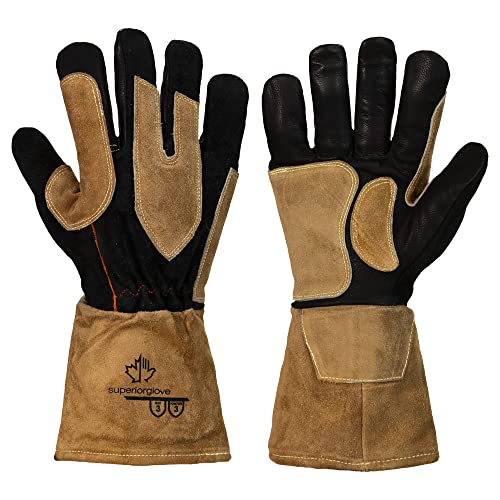
The Superior 505GP uses high-quality goatskin leather, which is naturally more supple than cowhide and offers the best tactile feedback among the heavy-duty options. This makes it the ideal choice for MIG welders who need to feel the wire feed and position the nozzle precisely without sacrificing protection. The ANSI Heat Level A3 rating (verified to 392°F or 200°C) provides a legitimate thermal barrier, and the strategically placed patches on the palm and back of the hand add wear resistance where you need it most.
A Kevlar lining runs through the interior, providing cut and puncture resistance that protects the palm from sharp steel edges during part handling. The glove fits tight initially but breaks in quickly, and the pre-curved patterning reduces the effort needed to grip the torch. Users who switch between TIG and MIG on the same project will appreciate that the 505GP offers the finger sensitivity of a TIG glove with the palm protection of a MIG glove.
The one trade-off is that the goatskin is slightly thinner than cowhide, so it may not offer the same longevity in a production environment with constant slag exposure. Several users report that the glove has held up well for two years of daily use in a moderate shop, but heavy-duty fabricators may need to replace them more frequently. For precision MIG and light stick work, the 505GP is the most dexterous glove in this price bracket.
Why it’s great
- Goatskin provides superior tactile feedback for precision MIG work
- ANSI A3 heat rating offers verified thermal protection
- Kevlar lining adds cut and puncture resistance
Good to know
- Goatskin is less durable than cowhide under heavy slag exposure
- Fits snug; may not suit those who prefer a roomier glove
6. Caiman 1878-5 Premium Split Deerskin MIG/Stick Welding Gloves, X-Large
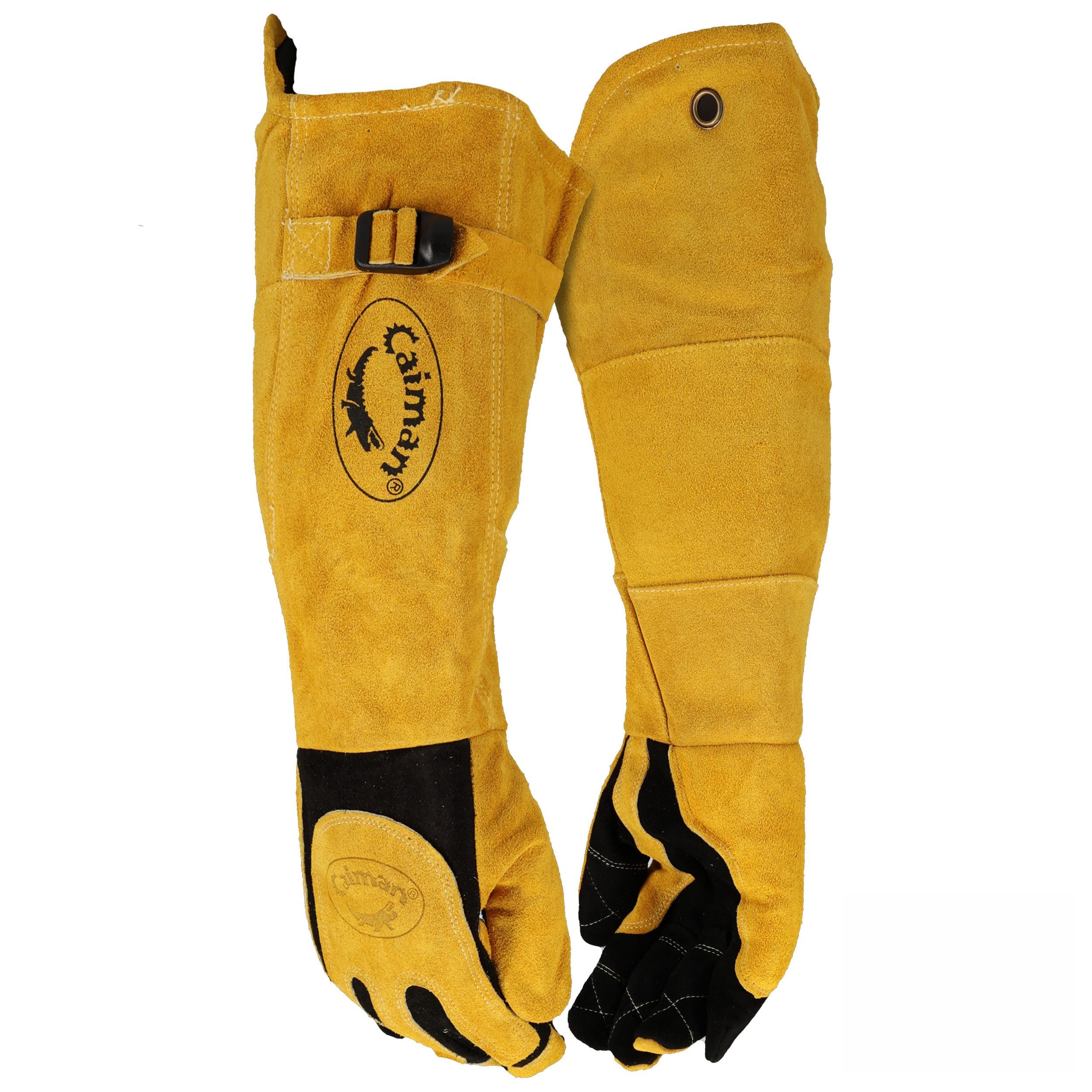
The Caiman 1878-5 is built from genuine American split deerskin, which is the softest and most comfortable leather option available, requiring virtually no break-in period. The 21-inch length and heavy-duty padding on the forearm and elbow are designed for pipe welders and fabricators who need to rest their arm on hot surfaces. The sock-lined foam/fleece insulation provides warmth in cold shops and a cushion that absorbs vibration from the gun.
The glove features exclusive 3-dimensional, pre-curved fingers that follow the natural resting position of the hand, reducing fatigue during extended overhead welds. Kevlar stitching runs through all seams, and the reinforced palm, cuff, and lean-on patch further enhance the glove’s longevity. A split cowhide leather heat shield patch on the back of the hand deflects spatter during tight-position welding. A complimentary carabiner and glove loops are included for easy storage.
Some users note that the black leather portions on the palm develop holes from heavy spatter faster than the yellow cowhide sections, which scar but hold up better. The glove is also quite warm due to the insulation, which can cause the hand to sweat during long summer shifts. For MIG welders who frequently work on pipe and need forearm protection, or for those who work in colder environments, the Caiman 1878-5 is a premium option that prioritizes comfort and coverage.
Why it’s great
- Deerskin offers unmatched comfort and zero break-in time
- 21-inch gauntlet with forearm padding protects against hot pipe
- Pre-curved fingers reduce fatigue during extended welding sessions
Good to know
- High insulation can cause sweating in hot environments
- Black palm leather is less resistant to spatter than the cowhide patch
7. Lincoln Electric K2980-M Premium Leather MIG Stick Welding Gloves

The Lincoln K2980-M is a proven professional design that has been a staple in welding shops for nearly a decade. It uses a combination of grain and split leathers to balance heat resistance, durability, and dexterity. The three-layer liner combines grain leather with flame-retardant foam and soft flame-retardant cotton, creating a robust thermal barrier that protects against high heat, flames, and sparks during heavy MIG and stick processes.
All seams are stitched with high-strength Nomex thread, which is an alternative to Kevlar that provides similar heat resistance with slightly better flexibility. The leather-reinforced finger tips and thumb add material where wear is most common, extending the glove’s lifespan. The inside cuff is lined with twill cotton to absorb sweat, which is a thoughtful addition for welders working in high-temperature environments where moisture can cause glove slip.
Some users question the leather quality, with a minority reporting that the inner fingers can shrink from slag burn. The fit is true to size, running slightly loose to accommodate the multi-layer liner. This glove is a direct competitor to the K4082-XL, but offers a slightly more refined balance of protection and mobility. For a professional welder who needs a single pair that handles both MIG and stick without feeling like a boxing glove, the K2980-M is a reliable, battle-tested option.
Why it’s great
- Nomex stitching combines heat resistance with flexibility
- Three-layer liner provides a serious thermal barrier for pro use
- Moisture-absorbing twill cuff reduces sweat buildup inside the glove
Good to know
- Leather quality has been questioned by a minority of users
- Inner fingers may shrink from concentrated slag burn
FAQ
What is the difference between MIG and TIG welding gloves?
How often should I replace MIG welding gloves?
Final Thoughts: The Verdict
For most users, the best mig welding gloves winner is the Revco BM88L BSX Extreme because its pigskin and cowhide blend offers the best real-world balance of dexterity and heat resistance without needing a long break-in period. If you want maximum tactile feedback for precision MIG work, grab the Superior 505GP Endura Goatskin gloves. And for production-level heavy MIG or stick welding where thermal protection is the priority, nothing beats the Lincoln K4082-XL Heavy Duty gloves for sheer durability and heat retention.