
Nothing ages a car’s interior faster than a dashboard panel peeling up at the corner or a trim piece rattling loose. Standard super glue is too brittle for the temperature swings inside a parked car—it cracks in the summer heat and gets brittle in winter chill. A dedicated dashboard adhesive must stay flexible, resist UV degradation, and bond porous plastics without fogging the cabin.
I’m Mohammad Maruf — the founder and writer behind Drink4Good. I’ve analyzed hundreds of automotive adhesive formulations to understand how cyanoacrylate viscosity, gel vs. liquid format, and thermal tolerance affect real-world dashboard repairs.
After reviewing customer repair logs and lab-grade spec sheets, I’ve narrowed down the top contenders for glue for car dashboard applications that withstand cabin heat, vibration, and daily use without failing.
How To Choose The Best Glue For Car Dashboard
Dashboard plastic is uniquely demanding — it’s exposed to direct sunlight that can push surface temperatures past 180°F, yet it needs a bond that doesn’t become brittle when the cabin cools overnight. The adhesive must also handle occasional contact with interior cleaners and protectants without degrading. Here are the key factors to weigh before buying.
Gel vs. Liquid Format
Liquid cyanoacrylate penetrates hairline cracks and flows into tight gaps between the dashboard and supporting frame. This works well for reattaching clips or bonding pieces that fit flush together. Gel cyanoacrylate, by contrast, stays in place on vertical surfaces without dripping — ideal for reattaching trim overlays or gluing a loose vent frame without the adhesive running onto visible upholstery.
Temperature Tolerance
Look for an adhesive rated to at least 200°F (93°C). Dashboard interior temperatures in direct sun can exceed that, especially in dark-colored cabins. The best formulations maintain structural integrity from around -40°F up to 230°F, covering both deep winter cold and peak summer heat. Skip adhesives that only list “indoor use” — they weren’t designed for automotive thermal cycling.
Material Compatibility
Most dashboards are made from ABS plastic, sometimes with a PVC or polypropylene skin. Cyanoacrylate bonds well to ABS and rigid PVC, but struggles with polypropylene and polyethylene. If your dashboard has a textured TPO (thermoplastic olefin) surface, you may need a plastic primer or a urethane-based adhesive instead. Always tape-test a tiny drop on an inconspicuous area before committing to the full repair.
Quick Comparison
On smaller screens, swipe sideways to see the full table.
| Model | Category | Best For | Key Spec | Amazon |
|---|---|---|---|---|
| Automotive Super Glue Gel 1.76 oz | Gel Cyanoacrylate | Vertical dashboard trim | Heat resistant up to 230°F | Amazon |
| Automotive Super Glue Liquid 1.76 oz | Liquid Cyanoacrylate | Thin cracks & clip repairs | Penetrates gaps via capillary action | Amazon |
| 3M Super-Strength Molding Tape | Double-Sided Tape | Trim & emblem reattachment | Conforms to textured surfaces | Amazon |
| 3M Headliner & Fabric Adhesive | Spray Adhesive | Headliner & fabric repairs | Dries clear in 30-60 minutes | Amazon |
| Loctite Vinyl, Plastic, and Fabric Adhesive | Contact Paste | Vinyl & fabric covering | 24-hour full cure time | Amazon |
In‑Depth Reviews
1. Automotive Super Glue Gel 1.76 oz XXL
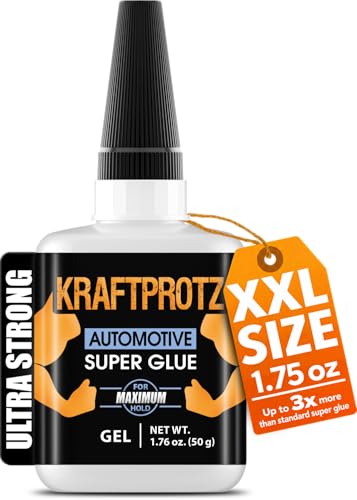
This gel formulation from KRAFTPROTZ is the single best answer for reattaching dashboard trim, vent surrounds, and any plastic panel that sits on a vertical or angled surface. The thixotropic gel stays exactly where you place it — no dripping down into the defroster vents or staining the upholstery beneath. With a thermal tolerance of up to 230°F, it easily survives the greenhouse effect inside a closed car on a July afternoon without losing grip or turning brittle.
At 1.76 ounces (about 50 grams), the bottle holds roughly three times the glue of standard automotive tubes, making it a practical choice for multiple repairs or for a mechanic who works on several vehicles. The anti-clog nozzle prevents the tip from crusting over between uses, which is a common frustration with smaller CA glue bottles. Users report successful bonds on ABS, PVC, painted metal, and rubber, covering most dashboard materials.
The gel formula requires about 2 to 3 minutes of clamping pressure before it sets — slightly slower than thin liquid CA — which actually helps by giving you time to align the part precisely. Once cured, the bond is vibration-proof and resists the mechanical stress of daily driving over potholes and rough roads.
Why it’s great
- No-drip gel stays on vertical dashboard surfaces without running
- Withstands cabin heat up to 230°F without degrading
- Large XXL bottle delivers 3x more glue than standard tubes
Good to know
- Requires 2-3 minutes of clamping pressure before full bond forms
- Strong chemical odor — use with good ventilation
2. Automotive Super Glue Liquid 1.76 oz XXL
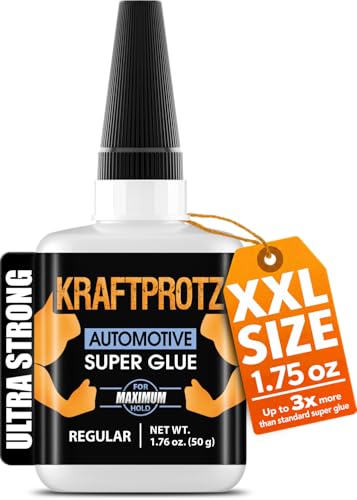
When a dashboard crack runs deep or a small clip has separated from its mounting tab, you need an adhesive that wicks into spaces too narrow for a gel to reach. The liquid version of KRAFTPROTZ’s automotive CA glue uses capillary action to pull the formula into hairline fractures and between overlapping plastic parts. It bonds fully within 4 hours, making it fast enough for same-day reassembly.
The temperature range matches the gel version — -40°F to 230°F — ensuring the repair won’t fail during seasonal extremes. German-engineered formulation keeps the shelf life long, and the precision dropper tip lets you place a single droplet exactly where it’s needed. Users report success bonding mirror housings, bumper cracks, and interior trim pieces that had separated from their clips.
Because it’s a thin liquid, you must be careful not to flood the area — excess CA can run onto visible surfaces and create a glossy spot. For best results, apply one drop at a time, press the parts together, and wipe away any squeeze-out immediately with a dry cloth before it cures.
Why it’s great
- Penetrates microcracks and tight gaps that gel cannot reach
- Withstands oil, heat, and vibration – ideal for dashboard stress points
- Anti-clog cap keeps the tip usable between repairs
Good to know
- Thin consistency can run onto visible surfaces if applied too quickly
- Bottle labels are in German — glue usage is intuitive but check the instructions online
3. 3M Super-Strength Molding Tape, 1/2 in x 15 ft

Sometimes you don’t need glue at all — especially for reattaching a chrome trim strip or an emblem that sits on a smooth dashboard surface. 3M’s VHB (Very High Bond) tape uses aircraft-grade acrylic adhesive on both sides, delivering permanent attachment without any liquid mess. The conformable tape bends around textured and slightly curved dashboard contours, which is critical for trim pieces that follow an irregular line.
The temperature range spans -40°F to 250°F, matching or exceeding most liquid dashboard adhesives. Because the bond is pressure-sensitive rather than chemically cured, you get immediate grip when you press the part into place — no waiting for setting time. This makes it ideal for situations where you need to hold a trim piece in position without the risk of it sliding out of alignment before the bond sets.
One important limit: 3M VHB tape works best on flat or gently curved surfaces. It won’t fill gaps or bond parts that don’t mate flush. For dashboard repairs where the plastic has warped or the two surfaces no longer meet perfectly, a gel cyanoacrylate will give better results.
Why it’s great
- Zero mess — no liquid, no drips, no curing fumes
- Immediate bond upon pressing — no clamping required
- Withstands car washes, weather, and thermal cycling
Good to know
- Only bonds flush-fitting parts; cannot fill gaps or warped gaps
- Precise alignment is critical — repositioning is difficult once pressed
4. 3M Headliner & Fabric Adhesive, 18.1 oz

Dashboard repairs sometimes go beyond plastic — when the fabric cover on the dashboard or the A-pillar headliner starts sagging, a spray adhesive is the right tool. 3M’s 38808 formula creates an exceptionally strong bond between fabric, foam, and metal surfaces, making it the preferred choice for headliner sagging that extends onto the dashboard area. The aerosol sprays evenly from 8 to 10 inches away and becomes tacky within 15 to 20 seconds.
The bond is repositionable for about 30 to 60 seconds after application, which gives you time to smooth the fabric without wrinkles. Full cure takes 24 hours, but the tack develops fast enough that fabric won’t sag again while it finishes curing. Users report professional-looking results on heavier tweed and suede fabrics used in luxury car interiors, with no bleed-through even on thin materials.
The adhesive dries clear, so any overspray on adjacent dashboard plastic is not visually obvious. However, the odor is strong — this is not a product to use inside a closed garage. Ventilate thoroughly and consider a respirator if you are applying it in the cabin.
Why it’s great
- Bonds heavy automotive fabric to metal and plastic surfaces
- Even aerosol spray prevents pooling and soak-through
- Dries clear — no visible residue on adjacent dashboard panels
Good to know
- Strong solvent odor requires excellent ventilation
- Not a gap-filler — surfaces must be fully contacting for a strong bond
5. Loctite Vinyl, Plastic, and Fabric Adhesive, Pack of 2

For dashboard repairs involving vinyl covering, fabric padding, or where the dashboard skin has separated from its foam backing, this contact-type paste from Loctite offers a targeted solution. It applies as a thick paste that won’t run, making it controllable on vertical sections. The 24-hour full cure cycle means you need to clamp or hold the repair overnight, but the final bond remains flexible enough to move with the dashboard as it expands and contracts with temperature changes.
Loctite designed this specifically for porous and semi-porous materials — vinyl, leather, fabric, and foam — which are common on higher-trim dashboards with soft-touch surfaces and leather wrapping. Users report success reattaching bar stool vinyl and lawn mower seat padding, which are comparable to the foam-and-vinyl sandwich construction found on many SUV dashboard covers.
The paste can “string” if you pull the applicator away too quickly — apply with a steady motion and let the tack build for a few seconds before pressing the materials together. It is not a structural glue for heavy plastic brackets, but for fabric-to-plastic or vinyl-to-foam dashboard skin repairs, it is a reliable entry-level option.
Why it’s great
- Flexible cure — moves with dashboard thermal expansion
- Designed for porous vinyl, fabric, and foam materials
- Two-pack gives a backup tube for later repairs
Good to know
- 24-hour cure time requires prolonged clamping or taping
- Tends to string if applicator is pulled away too quickly
FAQ
Can I use super glue on a cracked ABS dashboard?
Will dashboard adhesive withstand direct sunlight through the windshield?
Final Thoughts: The Verdict
For most users, the glue for car dashboard winner is the Automotive Super Glue Gel 1.76 oz XXL because its no-drip gel format pairs with a 230°F thermal ceiling to handle both vertical dashboard panels and the intense heat of a closed car. If you need to wick glue into a hairline crack that’s too narrow for gel, grab the Automotive Super Glue Liquid 1.76 oz XXL. And for a mess-free trim reattachment that sets instantly, nothing beats the 3M Super-Strength Molding Tape.